
On this page
Start here
Quick answer
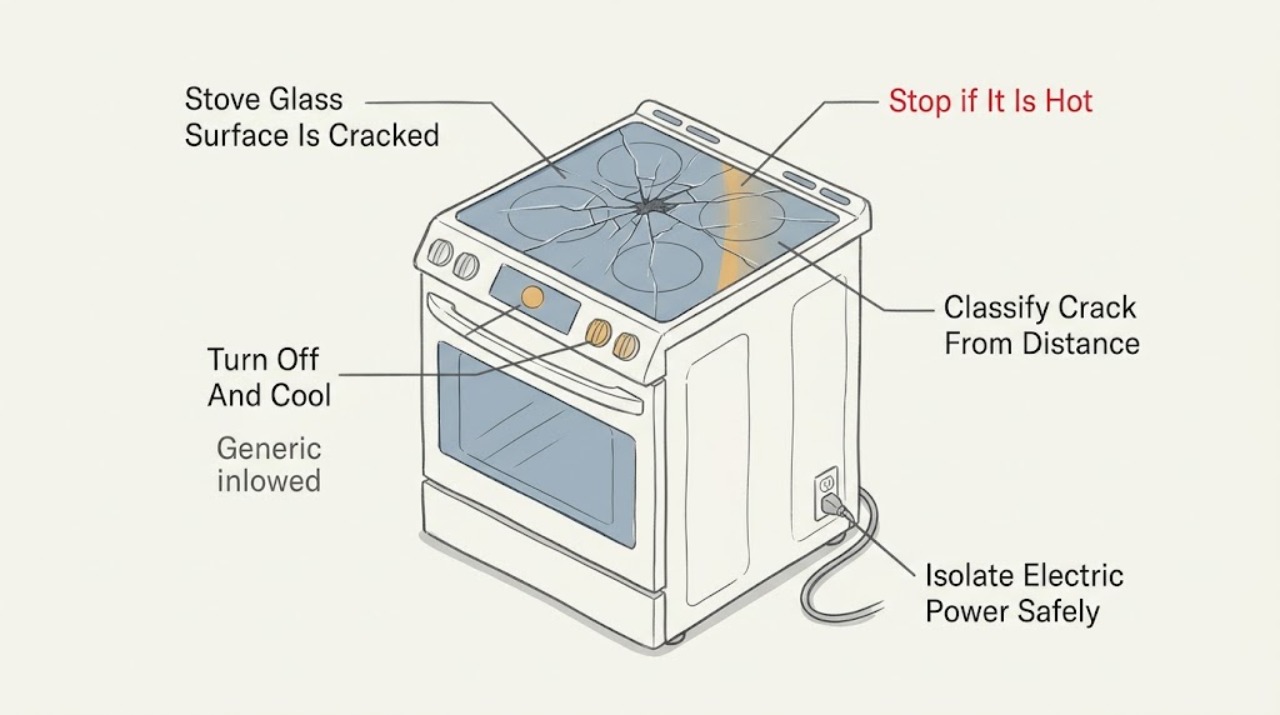
Stop cooking on an Amana stove with a visible crack in its glass surface. Turn every control off, keep people and cookware away, and let a recently used surface cool without pouring water on it. From a safe, dry position, note whether the crack is a surface line or an opening, whether any glass is loose, and whether a burner, display, odor, smoke, liquid, or sparking is still active. Do not tape, glue, epoxy, caulk, scrape, drill, or cover the crack, and do not remove panels. If the appliance is electric or induction and power can be isolated without reaching the damaged area, switch off its circuit breaker; if there is smoke, arcing, a burning odor, exposed wiring, or gas odor on a gas model, leave the area and use the appropriate emergency or utility procedure. Arrange model-specific appliance service for inspection and replacement of the glass cooktop assembly.
Work through in order
Diagnostic checks
Use only checks that match the exact appliance or system and its official guide.
-
Check 1
From a safe position, turn every stove and oven control off, remove no pan that is stuck to the surface, and keep hands, children, and pets away while the cooktop cools naturally.
Expected result: Record whether the surface was recently hot, whether the Hot Surface or Cooktop On indicator remains lit, and whether any burner or element is still producing heat after its control is off.
Next step: Do not cook or move cookware across the crack. Wait for natural cooling, then continue only with dry, no-touch visual checks; use service when heat or an indicator persists unexpectedly.
Stop if: Do not touch the glass, lift fragments, pour water on it, or test a burner to see whether the crack worsens.
Why this matters
Why: A lit indicator or residual heat can be normal after use, but it means the glass is not safe to touch. Continued heat with controls off is abnormal and raises the need for immediate power isolation and service.
-
Check 2
From ordinary safe access and good lighting, photograph the surface without touching it; note the crack's path relative to cooking areas, the control area, the edge, and any loose or missing glass.
Expected result: Classify the damage as a hairline that stays within one pane, a line reaching an edge or control area, a gap or lifted piece, several radiating lines, or damage with liquid, smoke, sparking, or exposed material beneath it.
Next step: Save the photos and complete model identification from the rating label or manual without opening the appliance. For an opening, loose glass, or damage near controls, keep the stove isolated and request prompt appliance service.
Stop if: Do not press, flex, tape, glue, epoxy, caulk, sand, drill, scrape, or cover the crack; do not remove the top or control panel.
Why this matters
Why: A contained line is still damaged glass and should not be heated. An opening, loose piece, edge-to-edge path, control-area crack, or material visible below the glass increases the chance of cutting, liquid entry, or contact with energized parts.
-
Check 3
If the stove is electric or induction and the breaker is clearly accessible from a dry, safe location, switch off the appliance circuit; do not reach behind the range or remove any cover to find power.
Expected result: After the surface has cooled, note whether indicators and displays go dark and whether any element still heats; do not use a hand test or deliberately energize a burner.
Next step: Leave the breaker off while awaiting service and label the appliance as out of use. Provide the breaker result and model information to the service provider.
Stop if: Do not touch exposed conductors, test voltage, remove panels, reset the breaker repeatedly, or continue if the breaker area is wet, hot, smoky, or arcing.
Why this matters
Why: A dark display after breaker isolation indicates the appliance has been de-energized at that point, but it does not make broken glass safe to handle. A display or heat that remains active means the wrong circuit may be off or there may be another supply, so stop and obtain qualified help.
-
Check 4
Without touching the stove, look and listen for smoke, a burning or electrical odor, crackling, visible arcing, liquid entering the crack, or a gas odor if this is a gas model.
Expected result: Record no active sign, a past sign that has stopped, or an active sign that continues while the appliance is off or isolated.
Next step: For smoke, arcing, or a burning electrical odor, move away and use the building's emergency response as appropriate; for a gas odor, leave without operating switches and contact the gas utility or emergency service from a safe location. Do not re-enter to retrieve cookware.
Stop if: Stop all inspection immediately for fire, smoke, arcing, gas odor, injury, sharp fragments, or any need to touch or move the appliance.
Why this matters
Why: No active sign supports keeping the stove out of service and arranging a controlled inspection. Smoke, arcing, a burning odor, liquid near electrical areas, or a gas odor is an immediate hazard and cannot be diagnosed by further home checks.
-
Check 5
From a safe position, read the complete Amana model and serial information from its documentation or an accessible label, and tell service whether the stove uses radiant electric, induction, or gas heat under the glass.
Expected result: Record the full model identifier, fuel or cooktop type, crack location, photos, whether the breaker was isolated, and any active-hazard observation; do not infer a part from appearance alone.
Next step: Request Amana or qualified appliance service for inspection and model-specific replacement guidance. Keep the appliance unused until the damaged glass and any affected parts are cleared or replaced.
Stop if: Do not remove the rating label, disassemble the top, or order a generic glass panel based only on dimensions or a photograph.
Why this matters
Why: Glass tops, controls, sensors, and mounting details vary by model and heat type. A model match lets service check the correct glass cooktop assembly and any related seals or controls; a partial identifier is not enough to promise fit.
Use your observations
Decision map
Find the observation that best matches what you see, then follow the next safe action.
-
PATH 01Safety boundary
What you see
The controls are off, the surface has cooled, there is no smoke, odor, liquid entry, or arcing, and the crack is visible but contained.
Do this next
Keep the stove out of service, photograph the damage, record the full model, and arrange a model-specific glass-top inspection.
Why this path and its safety boundary
Why it matters: This is a controlled service situation, not permission to keep cooking. The glass is still structurally damaged, and heating or flexing it could change the damage.
Safety stop: Do not patch, glue, tape, scrape, or heat-test the surface.
-
PATH 02Safety boundary
What you see
The crack reaches an edge or control area, forms a gap, has loose or missing glass, or reveals material below the cooktop.
Do this next
Keep everyone away, do not move cookware across it, isolate electric power only from a safe dry location if accessible, and request prompt appliance service.
Why this path and its safety boundary
Why it matters: The damage has a higher chance of sharp edges, liquid entry, or contact with internal parts; visual troubleshooting has reached its safe limit.
Safety stop: Do not touch fragments, lift the top, remove panels, or place tape or a cover over the crack.
-
PATH 03Safety boundary
What you see
Smoke, crackling, arcing, a burning odor, liquid near the crack, or an element that stays hot with controls off is present on an electric or induction stove.
Do this next
Move away; if the circuit breaker is accessible without approaching the hazard, switch it off once, then use emergency or qualified service procedures. Do not re-energize the appliance for a test.
Why this path and its safety boundary
Why it matters: The situation may involve an energized or overheated internal part. The surface cannot be safely assessed by a homeowner and a repeated reset can worsen the hazard.
Safety stop: Stop immediately for fire, smoke, arcing, injury, wet electrical areas, or any need to touch the stove or expose wiring.
-
PATH 04Safety boundary
What you see
A gas odor is present and the Amana stove uses gas burners, whether or not the glass crack is the suspected cause.
Do this next
Leave the area and contact the gas utility or emergency service from a safe location, following local gas-emergency instructions; arrange appliance service only after the area is declared safe.
Why this path and its safety boundary
Why it matters: Gas odor takes priority over crack classification. The appliance should not be tested, and switches or controls in the odor area should not be operated.
Safety stop: Do not light a burner, use a switch, reset power, search for the leak, or return for cookware.
Helpful context
Understand the symptom
Treat a visible crack as damaged glass, not a cleaning problem
Amana's cooktop guidance explains that a heavy or hard object can crack the cooktop and that trapped air under a hot lid can break ceramic glass when the lid is removed. Those instructions describe causes and prevention, not a safe repair for an existing crack. A visible crack can change when the surface heats or cools, so the prudent boundary is to keep the stove out of service until the exact model and glass assembly are assessed. Do not test the crack by heating a burner, pressing on it, or moving a pan across it.
Separate cooling, electrical, and gas risks before looking closely
The glass may remain too hot to touch after a surface control is off, and Amana says the whole cooktop area may become hot during use. Turn controls off and give it time to cool naturally. A user may visually document the damage from a dry position, but should not touch loose shards, lift the glass, open the console, or reach behind the stove. An electric or induction model can be isolated at its breaker only when the breaker is accessible without approaching smoke, liquid, arcing, or exposed conductors. A gas model with a gas odor needs immediate evacuation and the local gas-emergency procedure; do not operate electrical switches in the odor area.
Cleaning guidance does not authorize a crack repair
Amana's ceramic-glass cleaning page says controls must be off and cautions against steel wool, abrasive powder, bleach, rust remover, and ammonia. Those directions apply to residue on an intact surface. They do not make glue, tape, epoxy, caulk, a glass patch, or a household scraper suitable for a crack. Keep liquids and cleaners away from the damaged area, and ask service to identify the correct glass cooktop assembly for the complete model.
Safety boundary
Stop conditions
- Stop using the stove immediately when a crack, gap, loose glass, or edge-to-edge fracture is visible; do not heat-test it while waiting for service.
- Stop all hands-on inspection for smoke, arcing, burning odor, gas odor, liquid entering the crack, exposed conductors, sharp fragments, fire, or injury.
- Do not tape, glue, epoxy, caulk, sand, drill, scrape, or otherwise patch the glass, and do not remove the cooktop or control panels.
- Do not reset or re-energize an electric or induction stove to see whether a cracked surface still works; use qualified service for the electrical and glass assessment.
Only after diagnosis
Potential parts
- glass cooktop assembly
Only consider this category after service confirms that the glass surface is cracked and identifies the exact model and heat type; related controls, seals, sensors, or mounting hardware may also need inspection.
Glass panels are not universal. Confirm the complete model and the manufacturer's or service provider's fit information before any part is ordered or installed.
When checks do not resolve it
Need a professional?
Arrange Amana or qualified appliance service for any visible crack, even when the surface is cool and no active hazard is present. Treat smoke, arcing, burning odor, gas odor, liquid near electrical areas, exposed wiring, loose glass, or continued heat with controls off as an immediate stop-and-escalate situation.
Common questions
FAQ
Can I keep using one burner if the crack is on the other side?
No. Keep the stove out of service until the cracked glass and the appliance are assessed. Amana documents that the cooktop can become hot across its surface and that ceramic glass can crack or break; heating a damaged top is not a safe test.
Can I seal an Amana cracked glass cooktop with tape, glue, or epoxy?
No. Do not patch, press, scrape, or cover the crack. Cleaning products and procedures in Amana's guidance are for residue on the cooktop, not for repairing structural glass damage; request model-specific service instead.
What should I do if the glass cracked while the stove was hot?
Turn all controls off, keep away, and let the surface cool naturally. Do not pour water on it or move cookware across the crack. Once the area is safe to view without touching it, photograph the damage and arrange service; escalate immediately for smoke, arcing, burning odor, liquid entry, or gas odor.
Read the exact guide
Official sources
- Owner's ManualAmana · Amana ceramic-glass cooktop operation and damage-prevention guidance
- Burners Not Glowing - Glass CooktopAmana · Amana glass cooktop burner operation and safe service boundary
- Indicator or Display Flashing - Electric and Induction CooktopAmana · Amana electric and induction cooktop indicator, control, power reset, and service guidance
- Use & Care GuideAmana · Amana electric range ceramic-glass cooktop heat, crack prevention, and safe-use guidance
- Ceramic Glass Cooktop - Electric CooktopAmana · Amana ceramic-glass cooktop cleaning boundaries and safe handling
Community feedback
Share a repair observation
Share a plain-text repair observation. Accepted observations are published automatically; this page may take a moment to update.