
On this page
Start here
Quick answer
Stop cooking, turn every control to OFF, and do not use any cracked glass stove surface again. Let it cool without touching or moving cookware, then make only a safe visual record of the crack, the appliance model, and any liquid or fragments. A true crack or broken area needs qualified appliance service and may require the glass cooktop surface to be replaced; a mark, scratch, or metal transfer may look similar but still must not be tested with heat until the surface is clearly judged safe. Do not glue, heat-test, open panels, or rewire the appliance.
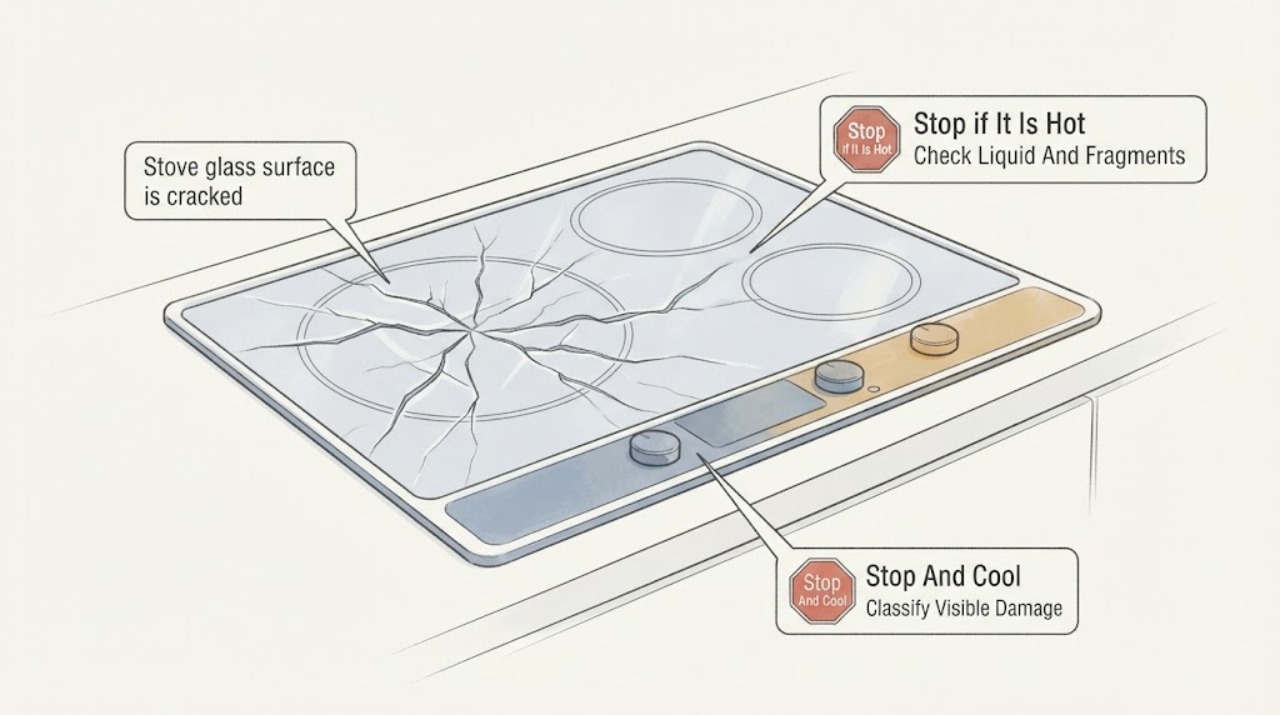
Work through in order
Diagnostic checks
Use only checks that match the exact appliance or system and its official guide.
-
Check 1
Stop cooking, turn all stove controls to OFF, keep cookware and people away from the surface, and allow the appliance to cool without touching the suspected damage.
Expected result: Confirm that every control is OFF and that no heat, smoke, odor, arcing, or hot cookware remains near the crack.
Next step: Once the surface is cool and stable, keep the stove and, where applicable, the oven out of use and continue with visual documentation only.
Stop if: Stop immediately, leave the area, and seek emergency or qualified service help for smoke, fire, sparking, burning odor, uncontrolled heating, or anyone burned.
Why this matters
Why: A crack is not a condition to test by reheating. Any continuing heat, smoke, odor, or control that will not turn off is an immediate safety escalation.
-
Check 2
From a safe standing position on a fully cool surface, view the mark under ordinary light and photograph it without scraping, pressing, polishing, or applying a repair product.
Expected result: Record whether it is a line that continues through the glass, a chip or broken edge, a pit, a shallow scratch, or a surface-colored mark that does not interrupt the glass.
Next step: Send the photographs and description to a qualified appliance technician for confirmation; do not attempt to fill or level the surface.
Stop if: Stop handling the surface if fragments are loose, the edge is sharp, the glass flexes, or the damage expands when observed. Keep people away and request urgent service.
Why this matters
Why: A continuous crack, chip, or broken area should be treated as damage requiring service. A shallow scratch or metal-transfer mark may be cosmetic, but appearance alone is not permission to apply heat when the diagnosis is uncertain.
-
Check 3
Look without contact for liquid, dried spill residue, loose shards, or a gap along the crack and note whether any spill reached a control, vent, burner area, or opening.
Expected result: Record whether the damaged area is dry and stable, visibly wet, contaminated by a spill, or shedding fragments.
Next step: Keep the appliance isolated and tell the technician exactly what reached the surface. Only remove an untouched item from nearby if it can be done without contacting the glass or wet area.
Stop if: Stop at any wet electrical area, exposed component, loose shard, sharp edge, or spill that cannot be isolated safely; do not touch or clean inside the damage.
Why this matters
Why: Liquid entry or loose glass increases shock, burn, and cut concerns; it is not a cleaning problem to solve by wiping into the crack or powering the appliance for a check.
-
Check 4
Record the stove brand and model from an accessible exterior label, owner manual, or existing service record, and describe which cooking zones and the surrounding surface are affected without removing anything.
Expected result: Note whether the damage crosses a marked cooking zone, reaches an edge or control area, or appears in more than one location; record the model exactly and do not infer compatibility from appearance.
Next step: Give the model, photos, and damage history to the qualified service provider and ask them to confirm the correct repair path before any part is ordered.
Stop if: Stop if finding the label would require lifting, sliding, tilting, panel removal, or contact with wiring or sharp edges.
Why this matters
Why: The model and damage location determine whether a replacement glass surface or another assembly is appropriate; the visible pattern cannot establish fitment or identify hidden damage.
-
Check 5
Without energizing or heat-testing the stove, recall and document whether a burner stayed hot, an indicator stayed lit, a control behaved unexpectedly, or a breaker or fuse event occurred before the crack was noticed.
Expected result: Classify the history as a simple impact or spill, a cosmetic mark with no operating event, or damage accompanied by unexpected heating, odor, smoke, or electrical interruption.
Next step: Include the history in the service request and keep the appliance isolated. Do not open the control area, perform live measurements, or repeatedly reset a protective device.
Stop if: Stop and seek urgent qualified help for smoke, fire, sparking, burning odor, repeated protective-device operation, or any uncontrolled heat.
Why this matters
Why: Unexpected operation or an electrical event can indicate more than a surface replacement and requires professional diagnosis; a quiet impact history still does not make a cracked surface safe to use.
Use your observations
Decision map
Find the observation that best matches what you see, then follow the next safe action.
-
PATH 01Safety boundary
What you see
Does the visible line interrupt the glass, form a chip, or leave a broken or sharp area?
Do this next
Keep the stove and oven out of use as applicable and arrange qualified appliance service; do not glue, tape, polish, or heat-test the surface.
Why this path and its safety boundary
Safety stop: If it is only a mark or shallow scratch, document it and use the model manual or qualified service to confirm the surface is sound before returning to use.
-
PATH 02Safety boundary
What you see
Is the area wet, contaminated by a spill, shedding fragments, or visibly open?
Do this next
Do not touch, wipe into, or energize the area. Isolate the appliance and request prompt professional help; use emergency help for smoke, fire, or sparking.
Why this path and its safety boundary
Safety stop: Keep the surface untouched and proceed only with cool, visual documentation and model identification.
-
PATH 03Safety boundary
What you see
Was there uncontrolled heating, a stuck indicator, smoke, odor, arcing, or a protective-device event?
Do this next
Treat it as a possible electrical or control fault in addition to glass damage; stop use and escalate to qualified service without opening the appliance.
Why this path and its safety boundary
Safety stop: A simple impact history still requires service for a true crack, but the technician can use the photos and model information to scope the visit.
-
PATH 04Safety boundary
What you see
Can the mark be confidently distinguished from a crack without touching or heating the surface?
Do this next
Record the result and follow the model-specific care guidance, while avoiding abrasive tools or cookware that could create more damage.
Why this path and its safety boundary
Safety stop: Treat it conservatively as possible glass damage and keep the appliance out of use until a qualified technician confirms the condition.
-
PATH 05Safety boundary
What you see
Would the next check require panel removal, live electrical testing, lifting the appliance, or handling shards?
Do this next
Stop the homeowner inspection and arrange professional service; provide the accessible model information and photographs instead.
Why this path and its safety boundary
Safety stop: Limit the next step to cool-surface visual documentation and a safe service handoff.
Helpful context
Understand the symptom
Why a real crack changes the answer
Ceramic glass is both the cooking surface and a barrier over energized or heated components. Manufacturer guidance treats a cracked or broken surface as a service condition rather than a cosmetic repair. Liquid or a spill can enter a broken surface, and using the oven on some ranges can also expose the damaged cooktop to heat. The exact repair depends on the model and whether the damage is a true crack, pitting, or a removable surface mark.
Keep the handoff useful and safe
After the appliance is cool, photograph the damage from a safe position and record the brand and model exactly as shown on an accessible label or manual. Do not scrape, press, tape, glue, remove trim, or lift the appliance to find a label. Tell the technician when the damage appeared, whether a pan or hard object struck it, whether liquid reached the crack, and whether any burner or control behaved unexpectedly.
Only after diagnosis
Potential parts
- glass cooktop surface
Only consider this category after a qualified technician confirms a true crack or broken ceramic surface and identifies the exact model assembly.
Confirm the complete stove model and manufacturer fit information; similar-looking glass does not establish compatibility. - stove surface element
Only relevant if professional diagnosis finds a separate element fault in addition to, or instead of, the visible surface damage.
Do not infer fit from burner shape; have the technician verify the model-specific element and electrical configuration. - cooktop trim
Only relevant if service confirms that trim is damaged separately and the glass surface itself is addressed safely.
Confirm the exact model and trim position before considering this category; it is not a repair for cracked glass.
When checks do not resolve it
Need a professional?
Have this ready
- Provide the exact brand and model, clear cool-surface photographs, the location and extent of the damage, what caused or preceded it, whether liquid or fragments are present, and any unexpected control or heating history.
Common questions
FAQ
Can I keep using a stove with a hairline crack in the glass?
No. Treat any genuine crack or broken area as a service condition and keep the cooktop out of use. Do not heat-test it to see whether the line grows.
How can I tell a crack from a scratch or metal mark?
Only make a cool, visual comparison without scraping, pressing, or heating. A line that interrupts the glass, a chip, an open edge, or loose fragments should be treated as a crack; uncertain damage should remain unused until qualified service confirms it.
Can I glue or seal the cracked surface?
Do not glue, tape, fill, polish, or otherwise patch a cracked cooking surface. The correct glass or assembly depends on the exact model and requires qualified diagnosis.
Can I use the oven if only the cooktop glass is cracked?
Follow the appliance manufacturer's safety guidance and keep the range out of use until service confirms it is safe; some ranges vent oven heat toward the cooktop.
Read the exact guide
Official sources
- Electric Range & Cooktop - Scratches on Glass CooktopGE Appliances · Supports cautious distinction between scratches or pan marks and a structural crack, and avoiding rough cookware or sliding cookware while the surface is sound.
- Owner's ManualWhirlpool Corporation · Supports not cooking on broken ceramic glass, the possibility of liquid penetration and shock risk, contacting a qualified technician, and referring other servicing to qualified personnel.
- Cooktop - Glass CrackedGE Appliances · Supports service for cracked or pitted glass and avoiding cooktop use until repaired; GE also cautions against using the range oven until the cooktop is fixed.
Community feedback
Share a repair observation
Share a plain-text repair observation. Accepted observations are published automatically; this page may take a moment to update.