
On this page
Start here
Quick answer
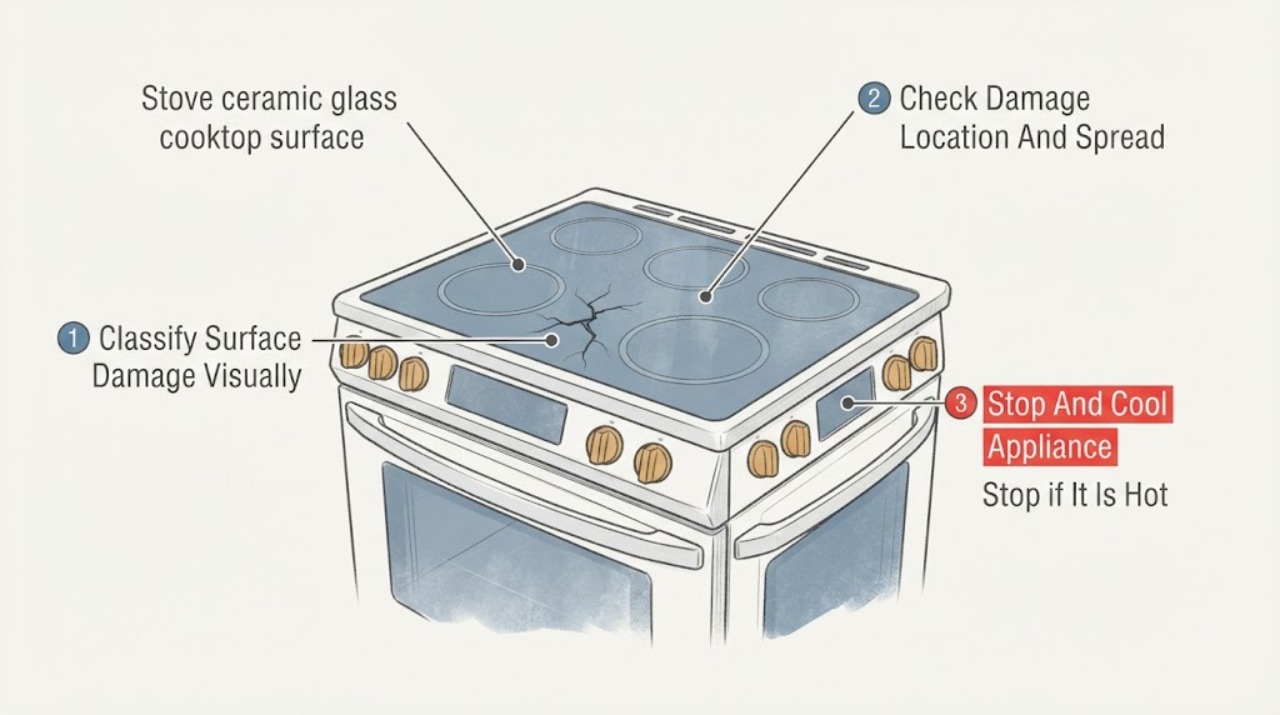
Treat a real crack, chip that exposes or separates the glass, or a spreading line in a ceramic-glass cooktop as a repair condition, not a cleaning problem. Turn all surface controls off, keep people away from the damaged area, and let the appliance cool without pouring water on it or pressing the glass. Do not use the cooktop again until the surface is repaired; for a range, do not use the oven either if the manufacturer warns that its vent discharges onto the cooktop. From a safe position, photograph the damage, note whether it is a surface mark or a line that catches light, and record the model information without moving the appliance or lifting the top. If glass is loose or falling, the crack reaches a control or edge, the surface is hot or smoking, there is an electrical smell, or the appliance has exposed wiring or liquid underneath, keep the appliance off and arrange qualified appliance service or urgent electrical help as appropriate.
Work through in order
Diagnostic checks
Use only checks that match the exact appliance or system and its official guide.
-
Check 1
Turn every surface control to Off from a normal standing position, move cookware away only if it can be done without reaching across the damaged area or touching hot glass, and allow the appliance to cool naturally; do not pour water on it or press the surface.
Expected result: Record whether the glass is cool and stable, still hot, actively changing, shedding fragments, or associated with smoke, odor, liquid, or an electrical sound.
Next step: Keep the appliance out of service and use the safety-stop branch when any hazard sign is present; otherwise continue only with a no-touch visual inspection.
Stop if: Do not touch loose glass, wipe a hot damaged surface, test a burner, or continue near smoke, burning odor, arcing, exposed wiring, or liquid under the appliance.
Why this matters
Why: A stable, cool surface permits a limited visual and documentation check. Heat, movement, fragments, smoke, odor, or liquid near controls increases the injury or electrical risk and is a stop condition rather than evidence that the crack can be used carefully.
-
Check 2
When the surface is fully cool and untouched, view the line from several angles under ordinary light and photograph it; compare its appearance with a shallow mark, cookware transfer, pit, chip, or a line that visibly separates the glass.
Expected result: Record a mark that changes or disappears with a manufacturer-approved cool-surface cleaning method, a fixed scratch or pit, a true crack, an edge chip, branching lines, or missing/loose glass.
Next step: Do not scrape, sand, fill, glue, or heat a suspected crack. If the damage cannot be confidently identified as a removable mark, treat it as damaged glass and arrange appliance service.
Stop if: Do not run a burner or oven to reproduce the appearance, press the line with a finger or tool, or use a razor scraper over a suspected crack.
Why this matters
Why: A removable mark may be cosmetic, while a fixed deep scratch, pit, chip, or crack is not restored by cleaning. Branching, edge-reaching, loose, or missing glass makes continued use especially inappropriate and needs service assessment.
-
Check 3
Without touching or moving the stove, note whether the line crosses a heating zone, control area, vent, front or side edge, or any seal, and whether it has lengthened or branched since it was first noticed.
Expected result: Record a stable isolated surface line, a crack reaching an edge or control area, branching or spreading, a chip or missing section, or damage near a vent or element outline.
Next step: Keep all cooking functions off, preserve the photographs, and tell the service provider the exact location and whether it changed. Do not lift the top to inspect beneath it.
Stop if: Stop the visual check if the glass moves, fragments fall, moisture enters a gap, or any electrical or burn hazard is present.
Why this matters
Why: Location and change help the technician judge whether the glass assembly, controls, seals, or underlying components may be affected. A crack that spreads, reaches an edge, exposes the interior, or sits near controls is not a candidate for continued cooking or a cosmetic patch.
-
Check 4
Read the model and serial information from its normal visible label or owner documentation without moving the appliance; record whether it is a freestanding range or separate cooktop and whether the glass is radiant, induction, or gas-on-glass if known.
Expected result: Record a complete model identity, an incomplete or unreadable label, the appliance type, and whether an oven shares the cracked top.
Next step: Send the model information and photographs to qualified appliance service. If the oven shares the range and the manufacturer warns its vent discharges onto the cooktop, keep the oven off until repair.
Stop if: Do not pull the range out, lift the cooktop, remove panels, or infer compatibility from a similar-looking glass surface.
Why this matters
Why: The exact model and appliance type determine the approved surface assembly and whether the oven vents toward the cooktop. GE includes radiant, induction, and gas-on-glass surfaces in its cracked-glass service guidance and cautions against oven use on affected ranges.
-
Check 5
Write down what preceded the damage—such as a dropped object, cookware movement, a hot lid, a spill, or a sudden change—and whether any burner, control, or oven behavior changed afterward; do not recreate the event.
Expected result: Record an impact, thermal event, sugary or melted residue, unexplained appearance, abnormal heating, control response, or no known cause.
Next step: Keep the appliance off and provide the timeline, photographs, model, and symptoms to the technician. If controls or wiring behaved abnormally, mention that before any visit.
Stop if: Do not clean aggressively, chip away fused material, operate a burner, run self-clean, or use the oven to test whether the glass still holds.
Why this matters
Why: Heavy or hard objects and thermal conditions are recognized ways ceramic glass can be damaged, while a new control or heating symptom may point to more than a surface replacement. The cause history helps service plan a safe inspection but does not justify testing the appliance.
-
Check 6
Prepare a repair request with the model identity, appliance type, photos from multiple angles, damage location and progression, last safe use, cause history, and any heat, odor, electrical, control, or oven symptoms.
Expected result: Confirm that the handoff contains external observations only and that the cooktop, oven, wiring, panels, and underlying components were not disturbed.
Next step: Keep the appliance out of service until the repair provider confirms the safe return-to-use condition. Use qualified electrical help if the damage involves wiring, arcing, or power symptoms.
Stop if: Stop all homeowner troubleshooting when the next step would require opening the appliance, lifting the glass, disconnecting power, testing elements, or handling broken glass.
Why this matters
Why: A complete handoff lets a qualified technician decide whether the glass surface/assembly, controls, heating element, seals, or another affected component needs inspection. It avoids ordering a visually similar but incompatible part or treating the crack with an unsafe temporary fix.
Use your observations
Decision map
Find the observation that best matches what you see, then follow the next safe action.
-
PATH 01Next step
What you see
The cool surface has a mark that is clearly superficial and responds to the exact manufacturer's approved cleaning method, with no line, chip, pit, separation, or heating symptom.
Do this next
Keep the surface cool while cleaning, remove all residue before any future heating, and stop if the mark remains fixed or reveals a line, pit, or chip.
-
PATH 02Next step
What you see
The mark remains after appropriate cool-surface cleaning and appears as a fixed scratch, pit, or indentation without loose glass.
Do this next
Do not use abrasive tools, fill the mark, or heat-test it. Photograph it and arrange appliance service, especially if the mark reaches an edge or changes.
-
PATH 03Next step
What you see
A true line separates or branches the ceramic glass, catches light consistently, or is accompanied by a chip or missing section.
Do this next
Keep every surface control off and arrange qualified appliance service. Do not tape, glue, seal, scrape, or order a glass panel based only on appearance.
-
PATH 04Next step
What you see
The damaged ceramic glass is on a range that has an oven vent discharging toward or onto the cooktop.
Do this next
Keep both cooktop and oven out of service and tell the repair provider that the appliance is a range with a cracked shared surface.
-
PATH 05Next step
What you see
The crack is spreading, reaches an edge or control area, exposes the interior, leaves loose fragments, or has liquid entering a gap.
Do this next
Keep people away, do not touch or move the appliance, and arrange prompt qualified appliance or electrical service. Use an appropriate emergency response for smoke, fire, or active electrical arcing.
-
PATH 06Next step
What you see
The damaged appliance has smoke, burning odor, arcing, a hot or sparking control, exposed wiring, liquid under the appliance, or a breaker that trips when the appliance is used.
Do this next
Keep clear and use the appropriate electrical or emergency response from a safe location. Do not restart the appliance to test the crack.
Helpful context
Understand the symptom
A crack changes the safe-use decision
Ceramic glass is a working surface above heating elements, not merely a decorative cover. GE's support guidance treats a cracked or pitted surface on radiant, induction, and gas-on-glass appliances as a service condition and advises against using the cooktop until repair. Samsung's safety guidance likewise says not to cook on broken glass because cuts, shock, or fire may result. Turning the controls off and allowing the appliance to cool is the useful first step; cleaning, sealing, or taping the crack is not a repair.
Confirm whether the line is a crack or a removable mark
Metal transfer from cookware, mineral residue, pitting, and scratches can look like a crack in dark glass. GE says some marks that only look like scratches can be removed, while deep scratches are not removable; its cleaning guidance identifies metal marks and residue as separate conditions. Make this distinction only with the surface fully cool and the controls off. Do not scrape across a suspected crack, press on it, flood it with cleaner, or heat the area to see what happens. If the line remains a true separation, branches, or catches a fingernail, stop using the appliance and request service.
The replacement is a model-specific service job
The visible glass may be sold as a cooktop surface or assembly, but the correct repair depends on the exact stove model, fuel or heating type, controls, and how the surface is secured. Whirlpool notes that heavy or hard objects and thermal conditions can crack ceramic glass, and says service is available when more help is needed. Do not lift the cooktop, move the range to inspect underneath, open the appliance, or attempt to replace glass around live or residual-heat components. Give the technician the model information and photographs instead.
Safety boundary
Stop conditions
- Do not use a ceramic-glass cooktop with a confirmed crack, chip, pitting, indentation, loose glass, or a line that is spreading; do not use the associated oven when the range manufacturer warns its vent discharges onto the damaged top.
- Do not scrape, sand, glue, tape, fill, press, lift, or flood a suspected crack. Do not move the range, lift the cooktop, open panels, disconnect wiring, or test heating elements as a homeowner.
- Stop immediately for smoke, fire, burning odor, arcing, a hot or sparking control, exposed wiring, liquid under the appliance, loose fragments, or a breaker trip; keep clear and use the appropriate emergency or qualified electrical response.
Only after diagnosis
Potential parts
- ceramic-glass cooktop surface or assembly
Consider this only after qualified service confirms that the structural surface is cracked or pitted and identifies the model-specific replacement assembly.
Confirm the exact model, appliance type, heating technology, dimensions, controls, and manufacturer-approved fit before any order or installation. - cooktop surface seal or mounting hardware
Consider this only if the technician's inspection shows the surface replacement also requires a model-specific seal or mounting hardware; it is not a safe crack patch.
The repair provider must verify the part against the exact appliance model and installation procedure. - surface heating element or control component
Consider this class only if a qualified technician finds a related element or control fault in addition to the damaged glass; a visible crack alone does not identify an electrical component failure.
Confirm the exact model, element/control configuration, electrical requirements, and manufacturer-approved part information through qualified service.
When checks do not resolve it
Need a professional?
Arrange qualified appliance service for any confirmed crack, chip, pitting, indentation, spreading line, edge damage, or uncertain damage that cannot be identified as a removable mark. On a range, keep the oven off when the manufacturer warns that its vent discharges onto the cracked cooktop. Use qualified electrical or emergency help for smoke, burning odor, arcing, exposed wiring, liquid near electrical parts, a hot/sparking control, or a breaker that trips when the appliance is used.
Have this ready
- Provide the exact model if safely visible, appliance type, photographs, crack location and progression, impact or thermal-event history, whether the oven shares the surface, last safe use, and all heat, odor, smoke, arcing, liquid, breaker, or control symptoms.
Common questions
FAQ
Can I still use a ceramic-glass cooktop with a small crack?
No. Treat a confirmed crack, chip, pit, or separation as a service condition and keep the cooktop off until repaired. A small-looking crack can change with heat, and manufacturers warn against cooking on broken glass.
Can I use the oven if only the glass cooktop is cracked?
Do not assume the oven is safe. On ranges whose oven vents toward the cooktop, GE advises keeping the oven off until the cracked cooktop is fixed. Follow the exact range manual and the service provider's direction.
How do I know whether it is a scratch or a crack?
When fully cool and with controls off, view and photograph the mark without pressing it. A removable cookware mark may change with approved cleaning, while a persistent separating or branching line, chip, pit, or edge break should be treated as damaged glass. Do not scrape or heat-test a suspected crack.
Can I seal a cracked cooktop with glue or tape?
No. Glue, tape, filler, and sealant are not a safe structural repair for a heated cooktop. Keep the appliance off and have qualified service identify the model-specific surface or assembly.
What should I give the repair technician?
Provide the exact model if visible without moving the stove, photos from several angles, crack location and progression, what caused or preceded it, whether the oven shares the surface, last safe use, and any control, heating, smoke, odor, liquid, or breaker symptoms.
Read the exact guide
Official sources
- Electric Range & Cooktop - Glass Cooktop Cleaning InstructionsGE Appliances · GE cleaning guidance used for a limited, cool-surface mark check; suspected cracks are excluded from scraping or heating tests.
- Electric Range & Cooktop - Scratches on Glass CooktopGE Appliances · GE glass-cooktop care guidance used to explain why an apparent mark may differ from a crack; it does not authorize use of a damaged surface.
- Cooktop - Glass CrackedGE Appliances · GE consumer support guidance used for general radiant, induction, and gas-on-glass safety; the exact appliance manual governs model-specific instructions.
- Home Appliance Terms and ConditionsSamsung · Samsung appliance safety language used for general broken-glass and repair boundaries; exact model manuals and local service guidance govern a particular stove.
- Maintenance of Ceramic GlassWhirlpool · Whirlpool ceramic-glass maintenance guidance used for general damage context; exact stove model instructions govern use and repair.
Community feedback
Share a repair observation
Share a plain-text repair observation. Accepted observations are published automatically; this page may take a moment to update.