
On this page
Start here
Quick answer
First determine whether the crack is in the stove's control-panel glass or in the load-bearing glass cooking surface. Do not operate or clean a broken control panel or cooktop, and do not touch loose shards. If the crack is on the ceramic cooktop, manufacturer guidance says to stop using the cooktop and, on a range, avoid using the oven until the cooktop is repaired because the oven vents toward the cooktop. A control-panel crack still needs model-specific appliance service, especially if an edge is sharp, controls are exposed or erratic, moisture entered, or the glass is separating. Turn the appliance off and disconnect power only by a safe, accessible means; do not tape, glue, remove the panel, or order a glass part by appearance.
Before you begin
Safety first
- This article supports stopping use, identifying the damaged surface visually, recording the model, protecting people from fragments, and isolating power only through a safe accessible disconnect. A qualified appliance technician should open the appliance, inspect wiring and controls, determine whether glass or a complete assembly is required, and perform the repair.
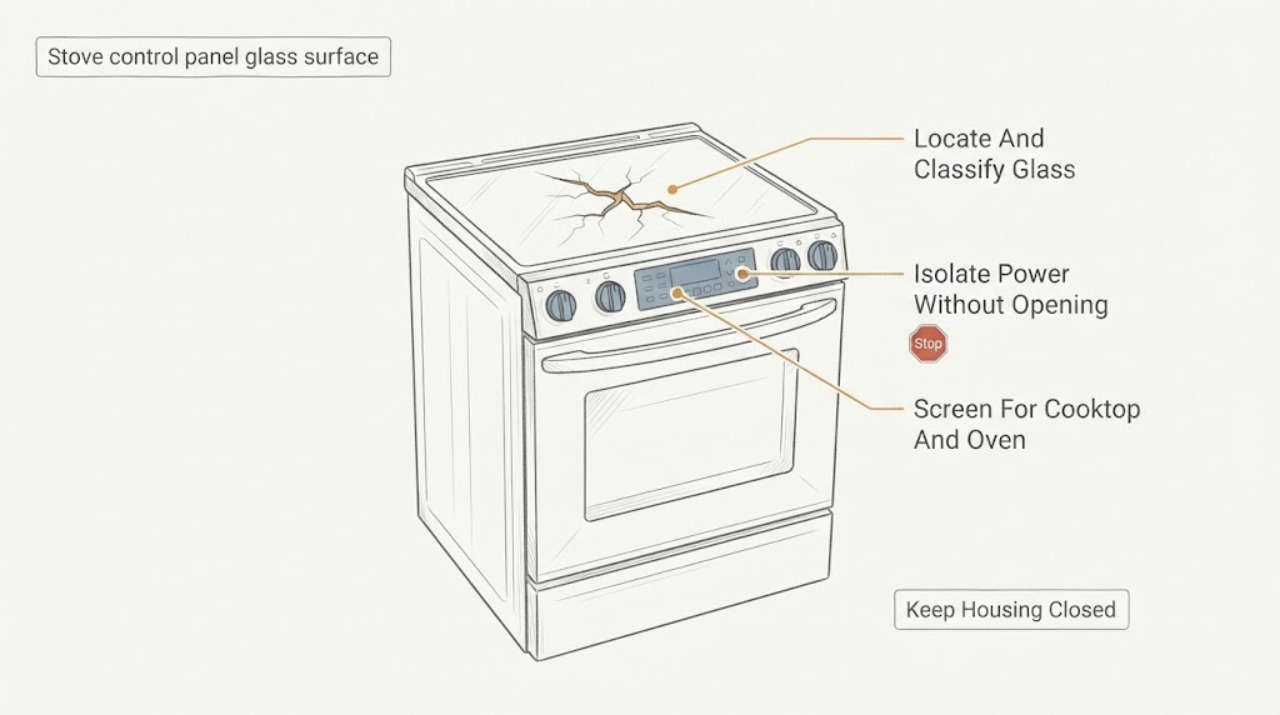
Work through in order
Diagnostic checks
Use only checks that match the exact appliance or system and its official guide.
-
Check 1
With the stove cool and unused, look from a safe distance and trace where the crack begins and ends: control-panel overlay or touch keys, cooktop area under or between burners, edge, or a door or trim piece. Do not press the glass or run a fingertip along it.
Expected result: The line may stay within the labeled control area, reach a burner or pan-supporting surface, cross an edge, show lifting or loose fragments, or be only a surface mark that cannot be confidently classified.
Next step: Photograph the location without touching it and keep the stove off while arranging model-specific appliance service; use the cooktop stop rule whenever the crack reaches the cooking surface.
Stop if: Stop immediately for loose shards, a sharp edge, glass separating from the panel, a crack reaching a burner or cooktop edge, smoke, sparking, shock, or a smell of overheated wiring.
Why this matters
Why: A crack on the load-bearing cooking glass has a stricter no-use boundary than a cosmetic mark. A control-panel crack can still expose controls or allow liquid entry, and an uncertain location should be treated as damaged glass rather than assumed harmless.
-
Check 2
Stop cooking and isolate the stove using its normal off controls only if they respond without pressing cracked or loose glass; when practical, switch off a clearly identified appliance disconnect or breaker that you can access safely, and do not remove any panel.
Expected result: The stove may be cool and fully inactive, a display or indicator may remain on, a control may be stuck or activate unexpectedly, or the disconnect may be unlabeled, inaccessible, or unable to isolate the appliance.
Next step: Keep the appliance unused and ask a qualified appliance technician to isolate and inspect it if power cannot be safely controlled or any control behaves unexpectedly.
Stop if: Do not remove the control panel, probe wiring, bypass a control, or handle the appliance if there is shock, arcing, smoke, heat at the damaged area, or water near energized parts.
Why this matters
Why: A dark display does not prove that every internal part is safe to touch, while an unexpected indicator or stuck control increases the chance of damage beyond the glass. An uncertain disconnect is not a reason to open the appliance.
-
Check 3
From a dry, safe position, determine whether the crack reaches the ceramic cooking surface or remains entirely in the control-panel glass; do not turn on a burner or oven as a test.
Expected result: The crack may be confined to the controls, cross onto the cooktop, lie beside a burner, or be accompanied by pitting, an impact point, a hot-lid or dropped-object mark, or a crack that continues toward the rear vent area.
Next step: Leave both cooking functions off whenever the cooktop is affected or the boundary is uncertain; give the service provider the crack location and whether the appliance is a range, wall oven with cooktop, or separate cooktop.
Stop if: Do not use cookware, perform a heat test, place weight on the glass, or resume the oven when a cooktop crack, pitting, exposed edge, or loose glass is present.
Why this matters
Why: A cooktop crack or pitting requires service and no cooktop use. For a range, the oven vent path toward the cooktop means the oven should also remain off until that cooktop is fixed. A control-only crack still requires service because the control surface is part of the appliance safety boundary.
-
Check 4
Without touching the damaged area, inspect visually for liquid or cleaner in the crack, grease or food under a lifted edge, exposed touch-control film, missing glass, and any fragments on the surrounding surface.
Expected result: The area may be dry and stable, damp or contaminated, open to the controls, shedding fragments, or impossible to inspect without moving the panel or using a tool.
Next step: Keep power isolated, keep people away, and tell the technician exactly what entered or detached; leave fragments and the panel in place unless a qualified technician gives a safe handling instruction.
Stop if: Do not spray, wipe through, vacuum inside, scrape, seal, or lift the glass. Stop for smoke, crackling, burning odor, liquid reaching wiring, or a cut hazard.
Why this matters
Why: Liquid or cleaner entry can create an electrical exposure and cleaning a broken surface can drive more material into the appliance. Exposed or unstable glass adds cut and control-malfunction risks, while an inaccessible area needs service rather than probing.
-
Check 5
Record the model and serial label, appliance type, crack location, approximate extent without measuring on the glass, date of impact if known, and any control or moisture symptoms; request diagnosis before selecting a replacement part.
Expected result: The service provider may identify a separately replaceable control-panel glass or overlay, a complete touch-control or panel assembly, or a ceramic cooktop surface; the model may offer only one of these assemblies.
Next step: Arrange qualified appliance repair and provide the photographs, model information, power-isolation status, and whether the crack reaches the cooktop; let the technician confirm the compatible part and inspect for hidden damage.
Stop if: Do not order by a generic description, remove the panel to find a part number, glue the crack, or resume use while waiting for the repair.
Why this matters
Why: Glass pieces that look alike are not interchangeable: fit, control layout, insulation, connectors, and the appliance model determine the repair. The visible crack does not prove which internal part is damaged.
Use your observations
Decision map
Find the observation that best matches what you see, then follow the next safe action.
-
PATH 01Safety boundary
What you see
The crack reaches the pan-supporting ceramic, radiant, induction, or gas-on-glass cooking surface, or the location cannot be separated from that surface.
Do this next
Do not use the cooktop. On a range, keep the oven off until the cooktop is repaired, and arrange qualified appliance service.
Why this path and its safety boundary
Why it matters: This is a cracked cooktop surface, not merely a control overlay. Continued heat or cleaning can worsen the break and create shock, cut, or fire exposure.
Safety stop: Do not place a pan over the crack, tape or seal it, clean it, or heat it to see whether it holds.
-
PATH 02Safety boundary
What you see
The crack appears limited to the control-panel glass, with no visible loose edge, exposed control area, liquid entry, or effect on the cooktop surface.
Do this next
Keep the stove off until a qualified technician confirms the model-specific repair; do not press cracked touch keys or clean through the crack.
Why this path and its safety boundary
Why it matters: A stable-looking control-only crack is less evidence of cooktop structural damage, but it remains appliance damage and can spread or allow contamination into controls.
Safety stop: Escalate promptly if the crack spreads, glass lifts, controls activate unexpectedly, moisture enters, or any heat, odor, spark, or shock appears.
-
PATH 03Safety boundary
What you see
The line may be a scratch, residue, or pitting rather than a through-crack, but the user cannot establish that safely without pressing or cleaning the surface.
Do this next
Do not use abrasive cleaning or a sharp edge to diagnose it; keep the appliance off if uncertain and have service identify the surface and repair boundary.
Why this path and its safety boundary
Why it matters: Ceramic glass can show scratches, pitting, or permanent marks, and a superficial appearance does not establish that the underlying glass is sound.
Safety stop: Treat it as a crack if an edge catches light, the mark branches, the surface moves, or any fragment or opening is visible.
-
PATH 04Safety boundary
What you see
Water, grease, cleaner, or steam may have entered the cracked control area or broken cooktop glass.
Do this next
Keep the appliance disconnected by a safe means, do not clean or power it, and tell the technician what substance entered and when.
Why this path and its safety boundary
Why it matters: Liquid or cleaning material can reach electrical parts or penetrate broken glass; wiping harder can spread the material and the damage.
Safety stop: Leave the area and obtain urgent help for smoke, arcing, burning odor, shock, or a hot or sparking control area.
-
PATH 05Safety boundary
What you see
The crack is spreading, the panel is lifting, the edge is sharp, fragments are loose, or a control opening is visible.
Do this next
Keep people and pets away, leave the stove disconnected, do not handle fragments, and arrange prompt qualified appliance service.
Why this path and its safety boundary
Why it matters: The immediate hazards include cuts, further glass failure, unintended control contact, and possible contamination of internal parts.
Safety stop: Do not cover the area with a hand, towel, tape, or adhesive, and do not move the appliance to gain access to the damage.
-
PATH 06Safety boundary
What you see
The display or burners appeared to work normally before the stove was switched off, despite the cracked glass.
Do this next
Keep the stove unused and provide the technician with the last known normal behavior, crack location, and model information.
Why this path and its safety boundary
Why it matters: Normal operation does not establish that the cracked control or cooktop remains safe; manufacturer safety guidance still prohibits cooking on broken glass.
Safety stop: Do not perform a burner, oven, touch-key, or self-clean test while waiting for service.
Helpful context
Understand the symptom
Locate the crack before deciding what is safe
A control-panel overlay or touch surface is usually above or beside the burners and carries labels, displays, or touch keys. The cooktop is the surface that supports pans and may be radiant, induction, or gas-on-glass. A line that reaches a burner ring, the cooktop edge, or the area under a pan must be treated as cooking-surface damage, even if it began near the controls. If you cannot tell which glass is cracked, leave the stove off and have service identify it.
Do not clean, press, or test cracked glass
Do not wipe through the crack, spray the controls, press on a lifting edge, or use tape, epoxy, abrasive cleaner, steam, or high-pressure water. Keep children and pets away from loose fragments. If the appliance is hot, let it cool without touching the damaged area; then use only a safe, clearly identified disconnect or appliance breaker if power must be isolated.
Operating symptoms change the urgency, not the repair boundary
Without restoring power, note whether the display or touch area was already responding incorrectly, whether the crack is spreading, and whether water, grease, or cleaner could have entered. A stove that still heats or displays normally is not proven safe: broken glass can expose controls and can worsen with heat, impact, or cleaning.
Service needs the exact appliance identity
Photograph the damage from a safe distance and record the model and serial information from the rating label without removing covers. Tell the technician whether the damaged piece is the control-panel glass, a touch-control assembly, or the ceramic cooking surface; the correct replacement may be a glass overlay, a complete control-panel assembly, or a cooktop surface, depending on the model.
Safety boundary
Stop conditions
- Do not operate or clean a stove when the cooktop or control-panel glass is broken, cracked, loose, or uncertain; do not use a cracked cooktop to test whether it still heats.
- Do not press, scrape, tape, glue, lift, vacuum, or probe cracked glass, and do not remove the control panel or handle internal wiring as a homeowner repair.
- Keep power off by a safe, accessible disconnect when controls are damaged or liquid may have entered; do not work near smoke, sparks, burning odor, shock, or hot exposed parts.
- If the crack reaches the cooking surface, keep the cooktop off and, for a range, keep the oven off until the cooktop is repaired because the oven vents toward the cooktop.
- Arrange qualified appliance service for any confirmed or uncertain crack, loose fragments, spreading edge, control malfunction, moisture entry, or need to identify a compatible replacement assembly.
Only after diagnosis
Potential parts
- control-panel glass or touch-control overlay
Consider this only when service confirms the crack is confined to a separately replaceable control-panel glass or overlay for that exact appliance.
Match the exact model, revision, control layout, mounting method, markings, and electrical interface; a similar-looking panel may not fit or provide the required insulation. - complete control-panel or touch-control assembly
Some models do not provide the glass separately, or the crack may have damaged the touch layer, display, gasket, or wiring behind it.
Use the technician-confirmed assembly for the exact model and revision; do not assume a glass-only part will restore safe controls. - ceramic cooktop glass surface
Consider this only if inspection confirms that the crack is on the pan-supporting cooktop rather than only on the control panel.
Radiant, induction, and gas-on-glass assemblies can differ in sensors, element layout, seals, and connectors; confirm the exact model before ordering.
When checks do not resolve it
Need a professional?
Arrange qualified appliance repair before using the stove again when a crack is confirmed or cannot be distinguished from a scratch, especially when it reaches the cooktop, a control edge is lifting, liquid entered, controls behave unexpectedly, or fragments are loose. Treat smoke, arcing, burning odor, shock, or a hot exposed area as an urgent safety condition: keep clear, leave power off if it can be isolated safely, and obtain emergency assistance appropriate to the hazard.
Safety scope: This article supports stopping use, identifying the damaged surface visually, recording the model, protecting people from fragments, and isolating power only through a safe accessible disconnect. A qualified appliance technician should open the appliance, inspect wiring and controls, determine whether glass or a complete assembly is required, and perform the repair.
Common questions
FAQ
Can I use the oven if only the stove control-panel glass is cracked?
Do not assume that it is safe. Keep the appliance off until service identifies the damaged glass and confirms the boundary. If the crack reaches the cooktop, manufacturer guidance says to keep the oven off on a range until the cooktop is repaired.
Can I cover a cracked control panel with clear tape or epoxy?
No. Adhesive can hide spreading damage, trap contamination, interfere with touch controls, or leave fragments unsecured. Keep the stove off and have the exact panel or assembly assessed.
What if the line looks like a scratch instead of a crack?
Do not press, scrape, or use abrasive cleaner to find out. If the mark branches, catches an edge, moves, opens, or cannot be identified confidently, treat it as cracked glass and arrange service.
Read the exact guide
Official sources
- IMPORTANT SAFETY INSTRUCTIONSGE Appliances · GE appliance safety instructions used for the broken-glass and service boundary; the linked guide is an older GE publication, so the installed appliance manual controls model-specific details.
- Cooktop - Glass CrackedGE Appliances · GE manufacturer support guidance for cracked glass cooking surfaces; the control-panel versus cooktop distinction still needs model-specific inspection.
- Home Appliance Terms and ConditionsSamsung Electronics America · Samsung appliance safety terms used for the general hazard boundary around broken control-panel or cooktop glass; model-specific instructions and the installed appliance manual take precedence.
- Maintenance of Ceramic Glass - Product Help | WhirlpoolWhirlpool Corporation · Whirlpool manufacturer guidance for ceramic cooktops, used to explain how impact, hot lids, sliding cookware, and unsuitable use can damage the cooking surface; it does not identify the user's model or authorize a repair.
Community feedback
Share a repair observation
Share a plain-text repair observation. Accepted observations are published automatically; this page may take a moment to update.