
On this page
Start here
Quick answer
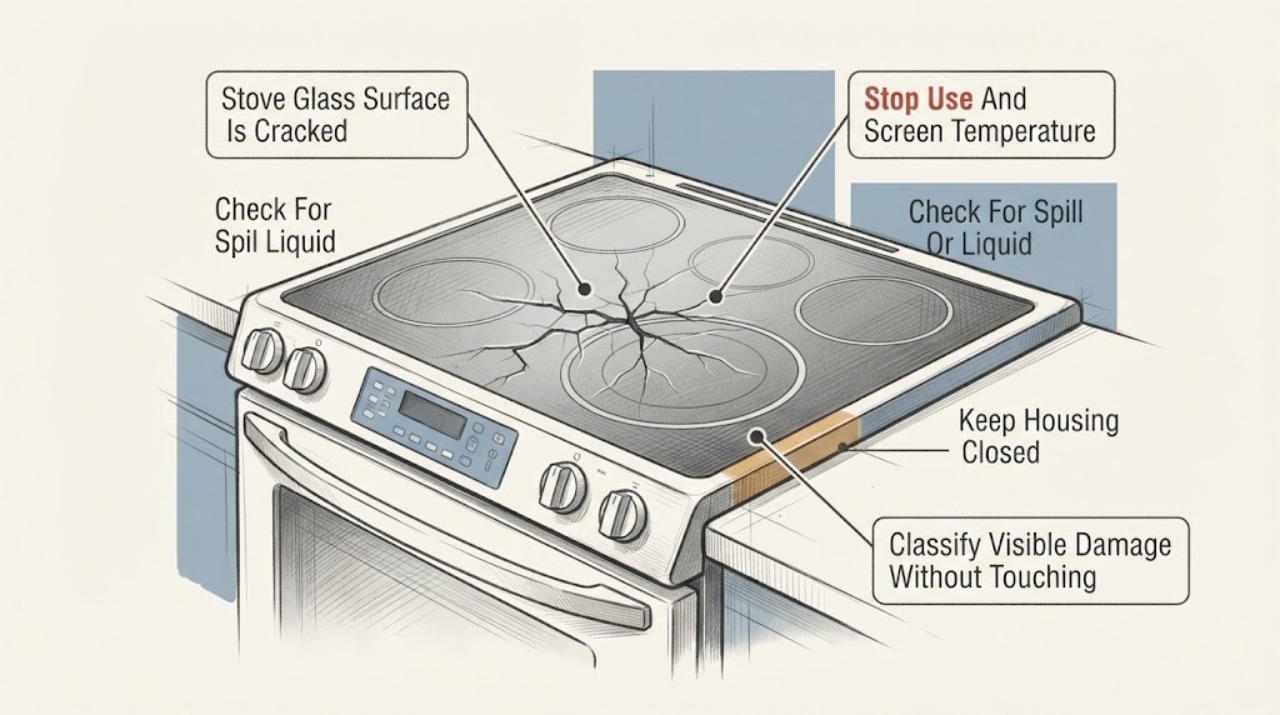
Do not use a stove or range with a cracked or broken glass cooktop, whether the surface is hot or cold. A hot surface can burn you and may worsen the damage if you pour liquid on it or move cookware across it; a cold-looking surface can still have an opening through which spills or cleaner reach electrical parts. Turn all controls off, keep people away, and let a hot surface cool without touching or shocking it with water. From a safe position, photograph the crack, note whether it is a true split, a chip, pitting, or only a removable mark, and record the appliance model and serial information without opening the appliance. Manufacturer guidance says a cracked ceramic glass surface needs service and, on a range, the oven should not be used until the cooktop is repaired because oven heat vents near the cooktop. Arrange qualified appliance service to identify the exact glass assembly and check the underlying elements, wiring, seals, and controls. Do not tape, glue, fill, sand, scrape a crack, lift the glass, remove the cooktop, or keep cooking because the surface feels cool.
Work through in order
Diagnostic checks
Use only checks that match the exact appliance or system and its official guide.
-
Check 1
Turn every surface control and the oven control to OFF using the normal controls, keep cookware and people away from the damaged area, and observe from a safe position whether the glass is hot, warm, or cool. If it is hot, allow it to cool naturally; do not touch it, pour water on it, cover it, or move a pan across the crack.
Expected result: The glass is hot or the hot-surface indicator remains on; the glass appears cool but the crack is visible; or a burner, indicator, or control does not turn off normally.
Next step: Keep the appliance unused and let the surface cool without contact. If a burner remains on, smoke appears, or a control will not shut the appliance down, keep clear and obtain urgent qualified appliance or electrical help; do not reach under the top or try to disconnect internal wiring.
Stop if: Do not cook, test a burner, pour cold water on hot glass, cover the crack with foil or tape, or touch the surface to check temperature.
Why this matters
Why: A hot surface can burn and thermal shock can worsen glass damage. A cool surface is not proof that the appliance is safe to use, because a break can still admit liquid to components below. A control or indicator that remains active adds a control or electrical concern beyond the glass itself.
-
Check 2
After the appliance is cool enough to view safely, use a flashlight and photographs to document the line without touching it. Note whether it is a continuous split, branching crack, edge chip, pitted indentation, star-shaped impact point, or a superficial mark that does not interrupt the surface. Look for glass fragments, a raised edge, or an opening around a heating zone.
Expected result: A true split, chip, pitting, raised edge, opening, loose fragment, or spreading line is visible; only a faint surface mark is visible; or the damage cannot be classified.
Next step: Treat uncertain or confirmed damage as a cracked cooktop and arrange qualified appliance service. Keep the area clear and provide the photos; let the technician determine whether the glass assembly and the parts beneath it need inspection or replacement.
Stop if: Do not run a fingernail over the line, press the glass, scrape a crack, pick out fragments, use abrasive cleaner, or attempt a glue, resin, silicone, or tape repair.
Why this matters
Why: A split, chip, pitted area, or opening is physical glass damage and cannot be made safe by polishing or household filler. A faint mark may be metal transfer or a scratch, but the distinction cannot be safely confirmed by operating the stove. Loose fragments and spreading damage increase cut and breakage risk.
-
Check 3
From outside the appliance, note whether a spill, boil-over, cleaner, melted plastic, or other liquid reached the crack, and whether there is moisture, a burnt smell, a tripped control, or a darkened area near a burner. Do not wipe through the crack or spray the surface. If liquid is still present, keep hands and cloths away from the damaged area and wait for qualified instructions.
Expected result: Liquid entered or may have entered the crack; the surface or nearby control is wet; there is odor, smoke, a trip, or discoloration; or the damaged area is dry and no such sign is present.
Next step: Keep the appliance off and obtain prompt qualified service for any liquid intrusion, odor, smoke, discoloration, shock, or tripped protection. Do not restore power to test it or clean beneath the glass.
Stop if: Do not pour cleaner or water into the crack, use a wet cloth on the damaged area, open the control panel, reset a trip repeatedly, or dry the interior with heat.
Why this matters
Why: Manufacturer safety guidance warns that spills or cleaning solution can penetrate broken glass and create an electrical-shock risk. Odor, smoke, discoloration, or an unexpected trip can indicate damage below the surface. A dry appearance does not rule out hidden damage.
-
Check 4
Photograph the model and serial label from its normal accessible location and record whether the appliance is a radiant electric, induction, gas-on-glass, slide-in range, freestanding range, or separate cooktop. Use the owner's manual only to identify the label location and service requirements; do not lift the top, remove a burner, or open a panel to find it.
Expected result: The model and serial are legible; the appliance type is clear; the label is inaccessible without disassembly; or the glass is part of a range with an oven below.
Next step: Give the model, serial, appliance type, and damage photographs to qualified appliance service so the correct glass assembly and any affected under-glass parts can be identified. Keep both cooktop and oven unused until the manufacturer-specific guidance is reviewed.
Stop if: Do not order a glass panel from dimensions or a visual match, remove the top, unplug internal connectors, or use the oven to avoid the cracked surface.
Why this matters
Why: Glass assemblies, heating elements, sensors, mounting, and service procedures vary by appliance type and model. A range with an oven below may vent heat near the cooktop, so a cracked cooktop can affect whether the oven should be used. An inaccessible label is a service task, not a reason to dismantle the appliance.
-
Check 5
Before arranging service, note any burner that stays on, hot-surface indicator that behaves unexpectedly, control that does not respond, exposed sharp glass, loose pieces, smoke, electrical smell, or a circuit that trips. Observe only from a safe distance and do not restore power or operate a control to reproduce the symptom.
Expected result: A burner or indicator remains on, a control is unresponsive, glass is loose or sharp, smoke or electrical odor is present, protection trips, or none of these signs is present.
Next step: For smoke, an electrical odor, a burner that remains on, a shock, or repeated tripping, keep clear and obtain urgent qualified help. For other confirmed or uncertain cracks, schedule appliance service promptly and leave the appliance off.
Stop if: Do not operate the appliance for diagnosis, handle loose glass, reach under the cooktop, remove fuses or breakers as a repair, or continue using a zone that appears unaffected.
Why this matters
Why: Unexpected heating or a nonresponsive control can create a burn or electrical hazard in addition to the crack. Loose or sharp glass creates injury risk. A quiet, cool appliance is still not approved for use because the broken barrier can admit liquid and the parts beneath have not been checked.
Use your observations
Decision map
Find the observation that best matches what you see, then follow the next safe action.
-
PATH 01Next step
What you see
A crack or chip is visible while the glass is hot or the hot-surface indicator is on.
Do this next
Turn controls off, keep clear, and allow cooling without touching or adding liquid. Do not use the cooktop or oven; arrange qualified appliance service after the surface is cool.
Why this path and its safety boundary
Why it matters: There is immediate burn and breakage risk, and heating may worsen the damaged surface.
-
PATH 02Next step
What you see
The surface is cool, but a split, chip, pitting, raised edge, or opening remains visible.
Do this next
Keep the appliance off and schedule qualified service to identify the exact glass assembly and inspect the underlying parts. Do not test an apparently unaffected burner.
Why this path and its safety boundary
Why it matters: Cooling does not repair the cooktop. The broken surface can still admit spills to electrical or heating components and can fail further under cookware or heat.
-
PATH 03Next step
What you see
The line may be a metal mark, residue, or shallow scratch, but it has not been safely confirmed as superficial.
Do this next
Leave it unused and provide a cool, close photograph and model information to qualified service or follow the exact owner manual's non-abrasive inspection guidance. If any split, chip, pitting, or opening is present, treat it as a crack.
Why this path and its safety boundary
Why it matters: Some surface marks can resemble cracks, but operating or aggressively cleaning the cooktop to decide can worsen real damage or drive liquid into it.
-
PATH 04Next step
What you see
A spill, cleaner, or moisture reached a crack, or odor, smoke, discoloration, shock, or tripping followed the damage.
Do this next
Keep clear, do not restore power or wipe into the break, and obtain prompt qualified appliance or electrical service. Use local emergency guidance for smoke, active fire, or shock.
Why this path and its safety boundary
Why it matters: Liquid intrusion can create an electrical-shock or component-damage risk, and the condition exceeds routine surface care.
-
PATH 05Next step
What you see
The cracked glass is on a range with an oven below, even if the oven itself appears to work.
Do this next
Keep both oven and cooktop unused until the exact manufacturer guidance is reviewed and qualified service inspects the appliance. Do not use the oven as a workaround.
Why this path and its safety boundary
Why it matters: The oven can vent heat near the cooktop on some ranges, and the manufacturer may prohibit oven use until the cooktop is repaired.
Helpful context
Understand the symptom
Hot or cold does not change the stop-use decision
Radiant glass cooktops have heating elements beneath the ceramic surface, and the glass can retain heat after the controls are turned off. Induction surfaces may be mostly cool, but heat can transfer back from a pan. A crack is therefore a structural and safety condition, not a temperature test. Whether the crack is visible while hot or only noticed after cooling, keep the cooking zones off and do not touch, wet, or load the damaged area.
A mark is not always a crack, but do not prove it by using the stove
Metal transfer, residue, and shallow scratches can resemble a crack in a photograph. A true split, branching line, raised edge, missing chip, pitting, or opening around a burner is different and needs service. Cleaning or scraping can make damage worse, and a liquid spill can enter a broken surface. If the appearance is uncertain, treat it as cracked until a qualified technician inspects it; do not run a burner to see whether the line changes.
Only after diagnosis
Potential parts
- model-specific ceramic glass cooktop or range-top assembly
Consider this only after qualified service confirms that the surface is structurally cracked or pitted and identifies the exact appliance model and surface type.
Glass shape, mounting, burner openings, controls, insulation, and surface technology vary by model. Do not choose a panel by dimensions, color, or a similar photograph. - under-glass heating element, sensor, seal, or mounting hardware
Consider these categories only if inspection finds liquid intrusion, heat damage, loose mounting, a failed element, sensor, or damaged seal beneath the cracked surface.
These parts are appliance- and surface-type-specific and may involve electrical connections or gas-on-glass construction. A qualified technician should inspect and select them after the glass is removed safely.
When checks do not resolve it
Need a professional?
Arrange qualified appliance service for any confirmed or uncertain crack, chip, pitting, raised edge, loose glass, or opening in a glass stove surface. Keep the cooktop unused whether it is hot or cold; on a range, keep the oven unused until the exact manufacturer guidance says it is safe after repair. Seek urgent qualified electrical or emergency help for a burner that remains on, smoke, electrical odor, shock, active arcing, water entering the appliance, or repeated tripping. Do not touch or load the damaged glass, pour water or cleaner on it, scrape or glue it, remove the top, order a visually similar panel, or test an unaffected burner.
Common questions
FAQ
Can I use a glass stove if the surface is cracked but cold?
No. A cold surface is not proof that a crack is safe. Spills or cleaner can pass through broken glass and reach electrical or heating parts, and heating or cookware can worsen the damage. Keep the appliance off and arrange qualified service.
What should I do if the cracked glass cooktop is still hot?
Turn the normal controls off, keep people away, and let it cool naturally without touching it, moving cookware across it, or pouring water on it. Do not clean or test it while hot. Once safe to view, photograph the damage and arrange appliance service.
Can I use the oven if only the range cooktop glass is cracked?
Do not assume the oven is safe. GE says that on ranges the oven can vent near the cooktop and does not recommend oven use until the cooktop is repaired. Keep both functions off until the exact model guidance and a qualified inspection say otherwise.
How can I tell whether a line is a crack or just a scratch?
From a cool, safe position, photograph whether the line branches, has a chip, raised edge, missing glass, pitting, or an opening. Do not touch, scrape, clean aggressively, or operate the stove to test it. If you cannot confidently classify it as superficial, treat it as a crack and have it inspected.
Does cracked cooktop glass need replacement?
A confirmed crack, chip, pitting, or indentation generally needs qualified service and may require the model-specific glass assembly. The technician should also check the elements, sensors, wiring, seals, and controls beneath it. Do not order a panel by appearance or attempt a glue or resin repair.
Read the exact guide
Official sources
- Cooktop - Glass CrackedGE Appliances · Manufacturer guidance for cracked ceramic glass cooktops on cooktops and ranges
- IMPORTANT SAFETY INFORMATIONGE Appliances · Glass cooktop broken-surface safety, electrical-shock risk, and qualified-service boundary
- Electric Range & Cooktop - Glass Smooth Top Surface Seems Too HotGE Appliances · Radiant and induction glass-surface temperature behavior and hot-surface indicators
- Electric Range & Cooktop - Glass Cooktop Cleaning InstructionsGE Appliances · GE glass cooktop surface marks, pitting, residue, and service-required damage
- GE Appliances, a Haier Company, Recalls Electric Cooktops Due to Burn HazardU.S. Consumer Product Safety Commission · Government recall safety example for electric cooktop controls that can remain energized and create burn hazards
- Use & Care GuideWhirlpool · Ceramic cooktop broken-surface safety, hot-surface precautions, cleaning limits, and qualified service
Community feedback
Share a repair observation
Share a plain-text repair observation. Accepted observations are published automatically; this page may take a moment to update.