
On this page
Start here
Quick answer
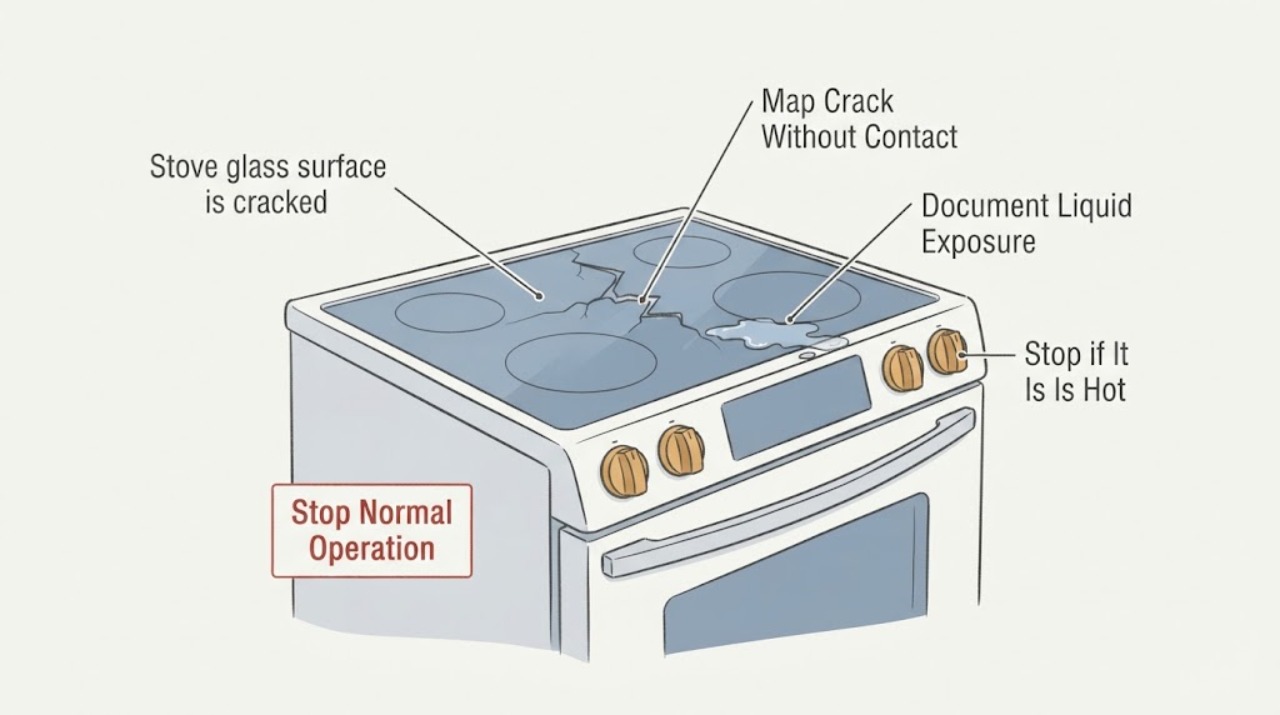
Treat a cracked glass stove surface as a stop-use condition, especially when liquid can reach the controls or the area beneath the glass. Turn every control OFF using only the normal control, keep people away from the crack and any spilled liquid, and do not cook, clean into the crack, or test the burners. GE's support guidance says cracked ceramic glass needs service and does not recommend using the cooktop—or the oven on a range that vents onto the cooktop—until it is repaired. A broken-glass safety warning also explains that spillovers or cleaning solution can penetrate the break and create an electrical-shock risk. Do not remove the glass, control panel, knobs, wiring, or breaker cover, and do not try to seal the crack as a repair. Arrange qualified appliance service; use emergency or gas-safety help for smoke, active arcing, gas odor, fire, or a control that will not shut off.
Work through in order
Diagnostic checks
Use only checks that match the exact appliance or system and its official guide.
-
Check 1
Turn all cooktop and oven controls to OFF using only their normal controls, then keep cookware, hands, and cleaning liquids away from the cracked area; do not test a burner or use the oven.
Expected result: Record whether every control reaches its normal OFF position, whether any burner, display, or indicator still appears active, and whether the crack is under a burner, near the controls, or across the work surface.
Next step: Leave the appliance out of service and arrange qualified appliance service; if a control will not turn off, there is smoke, or there is active arcing, move away and obtain urgent help.
Stop if: Stop immediately for heat that continues unexpectedly, smoke, sparks, burning odor, gas odor, or a control that cannot be turned OFF normally.
Why this matters
Why: A crack alone is enough to stop use, and an active element, display, or control that will not turn off adds an immediate service concern. GE specifically says not to use a cracked cooktop and, on ranges, not to use the oven until the cooktop is fixed.
-
Check 2
Once the surface is cool, observe the crack from above without pressing it, lifting the glass, sliding the range, or removing any component; take a photo from a safe distance and note whether it reaches a burner, control area, edge, or vent path.
Expected result: Separate a short surface line that stays away from edges and controls from a crack that reaches an edge, spreads under a heating zone, crosses the control area, has a missing chip, or leaves an opening.
Next step: Keep the appliance unused and give the photo and location to the service provider; do not use tape, sealant, a cover, or a temporary patch as permission to cook.
Stop if: Do not touch loose shards, press on the glass, or continue if the surface is warm, wet, unstable, or actively breaking.
Why this matters
Why: Any crack requires service, while an edge-reaching, open, spreading, or control-adjacent break gives liquid and heat more opportunity to reach underlying parts and raises the urgency. Appearance alone cannot establish that the glass remains structurally safe.
-
Check 3
Without wiping toward the crack or applying cleaner, document whether liquid has only pooled on top, entered the break, reached the control area, or contacted the underside or an opening; keep the appliance untouched after the observation.
Expected result: Note the liquid type in plain terms, approximate location, whether the controls or display were wet, and whether there was a pop, smell, flicker, smoke, or other change at the time.
Next step: Leave the appliance out of service, do not pour water or cleaner over it, and tell the technician about the exposure before any inspection or repair.
Stop if: Stop and leave the area for smoke, sparks, a shock sensation, burning odor, or active electrical noise; do not operate nearby switches if gas odor is also present.
Why this matters
Why: Liquid that can reach or has entered the controls or underside creates an electrical or control hazard beyond cosmetic glass damage. No visible reaction does not prove that liquid stayed out or that the appliance is safe to energize.
-
Check 4
If the surface was recently used, wait without touching it and record whether the hot-surface indication or residual warmth is simply declining after controls are OFF; do not use residual heat or place cookware on the cracked surface.
Expected result: Distinguish a surface that is cooling after normal operation from an element that appears energized at OFF, a hot spot that persists unexpectedly, or a control indicator that conflicts with the model manual after the surface is cool.
Next step: Keep the appliance unused in either case; report unexpected continuing heat, active elements, or indicator behavior to the technician instead of testing another setting.
Stop if: Do not touch the glass, use a wet cloth on it, move a pan across it, or inspect below the surface while it is warm.
Why this matters
Why: Glass and cookware can retain heat, and electric elements can cycle during normal operation, so immediate warmth is not proof of a stuck control. Heat that continues abnormally with controls OFF is a separate service and safety issue, made more urgent by the crack.
-
Check 5
Prepare the model marking, appliance type, crack location and length as an estimate, liquid exposure details, control/indicator behavior, and whether the oven was in use; do not remove labels, panels, or the glass to obtain more information.
Expected result: The service note should show whether the damage is isolated to the glass appearance or accompanied by liquid entry, a control problem, heat after OFF, odor, noise, smoke, or visible loose material.
Next step: Arrange qualified appliance service and keep the stove and oven unused until the technician confirms the repaired surface and controls are safe.
Stop if: There is no safe user troubleshooting path through an opened appliance, exposed terminals, gas-valve work, live testing, or handling broken glass.
Why this matters
Why: These distinctions help service determine whether the work involves the glass assembly, heating/control components, moisture inspection, or an urgent electrical or gas-safety response. The note cannot justify continued use or identify a replacement part by itself.
Use your observations
Decision map
Find the observation that best matches what you see, then follow the next safe action.
-
PATH 01Next step
What you see
The surface is cracked but dry, all controls reach OFF normally, and there is no smoke, odor, spark, or unexpected heat.
Do this next
Keep both cooktop and, where the appliance is a range, oven out of use until repaired, following the manufacturer's stop-use guidance.
-
PATH 02Next step
What you see
Liquid has entered the crack, can reach the controls or underside, or the control area was wet during the event.
Do this next
Do not energize, clean into, or disassemble the appliance. Keep it out of service and tell qualified service exactly where and when liquid reached it.
-
PATH 03Next step
What you see
A burner, heating zone, display, or indicator remains active unexpectedly after controls are OFF, or heat continues in a way the manual does not describe.
Do this next
Stay away from the surface, keep the appliance out of use, and obtain urgent qualified service. Do not open the control area or try another setting.
-
PATH 04Next step
What you see
There is gas odor, smoke, active arcing, a shock sensation, burning odor, rapidly spreading breakage, or a control that cannot be turned off normally.
Do this next
Do not operate electrical switches or create flames if gas is suspected. Leave the area when necessary and contact the appropriate emergency or gas-safety service; do not return the appliance to use until inspected.
Helpful context
Understand the symptom
The crack changes the normal cleaning and cooking decision
A superficial-looking line is difficult to classify safely from above. Once glass is cracked, heat, cookware movement, and liquid can worsen the damage or allow contamination to pass below the surface. GE's current support guidance covers cracked radiant, induction, and gas-on-glass surfaces and recommends service instead of continued use. That means this is not a stain, a setting problem, or a repair to postpone until the next spill.
Do only external, non-contact checks
After controls are OFF and the surface is no longer hot, you can look from a safe distance, note where the crack runs, and photograph the model marking without moving the appliance or probing the break. Do not wipe liquid toward the crack, pour cleaner onto the glass, lift the top, remove a knob to reach a control, or test a burner to see whether the crack matters. If liquid has already entered, leave the appliance out of service and tell the technician exactly what happened.
Include the oven and the controls in the stop decision
On some ranges, the oven vents toward the backsplash or cooktop area. GE therefore advises against using the oven until a cracked cooktop is repaired. Controls may also remain warm or show a hot-surface indication after a unit is turned off; that expected behavior does not make a damaged glass surface safe. Keep the appliance out of use until service confirms the complete surface and control area are safe.
Safety boundary
Stop conditions
- Stop using the cooktop and, on a range, the oven until the cracked glass is repaired; liquid entry makes this stop-use boundary especially important.
- Do not clean into the crack, pour liquid on the surface, press or lift broken glass, use tape or sealant as a repair, or place cookware on the damaged area.
- Do not open the appliance, remove the glass or control panel, expose wiring or terminals, perform live tests, or attempt gas-valve or heating-control work.
Only after diagnosis
Potential parts
- ceramic glass cooktop assembly
A glass assembly may be relevant only after service confirms the crack is the repairable damaged component and the model-specific assembly is available.
Match the exact appliance model, surface technology, burner layout, trim, and manufacturer fit; do not order by appearance or glass dimensions alone. - cooktop control or heating assembly
Consider this only if liquid entry or the service inspection identifies secondary damage or an abnormal control/heating function in addition to the cracked glass.
Confirm the exact model and manufacturer-approved component after diagnosis; a cracked surface alone does not identify a control or element failure. - gas-on-glass burner component
Only relevant when a gas-on-glass technician finds that the crack or liquid exposure also affected a burner, valve, cap, or related gas component.
Verify the appliance model, burner position, fuel type, and manufacturer fit through qualified service; do not perform gas work yourself.
When checks do not resolve it
Need a professional?
Arrange qualified appliance service for any cracked glass surface, even when the controls appear normal. Tell the technician if liquid entered or can reach the controls, if the crack reaches an edge or opening, or if a burner, indicator, or display remains active. Use emergency or gas-safety assistance for smoke, fire, gas odor, active arcing, shock, or a control that cannot be turned off normally.
Common questions
FAQ
Can I still use a cracked glass cooktop if the burners seem normal?
No. GE recommends service for any cracked ceramic glass surface and does not recommend using the cooktop until repaired. On a range, GE also advises against using the oven until the cooktop is fixed because heat and venting can affect the damaged area.
Why is liquid reaching the controls through a cooktop crack dangerous?
Broken glass can allow spillovers or cleaning solution to penetrate below the surface, creating an electrical-shock risk and potentially affecting controls. Keep the appliance out of service and tell the technician about the liquid path.
Should I wipe the liquid off a cracked glass stove?
Do not push liquid toward the crack or pour cleaner over the surface. If the appliance is still hot, do not touch it; if liquid has entered or reached controls, leave the appliance out of service and arrange qualified inspection.
Does a hot-surface light mean the cracked cooktop is still powered?
Not necessarily. Glass and cookware can retain heat, and hot-surface indicators can remain lit after a burner is turned off. However, a cracked cooktop should remain unused, and an element that is actually energized at OFF or an indicator that behaves abnormally needs service.
Can I repair or seal the crack myself?
No. Do not use sealant, tape, a patch, or a replacement glass panel without model-specific professional evaluation. The repair may also need an inspection for liquid exposure, controls, heating parts, and wiring beneath the surface.
Read the exact guide
Official sources
- 49-88823p1-8GE Appliances · GE radiant glass cooktop safety instructions and liquid-penetration warning
- Cooktop - Glass CrackedGE Appliances · Cracked ceramic glass cooktop service and stop-use guidance
- Electric Range - Hot Surface IndicatorGE Appliances · Electric range hot-surface and burner-on indicator behavior
- Caring for the Control Knobs and the Control PanelWhirlpool · Cooktop control cleaning boundaries and model-manual reference
- Owner's ManualWhirlpool · Ceramic glass electric cooktop controls, hot-surface indication, and normal cycling
Community feedback
Share a repair observation
Share a plain-text repair observation. Accepted observations are published automatically; this page may take a moment to update.