
On this page
Start here
Quick answer
Start by asking whether the washer is actually failing to spin or is leaving clothes wet because Low Spin, No Spin, a delicate cycle, an unbalanced load, or a drain problem was selected or detected. Wait until the basket is completely still, then record the cycle, load, water level, and any flashing light or code. Check the lid or door, redistribute or reduce a bulky or tightly packed load, verify that the washer is level, and inspect only the visible drain hose for kinks, a clog, incorrect insertion, or an unsuitable height. Whirlpool says a washer may stop spin when it detects a serious imbalance, and it must drain before many spin sequences. Do not reach into a moving basket, bypass the lid or door switch, tape over the drain opening, open the cabinet, or keep testing a washer that leaks, smokes, smells electrical, strikes the cabinet, or repeatedly fails. If water remains after the model-specific drain checks or the washer still will not spin with a balanced, level load, arrange qualified service.
Before you begin
Safety first
- Keep the washer off for smoke, burning or electrical odor, a hot plug or outlet, water near electrical equipment, a tub that will not stop, violent walking, cabinet impact, a significant leak, or a full tub with a humming pump. Do not open the cabinet, bypass safety devices, or repeat spin tests.
Work through in order
Diagnostic checks
Use only checks that match the exact appliance or system and its official guide.
-
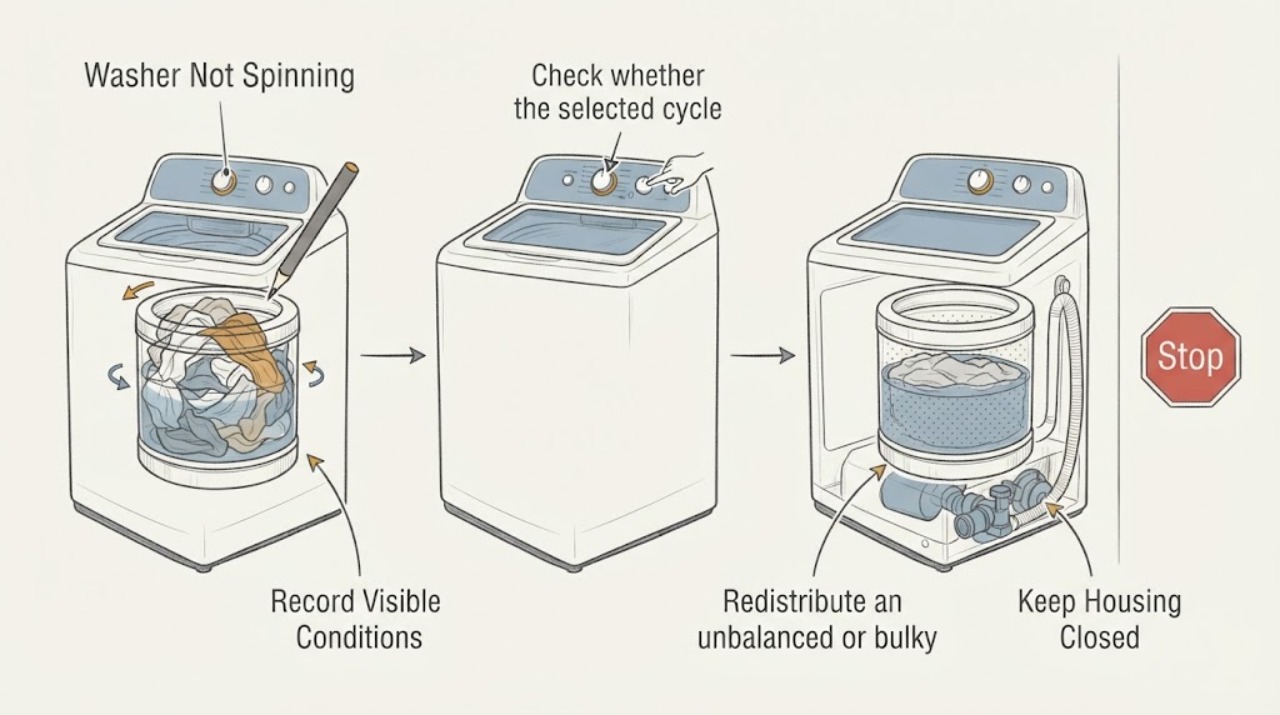
Stop safely and record the exact spin symptom
Press Start or Pause and wait until the basket is completely still before opening the lid or door. Record the exact model, top-load or front-load style, cycle and spin option, whether water remains, whether the washer tried to rebalance, and every flashing light or code. From a safe position, look for smoke, a burning or electrical odor, a hot plug, a leak near electrical equipment, violent movement, or a basket that does not stop.
Expected result: The basket does not stop, the washer walks or strikes the cabinet, water reaches electrical equipment, smoke or electrical odor appears, or the breaker trips repeatedly.
Next step: Stop immediately, keep clear, and isolate power only from a safe, dry location. Close the water supply only if safely reachable; arrange qualified appliance or electrical service and use emergency help for smoke or fire.
Stop if: Do not restart the washer, reach into the moving tub, or move it through pooled water.
Why this matters
Why: This is an injury, fire, electrical, or water-safety event rather than an ordinary load-balance check.
-
Check whether the selected cycle limits spin
With the tub stopped, read the selected cycle and spin setting. Check whether Low Spin, No Spin, Delicate, Hand Wash, or another fabric-protection setting was selected, and verify any remembered option for that cycle in the exact model instructions. Do not choose a faster spin than the garment-care label permits.
Expected result: A low or no-spin option or a delicate cycle was selected, or a normal/high-spin option was selected but the washer still leaves standing water or fails to rotate.
Next step: Use the model-appropriate spin setting and, when suitable for the fabric, a documented Drain and Spin or Rinse and Spin cycle. If water remains or the basket does not rotate, continue with drain and load checks.
Stop if: Do not override a fabric-care limit or repeatedly select high spin to force a stalled washer.
Why this matters
Why: The first pattern can intentionally leave more water in clothing; the second makes a drain, balance, lid or door, or mechanical issue more likely.
-
Redistribute an unbalanced or bulky load
After all motion stops, open the lid or door and inspect whether clothes are gathered on one side, tightly packed, a single absorbent item is being washed, or bedding, sheets, rugs, coats, blankets, or waterproof fabric has formed a lopsided mass. Remove some items or spread a suitable load evenly according to the model instructions; do not reach into a moving basket.
Expected result: The load is concentrated, overloaded, a single bulky item is present, the washer displayed an imbalance condition, or the load is evenly distributed but spin still fails.
Next step: Run one suitable, evenly distributed load or a model-documented Drain and Spin attempt only if the washer is stable and dry. Stop for repeated imbalance, walking, impact, or failure with a balanced load.
Stop if: Do not add weight blindly, wash waterproof items in an unsuitable cycle, or continue a violent spin.
Why this matters
Why: Whirlpool links an unbalanced load to noise, vibration, reduced spin speed, longer cycles, wet clothes, and an automatic stop or refill-and-rebalance attempt. A balanced load with the same failure points elsewhere.
-
Verify the washer is level and stable
With the washer off and safely empty or unloaded, press opposing corners to see whether the cabinet rocks. Check that all feet contact a solid, level floor and that the washer has not shifted. Use only the exact model's leveling procedure; do not drag a heavy appliance across connected hoses or its power lead.
Expected result: The cabinet rocks, a foot is loose or off the floor, the floor is unstable, the washer was recently moved, or the cabinet is stable but the same spin problem remains.
Next step: Correct only the model-documented leveling condition and verify all feet are firm. Arrange installation help if the floor or appliance cannot be made stable safely; request service if the level washer still will not spin.
Stop if: Do not place loose objects under the washer or move it while services remain connected.
Why this matters
Why: Whirlpool identifies an unlevel washer as a cause of imbalance, excessive vibration, and improper spin. Stability with a recurring no-spin symptom makes drain, lock, sensing, or drive trouble more likely.
-
Check for standing water and visible drain restrictions
Look for water remaining in the basket or drum and inspect the visible drain hose for kinks, crushing, blockage, an incorrect U-shape, excessive insertion, or a height outside the exact model instructions. Check the standpipe, utility sink, or household drain for visible backup. Do not tape over the drain opening or disconnect a wet hose to probe a hidden clog.
Expected result: Water remains, the hose is kinked or clogged, the drain connection is incorrectly installed, the household drain backs up, or the visible drain path is clear.
Next step: Correct only a visible model-documented hose-routing issue and clear a household drain only through safe plumbing means. If the hose is damaged, water remains, or the path is internal, leave the washer off and request service.
Stop if: Do not pour chemical drain cleaner into the washer, open the cabinet, or reach into a pump.
Why this matters
Why: Standing water or a restricted drain can prevent the washer from entering or completing spin. A clear visible drain path with retained water suggests the pump, filter, internal hose, or control path needs diagnosis.
-
Use the exact model's lid or door and power checks
Confirm that the lid or front door is fully closed and that no garment blocks the closure. Read any lid, door, or balance indicator exactly as displayed. If a power interruption occurred, restore power only from a safe, dry location and follow the exact model's restart guidance once; do not bypass a lock or switch.
Expected result: The lid or door was open or obstructed, a lock or balance light remains, power failed during spin, or the closure and power are normal but the washer still does not spin.
Next step: Clear only visible obstruction and close the lid or door correctly. Use one documented restart if needed; request service for a damaged interlock, returning indicator, or persistent no-spin condition.
Stop if: Do not pry the door, bypass the lid switch, or repeatedly reset a washer with a safety symptom.
Why this matters
Why: Whirlpool uses the lid or door state as a run condition, and a power interruption can prevent a spin from ramping up. A normal closure and restored power shift suspicion toward drain, balance, or internal fault.
-
Check detergent and suds as a secondary drain clue
If the washer leaves wet clothes but does not show a mechanical failure, note whether the load was full of suds or whether non-HE or excess detergent was used. Follow the model and detergent label for a measured amount, and do not add more product to solve wet clothes. Use a model-documented rinse or drain cycle only when the tub is stable and there is no leak or electrical hazard.
Expected result: Excessive suds are present, detergent was not HE or was overdosed, or there are no unusual suds and the washer still will not spin.
Next step: Correct detergent type and dose and run the exact model's documented rinse or drain response once. If wet loads or no-spin returns, arrange service after the visible checks.
Stop if: Do not mix cleaners or add detergent to a cycle intended to remove excess suds.
Why this matters
Why: Whirlpool says excessive suds can slow or stop draining and spinning. Without suds, the no-spin cause is more likely load balance, drain restriction, lid or door, power, or an internal fault.
-
Perform one supervised Drain and Spin test
Only after the load, level, lid or door, visible drain, and power checks are complete, select the exact model's Drain and Spin, Rinse and Spin, or equivalent cycle. Stay nearby and watch whether the washer pumps out first, reaches spin, and remains stable. Stop the test immediately for impact, leaking water, a returning code, smoke, electrical odor, or a basket that will not stop.
Expected result: The washer drains and spins normally, drains but will not accelerate, hums without moving water, leaves water in the tub, or fails again with a balanced and level load.
Next step: If normal, monitor the next ordinary load. If the symptom returns or any abnormal sign appears, leave the washer off and provide service with the exact test result rather than repeating tests.
Stop if: Do not run repeated or higher-speed tests to provoke a failure.
Why this matters
Why: A successful test after a correction supports a load, setting, installation, or visible drain cause. A full tub with humming or a load-independent no-spin condition suggests a pump, control, sensor, motor, belt, or transmission issue.
-
Record the evidence for professional diagnosis
If the washer still will not spin, record the model, style, cycle and spin selection, water level, load type, balance result, level result, drain-hose and plumbing observations, lid or door state, error or flashing light, power interruption, noise, and whether an empty or balanced test changed the symptom. Keep the washer off instead of opening the cabinet or selecting a part by sound alone.
Expected result: The no-spin condition is repeatable with a balanced, level, fully drained load, a code returns, the pump hums, the tub makes mechanical noise, or a component is damaged.
Next step: Arrange qualified appliance service and provide the recorded sequence. Use plumbing service as well when the household drain is blocked or the restriction is outside the washer.
Stop if: Do not dismantle the cabinet, bypass a safety switch, or continue operating with repeated no-spin or severe vibration.
Why this matters
Why: A pump, motor, belt, transmission, suspension, lock, sensor, wiring, or control fault is possible and cannot be confirmed by safe external checks.
Use your observations
Decision map
Find the observation that best matches what you see, then follow the next safe action.
-
PATH 01Next step
What you see
The washer leaves clothes wet but Low Spin, No Spin, Delicate, or Hand Wash was selected, and there is no standing water or abnormal movement.
Do this next
Use a garment-appropriate higher-spin or model-documented Drain and Spin option. Do not override fabric-care limits; request service if the same setting-independent failure remains.
Why this path and its safety boundary
Why it matters: The selected cycle may intentionally remove less water rather than indicating a failed spin.
-
PATH 02Next step
What you see
Noise, shaking, or reduced spin begins with a tightly packed, single bulky, waterproof, or one-sided load and improves after redistribution.
Do this next
Use suitable loads and the model-recommended cycle. Stop for repeated walking, impact, or imbalance with ordinary balanced loads.
Why this path and its safety boundary
Why it matters: An unbalanced or unsuitable load is more likely than a failed drive component.
-
PATH 03Next step
What you see
The washer rocks, a foot is not firmly planted, or the problem began after the washer was moved or installed.
Do this next
Use the exact model leveling procedure and verify the floor and feet. Arrange installation help if safe movement or floor correction is needed.
Why this path and its safety boundary
Why it matters: Leveling or installation is a stronger cause of the spin problem than the current laundry.
-
PATH 04Next step
What you see
Water remains in the tub, the drain hose is kinked or incorrectly installed, the standpipe backs up, or the pump-out phase is not completing.
Do this next
Correct only a visible hose issue under the exact model instructions and use plumbing help for a household blockage. Leave the washer off for a full tub, damaged hose, humming pump, or recurring no-drain condition.
Why this path and its safety boundary
Why it matters: A drain restriction can prevent the washer from reaching or completing spin.
-
PATH 05Next step
What you see
The lid or door is not closed or recognized, power failed during spin, or a lid or door indicator remains after the closure is corrected.
Do this next
Clear visible obstruction and follow the exact model restart guidance once. Do not bypass the lid or door switch; request service for a damaged latch, switch, or returning indicator.
Why this path and its safety boundary
Why it matters: The run interlock or interrupted control state may be preventing spin.
-
PATH 06Next step
What you see
Excessive suds are present after non-HE or over-measured detergent, and spin improves after the model-documented rinse or drain response.
Do this next
Use the exact detergent type and measured amount for the load and monitor one suitable cycle. Request service if the no-spin condition returns without excess suds.
Why this path and its safety boundary
Why it matters: Suds may have slowed or stopped pumping and spinning rather than proving a drive fault.
-
PATH 07Next step
What you see
A balanced, level, fully drained washer still will not spin, the tub is full and the pump only hums, or noise continues with an empty drum.
Do this next
Leave the washer off and arrange qualified appliance service. Do not open the cabinet or select a replacement part by symptom alone.
Why this path and its safety boundary
Why it matters: A pump, motor, belt, transmission, suspension, sensor, wiring, or control fault is possible.
-
PATH 08Next step
What you see
Smoke, burning or electrical odor, a hot plug, water near electrical equipment, a tub that will not stop, violent cabinet impact, or a rapidly worsening leak occurs.
Do this next
Keep clear, isolate power only from a safe, dry location, and arrange qualified appliance or electrical service. Do not touch wet equipment or restart the washer.
Why this path and its safety boundary
Why it matters: The immediate risk is shock, fire, water damage, or injury and ordinary spin troubleshooting must stop.
Helpful context
Understand the symptom
Wet clothes do not always mean the basket failed to spin
A Low Spin, No Spin, Delicate, or Hand Wash selection can intentionally leave more water in the load. A tightly packed or uneven load can also reduce spin speed or cause the washer to stop while it tries to rebalance. Check the selected cycle and the load before assuming a motor or transmission fault.
Drain first when water remains
Many Whirlpool washers pump water out before the final spin. A kinked or clogged hose, an incorrectly installed drain hose, a blocked household drain, excessive suds, or a clogged pump path can leave water in the tub and prevent the expected spin. Keep hose and plumbing checks visible and model-specific; internal pump work belongs to a qualified technician.
Balance and installation are separate checks
An out-of-balance load can cause noise, vibration, reduced spin speed, and wet clothes, while an unlevel washer can make the same symptom recur with different loads. A quiet, stable washer that still fails to spin with an empty or balanced tub points away from simple loading and toward a drain, lock, sensor, or drive diagnosis.
Safety boundary
Stop conditions
- Stop immediately for smoke, burning or electrical odor, arcing, a hot plug or outlet, water near electrical equipment, a tub that will not stop, violent walking, cabinet impact, or repeated breaker trips. Keep clear and isolate power only from a safe, dry location.
- Do not reach into a moving basket, bypass a lid or door switch, open the cabinet, dismantle the pump or drive, or move a heavy washer across connected hoses and power leads.
- Do not continue spin tests for a full tub, humming pump, returning code, severe vibration, empty-drum grinding or scraping, or a leak.
- Use the exact Whirlpool model instructions for cycle, load, leveling, drain-hose installation, and any serviceable filter. Do not tape over the drain opening or use a guessed replacement part.
Only after diagnosis
Potential parts
- lid or door-lock assembly
Consider this only when the exact model fails to recognize a correctly closed lid or door and qualified diagnosis confirms the interlock prevents spin.
Lock assemblies vary by Whirlpool top-load, front-load, and model series. Confirm the exact model and diagnosis before selecting a part. - drain pump or pump filter
Consider this only when the hose and household drain are clear, the applicable filter is obstructed or the pump fails to move water, and qualified diagnosis identifies that component.
Pump and filter access and fit vary by model. Do not order or install a component based on a humming sound alone. - motor, belt, suspension, or transmission component
Consider this only when a stable, balanced, fully drained washer still will not spin and qualified inspection confirms the relevant drive or suspension fault.
Internal drive and suspension parts are model-specific and may require professional installation. Confirm the exact model and diagnosis first.
When checks do not resolve it
Need a professional?
Request service for a persistent no-spin condition, standing water after the model drain checks, a humming pump, a returning code or spin light, a trapped object, severe vibration, a damaged lid or door, or any leak, smoke, heat, electrical odor, or repeated breaker trip.
Safety scope: Keep the washer off for smoke, burning or electrical odor, a hot plug or outlet, water near electrical equipment, a tub that will not stop, violent walking, cabinet impact, a significant leak, or a full tub with a humming pump. Do not open the cabinet, bypass safety devices, or repeat spin tests.
Common questions
FAQ
Why is my Whirlpool washer not spinning but the clothes are only wet?
Check whether Low Spin, No Spin, Delicate, or Hand Wash was selected, then check load balance, washer level, drain status, and any lid or door indicator. Those settings can intentionally leave more water, while standing water or an unbalanced load can prevent a normal spin.
Can an unbalanced load stop a Whirlpool washer from spinning?
Yes. Whirlpool says a tightly packed, one-sided, bulky, or unsuitable load can cause noise, vibration, reduced spin speed, wet clothes, and an automatic stop. Wait for the basket to stop, redistribute or reduce the load, and stop if the washer walks or strikes the cabinet.
What does standing water have to do with a Whirlpool washer not spinning?
Many washers must pump water out before the final spin. Inspect the visible drain hose for kinks or incorrect installation and check the household drain for backup. A full tub with a humming pump or a returning no-drain condition needs appliance service.
Should I run Drain and Spin on a Whirlpool washer?
Only after the load, lid or door, level, and visible drain checks are complete and the floor and electrical area are dry. Use the exact model's Drain and Spin or equivalent cycle once under supervision. Stop for a leak, full tub with humming, severe movement, a code, or any electrical warning.
Why is my Whirlpool washer spinning slowly or stopping during spin?
An unsuitable spin setting, excess suds, an unbalanced load, a level problem, standing water, or a power interruption can all change spin behavior. If the washer is balanced, level, and fully drained but still stops or makes mechanical noise, request service.
When should I stop using a Whirlpool washer that will not spin?
Stop for smoke, burning or electrical odor, a hot plug, water near electrical equipment, a tub that will not stop, violent walking, cabinet impact, a significant leak, a full tub with a humming pump, or a returning fault. Keep clear and isolate power only from a safe, dry location; arrange qualified service.
Read the exact guide
Official sources
- Not Spinning - WasherWhirlpool Product Help · Whirlpool top-load support article; exact model controls and settings vary.
- Top Load HE Washer is Unbalanced or OverloadedWhirlpool Product Help · Whirlpool top-load HE guidance; exact load limits and controls vary by model.
- Washer Not Draining or Spinning? Troubleshooting GuideWhirlpool Product Help · Whirlpool general support guide; model-specific instructions control.
- Not Spinning - Front Load WasherWhirlpool Product Help · Whirlpool front-load support article; exact model settings and installation dimensions vary.
- Owner's Manual W11545828Whirlpool · Specific Whirlpool owner's manual; use only for its documented safety and troubleshooting principles, not universal controls.
Community feedback
Share a repair observation
Share a plain-text repair observation. Accepted observations are published automatically; this page may take a moment to update.