
On this page
Start here
Quick answer
First distinguish a washer that never starts spinning from one that spins slowly or stops during the cycle. Record the exact Samsung model, front-load or top-load type, code or blinking lights, water level, and whether the clothes are wet. The washer must usually drain before it can spin, so check for standing water; clean the pump filter only on a front-load model that has the applicable access and only after hot water has cooled. Then check the drain hose for kinks or incorrect routing, redistribute a tangled, tiny, or bulky load, and verify the washer is level and stable. A brief balancing or calibration movement can be normal, and calibration controls vary by model. If an empty-model calibration does not rotate, a no-drain condition remains, the same code returns, or the washer has a leak, smoke, burning odor, sparks, or violent movement, keep it off and arrange qualified Samsung service.
Before you begin
Safety first
- This article supports model identification, stopped-machine drain and load checks, applicable front-load pump-filter cleaning after cooling, external leveling observations, and model-supported empty calibration. It does not authorize cabinet disassembly, live electrical testing, lock bypass, internal pump or drive access, movement of a water-filled appliance, or operation after a hazardous symptom.
Work through in order
Diagnostic checks
Use only checks that match the exact appliance or system and its official guide.
-
Check 1
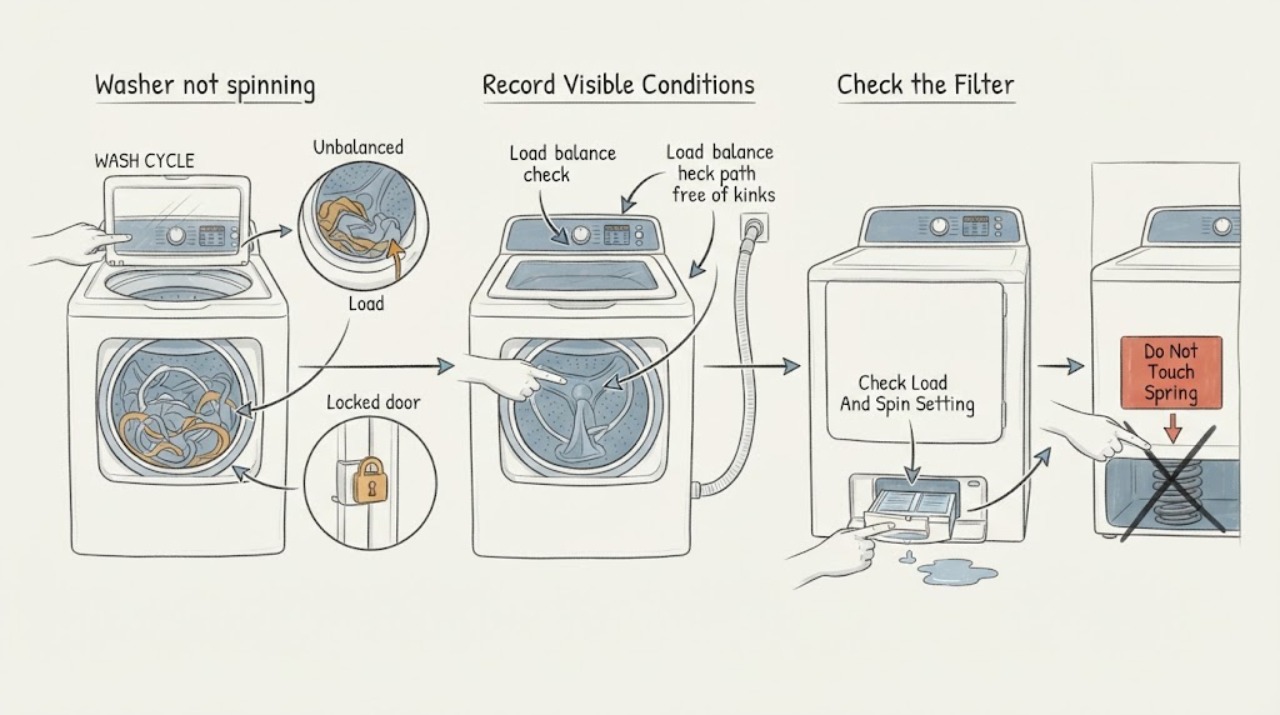
Stop and record the Samsung model, front-load or top-load type, selected cycle and spin setting, exact code or blinking lights, whether water remains, whether the door or lid is locked, and whether the drum never starts, stops mid-cycle, or spins slowly.
Expected result: The washer never moves to spin, begins to rotate and then stops, shows a no-drain or unbalanced-load indication, leaves clothes wet, or has no code but does not behave normally.
Next step: For water in the tub, start with the drain check. For a dry tub with a spin problem, continue to the load and installation checks. Keep the washer off for smoke, sparks, burning odor, an active leak, or violent movement.
Stop if: Do not force a locked door or lid, reach into a moving basket, or continue testing a washer with electrical, fire, leak, or severe mechanical symptoms.
Why this matters
Why: Samsung separates a no-spin-at-all problem from poor or interrupted spin. Drain status, unbalanced-load behavior, and model-specific code meanings determine the next safe check; a code or blinking pattern should not be interpreted across models without the manual.
-
Check 2
If water remains or the washer never reaches spin, check the visible drain hose and household drain. On a front-load Samsung model with an applicable pump-filter panel, wait for hot water to cool, use the model's emergency drain hose if provided, and clean and reinstall the filter exactly as the manual directs; skip this filter procedure on top-load models.
Expected result: Water remains, the drain hose is kinked or blocked, the household drain backs up, a front-load filter contains debris, the filter is not secure, or drainage is clear and the applicable filter is clean.
Next step: Correct only an obvious visible hose issue and clean a matching front-load filter through the model procedure. Reassemble the filter and cap securely, then perform one approved drain or spin test. Arrange service if water remains or the path is inaccessible.
Stop if: Do not open a filter after a hot cycle, remove a top-load cabinet to search for one, force a cap, probe the pump, tip the washer, or operate with standing water that cannot be contained safely.
Why this matters
Why: Samsung says the washer attempts to drain before spin, and a blocked filter or drain path can prevent the spin step. The pump-filter check is front-load-only, while a clear drain path shifts concern toward balance, lock, calibration, motor, or control.
-
Check 3
After the basket stops and the door or lid safely releases, inspect the load and selected cycle. Untangle and redistribute clothing, avoid a tightly packed tub or a single bulky item, and verify that Low Spin or No Spin was not selected for a load that needs more water extraction.
Expected result: The load is bunched, overloaded, very small, a single absorbent blanket or sheet, the cycle is not suited to the load, or the load is balanced and the spin setting is appropriate.
Next step: Redistribute or reduce the load, select the model-recommended cycle and spin setting, and run one small supervised test. If the washer still will not spin or repeatedly becomes unbalanced with ordinary loads, stop and arrange service.
Stop if: Do not open the lid or door while the drum is moving, add more laundry to a locked machine, hold the basket, or continue a violent spin.
Why this matters
Why: Samsung links load size, tangled large items, incorrect cycle, and unbalanced weight to slow, stopped, or reduced spin. An appropriate load with the same failure makes a mechanical, drain, level, or control issue more likely.
-
Check 4
From outside the appliance, check that the floor is stable, all applicable feet contact the floor, the washer does not rock, and a front-load installation has no unremoved shipping bolts. If the washer is on a pedestal or riser, compare its mounting and leveling with the installation instructions.
Expected result: The washer rocks, a foot or pedestal is loose, the floor is slippery or damaged, shipping bolts were not confirmed removed, or the installation is stable and model-correct.
Next step: Correct only an obvious external leveling or installation condition using the exact Samsung manual; then test with a small balanced load. Do not guess at shipping-bolt removal or move a water-filled appliance. Arrange service when stability cannot be restored.
Stop if: Do not lift, tilt, jack, place the washer on an improvised platform, remove hardware by guesswork, or continue with violent walking or cabinet impact.
Why this matters
Why: Samsung says an unlevel or unstable washer can reduce spin or cause vibration, and shipping bolts left in a front-load machine can cause severe shaking. Stable installation with persistent no-spin shifts concern to drain, lock, calibration, motor, or control.
-
Check 5
If the drain path, applicable filter, load, spin setting, and installation are correct, run the model-supported Calibration mode only with an empty washer and only as the owner's manual specifies. Observe whether the tub rotates through calibration and whether the washer then completes one safe test cycle.
Expected result: Calibration is not supported, the model's controls differ, the empty tub rotates and spin returns, the tub does not rotate, or the original no-spin behavior returns.
Next step: If calibration fails or the symptom returns, leave the washer off and arrange qualified Samsung appliance service. Provide the model, code, water level, filter and hose results, load, level, calibration behavior, and any unusual noise or leak.
Stop if: Do not repeat calibration continuously, open the cabinet, bypass a lock, perform live electrical testing, or operate after smoke, sparks, burning odor, a leak, or violent movement.
Why this matters
Why: Samsung says calibration is model-specific and must be empty; a successful rotation can correct weight-detection behavior, but failure to rotate or a returning symptom points toward an unresolved drain, motor, control, lock, or mechanical fault.
Use your observations
Decision map
Find the observation that best matches what you see, then follow the next safe action.
-
PATH 01Safety boundary
What you see
Water remains in the tub, a no-drain code appears, the pump filter is dirty on an applicable front-loader, or the drain hose or household drain is kinked or blocked.
Do this next
Follow the model drain-hose and, for a front-loader only, pump-filter procedure after water has cooled. Test once after secure reassembly; arrange service for persistent water, an inaccessible blockage, or a failed pump.
Why this path and its safety boundary
Why it matters: The washer may be stopping before spin because it cannot safely remove water.
Safety stop: Do not force the door, open a hot filter, tip the washer, reach into the pump, or use a cycle to move water through an unsafe leak.
-
PATH 02Safety boundary
What you see
The washer starts or retries spin with wet, tangled, overloaded, tiny, or bulky laundry, shows an unbalanced-load code, or stops after moving the load back and forth.
Do this next
When the basket stops, untangle and redistribute the load, avoid overloading or washing one absorbent bulky item alone, and use the cycle and spin setting suited to the load. Arrange service for repeated imbalance with ordinary loads.
Why this path and its safety boundary
Why it matters: The load distribution or cycle choice is more likely than an immediate motor failure; Samsung says an unbalanced retry can extend or stop the cycle.
Safety stop: Do not reach into a moving basket, keep adding water or laundry to correct balance, or continue with violent shaking.
-
PATH 03Safety boundary
What you see
The washer rocks, walks, vibrates severely, has a loose foot or pedestal, sits on an unstable floor, or is a newly installed front-loader with shipping bolts not confirmed removed.
Do this next
Use the exact Samsung installation instructions to level the feet and verify shipping-material and pedestal requirements. Test with a small balanced load only after the machine is stable; service is needed when it cannot be safely leveled.
Why this path and its safety boundary
Why it matters: Installation stability or retained shipping material is more likely to prevent safe high-speed spin.
Safety stop: Do not lift, tilt, jack, or move a water-filled washer, remove bolts by guesswork, or operate while it strikes the cabinet or walks.
-
PATH 04Safety boundary
What you see
The door or lid does not close or lock, a door-related code appears, Child Lock or a model safety state is active, or the washer will not proceed despite clear drain and load checks.
Do this next
Remove only visible clothing or debris blocking closure, confirm the model's lock or Child Lock state, and follow the manual's cancel or reset procedure once. Arrange service for a damaged latch, returning code, or door that remains locked after water is safely gone.
Why this path and its safety boundary
Why it matters: Samsung uses the lock to contain water and prevent access while unsafe; a lock condition can stop the cycle before spin and code meanings vary by model.
Safety stop: Do not pry the door or lid, insert tools into the latch, bypass the lock, or reach into the tub through an unlocked or moving opening.
-
PATH 05Safety boundary
What you see
The washer is empty, drains, is level, and has a suitable installation, but the model-supported calibration does not rotate the tub or the no-spin symptom returns immediately after calibration.
Do this next
Stop repeating calibration and arrange qualified Samsung appliance service. Share the exact model and code, the empty calibration result, drain and filter checks, and any sound or vibration.
Why this path and its safety boundary
Why it matters: Weight detection may not be the only issue; a motor, drive, control, sensor, lock, or mechanical fault remains possible.
Safety stop: Do not open the cabinet, measure live wiring, bypass sensors, or substitute a calibration sequence from another model.
-
PATH 06Safety boundary
What you see
No spin persists with a clear drain, secure applicable filter, balanced load, stable installation, and correct cycle, or the washer has grinding, smoke, burning odor, sparks, a hot cord, a leak, or violent movement.
Do this next
Keep the washer off and arrange qualified appliance service. For smoke or fire, leave the area and seek emergency help; otherwise isolate power only from a dry safe location without touching wet equipment.
Why this path and its safety boundary
Why it matters: An internal pump, motor, drive, bearing, suspension, control, wiring, or structural problem is more likely than a user-adjustable condition; the safety symptoms require immediate isolation.
Safety stop: Do not restart to reproduce the failure, open the cabinet, handle a wet or hot cord, bypass a lock, or continue operation with smoke, sparks, burning, leak, or violent movement.
Helpful context
Understand the symptom
No spin and poor spin are different symptoms
If the drum never begins to rotate, Samsung directs owners toward the drain path, applicable front-load pump filter, drain-hose installation, and model-supported calibration before service. If the washer starts but slows, retries, or leaves clothes wet, load balance, cycle choice, level, or standing water becomes more important. Write down the stage and any display code rather than treating every blinking light or pause as a motor failure.
Drain status comes before spin
Samsung explains that a washer tries to drain before spinning. A clogged front-load debris filter, a kinked hose, a household drain restriction, or incorrect hose routing can therefore look like a spin failure. Top-load models do not have the same removable pump-filter procedure. If water remains, handle it according to the model manual and water temperature before attempting a test.
Balance and installation control high-speed movement
Sheets, blankets, a single heavy item, a tangled small load, or an overloaded tub can move the weight to one side and cause the washer to reduce or stop spin. An unlevel floor or loose foot can do the same. Front-load units also require shipping materials to be removed. Redistribute clothing only when the basket has stopped, and make installation changes only from the exact Samsung instructions.
Calibration is optional and model-specific
Samsung provides a calibration mode on some washers to relearn load weight. The machine must be empty, the button combination varies by model, and a calibration run rotates the tub for a short period. Use it only if the owner's manual supports it. If the tub will not rotate during the model-approved calibration, stop troubleshooting and arrange service rather than repeating cycles or opening the cabinet.
Safety boundary
Stop conditions
- Stop for smoke, fire, sparks, a burning smell, a hot or melted cord or receptacle, an active leak, violent shaking, or cabinet impact; isolate power only from a dry safe location and arrange qualified help.
- If water may be hot from a recent hot, Pure Cycle, or Sanitize cycle, do not open drain or pump-filter access until it has cooled; do not force a locked door or lid.
- Do not reach into a moving basket, bypass a door or lid lock, open the cabinet, perform live electrical testing, tip or lift a water-filled washer, or probe an internal pump.
- Do not apply a calibration sequence, shipping-bolt procedure, filter procedure, or error-code interpretation from another Samsung model; follow the exact owner's manual.
- Arrange qualified Samsung appliance service for a returning no-spin or unbalanced code, water that remains after the visible drain path and applicable filter are clear, failed model calibration, inaccessible obstruction, damaged lock, or any internal repair need.
Only after diagnosis
Potential parts
- Samsung front-load washer pump filter or emergency-drain component
Consider this category only for a front-load model with the applicable access when safe cleaning finds a damaged filter, cap, or emergency-drain component that cannot seal or be secured.
Top-load models may not have a removable pump filter; confirm the exact model and filter design before ordering. - Samsung washer drain pump or internal drain hose
Consider this category only when the visible drain hose, household drain, and applicable filter are clear but water remains or an approved test shows the pump cannot move water.
Pump access and fit vary by model; verify the exact model and technician diagnosis before ordering or opening the cabinet. - Samsung washer suspension, motor, drive, or bearing component
Consider this category only when no-spin or severe vibration persists with a clear drain, balanced load, stable installation, and successful external checks and a technician identifies the component.
Do not infer a failed component from a symptom alone; confirm exact model fit and diagnosis through qualified service.
When checks do not resolve it
Need a professional?
Arrange qualified Samsung appliance service when the washer will not spin after the visible drain path, applicable front-load filter, load balance, spin setting, and installation checks; when it fails an empty model-supported calibration; when a door or lid lock, motor, drive, sensor, control, or inaccessible obstruction is suspected; or when a no-spin, no-drain, overflow, or unbalanced code returns. Keep the washer off for hot or standing water that cannot be handled safely, leaks, smoke, sparks, burning odor, a hot cord, violent movement, or cabinet impact, and provide the model, code, stage, water level, filter and hose results, load, level, calibration, and test-cycle behavior.
Safety scope: This article supports model identification, stopped-machine drain and load checks, applicable front-load pump-filter cleaning after cooling, external leveling observations, and model-supported empty calibration. It does not authorize cabinet disassembly, live electrical testing, lock bypass, internal pump or drive access, movement of a water-filled appliance, or operation after a hazardous symptom.
Common questions
FAQ
Why does my Samsung washer not spin at all?
Check whether water remains, because Samsung washers try to drain before spinning. On an applicable front-loader, inspect the pump filter after the water cools; on all models, check the drain hose, load balance, level, and door or lid lock. If an empty model-supported calibration does not rotate or the problem returns, arrange service.
Does every Samsung washer have a pump filter?
No. Samsung says the removable pump-filter procedure applies to front-load models; top-load models do not have that removable filter. Use the exact model manual rather than opening a top-load cabinet to search for one.
Can an unbalanced load stop a Samsung washer from spinning?
Yes. A tangled sheet or blanket, an overloaded tub, a very small load, or an unbalanced weight can make the washer slow, retry, or stop spin and leave clothes wet. Wait for the basket to stop, redistribute the load, and use the cycle and spin setting suited to it.
What do Samsung washer codes such as Ub, Ur, UE, or 5C mean?
Samsung lists Ub, Ur, UE, and related codes as unbalanced-load indications on applicable models, while 5C and similar codes indicate no-drain conditions. Code meanings and displays vary by model, so record the complete code and follow the owner's manual instead of applying a code from another washer.
Read the exact guide
Official sources
- Samsung washing machine information and error codesSamsung · Samsung washer no-drain, door, unbalanced-load, calibration, motor, voltage, and model-dependent error meanings
- Samsung washing machine spins poorlySamsung · Samsung washer poor or interrupted spin, load balance, drain, level, filter, calibration, and test-cycle guidance
- Samsung washing machine will not start or fill with waterSamsung · Samsung washer door-lock safety, emergency drain, child lock, and unlock behavior with water in the tub
- Samsung washing machine is shaking too muchSamsung · Samsung washer vibration, walking, load balance, floor, leveling, pedestal, and front-load shipping-bolt checks
- Samsung washing machine does not spin at allSamsung · Samsung washer no-spin-at-all, front-load filter applicability, drain-before-spin, hose, calibration, and service guidance
- How to clean your Samsung washerSamsung · Samsung front-load pump-filter, emergency-drain, cooling, cleaning, and secure reassembly procedure
- Samsung washing machine will not drainSamsung · Samsung washer no-drain, hose routing, level, front-load filter applicability, hot-water caution, and drain test
Community feedback
Share a repair observation
Share a plain-text repair observation. Accepted observations are published automatically; this page may take a moment to update.