
On this page
Start here
Quick answer
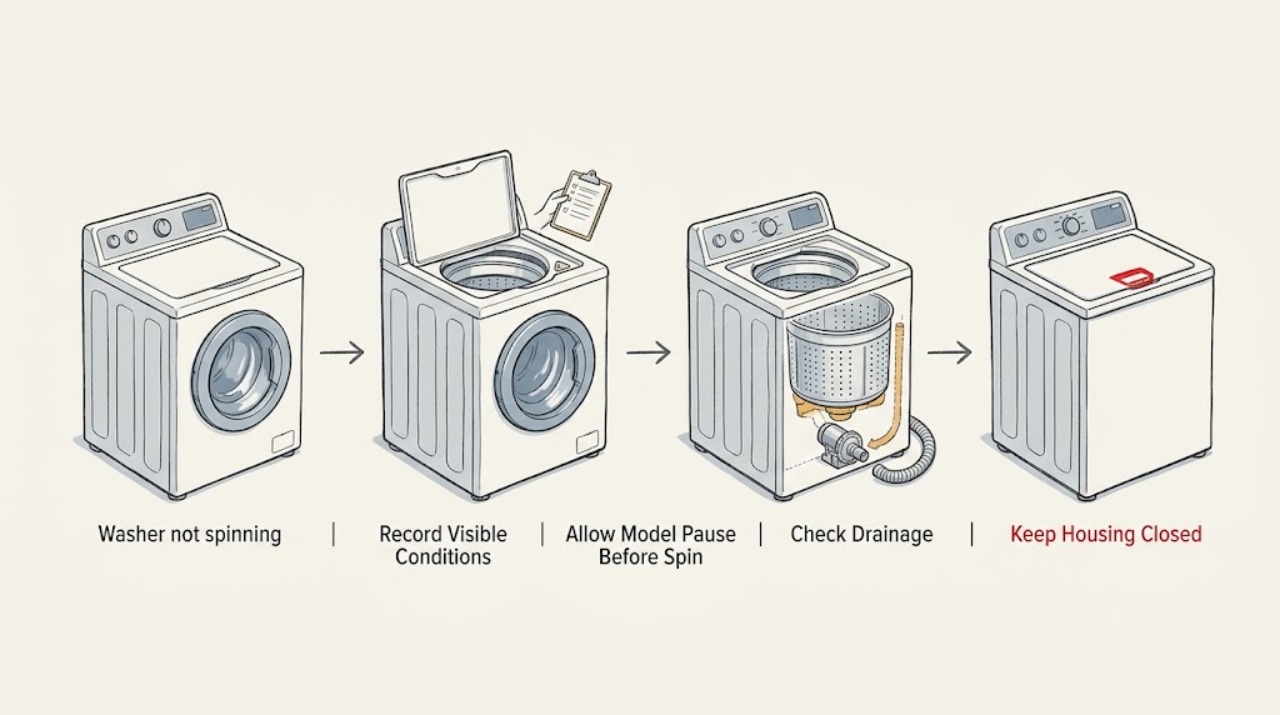
Record the GE model, top-load or front-load configuration, display code, and whether the tub is full of water, the load is simply wet, or the basket never moves. A washer may pause before pumping out and spinning, and a top-load washer may stop for an unbalanced load or an open lid. First check the lid or door state, load distribution, selected cycle, visible drain hose and household drain, and any model-specific pump-filter access. If the washer fills but does not spin, do not assume the motor or transmission is bad: a drain restriction, control or lock condition, or a model-specific motor reset may be involved. Do not reach into a moving basket, bypass a lid or door lock, open panels, or test live circuits. Stop for violent movement, smoke, scorching, sparking, water near electrical parts, a damaged cord, or a failed pump, and arrange GE service when the model-approved checks do not restore spin.
Before you begin
Safety first
- This article supports model identification, normal-pause observation, visible drain and hose checks, load and control checks, and a model-approved reset only when the owner's manual permits it. It does not authorize lock bypass, pump or panel access, live electrical testing, appliance movement, or operation after a water, fire, or electrical hazard.
Work through in order
Diagnostic checks
Use only checks that match the exact appliance or system and its official guide.
-
Check 1
With the GE washer stopped and safe to approach, record the full model, top-load or front-load configuration, exact display or indicator, selected cycle, and whether the tub is full, partly full, or empty with wet clothes.
Expected result: Classify the symptom as no basket movement, repeated spin-and-stop, a pause before spin, drain failure, wet load with an empty tub, lid or door lock, flashing Spin or balancing indicator, or loss of power.
Next step: Photograph the model label and display, then follow the matching drain, lid or door, load, power, or model-reset check without repeatedly restarting the cycle.
Stop if: Stop for smoke, burning smell, sparking, abnormal heat, water near electrical parts, a damaged cord, violent movement, or a basket striking the cabinet.
Why this matters
Why: These symptoms follow different paths. A full tub points toward drain-before-spin; an empty tub with wet clothes points toward balance or spin selection; a top-load or front-load code cannot be interpreted without its exact model.
-
Check 2
If the washer has just finished agitation or wash, wait through the pause described by the exact GE model and do not manually advance a mechanical timer while it is moving toward pump-out and spin.
Expected result: Record whether the pump starts, water leaves, the basket then accelerates, the washer repeats spin-and-pump-out, or no transition occurs after the model's normal pause.
Next step: Let one normal pause complete; if water remains, the sequence repeats, or no spin follows, move to the visible drain and load checks and arrange service if the problem persists.
Stop if: Do not manually force the timer, open a locked lid or door, or continue if the washer rocks violently, leaks, overheats, or makes a new metal-on-metal sound.
Why this matters
Why: GE explains that pauses before pump-out and spin can be normal, and a washer may briefly try to spin, detect remaining water, pump again, and then spin. A constant repeat or failure to drain is not a normal pause pattern.
-
Check 3
If water remains or the washer repeatedly tries to spin and stops, inspect the visible drain hose, standpipe or utility sink, and any model-approved pump-filter access while the washer is off; do not remove panels or reach into the pump.
Expected result: Record a kinked or crushed hose, clog, hose pushed too far or sealed into the standpipe, household drain backup, accessible filter with lint or foreign objects, pump hum without water movement, or a clear drain path.
Next step: Correct only an obvious visible hose-routing issue according to the exact installation guide; clean an accessible pump filter only when the owner's manual explicitly allows it, then service the washer if water remains.
Stop if: Do not seal the drain hose, pour drain chemicals into the washer or standpipe, open the pump, tip or move a water-filled washer, or work near wet electrical parts.
Why this matters
Why: GE states that newer washers drain through a separate pump before spin and that a hose, standpipe, plumbing, or pump-filter restriction can prevent spin. A full tub with only a hum may require service rather than a user-accessible fix.
-
Check 4
Verify from outside that the top-load lid or front-load door is fully closed and the model's control or dispenser state allows a spin; do not bypass the lock or reach into the basket.
Expected result: Record an open lid or door, lock indicator, dispenser drawer not fully closed on an applicable front-load model, an options knob between settings, a paused cycle, or a control that does not respond.
Next step: Close and latch the lid or door normally, return controls to a documented setting, and use the exact manual's restart step once; if the lock or control still prevents spin, arrange service.
Stop if: Do not tape, wedge, magnetically defeat, or otherwise bypass the lid or door lock, and do not open the console or panel.
Why this matters
Why: GE's front-load guidance says an incompletely closed dispenser drawer can prevent spin, while top-load guidance links lid state, options position, and pause codes to no-spin behavior. A lock that will not engage or a control that will not respond needs service.
-
Check 5
With the basket fully stopped, inspect whether the load is too small, overloaded, tightly packed, or gathered to one side, and confirm that the selected cycle permits the expected spin speed.
Expected result: Record a single bulky item, a very small load, a heavy or uneven load, a gentle or low-spin cycle, a flashing Spin or balancing indicator, or balanced loading with the correct cycle.
Next step: Redistribute or reduce the load, add compatible items only when the manual permits, and select the model-approved Drain and Spin or spin option; stop if the washer remains unstable.
Stop if: Do not add water to balance a load, force a high-speed cycle through violent movement, or reach into the basket while it is moving.
Why this matters
Why: GE and its model guidance link out-of-balance or unsuitable load size to a stopped spin, and gentle cycles can leave more water without indicating a failed motor. A balanced normal load that still does not spin points elsewhere.
-
Check 6
If the washer fills but does not agitate or spin, check the exact GE specifications and owner's manual to determine whether the top-load unit has the Hydrowave system or another documented reset path; do not perform a reset from a generic video or model family.
Expected result: Record a confirmed model-specific Hydrowave or reset instruction, a normal power interruption, a recurring fault after reset, or no matching reset guidance.
Next step: Perform a model-approved reset once only when there is no water or electrical hazard and the manual permits it; if spin does not return or the fault recurs, keep the washer off and arrange service.
Stop if: Do not open panels, test live voltage, bypass a lid lock, repeat resets to mask a fault, or use a reset procedure on an unconfirmed model.
Why this matters
Why: GE limits its Hydrowave motor-reset procedure to specified top-load systems and says service is needed if the washer still fails or stops again. A reset cannot establish that a motor, control, lid lock, or drive component is healthy.
-
Check 7
After one safe visible correction or model-approved reset, document whether the washer drains and spins normally, spins only empty, repeats the fault, or remains still, and preserve a short recording from a safe distance.
Expected result: Classify the result as restored spin, intermittent spin, drain failure, motor running with basket still, no motor response, recurring code, leak, abnormal movement, or unsafe to retry.
Next step: Request qualified GE service with the model, display, stage, water level, load, drain findings, reset status, and recording; do not order a drive or control part from the symptom alone.
Stop if: Keep the washer out of service for smoke, sparking, burning odor, abnormal heat, water near electrical parts, damaged cord, violent movement, or a basket that rubs or strikes.
Why this matters
Why: A persistent no-spin condition after drain, lock, load, control, and applicable reset checks points toward the motor, clutch, belt, bearing, suspension, pump, control, wiring, or another model-specific fault.
Use your observations
Decision map
Find the observation that best matches what you see, then follow the next safe action.
-
PATH 01Safety boundary
What you see
The washer pauses briefly after agitation, then pumps out and spins, or makes a documented drain or spin transition sound without a fault or unstable movement.
Do this next
Allow the exact model's cycle to continue and monitor; investigate if the pause becomes continuous, water remains, or spin never follows.
Why this path and its safety boundary
Why it matters: The pause or transition may be normal for the model. GE warns that manually advancing a timer can skip the pump-out portion, and a washer may pump more than once before spin.
Safety stop: Do not force the timer, open a locked lid or door, or dismiss a new sound with leaks, smoke, heat, or violent movement.
-
PATH 02Safety boundary
What you see
Water remains in the tub, the pump hums without moving water, the washer repeats spin-and-pump-out, or a hose, standpipe, plumbing, or applicable pump filter is restricted.
Do this next
Check visible hose and household drain routing and the exact model's accessible filter procedure; request plumbing or appliance service when water remains or the pump path is internal.
Why this path and its safety boundary
Why it matters: The drain path is more likely than a pure spin-drive failure because GE washers generally pump water out before spinning.
Safety stop: Do not open the pump, pour chemicals into the drain, seal the hose, move a water-filled washer, or work near electrical parts.
-
PATH 03Safety boundary
What you see
The tub is mostly empty but clothes are wet, and the load is uneven, too small or large, a balancing indicator is active, or a gentle or low-spin cycle was selected.
Do this next
Redistribute or adjust the load within the manual's guidance and select an appropriate spin option; service the washer if a balanced normal load still does not spin.
Why this path and its safety boundary
Why it matters: Load sensing and the selected cycle can explain the no-spin or wet-load symptom without proving motor failure.
Safety stop: Do not run through violent rocking, add water to balance, or reach into a moving basket.
-
PATH 04Safety boundary
What you see
The lid or door is not latched, a lock or dispenser state is wrong, a top-load option control is between settings, or the washer has lost power or shows a documented pause code.
Do this next
Restore only a normal documented lid, door, control, or power condition from a dry safe position; arrange service for a failed lock, control, outlet, or recurring power interruption.
Why this path and its safety boundary
Why it matters: A safety interlock, control selection, or power condition can prevent spin before any drive component is blamed.
Safety stop: Do not bypass the lock, open panels, test live circuits, use an extension cord, or reset a breaker repeatedly after a fault.
-
PATH 05Safety boundary
What you see
The washer drains, the load is balanced, the lid or door and controls are normal, and any confirmed model-approved reset does not restore spin; the motor runs with a still basket or no drive response occurs.
Do this next
Keep the washer off and request qualified GE diagnosis with the model, cycle stage, sound, drain result, load, reset status, and recording.
Why this path and its safety boundary
Why it matters: A motor, clutch, belt, bearing, suspension, control, wiring, or other model-specific drive fault is more likely and cannot be safely confirmed by external checks.
Safety stop: Do not open panels, test live voltage, reach beneath the tub, bypass a lock, or replace a drive part by guesswork.
Helpful context
Understand the symptom
First decide whether the washer is not spinning or not draining
A GE washer normally pumps out water before high-speed spin on newer designs. If the tub remains full, the drain path or pump takes priority. If the tub is empty but clothes are wet, check load balance, cycle selection, and spin behavior. If the motor runs but the basket never turns, stop treating it as a simple load problem and prepare for model-specific service.
Front-load and top-load paths are not interchangeable
GE publishes separate no-spin guidance for front-load and top-load washers. Front-load models may have an accessible pump filter and a dispenser-drawer or door condition; top-load models may use a lid lock, balance sensing, an options control, or a Hydrowave-specific motor reset. Use the exact owner's manual before attempting any reset or filter procedure.
Protect the locked basket and electrical system
A door or lid can remain locked while water is present or while the basket is moving. Do not force it open or reach inside. Keep water away from the outlet, plug, controls, and wiring; panel removal, pump access, drive diagnosis, and live electrical testing belong to qualified service.
Safety boundary
Stop conditions
- Do not reach into a moving basket, force a locked lid or door, bypass an interlock, place hands under the cabinet, or move a water-filled washer alone.
- Do not open panels, test live voltage, reach into a pump, replace a motor, clutch, belt, bearing, suspension, or control by guesswork, or use an unconfirmed reset procedure.
- Do not seal or tape the drain hose, pour drain chemicals into the washer or standpipe, or repeatedly run cycles with standing water.
- Stop for smoke, burning smell, sparking, abnormal heat, water near the outlet, plug, controls, or wiring, a damaged cord, violent rocking, or a basket that rubs or strikes.
- Do not apply front-load filter or drain instructions to a top-load model, or interpret a GE no-spin code without matching the exact model and configuration.
Only after diagnosis
Potential parts
- drain pump or pump filter assembly
Consider this category only when the exact model permits filter access and service confirms a blocked, damaged, or failed drain component after visible hose and standpipe checks.
Confirm full GE model and pump or filter design; do not order from a no-spin symptom or apply a front-load filter procedure to a different configuration. - lid or door lock assembly
Consider this category only when model-specific diagnosis confirms the lock or latch is preventing a safe spin after the lid or door is clean, aligned, and normally closed.
Match exact GE model and lock design; never bypass the lock or substitute a part based on a no-spin symptom alone. - drive motor or clutch assembly
Consider this category only when the washer drains, load and controls are normal, and qualified diagnosis confirms a motor, clutch, or drive fault.
Confirm full GE model, drive platform, revision, and service diagnosis; model-specific reset behavior does not prove a failed part. - belt, bearing, or suspension component
Consider this category only when persistent speed-related noise, a still basket with motor response, excessive movement, or bearing or suspension symptoms are confirmed by qualified diagnosis.
Verify the exact GE model and assembly design before ordering; installation normally requires qualified service and must not be inferred from a wet load alone.
When checks do not resolve it
Need a professional?
Arrange qualified GE appliance service when the washer still does not spin after the exact model's pause, drain, lid or door, load, control, and applicable reset checks; when the pump hums without moving water, the motor runs with a still basket, a code returns, or diagnosis requires pump, drive, suspension, bearing, control, wiring, panel, or live electrical access. Contact a plumber for a blocked household standpipe. Treat water near electrical parts, smoke, sparking, burning smell, abnormal heat, damaged cord, violent movement, or a rubbing basket as immediate stop-use conditions.
Safety scope: This article supports model identification, normal-pause observation, visible drain and hose checks, load and control checks, and a model-approved reset only when the owner's manual permits it. It does not authorize lock bypass, pump or panel access, live electrical testing, appliance movement, or operation after a water, fire, or electrical hazard.
Common questions
FAQ
Why is my GE washer not spinning?
First distinguish a full tub from a wet load with an empty tub. Possible paths include a normal pause, incomplete draining, a kinked hose or blocked standpipe, pump filter, unbalanced load, low-spin cycle, lid or door lock, dispenser or control state, power, a model-specific motor reset condition, or a drive fault.
Why does my GE washer spin and stop repeatedly?
GE explains that newer washers pump water out before spin and may repeat spin and pump-out attempts while water remains. Check the exact model's visible drain path and accessible filter guidance; constant difficulty draining and spinning needs service.
Can an unbalanced load stop a GE washer from spinning?
Yes. GE's top-load and front-load guidance links uneven, overloaded, or very small loads to stopped or poor spin. With the basket stopped, redistribute or adjust the load according to the model guide, and stop if the washer rocks violently or remains unstable.
Should I reset the motor on a GE washer that will not spin?
Only if the exact top-load model is confirmed to use the Hydrowave system and its GE instructions provide that reset. GE limits the procedure to that model family and recommends service when the washer still fails or stops again.
Why is my GE front-load washer door still locked when it will not spin?
Water remaining in the washer can keep a front-load door locked for safety. Do not force or bypass it. Follow the exact model's safe drain or cancel instructions and arrange service if water remains, the lock fails, or the pump does not move water.
When should I call for GE washer no-spin service?
Call when the washer drains, the load is balanced, the lid or door and controls are normal, and the basket still does not spin; when a pump hums without movement, a code returns, or diagnosis requires pump, drive, suspension, control, wiring, panel, or live electrical access. Stop for smoke, sparking, heat, leaks near electricity, a damaged cord, or violent movement.
Read the exact guide
Official sources
- Washer - Spins and Stops RepeatedlyGE Appliances · Official GE Appliances article describing newer washer drain-pump behavior and repeated spin-and-pump-out symptoms; exact model controls the application.
- Front Load Washer - Does Not SpinGE Appliances · Official GE Appliances support article for front-load washers; use only as a model-family comparison and follow the exact GE owner's manual.
- Top Load Washer - Hydrowave Motor ResetGE Appliances · Official GE Appliances support article limited to top-load washers equipped with the Hydrowave system; verify the exact model before any reset.
- Top Load Washer - Does Not SpinGE Appliances · Official GE Appliances support article for top-load washers; code and control behavior are model-specific.
- Top Load Washer - Will Not DrainGE Appliances · Official GE Appliances support article for top-load washers; model-specific installation instructions control drain routing and access.
- Front Load Washer - TroubleshootingGE Appliances · Official GE Appliances troubleshooting article for front-load washers; filter access and all procedures depend on the exact model manual.
Community feedback
Share a repair observation
Share a plain-text repair observation. Accepted observations are published automatically; this page may take a moment to update.