
On this page
Start here
Quick answer
If an Amana washer leaves clothes wet or does not enter spin, first determine whether water remains, which cycle and phase stopped, whether Low Spin or No Spin was selected, and whether the lid or door is securely closed and locked. Amana says an unbalanced load can reduce or stop spin, low or no spin settings remove less water, bulky items may need a different cycle, a standing tub points to the drain hose or drainpipe, and an unlevel washer can spin incorrectly. Keep hands out of a moving basket, never bypass the lid lock, and do not open panels or test live parts. If the washer leaks, trips a breaker, smells burnt, moves violently, or still will not spin after one safe model-approved check, keep it off and arrange qualified appliance service.
Before you begin
Safety first
- This article supports ordinary-access observation and model-directed controls only. Do not reach into moving parts, bypass safety interlocks, force a locked lid or door, tip or slide the washer, disconnect pressurized hoses, open panels, or test live electrical components.
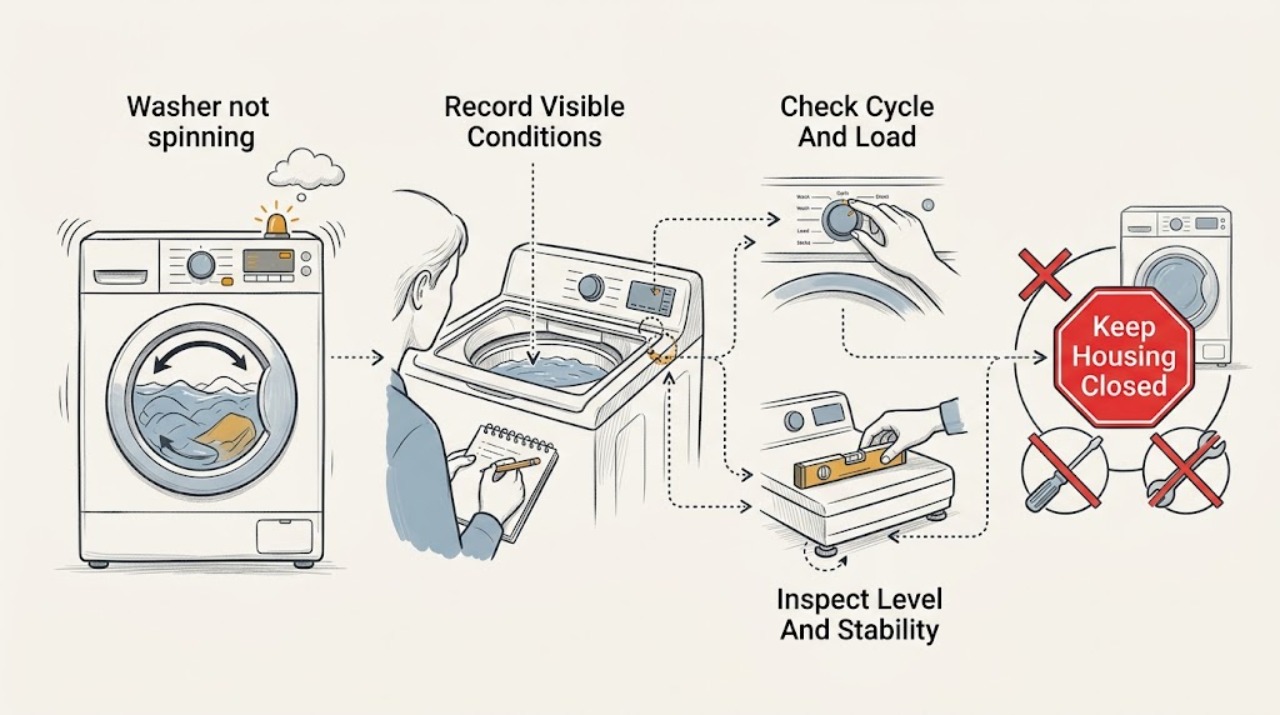
Work through in order
Diagnostic checks
Use only checks that match the exact appliance or system and its official guide.
-
Check 1
From outside the Amana washer, record the complete model number, selected cycle and spin option, the phase where it stopped, whether water remains, and whether the basket turns during sensing or agitation.
Expected result: Note wet clothes with an empty tub versus a full or partly full tub, lid-lock or door-lock light behavior, displayed codes, pump sounds, and whether the symptom repeats with different loads.
Next step: Photograph the model label and controls and continue only if the washer is stable, dry, and free of heat, smoke, electrical odor, or leaks.
Stop if: Stop for smoke, burning or electrical odor, sparking, a hot plug, water near electrical parts, violent movement, or an unsafe locked lid or door.
Why this matters
Why: Wet clothes with no standing water can reflect a low/no-spin setting or imbalance; standing water points to a drain path or pump-out issue that may prevent effective spin. A code or lock symptom must be interpreted for the exact model.
-
Check 2
With the washer fully stopped, check whether Low Spin or No Spin was selected and whether the load is bunched, a single heavy item, or bulky bedding that does not suit the selected cycle.
Expected result: Record whether clothes are evenly distributed, whether the basket or cabinet was shaking at spin, and whether the no-spin symptom disappears after a safe redistribution or a model-approved bulky-item cycle.
Next step: Redistribute or reduce the load only with the machine stopped; select the exact recommended spin and cycle settings, then plan one supervised verification.
Stop if: Do not reach into a moving basket, hold the washer during movement, overload it, or continue if it walks, strikes objects, or leaks.
Why this matters
Why: Amana says lower spin speeds remove less water, and an out-of-balance load can reduce or stop spin, create vibration, and leave clothes wet. Bulky items can require a designated cycle; this does not prove an internal fault is absent.
-
Check 3
From a safe position, check that the Amana washer stands firmly on all feet and compare its level with the exact installation instructions; do not slide or tip the appliance.
Expected result: Note rocking when not running, a visibly sloped cabinet, excessive vibration only as spin rises, or a problem that remains with a balanced load and stable installation.
Next step: Correct leveling only with the model installation procedure or arrange service; do not use repeated high-speed cycles to test stability.
Stop if: Stop if the washer moves violently, threatens nearby objects, has a damaged cord or hose, or requires moving it into a wet area.
Why this matters
Why: Amana says the washer must be level because an unlevel machine can create imbalance, noise, vibration, and incorrect spinning. Persistent no-spin on a level, balanced machine needs a different branch.
-
Check 4
If water remains, inspect the visible drain hose, its model-specific support, and the standpipe or utility-sink opening from a dry, accessible position.
Expected result: Look for a kink, crush, clog, unsupported hose, water backing up in the receptacle, or a hose installation that differs from the model instructions; note whether other fixtures also drain slowly.
Next step: Restore accessible hose routing only as the exact manual allows and arrange plumbing service for a backing-up household drain; arrange appliance service for a damaged hose or persistent no-spin.
Stop if: Do not disconnect a pressurized hose, run cycles into a backing-up drain, enter standing water near electricity, or pull the washer forward to reach hidden plumbing.
Why this matters
Why: Amana links standing water with drain-hose installation and says a kinked or clogged hose or obstructed utility-sink drain can reduce water flow. A shared backup is more likely a household drain issue than a spin-drive fault.
-
Check 5
With the washer stopped, verify that the lid or door closes and latches without clothing, packing material, or visible soil interfering; clean only the external contact area as the Amana guidance permits.
Expected result: Record whether the lock light engages, flashes, clicks through a brief self-test, or remains unable to lock; note whether the basket is fully stopped before opening.
Next step: Remove only visible external debris, close the lid or door normally, and use the exact model manual for any lock indicator; arrange service if the lock remains unreliable.
Stop if: Never hold down the lid switch, bypass the lock, force a locked lid or door, or reach into a basket that may start moving.
Why this matters
Why: Amana says the lid must be closed and latched for many top-load models to advance through spin, and visible interference or buildup can prevent latching. A lock symptom is not a reason to bypass the safety device.
-
Check 6
Ask whether a power interruption, tripped breaker, or control reset occurred during the spin phase and inspect the outlet and cord only from a dry, safe position.
Expected result: Note a recent outage, controls that reset, a breaker that tripped again, a hot outlet or plug, or a washer that powers normally but still will not ramp up to spin.
Next step: If there is no safety symptom, follow only the exact model's documented restart procedure and make one supervised verification; arrange service for repeat interruption or no-spin.
Stop if: Stop for a hot plug or outlet, burning odor, sparking, damaged cord, water near electricity, or another breaker trip. Do not reset a tripping circuit repeatedly.
Why this matters
Why: Amana says a power failure during spin can prevent the washer from reaching full spin speed. A repeated breaker or heat symptom is an electrical safety issue, not a reset invitation.
-
Check 7
After one safe correction to load, setting, level, drain path, or latch, run one supervised model-approved Drain & Spin or comparable cycle with hands and loose objects away from the washer.
Expected result: Record whether the basket accelerates, clothes are less wet, water drains, the lock behaves normally, and any code, leak, noise, odor, heat, or violent movement returns.
Next step: Keep the model, phase, options, water level, lock behavior, and test result for qualified appliance service; use plumbing service if the household drain backs up.
Stop if: Stop immediately for leak, smoke, burning odor, electrical symptom, violent movement, harsh mechanical noise, or a returning no-spin condition.
Why this matters
Why: A successful result supports the corrected external condition but does not identify or clear internal components. A repeat no-spin after safe checks moves the problem beyond ordinary user troubleshooting.
Use your observations
Decision map
Find the observation that best matches what you see, then follow the next safe action.
-
PATH 01Safety boundary
What you see
The tub is empty after the cycle, clothes are wet rather than soaked, and Low Spin or No Spin was selected.
Do this next
Use the garment-appropriate spin setting from the exact cycle guide and perform one supervised verification; service the washer if it still refuses normal spin.
Why this path and its safety boundary
Why it matters: The selected spin setting is more likely than a failed drive component.
Safety stop: Do not select a higher speed for items the garment instructions do not permit.
-
PATH 02Safety boundary
What you see
Spin starts slowly, shakes, stops, or leaves wet clothes with a bunched load, single heavy item, or bedding and the washer is otherwise stable.
Do this next
Stop fully, redistribute or reduce the load, use the designated bulky-item cycle where the manual calls for it, and verify once.
Why this path and its safety boundary
Why it matters: Load distribution or cycle suitability is more likely than a motor or control fault.
Safety stop: Do not hold a moving washer or continue if it walks, strikes objects, or leaks.
-
PATH 03Safety boundary
What you see
Water remains in the tub, the drain receptacle backs up, or the visible drain hose is kinked, clogged, unsupported, or incorrectly installed.
Do this next
Correct only accessible hose routing under the exact instructions and use plumbing service for a shared or backing-up drain; arrange appliance service if the hose and receptacle are clear.
Why this path and its safety boundary
Why it matters: Water removal or household drainage is more likely to be limiting spin.
Safety stop: Do not run repeated cycles into a backup or work around wet electrical equipment.
-
PATH 04Safety boundary
What you see
The washer does not advance into spin and the lid or door will not latch, the lock light flashes, or visible clothing or buildup interferes.
Do this next
Clear only visible external interference, close the lid normally, and follow the exact model indicator procedure; arrange service if locking remains unreliable.
Why this path and its safety boundary
Why it matters: The safety interlock or its contact area is more likely than an unbalanced load, but the lock cannot be bypassed to prove it.
Safety stop: Do not defeat the lock, force the lid, or reach into a moving basket.
-
PATH 05Safety boundary
What you see
The washer lost power during spin, controls reset, and there is no hot plug, odor, sparking, leak, or repeat breaker trip.
Do this next
Follow one model-approved restart or verification and service the washer if spin does not return or power symptoms recur.
Why this path and its safety boundary
Why it matters: The interruption may explain why the washer did not ramp to full speed, but it does not explain a recurring no-spin condition.
Safety stop: Do not repeatedly reset a tripping breaker or touch a wet or hot outlet.
-
PATH 06Safety boundary
What you see
The load, setting, level, drain path, latch, and one supervised verification are normal, yet the washer still will not spin, or it has a leak, violent movement, abnormal noise, heat, odor, or electrical symptom.
Do this next
Keep the washer off, isolate water or power only from a dry safe location when appropriate, and arrange qualified appliance service.
Why this path and its safety boundary
Why it matters: An internal drive, motor, suspension, pump, control, lock, or another model-specific fault requires diagnosis; user observations cannot select a part reliably.
Safety stop: Do not open panels, test live parts, operate with a bypassed lock, or continue cycles to reproduce the fault.
Helpful context
Understand the symptom
Separate wet clothes from a true no-spin fault
Wet laundry does not always mean the basket never spun. Note whether the tub is empty or still holds water, whether the basket turns during sensing or agitation, and whether the problem occurs only at final spin. A selected Low Spin or No Spin option can leave more water in the load, while a major imbalance can make the control reduce or stop spin. Record the complete model number, cycle, options, lights, and any code before changing settings.
Start with load and cycle conditions
An uneven load can make the basket shake, reduce spin speed, extend the cycle, or stop spin while the washer attempts to redistribute items. Amana also calls out bedding, sheets, coats, blankets, and other bulky items as cycle-sensitive. Stop the machine fully, redistribute or reduce the load, and choose only the cycle and spin speed permitted by the garment labels and the exact cycle guide.
Check water removal before blaming the drive
A washer may decline to spin or leave clothes wet when water has not been removed. From a dry, safe position, look for a kinked or clogged drain hose, an obstructed utility-sink drain, or drain-hose installation that does not match the model instructions. Amana's top-load page lists a U-shaped hose form, limited hose insertion, and standpipe height requirements for the applicable models; do not transfer those dimensions to another design without its manual.
Respect the lid-lock boundary
A lid or door lock is part of the spin safety system. A lid that looks closed may not be latched because clothing, packing material, or buildup interferes with the latch. Amana says some models run a brief lock self-test and that features vary. Clean only visible external buildup with the model-approved method; never hold the lid switch, bypass the lock, or reach into a basket that may move.
One supervised verification, then service
After one low-risk correction, use one short, model-approved Drain & Spin or comparable test while watching from outside. A successful spin supports the corrected load, setting, level, or drain condition but does not prove the motor, suspension, pump, lid lock, or control is healthy. Repeated no-spin, a returning code, standing water, or any safety symptom is a service boundary.
Safety boundary
Stop conditions
- Stop for smoke, burning or electrical odor, sparking, a hot plug or outlet, repeated breaker trips, water near electrical parts, or a damaged cord.
- Do not reach into a moving basket, bypass a lid or door lock, hold a safety switch, open panels, or probe live wiring.
- Do not force a locked lid or door, tip or slide the washer, disconnect pressurized hoses, or enter standing water near electricity.
- Stop a washer that walks, shakes violently, strikes nearby objects, leaks, makes harsh mechanical noise, or develops abnormal heat.
- Do not transfer spin settings, hose dimensions, lock procedures, or component assumptions from another Amana model; use the complete model manual.
- After one safe, model-approved correction and supervised verification, arrange service for repeat no-spin, standing water, recurring codes, an unreliable lock, or any unexplained fault.
Only after diagnosis
Potential parts
- lid lock or lid-latch assembly
Consider this category only after visible latch interference is cleared and qualified diagnosis confirms that the lock or latch prevents the cycle from entering spin.
Confirm the complete Amana model and lock/latch design; do not bypass the safety device or infer fit from another model. - drain pump or drain hose
Consider this category only when the household drain and visible hose are clear or correctly routed, standing water persists, and diagnosis links the flow problem to the pump or hose.
Confirm the complete Amana model, hose ends, pump configuration, electrical specification, and service procedure. - motor, drive, or suspension component
Consider this category only after load, setting, level, drain, and lock checks are normal and qualified diagnosis identifies an internal no-spin cause.
Confirm the complete Amana model, component position, mechanical and electrical specifications, and exact repair procedure.
When checks do not resolve it
Need a professional?
Arrange qualified Amana appliance service when the load, spin selection, level, drain path, and latch checks do not restore spin, when the lid lock remains unreliable, when a code returns, or when an internal component may be involved. Use plumbing service when the standpipe or utility-sink drain backs up independently of the washer.
Safety scope: This article supports ordinary-access observation and model-directed controls only. Do not reach into moving parts, bypass safety interlocks, force a locked lid or door, tip or slide the washer, disconnect pressurized hoses, open panels, or test live electrical components.
Common questions
FAQ
Why are my Amana washer clothes wet but the tub is empty?
Check whether Low Spin or No Spin was selected, then consider an uneven or bulky load and whether the washer is level. Amana says these conditions can reduce spin speed or leave clothing wetter. Use the exact cycle guide and stop if the washer shakes violently or still will not spin.
Why does my Amana washer fill and wash but not spin?
A lid or door that is not fully latched, an out-of-balance load, standing water, an unsuitable spin setting, a power interruption, or an internal fault can all change the result. Record the phase and lock behavior; never bypass the safety lock.
Can a clogged drain hose stop an Amana washer from spinning?
Yes, standing water can point to a kinked or clogged hose, an obstructed utility-sink drain, or incorrect installation. Inspect only visible accessible routing and use the exact model instructions; a shared drain backup needs plumbing service.
Should I use Drain & Spin on an Amana washer that is not spinning?
Only when the washer is stable, dry, not leaking, and the exact model manual permits that cycle. A Drain & Spin selection can help remove extra water after a low-spin setting, but it cannot safely diagnose a lock, pump, motor, or control fault.
Why is the Amana lid locked when the washer will not spin?
The lock may remain engaged while the basket is moving or when water remains, and a lid that is not properly latched can prevent the cycle from advancing. Wait for movement to stop, clear only visible external interference, and never force or bypass the lock.
When should I call for Amana washer service?
Arrange service when safe load, setting, level, drain-path, latch, and one supervised verification do not restore spin; when the lock remains unreliable; or when there is standing water, a leak, violent movement, a returning code, smoke, burning odor, heat, or a breaker trip.
Read the exact guide
Official sources
- Lid Not Latching - Washer - Product Help | AmanaAmana · Official Amana guidance for the named top-load washer family; do not assume the latch layout or indicator behavior applies to another model.
- Not Spinning - Washer - Product Help | AmanaAmana · Official Amana guidance for top-load washer models; exact cycle, hose, standpipe, and level requirements vary by model.
- Lid Locking on a Top Load High Efficiency Washer - Product Help | AmanaAmana · Official Amana guidance for top-load high-efficiency washers; lock behavior and indicators vary by model.
Community feedback
Share a repair observation
Share a plain-text repair observation. Accepted observations are published automatically; this page may take a moment to update.