
On this page
Start here
Quick answer
On the Amana top-load washer family covered by the opened technical sheet, F7 E5 is a shifter fault: the main control cannot determine the shifter position. Replacing the actuator alone does not prove that the connector, harness, shifter mechanism, motor path, or control can move and report position. Record the exact model and code, keep the washer unplugged while any authorized post-repair inspection is made, verify only the model-approved actuator and visibly seated, undamaged connections, then use Amana's single five-minute power reset once. If F7 E5 returns, the washer still loops before final spin, the basket will not move, or any wiring, leak, burning smell, or electrical hazard is present, stop and arrange qualified appliance service.
Before you begin
Safety first
- Do not perform live electrical tests, probe terminals, bypass the lid lock, run the washer with panels or guards removed, reach into a moving basket, force the drive mechanism, or replace another part from F7 E5 alone. Stop immediately for smoke, burning odor, sparking, water near electrical parts, damaged wiring, unstable movement, or a repeated breaker trip.
Work through in order
Diagnostic checks
Use only checks that match the exact appliance or system and its official guide.
-
Check 1
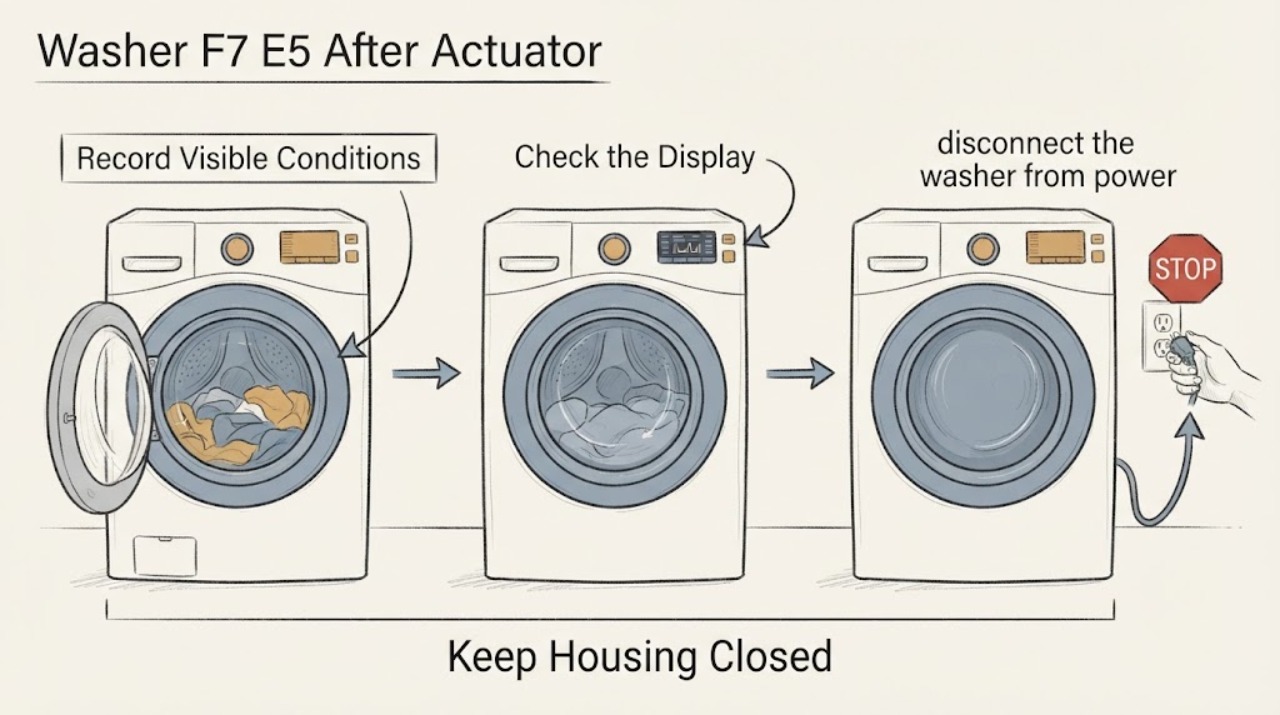
Record the full Amana model number, the exact display as F7 E5 or F7E5, the cycle stage where it loops, whether the actuator was replaced with the model-approved part, and whether the basket ever moves before the final-spin attempt.
Expected result: The exact model, code format, replacement part identity, and timing are known, or one or more are uncertain.
Next step: If the model or part identity is uncertain, stop further cycles and retrieve the matching Amana manual or service documentation before inspecting the drive system. Do not assume a generic actuator is compatible.
Why this matters
Why: Amana uses model-specific manuals and the technical sheet's F7E5 mapping is for a top-load drive system. An unconfirmed model or actuator fit can make a mechanically similar repair appear complete while the control still cannot recognize shifter position.
-
Check 2
Before any post-repair inspection, disconnect the washer from power from a dry location, close the water supply if the model procedure requires it, and check from outside for a loose panel, exposed or pinched wiring, water leak, burning smell, smoke, sparking, damaged cord, or a repeated breaker trip.
Expected result: A safety or installation hazard is present, or the washer is stable, dry, and free of visible hazard.
Next step: For smoke, sparks, burning odor, damaged wiring, water near electrical parts, or a recurring trip, keep clear and arrange qualified appliance or electrical help. Do not restore power just to see whether the code clears.
Why this matters
Why: A hazard overrides the F7 E5 drive diagnosis and makes another test unsafe. A dry, stable washer permits only the limited model-authorized inspection below; it does not prove the motor or control is safe to energize.
-
Check 3
Only if the exact model documentation authorizes access and the washer is safely de-energized, verify that the replacement actuator's connector is fully seated, the harness between the main control, motor, and shifter is not unplugged, pinched, or visibly damaged, and the shifter linkage is not visibly obstructed. Do not probe terminals or perform a live test.
Expected result: A connector or harness is visibly loose/damaged, the shifter cannot move as the model procedure describes, or the visible path appears intact.
Next step: Correct only a plainly loose connection when the exact manual authorizes it and the washer remains unplugged, then reassemble guards before testing. For damage, resistance/voltage questions, blocked movement, or uncertainty, stop and arrange service.
Why this matters
Why: Amana's technical sheet directs the F7E5 service path toward the motor/shifter harness and shifter operation. A visible post-repair connection issue is more actionable than immediately replacing another component; an intact visible path does not rule out an internal control or drive fault.
-
Check 4
Use Amana's public F7E5 reset once: disconnect the washer from its power source for five minutes, reconnect it, and observe whether the code clears before starting another cycle. Do not repeat the reset or bypass the lid lock.
Expected result: F7 E5 clears, returns immediately, or the washer remains in the same loop and will not reach final spin.
Next step: If the code returns or the loop remains, leave the washer off and arrange qualified Amana appliance service with the model, actuator details, harness observations, and reset result.
Why this matters
Why: A successful reset can clear a control state but does not prove the actuator, shifter feedback, harness, motor, or control fault is repaired. A returning code after the replacement points to an unresolved drive-system path.
-
Check 5
If the reset clears the code and the exact model manual permits a test, run one supervised empty or otherwise model-approved short cycle and note whether the lid locks, the basket moves, the washer drains, and final spin begins without F7 E5. Stop at the first abnormal noise, leak, smell, or repeated loop.
Expected result: The cycle completes with normal movement, F7 E5 returns during the shift to spin, the basket does not move, or a new safety symptom appears.
Next step: Use the washer only if it remains stable, dry, and code-free. For any repeat, incomplete spin, abnormal movement, or hazard, stop testing and provide the complete record to qualified service.
Why this matters
Why: A normal cycle makes a transient control state more plausible but does not certify an intermittent repair. A repeat at the same shift point keeps the shifter, feedback harness, motor, mechanical drive, or control path in scope; a safety symptom changes the problem to stop-use.
Use your observations
Decision map
Find the observation that best matches what you see, then follow the next safe action.
-
PATH 01Next step
What you see
After the actuator replacement, the exact top-load model still shows F7 E5, the reset does not clear it, and the basket never reaches final spin.
Do this next
Keep the washer off and arrange qualified appliance service. Give the provider the model, actuator part information, exact code, cycle stage, and any de-energized visual observations.
Why this path and its safety boundary
Why it matters: The official Amana mapping points to a shifter-position fault rather than proving the new actuator itself is defective. The actuator connection, shifter mechanism, motor path, feedback harness, or control may still be unresolved.
-
PATH 02Next step
What you see
The de-energized, model-authorized inspection finds a visibly loose actuator connector or harness connection, with no damage, leak, or electrical hazard.
Do this next
Reseat only the plainly loose connection as the exact manual permits, restore all guards, run Amana's one five-minute reset, and stop if F7 E5 returns.
Why this path and its safety boundary
Why it matters: A post-repair connection problem is more likely than a confirmed failed control, but the user-visible check still cannot verify shifter feedback under power.
-
PATH 03Next step
What you see
The actuator and visible harness appear correctly fitted, but F7 E5 returns during the shift into spin or the basket cannot rotate normally.
Do this next
Do not order another actuator or make live tests. Leave the washer off and have qualified service perform the model-specific drive-system diagnosis.
Why this path and its safety boundary
Why it matters: The remaining possibilities include shifter movement/feedback, motor or drive mechanics, wiring, or the main control; the code alone cannot choose a part.
-
PATH 04Next step
What you see
There is smoke, burning odor, sparking, water near electrical parts, a damaged cord or harness, repeated breaker operation, unstable movement, or a leak.
Do this next
Stop use, keep clear, and isolate power only from a dry safe location if that can be done without touching the hazard. Arrange qualified appliance or electrical help and do not restart the washer.
Why this path and its safety boundary
Why it matters: This is an immediate fire, shock, water, or mechanical-safety condition and overrides the F7 E5 troubleshooting path.
Helpful context
Understand the symptom
Why a new actuator does not close the F7 E5 diagnosis
The official Amana top-load technical sheet calls F7E5 a shifter fault and says the main control cannot determine the shifter position. Its service path includes the harness between the main control, motor, and shifter and observing shifter operation. That means a newly installed actuator can still leave the code if its connector is not seated, the harness is damaged or pinched, the shifter mechanism cannot move, or another drive/control condition prevents position feedback. The code does not identify one replacement part by itself.
The endless loop is an observation, not a part number
A washer that keeps repeating sensing or agitation and never reaches final spin is useful timing information: note whether the basket ever moves, whether the lid locks normally, and whether F7 E5 returns immediately after the actuator replacement or only during a spin transition. Do not keep running cycles to force the shifter into position.
Keep the inspection and reset within a safe boundary
Amana's public help page permits one five-minute power disconnect as a control reset. Any connector, harness, shifter, motor, belt, or control diagnosis beyond a safe model-authorized inspection is service work. Keep hands away from a moving basket and do not perform live electrical tests.
Only after diagnosis
Potential parts
- shifter actuator, shifter mechanism, drive-system harness, motor, or main control
Consider these only after the exact model is confirmed, the actuator installation and visible harness are verified with power disconnected, F7 E5 is reproduced, and qualified diagnosis identifies the failed path.
Amana top-load drive systems and actuator parts vary by model. Do not order a second actuator, motor, harness, or control board from F7 E5 or an endless loop alone.
When checks do not resolve it
Need a professional?
Arrange qualified Amana appliance service when F7 E5 returns after the model-authorized post-repair inspection and one five-minute reset, the washer loops before final spin, the basket or shifter cannot move normally, the visible harness is damaged, or diagnosis requires internal or live testing. Use qualified electrical help for unsafe household power symptoms.
Safety scope: Do not perform live electrical tests, probe terminals, bypass the lid lock, run the washer with panels or guards removed, reach into a moving basket, force the drive mechanism, or replace another part from F7 E5 alone. Stop immediately for smoke, burning odor, sparking, water near electrical parts, damaged wiring, unstable movement, or a repeated breaker trip.
Have this ready
- Provide the full model and serial information, exact F7 E5 display, top-load configuration, actuator brand and part identity, date and reason for replacement, cycle stage, whether the basket ever moves, lid-lock behavior, visible connector/harness observations, leaks or noise, and the reset result.
Common questions
FAQ
What does F7 E5 mean on an Amana top-load washer?
The opened Amana top-load technical sheet identifies F7E5 as a shifter fault: the main control cannot determine the shifter position. The display does not prove that the actuator alone is the failed part.
Why does F7 E5 remain after I replaced the actuator?
The actuator may not be the only part of the position path. The connector, harness, shifter movement, motor/drive system, or main control may still prevent the washer from reporting the correct position. Confirm the exact model and arrange service if the code returns.
Should I keep restarting the washer until it spins?
No. Use Amana's five-minute power disconnect once, then make one model-approved supervised test only if the washer is safe. A returning F7 E5 or endless loop needs qualified diagnosis.
Can I test the actuator with a meter?
Do not perform live electrical tests or probe the harness as a casual check. The Amana technical sheet is for service technicians; provide the exact model and post-repair symptoms to qualified appliance service.
Read the exact guide
Official sources
- Tech Sheet - W11448643 - Rev AAmana · Official Amana technical sheet opened for a top-load washer family. It identifies F7E5 as a shifter fault and directs the service path to harness connections and shifter operation; exact model coverage must be confirmed before applying it.
- F7E5 - Error Code - Product HelpAmana · Official Amana Product Help page opened for the F7E5 code. It recommends a single five-minute power disconnect and service if the problem remains; it does not authorize actuator replacement or live diagnosis.
- Top Load Washer - Product HelpAmana · Official Amana top-load support hub opened to verify model-specific manuals, troubleshooting categories, and service routing; it does not replace the exact owner manual.
- Owners - AmanaAmana · Official Amana owner-support page opened to verify the need for model and serial information and the washer model-label locations and service route.
Community feedback
Share a repair observation
Share a plain-text repair observation. Accepted observations are published automatically; this page may take a moment to update.