
On this page
Start here
Quick answer
If an LG washer is not spinning, first record whether the tub never moves, starts and stops, spins weakly, or leaves clothes wet, and note any displayed code. Confirm that the selected course actually includes a spin phase, then pause safely and redistribute a tangled, single, large, or bulky load. Check that the washer is stable and level, and look for a visible object affecting the tub or wash plate without reaching into moving parts. If water remains, a drain restriction can prevent a proper spin, so compare the visible drain hose and any model-approved filter path before testing again. Use one model-appropriate Spin or Rinse + Spin test only when the washer is dry and stable. If it drains but still will not spin, repeatedly stops, shows a fault, makes grinding or burning sounds, leaks, or cannot be tested safely, stop and arrange qualified LG appliance service.
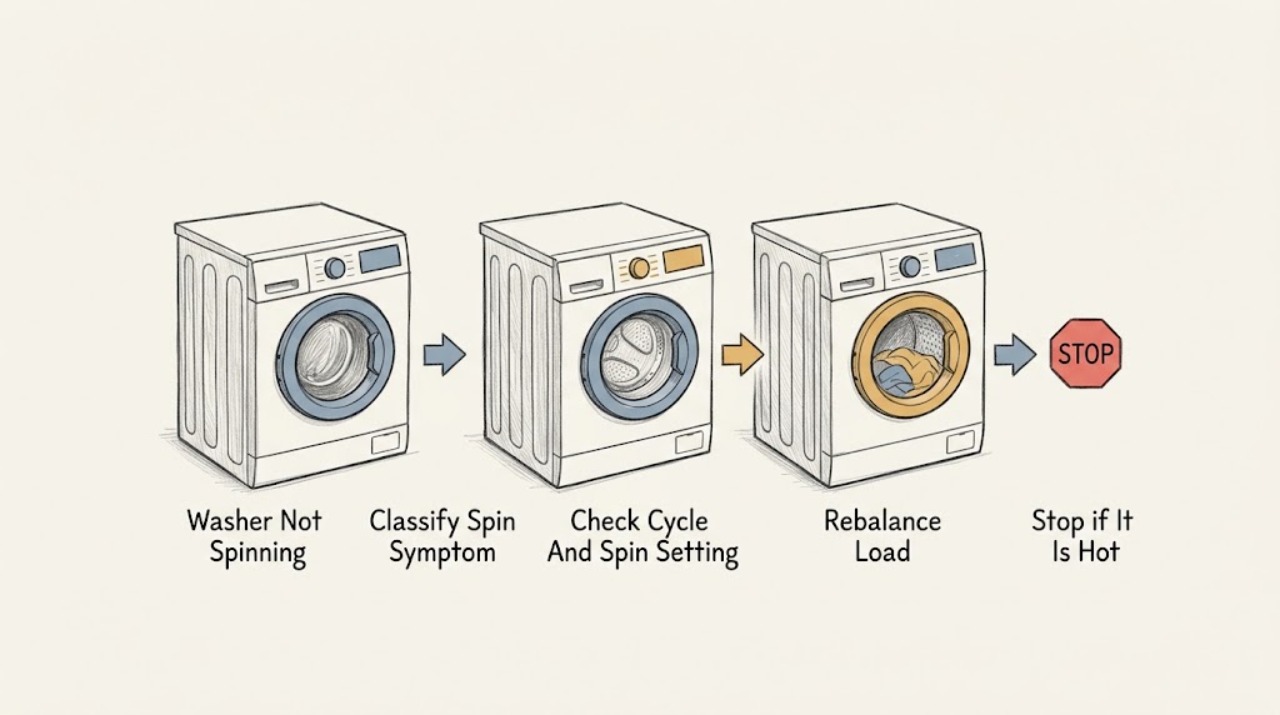
Work through in order
Diagnostic checks
Use only checks that match the exact appliance or system and its official guide.
-
Check 1
From a dry, stable position, record the LG model number, front-load or top-load style, selected course and spin setting, tub water level, lid or door state, exact displayed code if any, and whether the tub never moves, starts and stops, or spins weakly.
Expected result: The selected course is soak or wash-only, the washer is paused, water remains, a code is displayed, the tub rotates slowly, or the tub never rotates at all.
Next step: Use the exact LG manual for the selected course and code, and continue only with checks that match the washer type. Do not force a locked door or lid or restart repeatedly.
Stop if: Stop for smoke, burning odor, arcing, a damaged cord or outlet, an uncontrolled leak, or a lid or door that will not safely close or release.
Why this matters
Why: A course or pause can explain an intentional stop. Standing water shifts attention to the drain path, while a code, repeated stop, or no movement after a proper spin command needs the exact model guide. Slow motion can be a protective response to imbalance rather than a failed motor.
-
Check 2
Verify that the chosen LG course includes a spin phase and that the spin option is not set to a low or no-spin setting intended for delicate fabrics; if the model permits, choose its documented Spin or Rinse + Spin course for one supervised test.
Expected result: The washer was in soak or wash-only, the spin setting was reduced or disabled, or the correct spin course is selected but the tub still does not rotate.
Next step: Use the exact model's normal spin procedure once. If the correct course still fails, stop changing settings and continue with the load and stability observations.
Stop if: Do not bypass a lock, force the selector, use a diagnostic code from another model, or keep running cycles to overcome a failed spin.
Why this matters
Why: LG says some courses stop after washing without draining or spinning, and some fabric-protection courses intentionally use lower spin. If a proper spin course still produces no rotation, a load, drain, level, obstruction, or machine fault is more likely.
-
Check 3
Pause only through the normal control, wait for motion to stop, and spread the laundry evenly. Check for a single heavy item, a tightly tangled bundle, a very small load, or bulky, waterproof, rug-like, or blanket-like items that could collect on one side.
Expected result: The load was clearly on one side or unsuitable, the tub becomes balanced after redistribution, or the load is even but the washer still refuses to spin.
Next step: Run one appropriate spin observation at a setting suitable for the fabric. Use the exact manual for load size and spin intensity; do not add water or hold the tub by hand.
Stop if: Stop if the tub bangs violently, the washer walks, the floor flexes, the load cannot be removed without reaching past a lock, or the washer leaks.
Why this matters
Why: LG says an uneven or unsuitable load can trigger an unbalanced response that reduces or prevents spin. If an even load still fails, imbalance alone is less likely and level, drain, obstruction, or machine diagnosis becomes more important.
-
Check 4
With the tub empty or safely paused, place hands on stable exterior corners and observe whether the LG washer rocks or shakes on its floor; do not tip or pull the appliance to inspect underneath.
Expected result: The washer rocks, the floor flexes during spin, the unit is stable, or a pan or visible object under the unit interferes with its position.
Next step: If the model instructions allow user leveling, adjust only the accessible leveling feet as directed and verify stable contact. Remove only a loose visible object that can be reached without moving the washer; request service for a flexing floor, pedestal concern, or anything under the unit that needs relocation.
Stop if: Do not move or tip the washer, place hands under it, loosen structural hardware, or continue with a rocking unit, unstable pedestal, cracked floor, or active leak.
Why this matters
Why: LG links an unleveled washer and unsuitable floor or obstruction with vibration and spin problems. A stable unit makes a persistent no-spin symptom less likely to be caused by balance alone.
-
Check 5
If water remains or clothes are unusually wet, inspect the visible drain hose for a kink, crush point, freezing, or an abnormal loop, and inspect the tub or wash plate for a visible coin, wire, button, or other object only after power is off and movement has stopped.
Expected result: Water remains, the drain hose is restricted, the washer hums but does not discharge, a visible object is present, or the drain path and tub look clear.
Next step: Correct only a safe external hose position and remove only a loose visible object with the model-approved method. If the model provides a pump-filter procedure, use it only after the tub is safe to drain and the exact guide permits it; otherwise arrange service.
Stop if: Do not reach into a locked or wet tub, pry an object from a gap, open a pump or panel, disconnect a hose full of water, or continue after grinding, burning odor, a leak, or electrical contact.
Why this matters
Why: LG says poor drainage can lower spin performance, while foreign objects can affect tub operation. A clear visible path does not rule out an internal pump, drive, sensor, or control issue; humming, grinding, or no flow is a service clue.
-
Check 6
After the safe external checks, use the exact LG manual's Spin or Rinse + Spin test once, with the washer empty or loaded as the manual directs, and watch the complete drain-to-spin transition from outside.
Expected result: The washer drains and spins, drains but does not spin, does not drain, starts and stops with a balance response, or makes an abnormal sound.
Next step: Stop after that result and record the code, sound, water level, and load condition. Arrange qualified LG appliance service for a persistent no-spin or no-drain result rather than selecting a motor, pump, belt, or control part from symptoms alone.
Stop if: Do not repeat the test for a leak, smoke, burning smell, grinding, arcing, violent vibration, a locked lid or door, or water near electrical parts.
Why this matters
Why: Drain-and-spin after a corrected load or hose supports a reversible setup problem. Drain without spin points toward a spin, balance, obstruction, lock, drive, or control fault; no drain points toward the drain path; abnormal sound or repeated stop requires professional diagnosis.
Use your observations
Decision map
Find the observation that best matches what you see, then follow the next safe action.
-
PATH 01Next step
What you see
The tub does not spin only on a soak, wash-only, or low-spin fabric-protection course, while the washer otherwise operates normally.
Do this next
Select the exact model's documented Spin or Rinse + Spin course once. If that course also fails, continue with balance, drain, and service checks.
Why this path and its safety boundary
Why it matters: The course selection may intentionally omit or reduce spin rather than indicate a mechanical fault.
-
PATH 02Next step
What you see
A single, bulky, waterproof, or tangled load collects on one side, or the empty washer rocks and shakes during the spin attempt.
Do this next
Redistribute the load and use the model's leveling procedure only from safe access. Request service for repeated imbalance with ordinary loads, a walking washer, or an unstable floor.
Why this path and its safety boundary
Why it matters: Load distribution, level, floor flex, or an obstruction is more likely than a failed drive component; LG may reduce or stop spin to limit vibration.
-
PATH 03Next step
What you see
Water remains, the drain hose is restricted, or the washer drains poorly before the spin phase; a supervised test produces no or weak discharge.
Do this next
Correct only a visible hose issue or follow a model-approved filter procedure. Stop and request appliance or plumbing service for weak flow, abnormal pump sound, repeated no-drain behavior, or a leak.
Why this path and its safety boundary
Why it matters: Drain restriction or a drain-system fault is more likely than a spin-only fault, and remaining water can make the spin appear weak.
-
PATH 04Next step
What you see
A visible coin, wire, button, or other object interferes with the tub or wash plate, or the lid or door does not confirm closed while supplies and the course are normal.
Do this next
Remove only a loose visible object with power off and the model-approved method; do not bypass a lid or door lock. Request service if the object is trapped or the lock remains abnormal.
Why this path and its safety boundary
Why it matters: A physical obstruction or interlock state can prevent rotation even when the motor command is present.
-
PATH 05Next step
What you see
The correct spin course is selected, the load is balanced, the washer is stable, the visible drain path is clear, and it still drains without spinning, stops repeatedly, or makes unusual sounds.
Do this next
Keep the washer off and arrange qualified LG appliance service with the model, code, timing, drain result, load, vibration, and sound observations. Do not open panels or test live components.
Why this path and its safety boundary
Why it matters: An internal drive, motor, sensor, control, pump, or wiring fault is more likely, but external symptoms cannot identify the failed part.
Helpful context
Understand the symptom
Define what not spinning means on this LG model
A washer can appear not to spin because the selected course is a soak or wash-only course, because it is still draining, because it has reduced speed to manage an imbalance, or because the tub never rotates. Record the exact course, spin setting, water left in the tub, and any code before changing the load. LG notes that course choices and load type affect spin behavior, and that guides can differ by model.
Balance and drain checks answer different questions
A single heavy item, a tightly tangled load, bulky or waterproof items, or a washer that rocks can make the control reduce or stop spin to limit vibration. Water that does not leave can also make the spin appear weak. Treat load balance, level, drain path, and tub obstruction as separate observations so a corrected load is not mistaken for a repaired pump or motor.
Keep the test cycle supervised and model-specific
LG's test guidance uses a model-appropriate Rinse + Spin or Spin-only sequence to distinguish draining and spinning results. Run only one supervised check after the visible causes are addressed. Do not bypass a lid or door lock, reach into a moving tub, remove panels, or continue testing after an abnormal sound, leak, smoke, or burning smell.
Safety boundary
Stop conditions
- Stop immediately for smoke, burning odor, arcing, a damaged cord or outlet, water near electrical parts, or an uncontrolled leak.
- Stop for violent vibration, a washer that walks, an unstable pedestal or floor, grinding, a trapped object, or a lid or door that will not safely close or release.
- Do not bypass a lid or door lock, reach into a moving tub, tip or move the appliance, open the pump or console, or test live wiring.
- Stop after one supervised spin test if the washer still will not spin, will not drain, repeatedly stops, or displays a recurring fault; arrange model-specific service.
When checks do not resolve it
Need a professional?
Arrange qualified LG appliance service when the selected course is appropriate, the load is balanced, the washer is stable, and the drain path is clear but it still will not spin. Service is also needed for repeated unbalance, no-drain or drain-without-spin behavior, a trapped object, a failed lid or door interlock, grinding or burning sounds, a leak, smoke, or any check requiring panels or live electrical access.
Common questions
FAQ
Why does my LG washer fill and wash but not spin?
Check whether the course is soak or wash-only, whether the washer is paused, and whether water remains. Then inspect load balance, stability, visible obstruction, and the drain path. If the proper Spin course still does not rotate the tub, arrange service.
Can an unbalanced load stop an LG washer from spinning?
Yes. LG says a single, bulky, tangled, or uneven load can trigger a balance response that reduces or prevents spin. Pause normally, spread the load evenly, and use the model's appropriate spin setting; repeated imbalance needs diagnosis.
Why are my LG washer clothes wet if the tub did spin?
Poor drainage, an unbalanced load, a low-spin course, excessive suds, or water-resistant fabrics can leave laundry wet. Check the visible drain path and load condition without opening panels, then use one model-appropriate test.
Should I keep running an LG washer that will not spin?
No. Do not repeat cycles after a failed supervised test, violent vibration, a leak, grinding, burning odor, a locked lid or door, no drainage, or a recurring fault. Keep the unit off and arrange qualified appliance service.
Read the exact guide
Official sources
- Front Load Washer – Troubleshooting a UE/Ub Error CodeLG Electronics · LG front-load washer support; exact model and installed floor determine the permitted leveling procedure.
- LG Washer – Troubleshooting Washing Machine Drum Not SpinningLG Electronics · LG washer and washer-dryer-combo support guidance; exact model controls and service procedures vary.
- [LG washing machine washing] The tub does not spin after water is supplied.LG Electronics · LG washer support guidance for all models; displayed controls and course names can differ.
- [LG Front Load Washer] No Spin & Drain after WashingLG Electronics · LG front-load washer support; guide content and controls vary by model.
- LG Washer - Troubleshooting Noises During the CycleLG Electronics · LG washer support for front-load and top-load models; exact model instructions govern access and adjustment.
- LG Washer - Troubleshooting Washer Does Not Drain or Spin (Clothes Too Wet)LG Electronics · LG washer and combo support guidance; drain filters, hose arrangements, and controls vary by model.
Community feedback
Share a repair observation
Share a plain-text repair observation. Accepted observations are published automatically; this page may take a moment to update.