
On this page
Start here
Quick answer
A washer that will not spin may have a worn, broken, loose, or displaced drive belt, but a belt is only one possible cause. First check the selected cycle, door or lid closure, standing water, load balance, and any displayed error without opening the cabinet. If the washer drains but the motor can be heard while the basket does not move, a belt, pulley, motor, or drive-system problem becomes more likely. If it does not drain, solve the drain-path question first because many washers will not enter spin with water remaining. Check the model manual before any access: some washers use a belt and others use a different drive design. Do not tip the washer, remove panels, handle the belt around a pulley, or perform live electrical tests unless the exact service procedure is being carried out by a qualified technician. Stop for burning odor, smoke, exposed wiring, repeated breaker trips, leaking water, abnormal grinding, or a door/lid that will not safely latch.
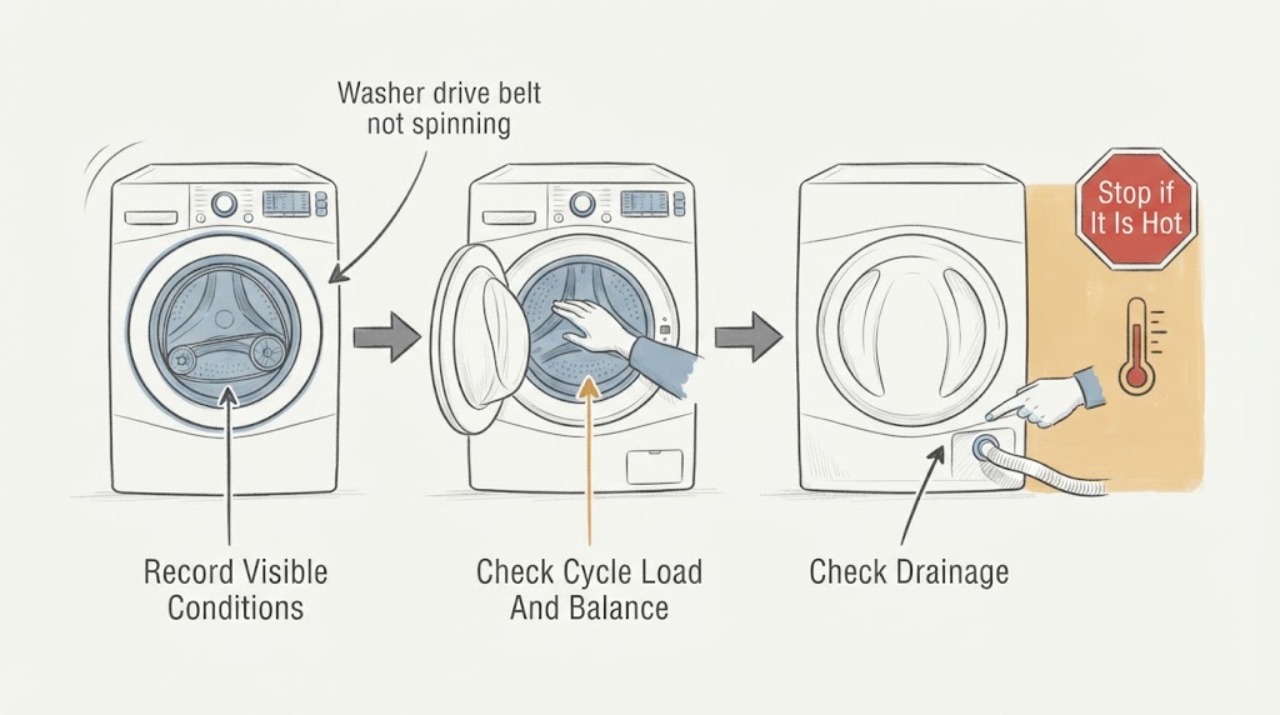
Work through in order
Diagnostic checks
Use only checks that match the exact appliance or system and its official guide.
-
Check 1
Stop the current cycle using the normal controls and note the selected cycle, any error message, water level, door or lid state, and whether the basket moved during wash or attempted spin; keep hands out of a moving tub.
Expected result: Classify the symptom as no movement at any point, wash movement but no spin, intermittent movement, a spin that stops after a balance attempt, or a cycle that pauses with water still present.
Next step: Record the pattern and continue only with external, model-appropriate checks; arrange service for a persistent no-spin condition or any recurring error.
Stop if: Stop for burning odor, smoke, exposed wiring, repeated breaker trips, leaking water, or a door or lid that will not latch safely.
Why this matters
Why: No movement at any point keeps power, interlock, motor, control, and drive faults in consideration. Wash movement with no spin narrows attention to drain, balance, spin control, interlock, or drive behavior. Water remaining means a drain problem may be preventing spin and does not prove a belt failure.
-
Check 2
Check the display and cycle selection for a no-spin or low-spin option, then with the washer off inspect whether the load is tightly packed, a single bulky item, or visibly gathered on one side; redistribute only from normal door or lid access.
Expected result: Record a deliberate low-spin selection, a balanced ordinary load, a single bulky or overloaded load, or a load that repeatedly becomes unbalanced with shaking or vibration.
Next step: Use the documented cycle for the fabric and run an appropriate empty or lightly loaded test only if the manual permits it; request service if the basket still will not spin or the washer shakes violently.
Stop if: Do not overload the tub, bypass a lid or door lock, hold the door open during operation, or keep running a washer that walks, bangs, or leaks.
Why this matters
Why: A no-spin setting or unstable load can leave clothes wet without a belt problem. Repeated imbalance can make the washer reduce or stop spin to protect itself. A balanced load with no movement keeps mechanical and control causes in consideration.
-
Check 3
Observe whether water has drained and inspect the visible drain hose for a kink, crushing, or obvious blockage without disconnecting a full hose or using chemical drain cleaner.
Expected result: Record an empty tub, slow drainage, standing water, a hose pressed against the wall, water backing up at the receiving drain, or no visible drain-path issue.
Next step: Correct only an obvious external kink within the installation guidance and address a backed-up household drain; arrange appliance service if the washer still will not drain or spin.
Stop if: Do not tip the washer, disconnect a pressurized or water-filled hose, pour drain chemicals into the appliance, or continue with water near electrical parts.
Why this matters
Why: A washer that cannot drain may not proceed to spin, so standing water can mimic a belt failure. A clear tub and drain path make the drive system more relevant, while a receiving drain that backs up points to household plumbing rather than the belt.
-
Check 4
Read the washer rating label and owner's documentation to confirm the model, whether it uses a drive belt, and whether any belt inspection is explicitly a user procedure; do not remove the back, top, bottom, or front panel.
Expected result: Record an exact model with a documented belt, an exact model with a different drive design, an unknown model, or a manual that reserves belt access for service.
Next step: Use the exact manual and model information when requesting service or a part lookup; do not order or install a belt from a generic description.
Stop if: Do not open the cabinet, move a heavy washer alone, reach around a pulley, or use a belt replacement procedure intended for another model.
Why this matters
Why: A documented belt design supports a technician's belt inspection; a different drive design means the no-spin symptom should not be forced into a belt diagnosis. An unknown model leaves fit, access, and safety questions unresolved.
-
Check 5
From outside the closed washer, listen during a permitted short test for a motor sound, a belt-like squeal, clicking, grinding, or silence while observing through the door or lid; do not place hands on the basket or cabinet openings.
Expected result: Record motor sound with no basket movement, grinding or squealing, silence, repeated start-stop behavior, or normal movement during a no-load test.
Next step: Stop the test and provide the sound and movement pattern to a qualified technician; do not remove panels to confirm a belt visually.
Stop if: Stop immediately for smoke, burning odor, grinding that worsens, exposed moving parts, repeated breaker trips, or violent vibration.
Why this matters
Why: Motor sound without basket movement makes belt, pulley, coupling, or drive-system inspection more useful. Grinding or squealing can indicate a drive or bearing issue and should not be tested repeatedly. Silence keeps interlock, control, power, motor, and wiring causes in consideration. Normal no-load movement shifts attention to load, balance, drain, or cycle conditions.
-
Check 6
Prepare the model and serial-label information, cycle and load details, water level, error message, sound pattern, visible hose condition, and recent installation or repair history for a qualified appliance technician.
Expected result: Confirm that the handoff states whether the washer drains, whether the motor runs, whether the basket moves at any stage, whether a belt is documented for the model, and whether any hazard occurred.
Next step: Request a drive-system diagnosis and exact-part confirmation before approving replacement; keep the washer off when a hazard or leak is present.
Stop if: Do not continue testing when cabinet access, live electrical measurements, heavy appliance movement, or a recurring fault is required.
Why this matters
Why: This separates a drain, balance, cycle, interlock, motor, belt, pulley, or control issue and lets the technician select the correct model-specific procedure. A symptom alone is not enough to identify a belt or guarantee compatibility.
Use your observations
Decision map
Find the observation that best matches what you see, then follow the next safe action.
-
PATH 01Next step
What you see
The washer spins after a correct spin selection and a balanced, lighter load, with no abnormal sound or error.
Do this next
A cycle, load-size, or balance condition is more likely than a confirmed belt failure. Avoid tightly packing the washer and monitor whether the symptom returns with ordinary loads.
-
PATH 02Next step
What you see
Water remains in the tub, the drain is slow, the hose is kinked, or the household drain backs up before the spin step.
Do this next
A drain-path problem is more likely to be preventing spin than the drive belt. Correct only an obvious external hose issue within the manual's guidance and arrange appliance or plumbing service for a persistent blockage.
-
PATH 03Next step
What you see
The washer drains, the model documentation confirms a belt drive, the motor can be heard, and the basket does not move or a belt-like squeal occurs.
Do this next
A broken, loose, displaced, or worn belt or another drive-system fault becomes more likely. Keep the washer off and have a technician inspect the belt, pulleys, motor, and related drive parts before selecting a replacement.
-
PATH 04Next step
What you see
The washer does not spin, the tub is empty, the model's belt design is unknown or the drive is clear, and there is no motor sound or a door/lid error.
Do this next
An interlock, power, motor, wiring, or control issue is more likely than a belt-only failure. Arrange qualified service and do not perform live electrical tests or bypass the lock.
-
PATH 05Next step
What you see
The washer grinds, shakes violently, walks, leaks, smells burned, smokes, exposes moving parts, or repeatedly trips its breaker.
Do this next
Stop operation and disconnect power only if it can be done without contact with water or damage; keep clear and arrange qualified appliance service or emergency help as appropriate. Do not restart to confirm the belt.
Helpful context
Understand the symptom
Do not diagnose the belt from a wet load alone
Wet clothes at the end of a cycle can result from a washer that never spins, but also from a no-spin setting, an unbalanced or overloaded load, a kinked drain hose, standing water, a door or lid condition, a power interruption, or normal pauses. A belt diagnosis becomes more useful only after you know whether the tub emptied and whether the machine attempted to tumble or spin. Record the cycle and any error before changing anything.
Use motor sound and drum movement as separate clues
If the motor sounds as though it is running but the basket stays still, the belt, pulley, motor coupling, or another drive component may not be transferring motion. If the washer is silent, a door or lid interlock, control, power, motor, or wiring issue remains possible. A basket that turns during wash but not spin can also reflect drain, load, speed-selection, balance, or control conditions. These observations narrow the diagnosis but do not justify removing a panel or ordering a belt without the model.
Confirm that the washer actually uses a belt
Drive layouts differ by model and generation. Some washers use a belt between the motor and drive system, while others use a different motor arrangement. Use the rating label and owner documentation to identify the model and the intended drive design. GE's parts guidance specifically says to confirm the model number for a washer belt. Do not infer fit from a similar-looking belt or from a search result.
Leave cabinet and belt access to qualified service
A belt check can require moving a heavy appliance, removing panels, reaching near pulleys, and disconnecting power and water. Manufacturer technical sheets are written for service technicians and may include electrical and drive tests that are not ordinary user checks. Keep the washer assembled and document the symptom instead. A technician can inspect belt condition and tracking along with the pulley, motor, clutch or transmission where applicable, bearings, interlock, wiring, and control.
Prepare a focused repair handoff
Provide the exact model, washer type, cycle selected, whether water remained, whether the motor hums or runs, whether the basket moved during wash, any displayed code, load condition, and recent moving or repair history. Include photos of the rating label and visible hose or floor conditions, not an opened cabinet. This helps service distinguish a restricted drain or balance event from a belt, motor, pulley, interlock, or control problem and prevents an incompatible belt from being installed.
Safety boundary
Stop conditions
- Burning odor, smoke, exposed wiring, repeated breaker trips, or water near electrical parts.
- Violent vibration, grinding, a broken or exposed moving component, or a washer that walks during operation.
- An active leak, uncontrolled water, or a door/lid that will not latch or unlock safely.
- Any step that requires opening cabinet panels, moving a heavy washer alone, reaching near a pulley, bypassing an interlock, or testing live voltage.
- An unknown drive design or a part whose model compatibility has not been confirmed.
Only after diagnosis
Potential parts
- Use the exact model-number match; belt appearance, length, or a generic listing is not sufficient.
- The applicable component varies by washer design and must be confirmed against the exact model.
- Do not infer a motor or control replacement from a silent or non-spinning tub alone.
- Match the exact model and never bypass the interlock during testing or operation.
When checks do not resolve it
Need a professional?
Call a qualified appliance technician when the washer still will not spin after the documented cycle, load, balance, and drain checks; when the motor runs but the basket does not move; when a belt, pulley, motor, interlock, or control may be involved; or when cabinet access is required. Call a plumber when the washer's hose drains into a backed-up household standpipe or sink. Stop immediately for smoke, burning odor, leaks near electrical parts, violent shaking, repeated breaker trips, or exposed moving components.
Common questions
FAQ
How can I tell if my washer drive belt is broken?
A belt becomes more likely when the washer drains, the motor can be heard, and the basket does not move, especially on a model documented as belt-driven. That symptom can also come from a pulley, motor, coupling, or control, so have a technician inspect the drive system before ordering a belt.
Can an unbalanced load make the belt stop spinning?
An unbalanced or overloaded load can cause the washer to reduce or stop spin, and Samsung notes that overload can contribute to belt slip on older models. Correct the load only from normal access; repeated no-spin or belt noise needs service.
Should I remove the back panel to inspect the belt?
Not as a general user check. Belt access varies by model and may require heavy-appliance movement, panel removal, and work near pulleys and wiring. Use the owner's manual to identify the drive design and arrange qualified service when cabinet access is required.
Why does my washer not spin even though the belt looks intact?
The washer may still have a drain, balance, cycle, door or lid interlock, motor, pulley, control, wiring, or bearing problem. A belt that looks present is not proof that it is tracking correctly or transferring motion; a technician should test the complete drive system.
Read the exact guide
Official sources
- Not Spinning - WasherWhirlpool · Whirlpool washer no-spin troubleshooting
- Tech Sheet W11316888 Rev AWhirlpool · Whirlpool front-load washer technician diagnosis of drum rotation and drive systems
- What to do if your washing machine is not spinningSamsung · Samsung washing-machine no-spin troubleshooting concepts
- Front Load Washer - Does Not SpinGE Appliances · GE front-load washer no-spin troubleshooting
- LG Washer – Troubleshooting Washing Machine Drum Not SpinningLG · LG washer no-spin symptom checks
- Washer Tub Drive BeltGE Appliances · GE washer drive-belt function and model-number compatibility
Community feedback
Share a repair observation
Share a plain-text repair observation. Accepted observations are published automatically; this page may take a moment to update.