
On this page
Start here
Quick answer
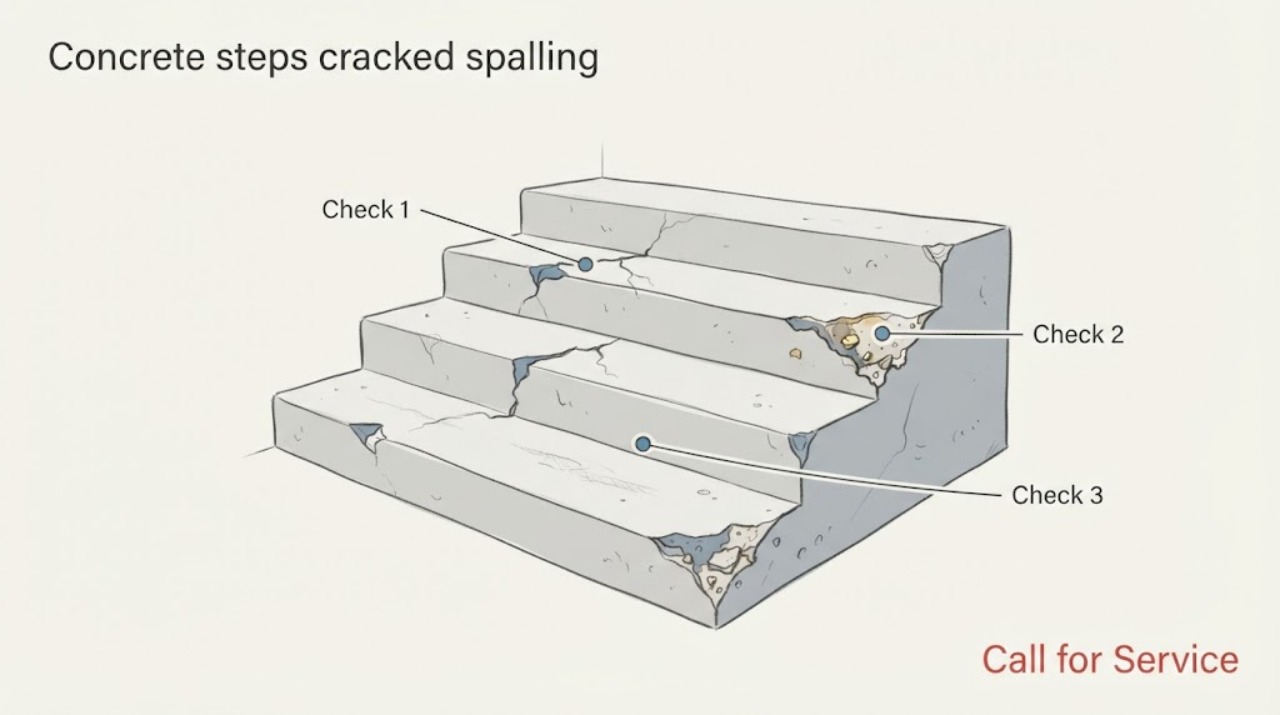
Concrete step spalling is the loss of surface material, not just a cosmetic crack. From a safe standing position, document whether the loss is a thin surface flake or extends into the step, whether fragments are loose, whether rust-stained or exposed reinforcing steel is visible, and whether water or freeze-thaw exposure is involved. Check the tread edge, walking route, and handrail without touching the damage. Do not knock, grind, scrape, or patch it; deep or uncertain loss, exposed steel, a damaged step edge, a loose handrail, or any movement needs prompt professional evaluation.
Work through in order
Diagnostic checks
Use only checks that match the exact appliance or system and its official guide.
-
Check 1
From a safe position, photograph the entire flight and each affected tread, riser, corner, and side edge without stepping on the damaged area.
Expected result: Record the location, approximate visible footprint, whether the surface is flaking or a chunk is missing, and whether the boundary is stable, spreading, or associated with a crack.
Next step: Send dated wide and close photos to a qualified concrete or structural professional and keep traffic off any questionable step.
Stop if: Stop if the only safe view would require standing on the damaged step, crossing loose fragments, or approaching an unstable edge.
Why this matters
Why: A thin, isolated surface loss is a different starting point from a missing corner, a deep-looking void, or a defect that crosses the walking edge. Do not infer an exact depth from a photograph.
-
Check 2
Look at the visible loss from the side and front, using normal lighting or a camera zoom rather than touching, tapping, scraping, or probing the concrete.
Expected result: Note whether the loss appears limited to the surface skin, reaches beneath the tread or nosing, exposes coarse aggregate, creates a hollow-looking separation, or leaves fragments that could detach.
Next step: Request an on-site assessment that identifies sound concrete, deteriorated concrete, and the safe repair boundary before any material is purchased.
Stop if: Do not hit the concrete with a tool, pull fragments free, grind the surface, or create an opening to inspect depth.
Why this matters
Why: The apparent depth and an undermined tread edge affect load and trip risk. A deep or uncertain loss cannot be safely classified as a cosmetic patch job from observation alone.
-
Check 3
Inspect the exposed area visually for reinforcing steel (rebar), rust staining, dark moisture, mineral deposits, or water tracks without brushing or cleaning it.
Expected result: Record whether steel or rebar is visible, whether rust-colored staining follows a crack or edge, whether the concrete stays damp, and whether deterioration is concentrated near a joint or drainage path.
Next step: Arrange a priority concrete or structural evaluation and provide the photos; do not cover the steel, seal the stain, or remove corrosion yourself.
Stop if: Stop for sharp exposed steel, loose overhead material, unstable concrete, contaminated water, or any need to touch the exposed area.
Why this matters
Why: Visible or rust-stained reinforcement raises concern for corrosion and loss of concrete bond; persistent moisture or deposits support a water-related deterioration branch. Neither observation tells you how much steel or sound concrete remains.
-
Check 4
Record the step's water and weather history from a safe position, including pooling, downspout discharge, deicing-salt use, wet seasons, and freeze-thaw exposure.
Expected result: Note whether spalling appeared or worsened after repeated wet-freezing cycles, winter salt, a drainage change, or a leak; compare with nearby steps that receive the same weather.
Next step: Tell the professional the timeline and drainage history so the assessment covers both concrete deterioration and the source of moisture.
Stop if: Do not redirect a downspout, apply deicer or sealant as a test, chip ice, or work during freezing, wet, or slippery conditions.
Why this matters
Why: Saturated concrete exposed to freezing can progressively scale or spall, while water and salts can accelerate reinforcement corrosion. A continuing source means a surface patch alone may not address the cause.
-
Check 5
Assess the walking route, tread front edges, risers, side edges, and handrail visually from a stable position without loading or shaking any component.
Expected result: Record a sharp missing nosing, uneven surface, exposed edge, loose-looking handrail or post, blocked route, poor visibility, or a height change likely to catch a foot.
Next step: Use another entrance when possible, keep people away with a safe visible barrier that does not touch the damaged structure, and request prompt professional repair planning.
Stop if: Do not test the step by jumping, loading, rocking the handrail, sweeping fragments, or walking across the damaged edge.
Why this matters
Why: A defect at the step edge or a handrail problem changes the immediate safety decision even if the spall itself looks shallow. A route that cannot be used safely should be isolated while service is arranged.
-
Check 6
Check from a safe position whether loose fragments, exposed steel, a damaged step edge, a loose handrail, visible movement, or a rapidly worsening crack is present.
Expected result: Answer yes if any of those conditions is visible or if a person could fall onto a sharp or unstable area; answer no only when none is observed from the safe view.
Next step: If yes, keep everyone off the affected route and contact a qualified concrete or structural professional promptly. If no, preserve the photos and arrange assessment before repair.
Stop if: Do not touch loose concrete or steel, brace the step, tighten the handrail, or attempt a temporary patch.
Why this matters
Why: Yes makes the route a prompt safety and professional-service concern, not a product-selection question. No supports scheduling a scoped assessment, but it does not prove the concrete is structurally sound.
Use your observations
Decision map
Find the observation that best matches what you see, then follow the next safe action.
-
PATH 01Next step
What you see
Visible loss appears limited to a small, stable surface area, with no exposed or rust-stained steel, no changing crack, no edge loss, and a secure-looking handrail.
Do this next
Keep the area dry and low-traffic, schedule a concrete professional to confirm the repair boundary, and do not choose a patch or sealer from appearance alone.
-
PATH 02Next step
What you see
The loss appears deep or undercuts the tread, fragments are loose, reinforcement is visible, or rust staining and delamination-like separation are present.
Do this next
Keep people off the step and arrange prompt concrete or structural evaluation; the professional should determine whether the step needs structural repair rather than a surface patch.
-
PATH 03Next step
What you see
The front edge or nosing is missing or sharp, the tread is uneven, the route creates a clear trip hazard, or a handrail or post looks loose.
Do this next
Use another route and isolate the area safely without loading the step; request prompt repair of the walking surface and handrail system.
-
PATH 04Next step
What you see
Spalling is wet, follows a drainage path or joint, or appeared or worsened with freeze-thaw cycles, deicing salt, or repeated pooling.
Do this next
Request assessment of both the concrete and its water exposure; correcting the moisture source may be necessary for durable repair.
-
PATH 05Next step
What you see
The step shifts, settles, separates from adjacent work, carries a widening crack, or the support or landing appears unstable.
Do this next
Keep clear and seek prompt concrete or structural evaluation; do not load, lift, brace, or demolish the step.
-
PATH 06Next step
What you see
Safe observation cannot establish the apparent depth, soundness behind the surface, reinforcement condition, or whether the step is safe to use.
Do this next
Treat the condition as unresolved, keep traffic off the questionable area, and give a professional the photos, timeline, and access limits.
Helpful context
Understand the symptom
What spalling can mean
Concrete spalling can follow surface scaling, trapped water and freeze-thaw cycling, or corrosion of embedded reinforcing steel. Rust can expand inside concrete and push the cover outward; water and deicing salts can accelerate that process. A photo cannot establish the true depth or structural effect, so treat the visible depth and the condition of the step edge as triage information, not a repair specification.
Safe observation only
Stand on a sound, dry surface away from the affected step and photograph the tread, riser, edges, and handrail from several angles. Do not tap to hear a hollow sound, chip loose material, brush rust, measure by probing, grind, drill, or apply a patch or sealer. Keep children, visitors, and pets away from loose fragments and use another route when practical.
Repair versus urgency
A small, stable surface loss with no visible steel or edge movement still deserves a concrete professional's assessment before any repair product is chosen. Loss at the front edge, a deep or uncertain void, exposed or rusting steel, a loose handrail, active water, or a changing crack raises urgency because the walking surface or support may no longer be reliable.
Safety boundary
Stop conditions
- Do not tap, hammer, chip, scrape, grind, drill, probe, or pull fragments from the concrete.
- Do not apply patch, mortar, epoxy, paint, or sealer as a test or as a substitute for diagnosis.
- Do not load, jump on, rock, brace, lift, dismantle, or demolish the step or handrail.
- Keep away from exposed or sharp steel, loose fragments, unstable edges, slippery water or ice, and any route with a fall risk.
- Use another route and call a qualified professional for deep or uncertain spalling, rust or exposed reinforcement, edge loss, handrail instability, movement, or worsening damage.
Only after diagnosis
Potential parts
- concrete-patch
Consider only if a qualified professional classifies the damage as suitable for a surface repair and specifies the material.
Do not select by color or label alone; material compatibility, depth, edge loading, exposure, and the condition of reinforcement must be confirmed first. - concrete-sealer
Consider only after the concrete and moisture condition have been professionally assessed and the product is specified for that use.
A sealer does not replace assessment of loose concrete, rusting reinforcement, step-edge loss, movement, or an ongoing water source.
When checks do not resolve it
Need a professional?
Call a qualified concrete or structural professional for any visible spalling that persists or recurs, appears deep or undercuts an edge, exposes or stains reinforcement, affects a handrail or walking route, follows moisture or freeze-thaw exposure, or leaves the condition uncertain. Seek prompt service for loose fragments, movement, or an unsafe step.
Have this ready
- Dated wide and close photos from safe positions
- Approximate onset and whether spalling is spreading
- Visible loss location, edge or nosing condition, and any loose fragments
- Any exposed or rust-stained reinforcement, moisture, freeze-thaw or deicing history
- Handrail, route, trip, movement, and access concerns
- What was not touched, loaded, removed, or tested
Common questions
FAQ
What is the difference between a crack and spalling?
A crack is a separation line; spalling is loss of concrete surface or chunks. They can occur together, and spalling around reinforcement or an edge can carry more safety significance than a narrow stable surface crack.
Can I tell the spall depth by tapping or poking it?
No. This page limits the check to visual observation. Do not tap, chip, scrape, or probe; a professional must establish the sound and deteriorated boundary safely.
Why does rust on a step matter?
Rust staining or exposed reinforcing steel (rebar) can indicate corrosion. Rust occupies more space than the original steel and can create pressure that cracks and displaces surrounding concrete, so the repair may extend beyond the visible spot.
Can freeze-thaw cause this damage?
Yes. Water in concrete can freeze and expand; repeated freezing and thawing can produce scaling, cracking, delamination, and spalling. Wet conditions and deicing salts can worsen deterioration.
When is a spalled step a trip or fall hazard?
Treat missing or sharp tread edges, an undermined nosing, loose fragments, an uneven walking surface, a loose handrail, or movement as a safety concern. Use another route and arrange prompt professional service.
Should I use concrete patch or sealer now?
Not based on appearance alone. A professional should first determine whether the damage is superficial, reaches the step edge or support, involves reinforcing steel, or has an active water cause. A surface product can hide the condition without correcting it.
Read the exact guide
Official sources
- eTool : Construction - FallsOccupational Safety and Health Administration · Official safety guidance used for the boundary around exposed steel, fall hazards, and ladders.
- Preservation Brief 15: Preservation of Historic ConcreteNational Park Service · Official technical preservation guidance used for mechanism and escalation context, not as a repair procedure for a residential step.
- 2.0 Selection of Candidate Projects - Partial-Depth RepairsFederal Highway Administration · Official concrete-distress guidance used only to frame depth, corrosion, moisture, and freeze-thaw escalation.
Community feedback
Share a repair observation
Share a plain-text repair observation. Accepted observations are published automatically; this page may take a moment to update.