
On this page
Start here
Quick answer
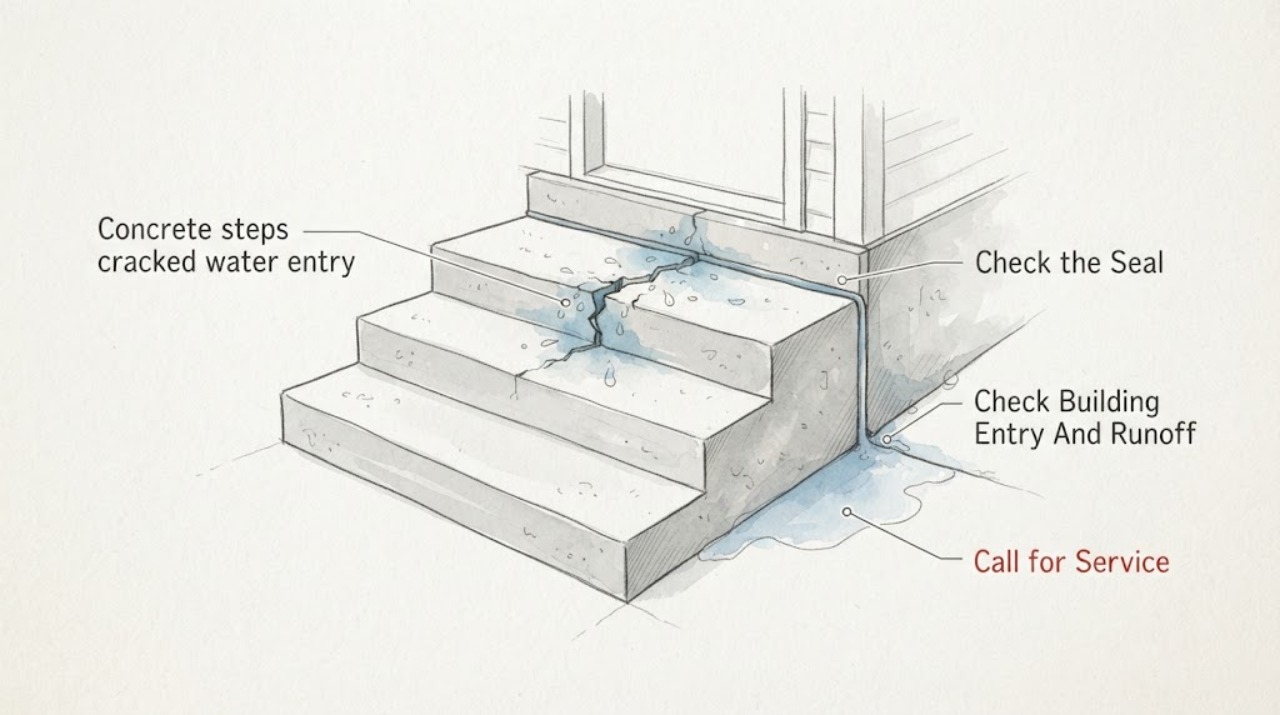
When a cracked concrete step admits water, the timing and path of the water matter as much as the crack's appearance. From a stable, dry position, compare the crack before and after rain or snowmelt and record whether it is at a tread, riser, landing, joint, wall interface, or free edge. Look for water entering the building or lower level, damp tracks or efflorescence, spalling, rust staining or exposed reinforcement, freeze-thaw scaling, step movement, or a handrail and trip hazard. Keep the route out of use and call a qualified concrete professional promptly for active entry, widening, offset, support loss, spalling, or reinforcement evidence. Do not inject, seal, grind, cut, patch, or demolish the crack as a test or repair.
Before you begin
Safety first
- The reader should remain on stable ground, avoid loading or altering the step, and leave injection, sealing, grinding, cutting, excavation, demolition, structural work, and permanent repair to qualified professionals.
Work through in order
Diagnostic checks
Use only checks that match the exact appliance or system and its official guide.
-
Check 1
From a stable, dry position, record whether water appears during rain, snowmelt, freeze-thaw weather, irrigation, or after a dry period, and photograph the step before and after the event without walking on an unsafe surface.
Expected result: Water that tracks precipitation or thaw suggests an exterior runoff or absorption path. Water that appears without precipitation may involve plumbing, drainage, condensation, or an existing saturated assembly.
Next step: Give the weather or water-use timing, photographs, and first visible wet location to a qualified concrete professional or drainage specialist.
Stop if: Do not hose the steps, redirect water toward the crack, walk on ice or saturated concrete, or enter a flooded area to trace the source.
Why this matters
Why: Timing narrows the source question but does not prove that the crack itself is the only entry path.
-
Check 2
Photograph and describe whether the crack is on the tread, riser, landing, side edge, wall or foundation interface, construction joint, or a transition between the step and another concrete placement.
Expected result: A line following a joint or interface may have a different water path from a crack crossing the tread, turning down a riser, or reaching a free edge. Record length, direction, endpoints, and whether several steps or the landing are involved.
Next step: Keep the photographs with the date and a safe reference scale, and ask the professional to evaluate the interface, drainage, and support together.
Stop if: Do not open the joint, remove a finish, pry the step, or inject material to see where water goes.
Why this matters
Why: Location and extent help separate a joint or interface problem from a crack that may reflect movement through the step; neither can be diagnosed by appearance alone.
-
Check 3
From a safe approach, observe whether runoff crosses the tread or landing, ponds at the wall or base, reaches a door or lower-level opening, stains an interior wall, or washes soil away from the step or foundation.
Expected result: Water entering the building, collecting at the wall, or washing out support is an active source or structural concern, even if the visible crack is small. A dry, well-drained landing does not rule out water passing through the concrete.
Next step: Keep the entrance or step area protected from use as needed, document the runoff path, and request prompt service for source control and structural review.
Stop if: Do not dig at the foundation, block a drain, enter standing water, or alter grading or drainage to test the path.
Why this matters
Why: Building entry and support loss change the scope from surface crack treatment to water control and concrete or structural assessment.
-
Check 4
From a safe accessible viewpoint, record damp tracks, white or brown deposits, dark staining, scaling, map cracking, loose or missing edge concrete, rust staining, or reinforcement visible at or around the crack.
Expected result: Deposits indicate water has moved through or across the concrete. Scaling or spalling near a joint or free edge can be consistent with repeated wetting and freezing; rust staining or exposed reinforcement adds a corrosion and concrete-loss concern.
Next step: Photograph the entire affected area and keep loose fragments and the route undisturbed for the professional's assessment.
Stop if: Do not scrape deposits, chip spalls, wire-brush reinforcement, pressure-wash the surface, or cover the evidence.
Why this matters
Why: These signs change the decision from monitoring a line to documenting deterioration before any surface material is applied.
-
Check 5
Compare the step, tread, riser, landing, and handrail alignment in dated photographs, and note any widening, raised or dropped edge, tilted section, frost or ice history, or change after thaw without loading or shaking the step.
Expected result: A changing crack, offset, tilt, loose handrail, or recurring change after freeze-thaw suggests movement or support deterioration rather than a simple water stain. An unchanged alignment lowers immediate concern but does not clear water entry through the assembly.
Next step: Restrict access for any offset or instability and provide the comparison photographs and weather history to qualified service.
Stop if: Do not bounce, load-test, pry, level, brace, or walk on a shifting or slippery step.
Why this matters
Why: Movement and freeze-thaw context determine whether the professional should prioritize structural support, drainage, concrete deterioration, or a combination.
-
Check 6
Decide whether the handoff needs concrete repair, drainage or water-source control, structural assessment, or all three based on the timing, interface, building entry, deterioration, and movement observations.
Expected result: A rain-linked crack without deterioration still needs professional evaluation of the path and joint. Entry into a building, washed-out support, spalling, exposed reinforcement, movement, or a trip and handrail hazard calls for prompt coordinated service.
Next step: Send a concise timeline, location map, photographs, water path, freeze-thaw history, and access or safety limits to the provider.
Stop if: Do not inject, seal, grind, cut, patch, excavate, remove, or demolish the step while the source and movement condition are unresolved.
Why this matters
Why: The water-entry condition changes the repair boundary: sealing the visible crack alone may leave the source, support, or structural risk unaddressed.
Use your observations
Decision map
Find the observation that best matches what you see, then follow the next safe action.
-
PATH 01Safety boundary
What you see
Water appears after rain or snowmelt at a crack, joint, landing, wall, or step transition, without a known plumbing event.
Do this next
Request professional review of runoff, drainage, joint or interface condition, concrete deterioration, and any route into the building.
Why this path and its safety boundary
Why it matters: The exterior water path and the concrete interface need to be evaluated together; a surface seal may not address the source.
Safety stop: Do not hose, seal, inject, or alter drainage to reproduce or hide the entry.
-
PATH 02Safety boundary
What you see
Cracks or scaling cluster at joints or free edges and follow periods of wetting, freezing, thawing, or deicing, with spalling or loose surface concrete.
Do this next
Keep the area clear and arrange prompt concrete assessment of the affected depth, drainage, edge support, and safe repair or replacement scope.
Why this path and its safety boundary
Why it matters: Repeated moisture and freezing may be contributing to surface or internal deterioration; the visible crack may not be an isolated finish defect.
Safety stop: Do not chip, grind, patch, apply deicer experimentally, or remove spalled concrete.
-
PATH 03Safety boundary
What you see
Water reaches a doorway or lower level, the step or landing has a support gap or washout, or the crack is accompanied by visible settlement, offset, or movement.
Do this next
Restrict access and request prompt coordinated concrete, drainage, and structural evaluation; use emergency service for immediate danger to people or the building.
Why this path and its safety boundary
Why it matters: Active water entry and possible support movement create a higher-priority building and structural concern.
Safety stop: Do not enter the affected area, dig, brace, level, inject, or attempt a temporary structural repair.
-
PATH 04Safety boundary
What you see
Rust staining, exposed reinforcement, loose edge concrete, delamination-like separation, or expanding spall is visible around the water path.
Do this next
Keep people away from falling fragments and request prompt professional inspection and repair-scope determination.
Why this path and its safety boundary
Why it matters: Moisture may be associated with reinforcement corrosion or loss of concrete cover, which requires more than a surface crack treatment.
Safety stop: Do not scrape, wire-brush, coat, seal, or cover the reinforcement or spall.
-
PATH 05Safety boundary
What you see
The crack appears unchanged, no water reaches the building, no support or alignment change is visible, and there is no spall, reinforcement evidence, or trip hazard from safe viewpoints.
Do this next
Keep dated photographs, arrange a planned assessment, and ask the professional whether a compatible joint or crack treatment is appropriate after the source is understood.
Why this path and its safety boundary
Why it matters: Immediate urgency may be lower, but a dormant-looking crack can still admit water or worsen under future weather.
Safety stop: Do not treat the absence of visible entry on one day as permission to inject or seal the crack yourself.
Helpful context
Understand the symptom
Follow the water, not just the visible crack
Rain, snowmelt, runoff, irrigation, and water moving through a joint can reach concrete steps by different paths. Note whether the wetting starts at the tread, riser, landing, wall or foundation interface, a construction joint, or an exposed edge. A crack that is dry during one visit may still be a water path; compare dated observations around precipitation rather than relying on a single dry surface.
Water entry can change the urgency
Water that reaches a doorway, lower level, wall, or step support needs source and drainage assessment as well as concrete assessment. White or brown deposits, dark wet tracks, surface scaling, loose edge material, rust staining, or exposed reinforcement indicate that moisture may be contributing to deterioration. In cold weather, repeated wetting and freezing can worsen cracks and spalling, especially at joints and free edges.
Do not turn a water path into a hidden defect
A sealant or patch may be appropriate only after a professional identifies the crack, joint, water source, substrate, and movement condition. Covering the surface before the source and support are understood can hide evidence and leave water entering elsewhere. Keep people off a slippery, offset, loose, or undermined step and let the professional decide whether water control, repair, replacement, or structural review is needed.
Safety boundary
Stop conditions
- Do not inject, seal, grind, saw, widen, patch, excavate, remove, or demolish the crack, joint, step, landing, or support during this observation-only check.
- Do not walk on a shifting, undermined, icy, slippery, or loose step, and do not load-test the step or handrail.
- Restrict access and call promptly for building water entry, support washout, movement, offset, spalling, exposed or rust-stained reinforcement, or a trip or handrail hazard.
- Keep water, deicing chemicals, tools, and debris from being directed into the crack or used to test whether it is sealed.
Only after diagnosis
Potential parts
- concrete-patch
Consider only after a qualified professional identifies the water source, crack or joint movement, substrate condition, and a suitable repair scope.
A patch must not conceal support loss, active water entry, freeze-thaw deterioration, spalling, or reinforcement corrosion; follow the selected material's instructions. - concrete-sealer
Consider only after the professional confirms that sealing is appropriate for the concrete, joint or crack, moisture condition, traction needs, and source-control plan.
A sealer treats only a defined surface condition and may not stop water entering through a moving joint or support; do not apply it before assessment.
When checks do not resolve it
Need a professional?
Call promptly when rain or snowmelt sends water into a building, when soil or step support is washed out, or when there is widening, movement, offset, spalling, exposed or rust-stained reinforcement, a slippery or trip edge, or a loose handrail. A stable-looking crack without visible entry still merits planned assessment if it recurs after wet weather.
Safety scope: The reader should remain on stable ground, avoid loading or altering the step, and leave injection, sealing, grinding, cutting, excavation, demolition, structural work, and permanent repair to qualified professionals.
Have this ready
- Dated photographs before and after rain, snowmelt, freezing, thawing, or other water events
- Exact crack or joint location on the tread, riser, landing, wall interface, free edge, or transition between concrete placements
- Water path, doorway or lower-level entry, damp deposits, runoff, drainage, soil washout, and any plumbing or irrigation context
- Spalling, scaling, loose material, rust staining, exposed reinforcement, step movement, alignment changes, trip edge, and handrail condition
- Access limitations and the areas kept out of use; do not attempt to inspect the underside or support if it is unsafe
Common questions
FAQ
How do I know whether rain is entering through the crack?
Compare safe, dated observations before and after rain or snowmelt and map where wetness, deposits, or runoff first appears. Water may also travel through a joint, wall interface, landing, or support, so the crack alone is not proof of the route.
Why are joints and step edges important?
Joints and free edges can provide easier moisture paths and are common locations for freeze-thaw scaling, spalling, and deterioration. A crack that follows or crosses an interface needs that interface and the surrounding drainage assessed together.
What do white deposits or rust stains mean?
They show that water or corrosion-related material may be moving through or across the concrete. They do not identify the exact cause, but they are useful evidence to photograph before a professional decides whether water control, concrete repair, or structural review is needed.
Can I seal the crack before the next storm?
Do not seal or inject it as a test. If the crack is moving, the joint is active, water is reaching the building, or the concrete is spalling, a surface treatment can hide evidence or leave the source and support problem unresolved.
When is a cracked step unsafe to use?
Keep it out of use when it shifts, has an offset or slippery trip edge, is undermined, sheds loose concrete, affects a handrail, admits water into the building, or cannot be safely assessed. Use another route until qualified service evaluates it.
Read the exact guide
Official sources
- Preservation Brief 15: Preservation of Historic ConcreteNational Park Service · This brief addresses historic concrete, not a site-specific residential step; it supports the distinction between active and dormant cracks and the need to evaluate water, spalling, deflection, and structural context before repair.
- Chapter 2 - Guidelines for Detection, Analysis, and Treatment of Materials-Related Distress in Concrete Pavements, March 2002 - FHWA-RD-01-163Federal Highway Administration · The guidance concerns concrete pavements rather than residential steps; its described mechanisms support treating wet joints, free edges, spalling, freeze-thaw history, and rust evidence as clues requiring professional diagnosis.
- Moisture Control Guidance for Building Design, Construction and MaintenanceU.S. Environmental Protection Agency · Supports separating rain or snowmelt, groundwater, plumbing, condensation, and runoff as different moisture sources and evaluating water transport before treating a visible crack.
- Concrete—CrackingFederal Highway Administration · This is a bridge inspection protocol, not a residential step repair manual; it supports recording crack and moisture characteristics and treating reinforcement evidence as material for professional assessment.
Community feedback
Share a repair observation
Share a plain-text repair observation. Accepted observations are published automatically; this page may take a moment to update.