
On this page
Start here
Quick answer
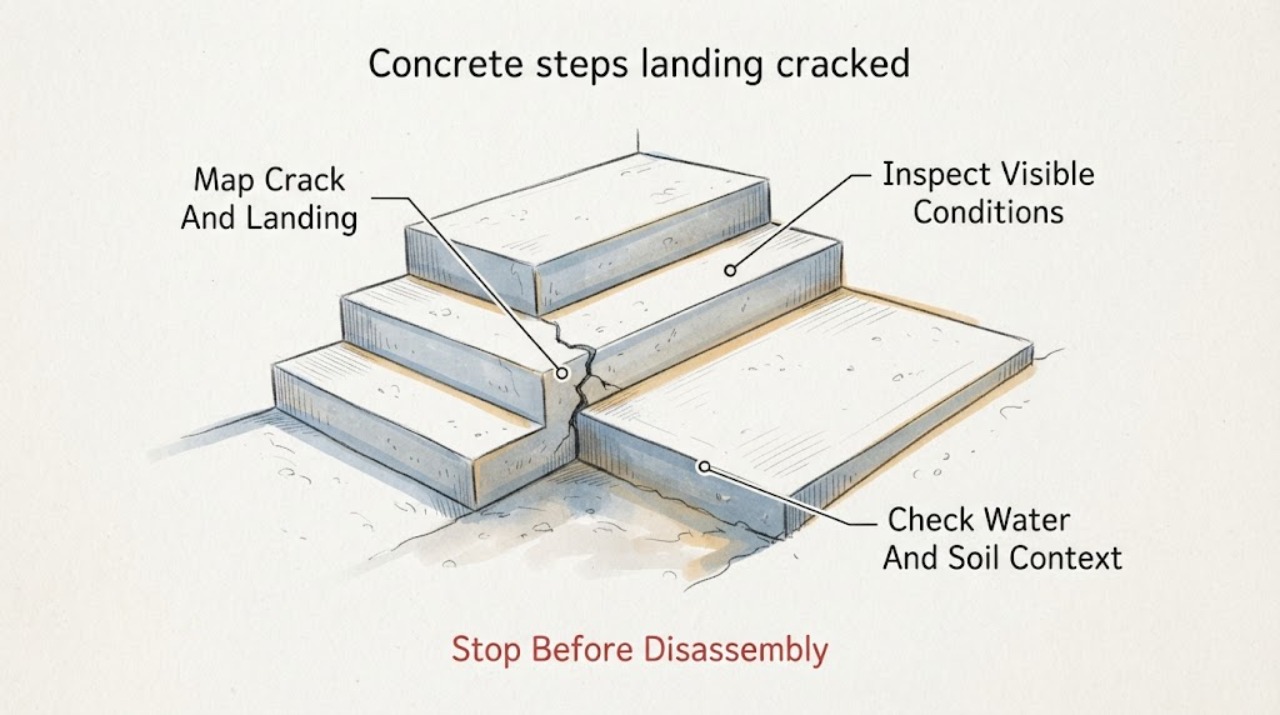
A crack across a concrete steps landing can be cosmetic shrinkage, but it can also reflect movement, water damage, settlement, or a failing connection to the stairs or house. Keep people off the area if the landing rocks, drops, has a raised edge, loose concrete, exposed reinforcement, or makes the stair path unsafe. From stable ground, photograph the crack and its direction, note changes after rain or frost, look for drainage or soil washout, and check for visible separation at the house and stair interfaces. Do not widen the crack, chisel, drill, jack, demolish, or apply patch or sealer until a qualified concrete or structural professional identifies the cause.
Work through in order
Diagnostic checks
Use only checks that match the exact appliance or system and its official guide.
-
Check 1
From a stable position, photograph and map the crack across the landing, including whether it runs parallel or across the stair direction, branches, reaches an edge, continues into a riser or wall joint, or is accompanied by spalling or loose pieces.
Expected result: The crack may be isolated on the surface, run through the landing and adjacent step, form a branching network, end at an edge, or accompany chipped, hollow-looking, or displaced concrete.
Next step: Keep the photos and mark the location for the technician. Do not widen, clean out, scrape, drill, or test the crack with a tool.
Stop if: Stop if pieces are falling, the landing shifts, the stair route is unstable, or documenting the crack requires stepping on an unsafe surface.
Why this matters
Why: A surface-only pattern can have different implications from a crack that crosses a support or interface. Continuity, displacement, and loose concrete make a professional assessment more important than the crack's appearance alone.
-
Check 2
Without stepping on a questionable area or applying force, compare the visible faces on each side of the crack and note any raised edge, drop, offset, gap, rocking, stair separation, or change after rain, freezing weather, or nearby work.
Expected result: The two sides may appear flush and stable, or one side may be visibly higher, lower, tilted, separated, or changing with weather or use.
Next step: Keep traffic off a displaced or moving landing and arrange qualified concrete or structural evaluation. Do not level it with a jack, wedge, pry bar, or temporary pour.
Stop if: Stop immediately for rocking, a sudden change, a dropped or raised tread, an unstable handrail or guard, or any need to load or lift the concrete.
Why this matters
Why: Visible displacement or repeatable change suggests movement, settlement, frost action, or a connection problem rather than a simple surface blemish. A flush appearance does not prove the crack is harmless.
-
Check 3
From outside the landing, look for roof or gutter discharge, pooling, blocked drainage, erosion, washed-out soil, frost heave signs, vegetation roots, or water entering the crack or the joint beside the house; do not excavate or dismantle drainage.
Expected result: There may be a dry and well-drained approach, staining or ponding, soil loss beneath an edge, a downspout aimed at the steps, or repeated wetting and freezing evidence.
Next step: Photograph the water and soil conditions and keep discharge away from the steps only with a low-risk adjustment that does not disturb the structure. Request a professional review before patching.
Stop if: Stop for undermined soil, a void below the landing, active washout, electrical equipment in water, excavation, or any need to move the landing or alter buried services.
Why this matters
Why: Water and soil movement can contribute to settlement, freeze-related movement, reinforcement corrosion, and recurring cracks. No visible drainage issue does not rule out concealed water or footing movement.
-
Check 4
Look without touching for spalling, rust staining, exposed reinforcement, damp areas, efflorescence, delamination-like pieces, or a worn and slippery walking surface on the landing and adjacent step faces.
Expected result: The concrete may look intact and dry, or show loose cover, rust-colored staining, exposed metal, dampness, surface scaling, or loose edges.
Next step: Keep the route closed or reroute traffic if the surface is unsafe, and arrange concrete or structural service. Do not chip away cover, wire-brush metal, or coat the area to hide the condition.
Stop if: Stop for exposed or corroded reinforcement, loose overhead or edge concrete, a slick surface, falling fragments, or any urge to knock on or remove material.
Why this matters
Why: Exposed steel, loose cover, and rust staining can indicate deterioration beyond a cosmetic crack and can worsen with water entry. A slippery or loose walking surface adds an immediate fall hazard.
-
Check 5
From a safe position, inspect the visible joint where the landing meets the stairs, porch, foundation, retaining wall, or house for separation, open gaps, seal failure, staining, or misalignment; do not pull trim, remove joint material, or enter a crawlspace.
Expected result: The interfaces may remain aligned and closed, or show a widening gap, shifted step, failed joint, water staining, or separation that continues beyond the landing crack.
Next step: Photograph each interface and request a qualified assessment of the landing, stairs, drainage, and supporting soil or structure. Keep weight off any shifted section.
Stop if: Stop for a visible void, settlement, detached stair, foundation separation, unstable railing, or any need to remove concrete or inspect beneath it.
Why this matters
Why: An interface crack or separation can point to differential movement or a support issue. It changes the job from filling a surface crack to evaluating how the landing and adjacent elements are supported.
-
Check 6
Use the crack map, displacement observations, water and soil context, concrete condition, and interface photos to classify the next step as monitoring a stable surface condition, correcting drainage after review, or obtaining prompt structural/concrete service; do not apply patch or sealer as a diagnostic test.
Expected result: The evidence may indicate a stable-looking isolated crack, active movement, water or soil involvement, deteriorated concrete, an unsafe walking surface, or an unresolved combination.
Next step: Arrange the appropriate service and provide the photo set, weather and change history, visible water paths, interface condition, and any traffic or fall concern.
Stop if: Stop all DIY repair for movement, support separation, exposed reinforcement, undermining, unsafe access, or any need for demolition, drilling, cutting, lifting, or structural alteration.
Why this matters
Why: A qualified professional must decide whether the repair is cosmetic, durability-related, or structural and select a compatible repair system. An unresolved cause can make a patch crack again or hide worsening movement.
Use your observations
Decision map
Find the observation that best matches what you see, then follow the next safe action.
-
PATH 01Next step
What you see
The landing rocks, has a visible step or drop, has a void beneath an edge, or makes the stair path unstable.
Do this next
Close or reroute the stair path and arrange prompt concrete or structural evaluation. Do not load, lift, wedge, demolish, or patch the landing.
-
PATH 02Next step
What you see
Pooling, discharge, erosion, washed-out soil, frost-related movement, or staining accompanies the crack.
Do this next
Keep water away with only a safe surface-level adjustment and obtain a drainage and concrete assessment before any crack repair.
-
PATH 03Next step
What you see
Spalling, loose cover, rust staining, exposed reinforcement, scaling, or loose edges are visible.
Do this next
Keep people clear and arrange qualified concrete or structural service. Do not chip, wire-brush, remove cover, or seal over the deterioration.
-
PATH 04Next step
What you see
The landing is separating from stairs, porch, foundation, retaining wall, or house, or the adjacent elements are misaligned.
Do this next
Treat the issue as a support or movement question and request professional evaluation of the connected elements and soil.
-
PATH 05Next step
What you see
The crack appears isolated and flush, with no visible displacement, water or soil issue, loose material, or unsafe access.
Do this next
Photograph and monitor from a safe position while arranging a professional repair recommendation. Do not assume a filler or sealer is suitable without assessing cause and surface condition.
-
PATH 06Next step
What you see
The crack is visible but its movement, support, drainage, or deterioration cause cannot be determined safely.
Do this next
Keep traffic limited if there is any doubt and request a qualified assessment rather than experimenting with patching or crack-widening.
Helpful context
Understand the symptom
Why a landing crack needs context
Concrete cracks have different causes and effects. A narrow, stable surface crack may be a nonstructural maintenance issue, while a crack paired with differential height, rocking, soil loss, water entry, exposed steel, or separation from adjacent steps can signal movement or deterioration. The crack alone cannot establish which case applies, so document the surrounding landing and stair geometry before choosing a material.
Make the first check observational
Stay on a stable surface and keep weight off a questionable landing. Take photos from the approach, side, and top only if those positions are safe, and include a fixed reference such as the step edge or wall joint. Note whether the crack branches, reaches an edge, changes in width or height, or collects water. Do not use a coin, blade, probe, hammer, or force to characterize it.
Patch products are not a structural diagnosis
Repair-material guidance emphasizes assessment, sound substrate, and selecting a product for the actual repair condition. A surface patch can hide active movement, and a sealer can trap or redirect water if drainage is unresolved. Have the cause and load path evaluated first, especially when the landing supports a stair route or has visibly shifted.
Safety boundary
Stop conditions
- Do not widen, chisel, drill, cut, jack, lift, demolish, or pressure-wash the cracked landing.
- Do not apply patch, sealer, epoxy, or a new overlay until the cause, movement, water exposure, and substrate condition are assessed.
- Keep people off a landing that rocks, has a raised or dropped edge, loose or falling concrete, exposed reinforcement, an undermined edge, or an unsafe slippery surface.
- Stop for voids, active washout, support separation, unstable stairs or railings, exposed services, or any work that requires excavation or structural alteration.
Only after diagnosis
Potential parts
- concrete-patch
Consider this category only if a qualified professional classifies the damage as a suitable nonstructural surface or edge repair and confirms a sound substrate.
Match the material to crack movement, depth, exposure, substrate, traction, and curing conditions; patch is not suitable for an unresolved structural or settlement problem. - concrete-sealer
Consider this category only after the crack cause, water path, surface condition, and walking-surface traction have been evaluated and the repair is complete.
Confirm compatibility with the concrete and repair material and avoid creating a slick surface or sealing active water, movement, or deteriorated concrete.
When checks do not resolve it
Need a professional?
Arrange qualified concrete or structural service for any landing crack that changes, crosses an interface, is accompanied by displacement, water or soil loss, spalling, rust staining, exposed reinforcement, loose concrete, or an unsafe walking surface. Seek prompt help when the landing rocks, a stair route is unstable, a void or washout is visible, or people could fall. Provide ground-level photos, the crack map, weather and change history, drainage and soil observations, interface condition, and any access or traffic concerns.
Common questions
FAQ
Is every crack in a concrete step landing structural?
No. Some cracks affect appearance, while others can indicate movement, water-related deterioration, settlement, or support problems. Look at displacement, interfaces, drainage, loose concrete, and change over time, then have an uncertain or unsafe landing assessed.
Can I fill the crack with concrete patch now?
Do not use patch as a diagnostic test. A professional should first determine whether the crack is moving, whether the substrate is sound, and whether water or settlement is involved. A patch over an active or structural problem can fail or hide the evidence.
What makes a cracked landing unsafe to use?
Rocking, a raised or dropped edge, a void, loose or falling concrete, exposed reinforcement, a slippery surface, unstable stairs or railings, and separation from the house or stairs are reasons to keep people off the route and arrange prompt service.
Could water cause a crack in concrete steps?
Water, poor drainage, soil washout, freeze-related movement, and repeated wetting can contribute to movement or deterioration. Photograph pooling, discharge, erosion, and staining, but do not excavate or alter buried drainage to investigate.
What should a concrete professional know about the crack?
Share ground-level photos and a map, whether the sides are displaced or rocking, changes after weather, drainage and soil observations, visible spalling or reinforcement, interface gaps, and whether the stair path presents a fall or access concern.
Read the exact guide
Official sources
- Repairing Concrete StepsThe QUIKRETE Companies · General product-manufacturer guidance showing that repair condition and sound preparation determine material choice; not authorization for this landing's structural repair.
- ACI 562-21: Assessment, Repair, and Rehabilitation of Existing Concrete StructuresAmerican Concrete Institute · Professional assessment framework, not a DIY repair procedure or determination of this residential landing's structural status.
- Do we always need to repair cracked concrete?American Concrete Institute · Industry-body guidance used to frame why a crack cannot be classified by appearance alone; it is not a site-specific evaluation of this landing.
Community feedback
Share a repair observation
Share a plain-text repair observation. Accepted observations are published automatically; this page may take a moment to update.