
On this page
Start here
Quick answer
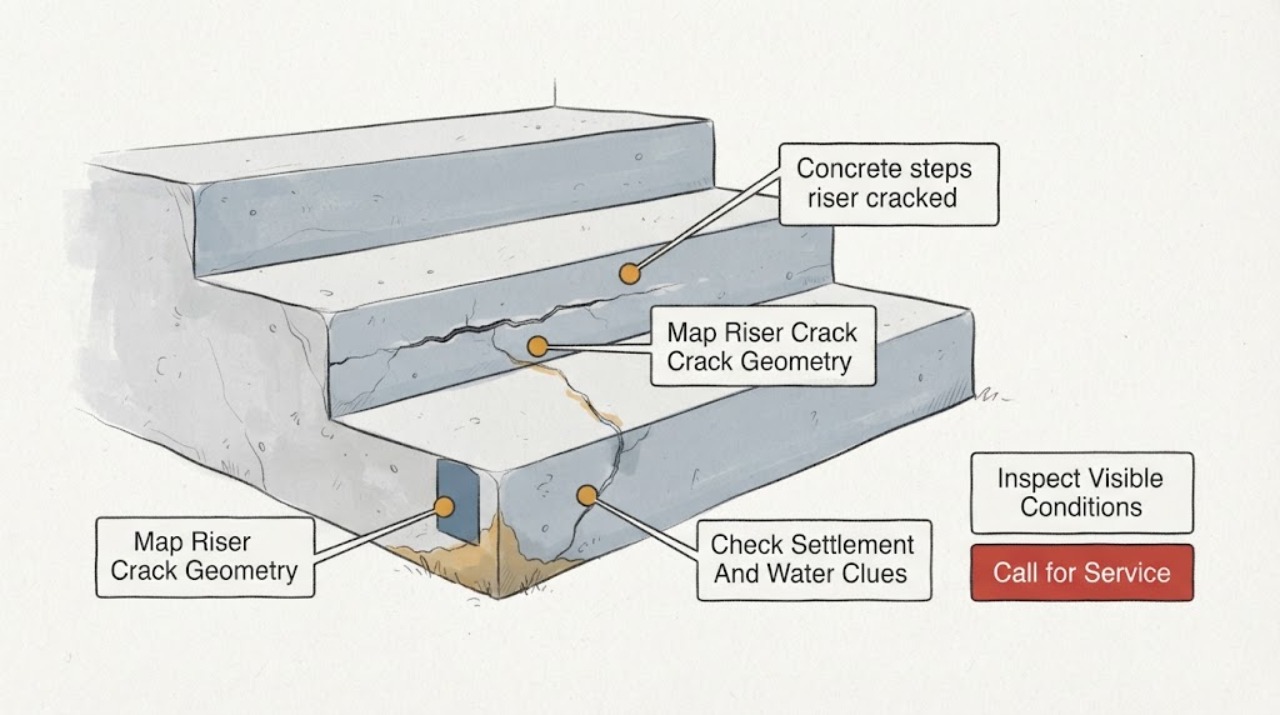
A crack in the vertical riser of concrete steps can be a surface defect, a trip hazard, or a sign that the step assembly is moving. From the ground or a safe landing, document the crack's direction, width, displacement, loose concrete, water or soil movement, and whether nearby joints or walls are also affected; do not load a questionable step or break, cut, drill, grind, lift, or dig around it. Keep people off any unstable or obstructed stairs and arrange qualified concrete or structural assessment promptly when the riser is separated, offset, widening, spalled, undermined, or associated with settlement or drainage signs. A patch or sealer is conditional and should be selected only after the cause and safety of the stairs are confirmed.
Before you begin
Safety first
- The writer provides observation guidance only. The professional determines whether surface repair, replacement, drainage work, or structural assessment is needed.
Work through in order
Diagnostic checks
Use only checks that match the exact appliance or system and its official guide.
-
Check 1
From the ground or a safe landing, photograph the riser without stepping on the questionable section and note whether the crack is vertical, horizontal, diagonal, isolated, or continuing into the tread, side wall, or adjacent step; do not touch or probe the concrete.
Expected result: The crack may look hairline and isolated, open into a visible gap, cross a corner, continue into another surface, or be obscured by dirt or finish.
Next step: Save overview and close photos from a safe position, identify the step and riser location, and give the geometry to a qualified concrete or structural professional.
Stop if: Stop if getting a closer view would require walking on an unstable step, climbing, moving debris, scraping, or disturbing the riser.
Why this matters
Why: An isolated fine line is not proof of a structural problem, while continuation across surfaces or a visible gap is a movement clue that needs assessment. Obscured areas cannot be classified safely by appearance alone.
-
Check 2
View the riser and tread edge from the side, without loading the step, and look for a height or alignment change, separated joint, bulging face, spalled area, loose fragment, or exposed reinforcement; do not press, tap, lift, or remove anything.
Expected result: The face may remain aligned and intact, show a small surface loss, show an offset or separation, or contain loose concrete or visible steel.
Next step: Keep the stairs closed to users, create a visible barrier from a safe location, and request prompt concrete or structural inspection for any displacement, loose material, or exposed steel.
Stop if: Stop immediately for movement, crumbling, a rocking-looking step, falling fragments, exposed steel, or any temptation to test the step with body weight.
Why this matters
Why: Offset, separation, loose material, or exposed reinforcement raises the urgency because the stair surface or support may not be behaving as one sound assembly. An intact-looking face does not confirm hidden stability.
-
Check 3
From safe ground, inspect the area around the steps for standing water, wet staining, soil washout, a void, a settled landing, downspout discharge, or a crack pattern that appears to change after rain or freezing weather; do not dig, pull soil away, or redirect drainage yourself.
Expected result: The surrounding ground may appear dry and level, show recurring water, show erosion or a void, or show settlement at the landing or beside the stair.
Next step: Photograph the surrounding grade and water path, note recent weather and when the crack was first noticed, and ask the professional to consider drainage and support as well as the riser surface.
Stop if: Stop if the ground is undermined, the landing appears to sink, water is actively flowing under the steps, or inspection would require excavation or moving a downspout.
Why this matters
Why: Water or settlement near the crack can be a contributing-condition clue rather than a repair diagnosis. A dry visit does not rule out intermittent drainage or seasonal movement.
-
Check 4
Without using the stairs, compare the cracked riser with adjacent risers, treads, side walls, and railings from the same safe viewpoint; look for repeated cracks, mismatched alignment, widening joints, wall separation, or a handrail that appears to move independently.
Expected result: The defect may be confined to one riser, repeat across several steps, extend into a side wall, or coincide with an apparently displaced rail or landing.
Next step: Mark the affected step on a sketch or photo, record all related visible defects, and provide the complete pattern when booking assessment.
Stop if: Stop for a separated wall, visibly displaced railing, a leaning stair edge, falling material, or any condition that makes the route unsafe to approach.
Why this matters
Why: A pattern across multiple elements suggests the professional should assess the stair system and its support, not just fill one visible line. A single visible crack still needs context before a surface repair is considered.
-
Check 5
Keep children, visitors, and pets away from the questionable stair and record the address area, affected step, photos, approximate crack change over time, weather, prior repairs, and any alternate route; do not use the stairs as a load test.
Expected result: The route may be avoidable, may be the only entry, or may have an obstruction or condition that prevents a safe bypass.
Next step: Use a safe alternate entrance if one exists and request qualified concrete or structural service; if there is no safe route, keep the area closed and state that access is restricted when arranging help.
Stop if: Stop all self-directed work and keep the area closed for an unstable step, blocked safe exit, falling concrete, exposed reinforcement, or sudden worsening.
Why this matters
Why: A route that cannot be safely bypassed increases urgency even when the crack is hard to classify. A dated record helps the professional compare progression without requiring the user to revisit an unsafe surface.
Use your observations
Decision map
Find the observation that best matches what you see, then follow the next safe action.
-
PATH 01Safety boundary
What you see
Does the riser appear aligned, intact, and free of loose material, displacement, water or settlement clues, with a crack that is isolated in the visible finish?
Do this next
Keep documenting without disturbing the surface and ask a concrete professional whether a compatible non-structural surface treatment is appropriate after inspection.
Why this path and its safety boundary
Safety stop: Do not widen, clean, fill, seal, or otherwise work the crack before the cause and safety have been evaluated.
-
PATH 02Safety boundary
What you see
Is there visible offset, separation from the tread or wall, a widening gap, loose concrete, exposed reinforcement, or a step that looks unstable?
Do this next
Close the stairs to users, place a safe barrier without approaching unstable concrete, and request prompt concrete or structural assessment.
Why this path and its safety boundary
Safety stop: Do not load-test, lift, reset, chip, cut, drill, grind, or demolish the riser or its support.
-
PATH 03Safety boundary
What you see
Are water, soil washout, a void, a settled landing, downspout discharge, or related wall and ground movement visible around the stairs?
Do this next
Report the condition as a possible drainage or support issue and request a professional assessment that includes the surrounding ground, not only the crack line.
Why this path and its safety boundary
Safety stop: Do not excavate, undermine, redirect buried drainage, or remove soil to expose the step.
-
PATH 04Safety boundary
What you see
Is the cracked stair the only route, or is there no safe position from which to inspect it?
Do this next
Keep people away and tell the service provider that access is restricted or the only route is affected so the visit can be planned safely.
Why this path and its safety boundary
Safety stop: Do not cross a questionable step to take a measurement, collect a fragment, or perform a repair.
Helpful context
Understand the symptom
Why a cracked riser deserves a visual assessment
The riser is the vertical face between treads, so a crack there may be limited to the finish or may continue through the step and its support. The useful distinction is not the word crack alone; it is whether the crack is widening, has a visible offset, separates the riser from the tread or side wall, or appears with loose pieces, settlement, or water movement. The checks below are observation-only and cannot establish load capacity or the hidden cause.
Treat displacement and trip hazards as service findings
Federal Highway Administration guidance describes several concrete crack patterns and notes that the crack type and its cause affect whether a repair will succeed; it also warns that sealing does not hold separated concrete sections together and that a crack creating a trip hazard may require replacement. A stair riser is not a sidewalk, so public-walkway thresholds should not be treated as a universal home-stair rule. Use any visible offset, separation, or unstable-looking concrete as a reason for professional assessment rather than as a measurement-based do-it-yourself decision.
Choose materials only after the scope is known
Manufacturer guidance for concrete crack products distinguishes small, non-structural crack-filling applications from larger or structural cracks and says the crack must be prepared to accept the selected material. That guidance does not make a cracked stair riser safe to repair without an inspection. Do not widen, clean, fill, seal, or otherwise disturb the riser yourself; provide the observations and photos to the professional who will determine whether a surface repair, replacement, drainage correction, or broader structural work is appropriate.
Only after diagnosis
Potential parts
- concrete-patch
Consider this category only if a qualified professional confirms that the defect is a compatible, non-structural surface repair and specifies the substrate preparation and service conditions.
Confirm the professional's material specification, cure and exposure requirements, and compatibility with the existing concrete before selecting a product. - concrete-sealer
Consider this category only after the professional identifies moisture protection as appropriate and confirms that sealing will not conceal movement or substitute for structural work.
Verify that the selected sealer is intended for the actual concrete surface and exterior stair exposure; do not apply it over an unresolved or moving crack.
When checks do not resolve it
Need a professional?
Arrange qualified concrete or structural service promptly for any widening or offset crack, separated riser, loose or falling concrete, exposed reinforcement, water or soil washout, settlement, related wall cracks, restricted access, or uncertainty about whether the stair is safe to use.
Safety scope: The writer provides observation guidance only. The professional determines whether surface repair, replacement, drainage work, or structural assessment is needed.
Have this ready
- The affected step and riser location
- Overview and close photos taken from a safe position
- Visible crack direction, separation, offset, loose material, or exposed reinforcement
- Water, drainage, soil, settlement, weather, and progression observations
- Whether the stairs are closed and whether a safe alternate route exists
Common questions
FAQ
Can I patch a cracked concrete stair riser myself?
Do not start by patching. First keep users away if the stair is questionable and document the crack from a safe position. A qualified professional should decide whether it is a non-structural surface defect or movement, and whether a patch or sealer is compatible and appropriate.
What makes a riser crack urgent?
Visible offset or separation, widening, loose or falling concrete, exposed reinforcement, a rocking-looking step, settlement, an undermined landing, water movement, or no safe alternate route warrants prompt qualified concrete or structural assessment and keeping the stairs closed.
Should I seal the crack to keep water out?
Only after the cause and safety are assessed. Official transportation guidance notes that sealants do not hold separated concrete sections together, so sealing can hide a movement problem or delay the needed work when the crack is structural or creates a trip hazard.
What information should I give the concrete professional?
Provide the affected step, safe-position photos, crack direction and visible separation or offset, related cracks, loose material, water or soil movement, settlement clues, weather and progression notes, prior repairs, and whether the route is closed or has an alternate path.
Read the exact guide
Official sources
- NYC DOT - SidewalksNew York City Department of Transportation · Used only as an official example that cracks, collapsed or uneven concrete, and missing sections are treated as pedestrian hazards; it does not establish a residential stair threshold.
- A Guide for Maintaining Pedestrian Facilities for Enhanced SafetyFederal Highway Administration · Used for general concrete crack, trip-hazard, cause-assessment, and limitation-of-sealing context; sidewalk guidance is not treated as a universal residential stair code.
- Pro Tips: How to Repair Cracked ConcreteSakrete · Used to frame product selection as conditional and to distinguish small crack-filler guidance from a structural crack; it is not a diagnosis or approval for user repair of a stair riser.
Community feedback
Share a repair observation
Share a plain-text repair observation. Accepted observations are published automatically; this page may take a moment to update.