
On this page
Start here
Quick answer
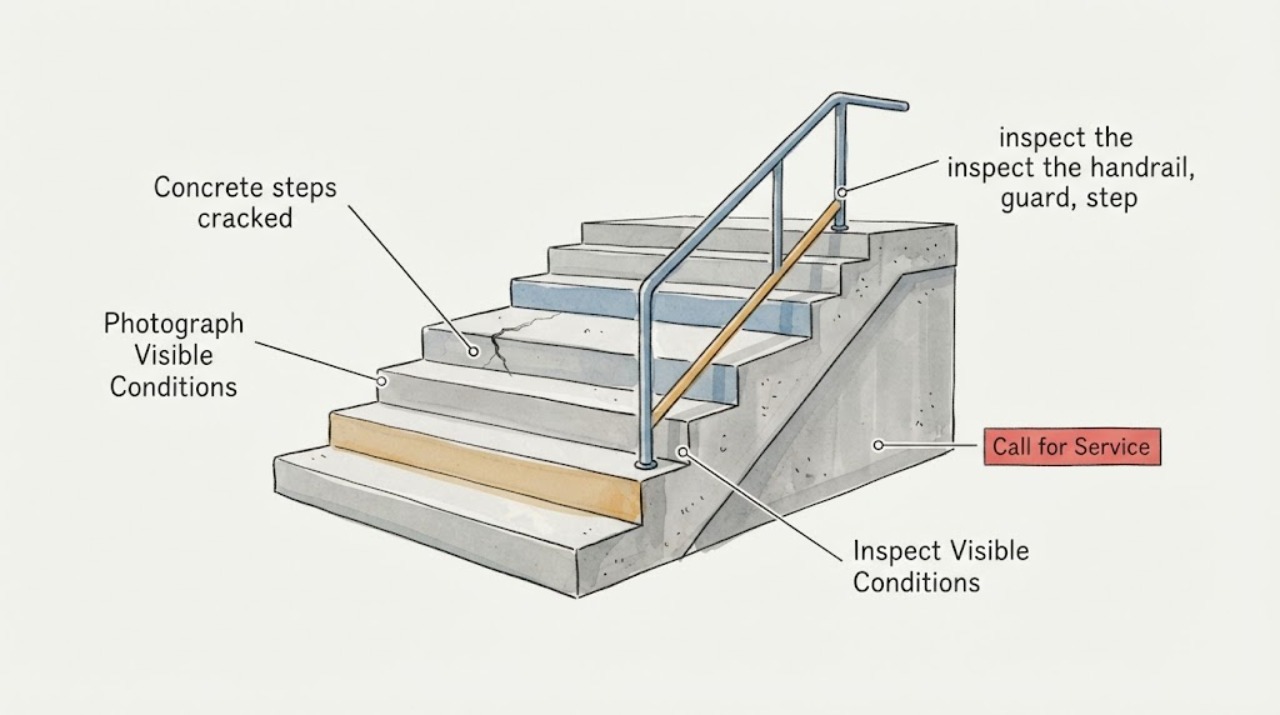
A crack in concrete steps is not automatically a cosmetic repair. A narrow surface crack may be stable, but widening, displacement, broken edges, loose pieces, water-related deterioration, or a change in the handrail or step geometry can make the steps unsafe. Stay on level ground and document the crack, step alignment, handrail condition, drainage, and any change over time from a safe distance. Keep people off steps that are unstable, slippery, missing an edge, or creating a trip or fall hazard, and arrange a qualified concrete or structural assessment. Do not cut, grind, chip, excavate, or demolish the steps yourself.
Work through in order
Diagnostic checks
Use only checks that match the exact appliance or system and its official guide.
-
Check 1
From level ground and without stepping on the affected flight, photograph the full steps and then the crack location from several safe viewpoints. Note whether the crack is on a tread, riser, side edge, landing, or the joint between the steps and adjacent structure.
Expected result: The crack may be a short surface line, run across a tread or riser, follow an edge, extend through multiple steps, or be accompanied by spalling and loose concrete.
Next step: Keep the photos with the date and arrange a concrete repair contractor or qualified structural professional when the crack crosses a load-bearing-looking area, repeats across steps, or is paired with movement or loose material.
Stop if: Stop the inspection and keep people away if concrete is loose, an edge is missing, debris can fall, or the route cannot be used without a trip or fall risk.
Why this matters
Why: Location and extent help a professional distinguish a localized surface defect from movement or deterioration affecting the stair assembly. A photo record is safer and more useful than trying to widen, clean, or test the crack.
-
Check 2
Compare the step faces and edges visually from the side and front, staying off the steps. Look for a raised or sunken tread, a leaning or separated section, a gap at the landing, or a change in the line of the stair relative to nearby walls or paving.
Expected result: The steps may remain visually aligned, or one tread, riser, landing, or side section may have shifted, settled, or separated.
Next step: If alignment has changed or the crack is widening, stop using the steps and request an in-person assessment. If alignment appears unchanged, continue only with ground-level observations and still seek service for a persistent or growing crack.
Stop if: Do not load, bounce, press, or otherwise test a questionable step. Keep the area closed if a tread or landing moves, sags, or appears unsupported.
Why this matters
Why: Visible displacement suggests movement or support issues rather than a simple surface finish defect. Do not infer structural safety from a crack that looks small if the step geometry has changed.
-
Check 3
From a safe position, inspect the handrail, guard, step edges, and lighting visually. Note whether the handrail is loose or out of line, an edge is chipped away, the tread surface is uneven or slippery, or the route is poorly lit.
Expected result: The handrail and edges may be intact, or there may be a loose rail, a missing corner, an abrupt height change, exposed sharp material, or poor visibility.
Next step: Block the route and arrange professional assessment if a handrail is loose, an edge is missing, or the tread is uneven or slippery. Tell the provider which safety feature is affected and whether anyone has already fallen or nearly fallen.
Stop if: Do not use the steps as a test path or attempt a handrail, edge, or tread repair before the damaged assembly is assessed.
Why this matters
Why: These conditions can make a cracked stair unsafe even when the concrete has not visibly shifted. Stair safety depends on the whole walking route, not just crack width.
-
Check 4
Observe the area around the steps during or after ordinary rain, without entering unsafe areas. Record whether water collects at the crack, flows toward the steps, washes soil away, freezes, or appears to come from a downspout, landing, or adjacent surface.
Expected result: The crack may stay dry, or there may be recurring dampness, staining, pooling, erosion, ice, or drainage directed toward the stair.
Next step: Photograph the water path and share it with the contractor. Keep the route closed when wet, icy, eroded, or undermined; do not dig or alter drainage to test a theory.
Stop if: Stop near the steps if runoff has exposed soil, undermined support, created ice, or made the landing unstable.
Why this matters
Why: Moisture and drainage can contribute to deterioration and can also create an immediate slip hazard. The source and extent of water need to be addressed as part of the repair plan rather than hidden under a surface patch.
-
Check 5
Create a dated observation record from the same safe viewpoint over time. Note whether the crack, displacement, spalling, staining, or nearby settlement changes after rain, frost, impact, or normal seasonal movement; do not mark or probe the concrete.
Expected result: The condition may remain visually unchanged, or the crack may lengthen, widen, branch, shed pieces, or coincide with new movement and moisture.
Next step: Send the photographs and change history to a qualified concrete contractor or structural professional and ask for an assessment of cause, extent, safe access, and repair scope before selecting any material.
Stop if: Do not keep observing from the steps when the route is deteriorating, pieces are falling, or a person could slip or fall.
Why this matters
Why: Progression is important evidence for the service provider. A stable-looking crack is not proof of structural adequacy, while visible progression or falling material increases urgency.
Use your observations
Decision map
Find the observation that best matches what you see, then follow the next safe action.
-
PATH 01Safety boundary
What you see
The crack is a small-looking surface line, with no visible displacement, loose material, drainage problem, or change in step geometry.
Do this next
Keep a dated photo record and ask a concrete professional whether it is a suitable nonstructural repair or should be monitored. Do not assume a cosmetic appearance proves the stair is safe.
Why this path and its safety boundary
Safety stop: Close the route if the crack grows, the surface becomes uneven or slippery, or loose material appears.
-
PATH 02Safety boundary
What you see
The crack crosses a tread or riser, repeats through several steps, or is accompanied by a raised, settled, leaning, or separated section.
Do this next
Stop using the steps and arrange an in-person concrete or structural assessment. Provide full-flight photographs and the date the movement was first noticed.
Why this path and its safety boundary
Safety stop: Do not load, test, cut, grind, chip, excavate, or demolish the stair assembly.
-
PATH 03Safety boundary
What you see
A handrail is loose, an edge is missing, the tread is uneven, or the route is poorly lit or slippery.
Do this next
Block access and use a safer entrance until the stair and its safety features are assessed and made safe by an appropriate professional.
Why this path and its safety boundary
Safety stop: Do not climb the steps to confirm the defect or use the handrail as a load test.
-
PATH 04Safety boundary
What you see
Water pools at the crack, drains toward the steps, washes away soil, freezes, or leaves recurring dampness or staining.
Do this next
Document the water path and request that drainage and support be considered in the repair scope. Keep the area closed when wet, icy, or undermined.
Why this path and its safety boundary
Safety stop: Do not dig, redirect buried drainage, or disturb potentially unstable soil as a homeowner test.
-
PATH 05Safety boundary
What you see
Concrete is loose or falling, support appears compromised, the steps have shifted, or someone has slipped or nearly fallen.
Do this next
Treat the route as unsafe, keep everyone away, and request urgent professional assessment. If there is an immediate fall or collapse hazard, contact local emergency or public-safety assistance.
Why this path and its safety boundary
Safety stop: Do not enter the exclusion area, attempt temporary structural support, or remove damaged concrete yourself.
Helpful context
Understand the symptom
The visible crack is only one part of the decision
Concrete cracks can have different causes and consequences. ACI notes that some affect appearance while others can indicate structural distress or environmental degradation, so the significance depends on the structure and crack pattern. The useful first step is a safe condition record, not a guessed patch. Surface repair products are intended for particular nonstructural conditions; they do not establish that a stair is safe to carry people.
Protect the route before investigating
Cracked steps can turn into a slip, trip, or fall hazard, especially when an edge is broken, a tread is uneven, a handrail moves, or water freezes. Do not climb on questionable steps to inspect them closely. Keep children, visitors, and delivery traffic away from an unsafe route and use a safer entrance while arranging assessment.
Only after diagnosis
Potential parts
- concrete patch
Only consider a patch material after a qualified assessment identifies a small, nonstructural surface or edge repair and specifies a compatible repair system.
Confirm the substrate condition, exposure, repair depth, traffic requirements, and manufacturer instructions; a patch does not correct movement or support problems. - concrete sealer
Only consider a sealer after the crack cause and moisture path are assessed and the professional confirms that sealing is appropriate for the repaired surface.
Confirm compatibility with the existing finish, repair material, weather exposure, and required slip resistance before selection.
When checks do not resolve it
Need a professional?
Arrange qualified concrete or structural service for any crack with displacement, repeated or worsening progression, loose or falling material, a damaged tread or riser, a loose handrail, drainage or settlement evidence, or uncertainty about whether the steps can safely carry people.
Common questions
FAQ
Does every crack in concrete steps require immediate rebuilding?
No. Cracks vary in cause and consequence. A professional should consider location, movement, moisture, loose material, and the role of the steps before deciding whether monitoring, a nonstructural repair, or broader work is appropriate.
Can I just fill a crack in the step?
Do not use a filler as a diagnosis. A patch may be suitable only for a confirmed small, nonstructural surface or edge condition. It will not correct settlement, movement, drainage, compromised support, or an unsafe tread.
What makes cracked steps an urgent safety issue?
Visible movement, a raised or settled tread, loose or falling concrete, a damaged edge, a loose handrail, undermined support, ice, or a route that creates a trip or fall risk should take the steps out of service until assessed.
What should I photograph for a concrete-step contractor?
From level ground, photograph the full flight, the crack location, adjacent landings and walls, step alignment, handrail and edge condition, drainage or staining, and dated changes. Include the history of settlement, freeze, impact, or prior repairs if known.
Read the exact guide
Official sources
- Do we always need to repair cracked concrete?American Concrete Institute · General concrete assessment context; the specific stair condition requires an in-person evaluation.
- Repairing Concrete StepsThe QUIKRETE Companies · Product-maker guidance; it does not establish that a cracked stair is safe or that a particular product fits an unknown structure.
- Guide to Concrete RepairAmerican Concrete Institute · Professional repair-planning guidance used here to support observation and escalation boundaries, not homeowner structural work.
- Work Areas: Stairways and Walking SurfacesOccupational Safety and Health Administration · General safety principles; the page is an occupational reference and does not replace local residential requirements.
Community feedback
Share a repair observation
Share a plain-text repair observation. Accepted observations are published automatically; this page may take a moment to update.