
On this page
Start here
Quick answer
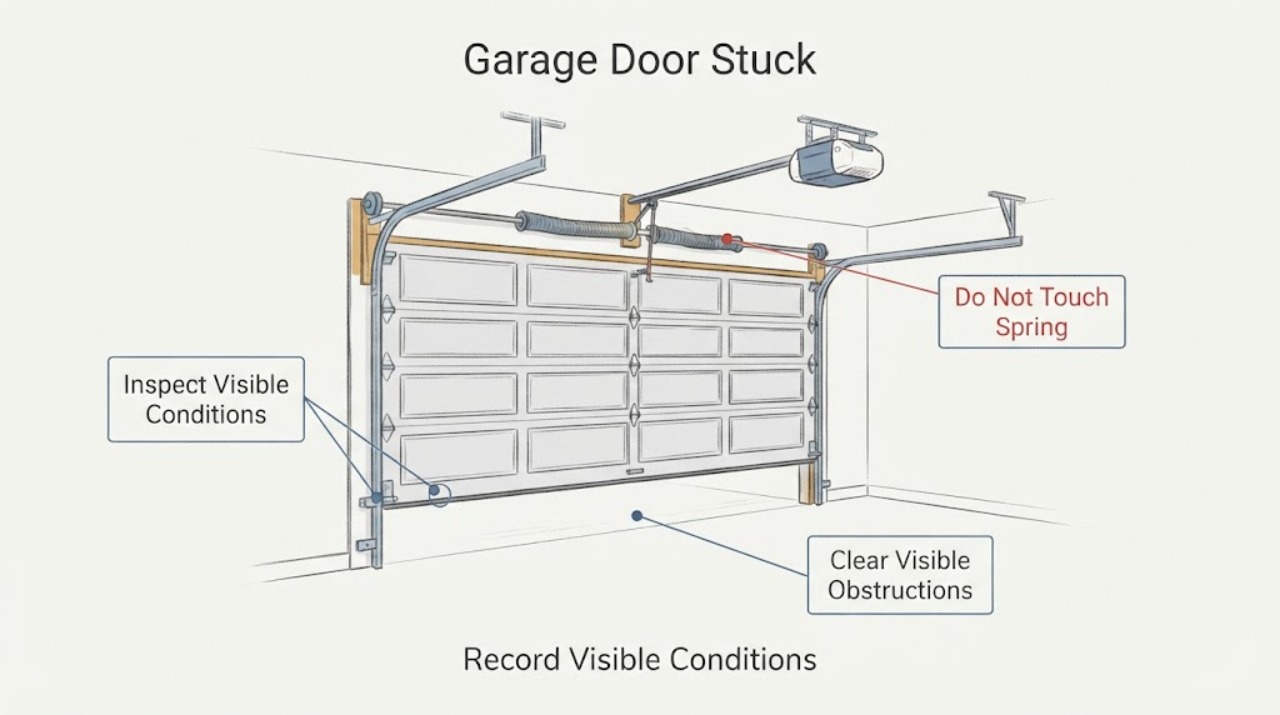
A stuck CHI garage door can be obstructed, bound in its tracks, out of balance, or affected by the opener or its safety system. First note whether the door is fully closed, partly open, crooked, or under visible strain, and keep people, pets, and vehicles out of the travel area. From a safe standing position, look for an obstruction or obvious track, roller, cable, spring, or panel damage and observe one normal control response only when there is no stop-use sign. If the door binds, sticks, is heavy, drops, will not stay open, or has damaged tensioned hardware, do not pull the release, lift it, adjust anything, or keep cycling it. C.H.I. directs owners with a door that is not functioning properly to a local C.H.I. dealer, and the CPSC says a door that binds or sticks should be serviced by a professional. Use the exact model documentation and report the door position, symptoms, and visible damage rather than ordering a guessed part.
Before you begin
Safety first
- The technician should determine whether the cause is an obstruction, opener or control issue, safety-system issue, track or roller problem, panel or hardware damage, counterbalance or spring condition, or a combination before selecting parts or adjustments.
Work through in order
Diagnostic checks
Use only checks that match the exact appliance or system and its official guide.
-
Check 1
From outside the travel path, note whether the CHI door is fully closed, partly open, crooked, or stopped against an obstruction, and keep people, pets, and vehicles clear; do not stand beneath a partly open door.
Expected result: The door is closed and level, partly open and stable, partly open and sagging or dropping, crooked in the tracks, or visibly under strain.
Next step: Photograph the position from a safe location and proceed only with checks that do not touch or load the door; keep a strained or partly open door unused and arrange prompt professional service.
Stop if: Stop immediately for a dropping door, a person or vehicle in the opening, a displaced cable or roller, a broken or stretched spring, a bent track, or any door that could move without control.
Why this matters
Why: A stable closed door leaves room for limited visual checks. A sagging, crooked, dropping, or strained door may have a balance, track, cable, spring, roller, or panel problem and can move unexpectedly.
-
Check 2
Only if the door is fully closed, the opening is clear, and no stop-use sign is present, use the wall control or remote once from a position with a clear view; do not repeatedly cycle a stuck door.
Expected result: The opener is silent, its light or control responds but the door does not move, the motor hums or strains, the door moves briefly and stops, or it starts and reverses.
Next step: Record the exact response and stop testing; use the response and door position to select the service path rather than increasing force or changing travel or force settings.
Stop if: Do not continue operating a door that grinds, binds, moves crookedly, drops, strains the opener, or has damaged springs, cables, tracks, rollers, or panels.
Why this matters
Why: A control response without door movement can involve the opener drive or a mechanically stuck door. Straining, brief movement, or reversal does not prove which component failed and should be interpreted with the door's visual condition.
-
Check 3
With the door stationary, inspect from a dry, stable position for an object in the opening, debris near the threshold, a visibly blocked sensor path, track separation or warping, a roller out of position, loose-looking hardware, or a damaged panel; do not reach into the tracks or move hardware.
Expected result: A loose object is clearly outside the door's load path, debris is present but inaccessible, a track or roller looks damaged, a sensor or cable is displaced, or nothing visible explains the stuck condition.
Next step: Remove only a loose object that is safely reachable without touching the door or hardware; otherwise photograph the finding, keep the door unused, and call qualified service.
Stop if: Do not straighten a track, reseat a roller, pull a cable, adjust brackets, bypass a sensor, or reach between door sections or into a track.
Why this matters
Why: A loose obstruction may explain a stopped door only when it can be removed without entering the travel path. A damaged track, roller, cable, panel, or sensor changes the issue to a service inspection; no visible obstruction does not make it safe to force the door.
-
Check 4
If and only if the door is fully closed, no spring, cable, track, panel, or balance damage is visible, and the exact opener instructions permit it, use the release mechanism as directed to separate the opener; do not lift the door if the release or manual movement is unfamiliar.
Expected result: The door moves smoothly by its handle, is hard to move, binds, feels unusually heavy, will not stay in a partially open position, or the manual check cannot be done without force or uncertainty.
Next step: Leave the door closed and attached or isolated exactly as the opener manual directs; request qualified service for any heavy, binding, unstable, or uncertain result.
Stop if: Do not pull the release on a partly open or damaged door, lift against resistance, hold a door under load, touch springs or cables, or attempt a balance adjustment.
Why this matters
Why: Smooth, controlled manual movement makes a completely locked track less likely, but does not clear the opener or prove balance. Heavy, binding, unstable, or uncertain movement supports a counterbalance, track, hardware, or door problem that requires professional handling.
-
Check 5
From safe access, photograph the full door, its sections and hardware, the opener label if visible, and any CHI model marking or original paperwork; do not remove covers or panels to identify a model.
Expected result: The CHI model is clear, only the brand is known, the opener identity is clear but the door model is not, or no identity can be read safely.
Next step: Use the model information with C.H.I.'s document finder or provide the photos and paperwork to a local C.H.I. dealer or qualified technician before ordering anything.
Stop if: Do not order a generic spring, cable, roller, panel, or operator component from appearance alone, and do not open a tensioned or powered assembly to read a label.
Why this matters
Why: A model number lets the C.H.I. document finder locate the relevant door information. Brand-only or ambiguous identity cannot establish which tracks, rollers, panels, operator parts, or procedures apply.
-
Check 6
Prepare a service record with the door position, last successful movement, opener response, visible obstruction or hardware findings, model information, photographs, and whether the release or manual check was skipped for safety.
Expected result: The record shows a simple accessible obstruction, an unexplained stuck door, a door that binds or is unbalanced, opener-only symptoms, or visible damage to tracks, rollers, cables, springs, panels, or controls.
Next step: Contact a local C.H.I. dealer or qualified garage-door professional, explain the exact pattern, and keep the door unused when the cause is unresolved or any safety symptom is present.
Stop if: Do not make further tests, adjustments, or disassembly after a failed safe check or whenever the door can move unexpectedly.
Why this matters
Why: These patterns help a technician separate an obstruction or control issue from a door, track, roller, counterbalance, or opener fault. The record is diagnostic context, not proof that a particular replacement part fits.
Use your observations
Decision map
Find the observation that best matches what you see, then follow the next safe action.
-
PATH 01Next step
What you see
The door is closed and aligned, a loose object is clearly in the opening, no hardware is damaged, and the object can be removed without entering the travel path or touching the door.
Do this next
Remove only the safely reachable object, then use the control once with the door in full view; stop and request service if it remains stuck, strains, or reverses.
Why this path and its safety boundary
Why it matters: A simple obstruction is more plausible than a failed counterbalance or track, but the door should still be observed from a safe position after the object is removed.
-
PATH 02Next step
What you see
The control or opener responds, but the closed door does not move, moves only briefly, hums or strains, or immediately stops, while no safe visual obstruction is found.
Do this next
Leave the door unused, provide the opener response and door model information to a qualified technician, and use only the exact owner instructions for any further safe observation.
Why this path and its safety boundary
Why it matters: An opener drive or control issue is possible, but a mechanically stuck door can produce a similar response. Do not increase force, alter travel settings, or disconnect components as a diagnostic shortcut.
-
PATH 03Next step
What you see
The door is partly open or closed but binds, moves crookedly, feels heavy, drops, will not stay open, or shows a displaced roller, track, cable, spring, panel, or other hardware damage.
Do this next
Keep the travel area clear, do not pull the release or lift the door, and arrange prompt qualified garage-door service.
Why this path and its safety boundary
Why it matters: A balance, counterbalance, track, roller, panel, or connected hardware fault is more likely than a routine opener setting. An unbalanced door can move or fall unexpectedly.
-
PATH 04Next step
What you see
The door starts but stops or reverses, especially while closing, and no damaged or binding door hardware is visible.
Do this next
Keep the door in full view, check only for a loose obstruction that is safely reachable, and request opener service if the behavior remains or any sensor, wiring, or hardware is displaced.
Why this path and its safety boundary
Why it matters: An obstruction, entrapment-protection sensor path, opener control, or setting may be involved, but a single symptom cannot identify the failed component.
-
PATH 05Next step
What you see
The door remains stuck after safe visual checks, the model or opener identity is unclear, or the observed pattern does not fit a simple obstruction, control response, or visible hardware condition.
Do this next
Send photos, model information if available, door position, and control response to a local C.H.I. dealer or qualified garage-door technician and leave the door unused until assessed.
Why this path and its safety boundary
Why it matters: The cause cannot be safely narrowed from outside. Guessing at a spring, cable, roller, panel, track, or operator part can create a compatibility or injury risk.
Helpful context
Understand the symptom
The door position changes the safe next step
Record whether the CHI door is fully closed, partly open, or crooked, and whether it stopped while opening or closing. A partly open door can move or fall if its balance or hardware is compromised. Do not stand under it, place a vehicle beneath it, or use repeated opener commands to reproduce the problem. Keep the area clear while you decide whether a simple visible obstruction is present or professional service is needed.
A stuck door is not automatically an opener problem
An opener that is silent, hums, moves briefly, or reverses can point to different inspection paths, but the symptom does not identify a failed part. A door that is heavy, binds, moves crookedly, drops, or will not stay open raises a door, track, roller, cable, spring, or balance concern. CPSC guidance warns that an unbalanced door can unexpectedly fall and says doors that bind or stick should be serviced by a professional.
Use CHI documentation to identify the door, not to guess a repair
C.H.I. provides a document finder that searches by model number and says its doors, replacement parts, and accessories are sold through its dealer network. Photograph the door and any safely visible model information, but do not remove panels, springs, cables, rollers, or operator covers to find a number. A dealer or qualified garage-door technician can match the door and opener information to the actual repair path.
Safety boundary
Stop conditions
- Stop operating the CHI door and opener for grinding, binding, crooked travel, unusual heaviness, a drop, a door that will not stay open, or any displaced, broken, or damaged spring, cable, roller, track, panel, or bracket.
- Do not pull the emergency release on a partly open or damaged door, lift against resistance, remove rollers or panels, straighten tracks, adjust springs or cables, or change opener force or travel settings as a guess.
- Keep people, pets, and vehicles out of the opening and travel path; do not use a partly open door as a parking or walking route while the cause is unresolved.
- Request qualified garage-door service when the door remains stuck after a safe obstruction check, when the model or opener is unclear, or when any control, balance, track, or hardware issue cannot be localized safely.
When checks do not resolve it
Need a professional?
Use prompt service whenever the CHI door remains stuck or the cause is uncertain. Keep the door unused and request urgent attention for a partly open, dropping, crooked, heavy, binding, or unbalanced door; damaged springs, cables, rollers, tracks, panels, or wiring; or a door that can move unexpectedly.
Safety scope: The technician should determine whether the cause is an obstruction, opener or control issue, safety-system issue, track or roller problem, panel or hardware damage, counterbalance or spring condition, or a combination before selecting parts or adjustments.
Have this ready
- The CHI door model or original paperwork if safely available, plus photographs of the full door, opener label, tracks, rollers, and visible hardware
- Whether the door is fully closed, partly open, crooked, or stopped at a repeatable height
- The last known normal operation and the exact response to one wall-control or remote command
- Any visible obstruction, sensor-path issue, damaged panel, track, roller, cable, spring, bracket, or power concern
- Whether the manual-release or balance check was skipped because the door was partly open, damaged, heavy, or unfamiliar
Common questions
FAQ
Why is my CHI garage door stuck?
A stuck door may have an obstruction, track or roller problem, opener or safety-system issue, panel or hardware damage, or a balance or counterbalance fault. The door's position, movement pattern, and visible condition narrow the possibilities, but a symptom alone does not identify a part.
Can I pull the emergency release on a stuck CHI door?
Only follow the exact opener instructions and only when the door is fully closed, undamaged, and the procedure is familiar. Do not pull the release on a partly open, crooked, heavy, binding, or damaged door; a qualified technician should assess it instead.
What should I do if my CHI garage door starts and reverses?
Keep the door in full view and check only for a loose obstruction that can be removed without entering the travel path or touching hardware. If it still stops or reverses, or if any sensor, wiring, track, cable, or panel looks damaged, stop cycling it and arrange opener or garage-door service.
How can I find the right CHI garage-door information?
Photograph the full door and any model marking or paperwork that is safely visible. C.H.I.'s document finder searches by model number; do not remove panels, covers, springs, cables, or operator parts to identify the model.
When is a stuck garage door an emergency service issue?
Keep the door unused and request urgent qualified service if it is partly open, dropping, crooked, unusually heavy, binding, unable to stay open, or has a broken or displaced spring, cable, roller, track, panel, bracket, or wiring.
Read the exact guide
Official sources
- Publication - 523 Non-Reversing Automatic Garage Door Openers Are a HazardU.S. Consumer Product Safety Commission · CPSC guidance covers automatic garage-door entrapment protection, safe balance observations, manual checks, and professional service for doors that bind or stick.
- Document finderC.H.I. Overhead Doors · The C.H.I. documentation tool searches detailed information for each door by model number.
- Frequently asked questionsC.H.I. Overhead Doors · C.H.I. says owners with a door that is not functioning properly should contact a local C.H.I. dealer for service and identifies its dealer network for doors, replacement parts, accessories, and opener service.
- Residential garage doorsC.H.I. Overhead Doors · The page provides C.H.I. residential product and operating-support information, including dealer service for a door that is not functioning properly.
Community feedback
Share a repair observation
Share a plain-text repair observation. Accepted observations are published automatically; this page may take a moment to update.