
On this page
Start here
Quick answer
A stuck Wayne Dalton garage door may have a simple obstruction or opener-control problem, but a door that binds, is unusually heavy, sits crooked, has a broken or frayed cable, or stops partway can involve the counterbalance or other hardware under high tension. Keep people and vehicles out of the door path. First observe whether the opener is silent, clicks, hums, moves the trolley without moving the door, or reverses; then check the remote or wall control, visible track obstructions, and photo-eye alignment from a safe standing position. Do not force the door, pull an emergency release while the door is open or partway up, loosen tracks, adjust springs, touch cables or bottom brackets, or reach between door sections. If the door itself is heavy, crooked, off track, damaged, or stuck in an elevated position, stop and arrange a trained garage-door technician. Wayne Dalton's own guidance says there is little for a homeowner to repair beyond checking opener batteries and ensuring tracks and sensors are clear.
Before you begin
Safety first
- Do not stand under a stopped or moving door, force or catch the panels, pull the emergency release while the door is open or partly open, loosen tracks, adjust springs or cables, remove bottom brackets, pry rollers into place, defeat photo eyes, or open the opener housing. Keep people and vehicles clear until a trained technician inspects the system.
Work through in order
Diagnostic checks
Use only checks that match the exact appliance or system and its official guide.
-
Check 1
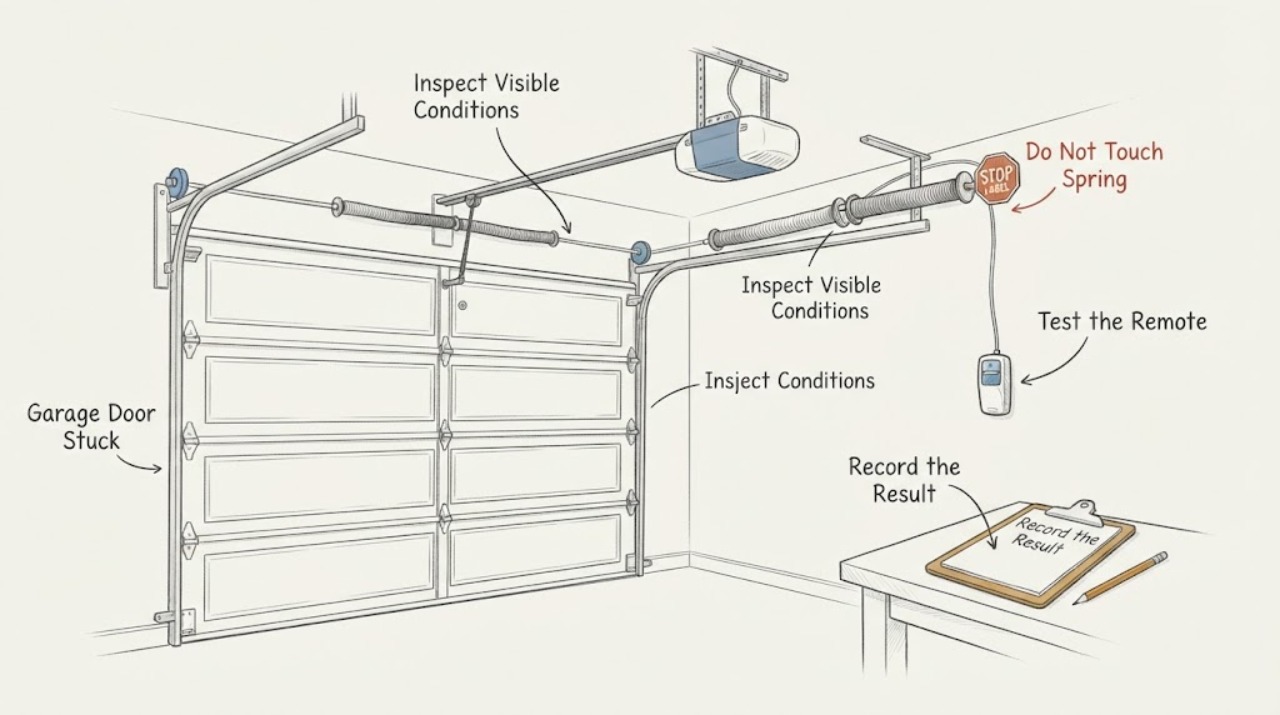
Keep everyone clear of the moving-door path and observe one control attempt from the side, without standing under the door. Record whether the opener is silent, clicks, hums, moves its trolley or chain, lifts a few inches, stops, or reverses, and whether the door is closed, partway open, or stuck open.
Expected result: The opener is silent; the motor runs but the door does not move; the door moves briefly then reverses or stops; or the door is visibly crooked, hanging, or partway open.
Next step: Stop repeated attempts and use the symptom pattern to select the control, sensor, obstruction, or hardware branch. Do not stand beneath, push, pull, or catch a door that is stuck open or partly open.
Stop if: Stop immediately for a crooked or unsupported door, a door off its track, a loud bang, a broken-looking spring or cable, or any movement that is sudden or uncontrolled.
Why this matters
Why: A silent opener can point to control or power; a moving trolley with a stationary door can point to a carriage or door connection; reversal can involve an obstruction or sensor; a crooked or elevated door makes hardware and fall risk more important than opener programming.
-
Check 2
Check the ordinary controls without opening the opener: try the wall control once, note any opener light or diagnostic response, inspect the remote or keypad batteries if accessible, and confirm that the opener has visible power. Do not repeatedly cycle the control or remove the opener cover.
Expected result: The wall control works while the remote does not; neither control produces a response; the opener light is off with no visible power; or the controls respond but the door remains stuck.
Next step: Replace only a clearly exhausted remote or keypad battery with the documented type and retest from a safe position. If wall control response, power, or door movement remains abnormal, preserve the symptoms and arrange service rather than opening or rewiring the opener.
Why this matters
Why: A remote or keypad battery can explain a control-only failure, while no response at the wall control can involve power or the opener. A responsive opener with a stuck door shifts the diagnosis toward obstruction, sensors, carriage connection, track, balance, spring, cable, or other door hardware.
-
Check 3
Inspect the door path, tracks, and photo eyes visually from outside the mechanism. Look for a box, vehicle, ice, dirt, bent track, roller outside its track, or anything interrupting the sensor beam; check that the two sensor lenses are clean and aimed at one another. Do not loosen track fasteners, reposition brackets, reach through the sensor path while the door moves, or touch the rollers.
Expected result: An object blocks travel; a sensor lens is dirty or its indicator is not normal; the track is bent or loose; a roller is out of the track; or the path and sensors look clear.
Next step: Remove only a loose object that is fully outside the door and sensor mechanism, and gently clean an accessible sensor lens with a soft dry cloth if the owner's manual permits. Do not straighten tracks or reseat rollers; request trained service for bent, loose, or displaced hardware or for a stuck door.
Stop if: Stop if an obstruction is trapped under load, a roller is out of the track, a track is bent, or clearing the path would require reaching under or between door sections.
Why this matters
Why: A genuine obstruction or sensor interruption can stop or reverse an otherwise functioning opener. A bent track, displaced roller, or loose hardware is a door-system condition, not a safe force-setting adjustment. A clear path and normal sensors make balance, carriage, spring, cable, or internal opener faults more likely.
-
Check 4
From a safe distance, inspect visible door hardware without touching it. Note a gap or fray in either lift cable, a spring that looks broken or displaced, a loose or bent bottom bracket, a panel separation, or a door that sits unevenly. Do not loosen, adjust, lubricate, or pull any spring, cable, pulley, bracket, or tensioned hardware.
Expected result: A cable is slack, frayed, or off its drum; a spring or bracket looks broken or displaced; the panels are crooked or damaged; or no visible hardware damage is apparent.
Next step: Keep the door stationary, prevent anyone from approaching it, and arrange trained garage-door service for any tensioned-hardware symptom. Do not pull the emergency release or attempt to move an elevated or heavy door to confirm the diagnosis.
Stop if: Stop all operation for any frayed or slack cable, broken spring, displaced bracket, loose panel, or door that is partially open and unsupported.
Why this matters
Why: Broken or frayed cables, broken springs, and damaged brackets can remove the counterbalance that supports the door and can cause a sudden fall or uneven movement. No visible damage does not clear hidden hardware or balance; a door that remains stuck still needs a controlled diagnosis.
-
Check 5
If the door is fully closed and the owner manual specifically provides a safe, user-level movement check, observe whether it is square and free of an obvious obstruction without forcing it. Do not lift a stuck, crooked, damaged, or partially open Wayne Dalton door by hand, and do not use the emergency release as a balance test in those conditions.
Expected result: The closed door appears square but the opener cannot move it; the door is heavy or binds; it moves unevenly; or the door cannot be safely checked in the closed position.
Next step: Record the exact movement symptom and arrange service for anything heavier than normal, binding, uneven, damaged, or stuck. Do not adjust travel or force settings to overpower a door that is not moving freely.
Stop if: Stop if the door is not fully closed, does not remain stable, needs force, or is near people, vehicles, or stored items that could be struck.
Why this matters
Why: A square closed door with a responsive opener can leave a carriage, travel, or opener-control issue to diagnose. Heavy, binding, uneven, or untestable movement makes balance, track, spring, cable, or panel problems more likely and makes a user movement test unsafe.
-
Check 6
Prepare the technician handoff instead of escalating the DIY repair. Photograph the door position, tracks, rollers, sensors, visible cables or springs, opener lights, and any obstruction from a safe location; record the Wayne Dalton door or opener model information from its normal label and the event that preceded the jam.
Expected result: The door jam followed a loud bang, impact, cold weather, a power interruption, repeated reversal, or no obvious event; or there are photos of the relevant hardware and controls.
Next step: Give the photos and timeline to a trained door-systems technician and keep the door isolated until inspected. Do not remove covers, release tension, disconnect cables, or keep trying the opener to obtain another symptom.
Stop if: Stop and seek prompt service for an open or partly open door, broken or frayed cable, spring damage, bent track, impact damage, or any uncontrolled movement.
Why this matters
Why: A loud bang or visible tensioned-hardware change increases concern for a spring or cable failure; impact or cold can affect tracks and movement; repeated reversal favors obstruction or sensor evidence. The same stuck symptom can have different service scopes, so the timeline matters.
Use your observations
Decision map
Find the observation that best matches what you see, then follow the next safe action.
-
PATH 01Next step
What you see
The wall control has no response or the opener has no visible power, while the door itself is closed, square, and not visibly damaged.
Do this next
Check the ordinary user controls and documented battery condition once, then arrange opener service if wall control response or power remains abnormal. Keep the door path clear.
Why this path and its safety boundary
Why it matters: A control, remote, keypad, power, or opener issue is more likely than a loaded door track. A control symptom does not justify opening the motor housing.
-
PATH 02Next step
What you see
The opener responds, but the door reverses or refuses to close, and a visible object, dirty or misaligned photo eye, or obstruction in the door path is present.
Do this next
Remove only a loose object away from the mechanism and clean an accessible lens as the manual permits. If the sensor indication stays abnormal or the door still reverses, call a trained technician and do not bypass the sensors.
Why this path and its safety boundary
Why it matters: The safety system may be correctly preventing movement because it sees an obstruction or cannot confirm the sensor beam. A bent track or trapped object is a separate mechanical stop.
-
PATH 03Next step
What you see
The door is crooked, catches at one height, a roller is outside the track, or a track is bent, loose, or impacted while the opener attempts to move.
Do this next
Stop using the opener, keep the door supported by its current position, and arrange trained garage-door service. Do not loosen track brackets, pry the roller back, or force the panels through the bind.
Why this path and its safety boundary
Why it matters: Track or roller binding is more likely than a remote-battery problem. The opener can strain or damage itself when it drives against a mechanically bound door.
-
PATH 04Next step
What you see
A loud bang preceded the jam, the door is suddenly heavy or uneven, a cable is slack or frayed, a spring appears broken, or the door is stuck halfway or elevated.
Do this next
Keep everyone away, do not pull the emergency release or move the door, and arrange prompt trained door-systems service. Do not attempt a spring, cable, pulley, bracket, balance, or bottom-roller repair.
Why this path and its safety boundary
Why it matters: A spring, cable, pulley, bracket, or balance failure is more likely, and the door may fall or move unexpectedly. Wayne Dalton treats these components as high-tension professional work.
-
PATH 05Next step
What you see
The opener motor or trolley moves but the door stays closed, or the door is mechanically clear and balanced-looking while the opener does not transmit movement.
Do this next
Stop repeated cycles and provide the movement observation and model information to a trained technician. Do not remove the opener cover, defeat a lock, alter travel or force settings, or pull a release on an elevated door.
Why this path and its safety boundary
Why it matters: A carriage, trolley, J-bar, lock, travel, or opener connection issue is more likely than a blocked photo eye. The exact connection varies by Wayne Dalton door and opener combination.
Helpful context
Understand the symptom
Separate an opener problem from a door-hardware problem
Pressing the control and hearing a motor does not tell you whether the door can safely move. If the trolley moves but the door does not, the connection or door hardware may be involved. If the door reverses, the opener may be responding to an obstruction or sensor signal. If the door is heavy, crooked, off its track, or stuck halfway, the counterbalance and door assembly take priority over opener settings. Start with sound and movement observations, not force.
The safe homeowner check is mostly visual
Clear a visible object from the door path and inspect the photo eyes without reaching into the mechanism. You can record the opener light pattern, remote or wall-control response, track obstruction, and visible cable or spring damage from a safe position. Do not loosen track brackets, pull tensioned cables, adjust springs, remove bottom brackets, or put fingers between door sections.
A temporary release is not a repair
An emergency-release handle can separate an opener from the door, but using it on an open or partially open door can let a door fall. Do not use the release as a test when the door is elevated, crooked, jammed, or unsupported. If the door must be secured, moved, or balanced, the appropriate next step is trained service with the correct tools and a controlled work area.
Only after diagnosis
Potential parts
- garage door remote or keypad battery
Consider this category only when the wall control or opener responds normally but a remote or keypad alone is inactive and the battery is confirmed exhausted.
Confirm the exact remote or keypad model and battery type from its manual or label. A battery cannot correct a door that binds, is unbalanced, or has damaged hardware. - photo-eye safety sensor or mounting hardware
Consider this category only when the opener's documented indication and a clear beam point to a failed sensor or mount, not simply because the door is stuck.
Match the opener model, sensor technology, wiring, mounting, and safety requirements. Never bypass or defeat the safety sensors to make the door move. - garage door roller or track component
Consider this category only after a trained technician identifies a worn roller or damaged track and determines that replacement, rather than alignment or another hardware repair, is appropriate.
Confirm door model, roller stem and track geometry, load, fasteners, and the manufacturer's or technician's fit information. Do not replace bottom rollers or loosen track brackets as a homeowner test. - Wayne Dalton counterbalance spring or cable assembly
Consider this category only after a trained door-systems technician confirms a broken or damaged counterbalance component and identifies the exact door system.
Confirm the exact door model, height, weight, spring system, cable routing, and manufacturer service procedure. Springs, cables, pulleys, brackets, and related hardware are tensioned and are not user-installation parts.
When checks do not resolve it
Need a professional?
Stop and arrange trained garage-door service for a door that binds, sticks, is out of balance, is stuck halfway or open, becomes suddenly heavy or crooked, has a broken or frayed cable, spring or bracket damage, a bent track, a displaced roller, uncontrolled movement, or a failed safety-reversal test. Do not pull the emergency release on an elevated door, loosen tracks, adjust springs or cables, remove bottom brackets, force the door, or bypass photo-eye sensors.
Safety scope: Do not stand under a stopped or moving door, force or catch the panels, pull the emergency release while the door is open or partly open, loosen tracks, adjust springs or cables, remove bottom brackets, pry rollers into place, defeat photo eyes, or open the opener housing. Keep people and vehicles clear until a trained technician inspects the system.
Common questions
FAQ
Why is my Wayne Dalton garage door stuck?
Common possibilities include an obstruction, photo-eye or opener problem, misaligned track or roller, broken or frayed cable, broken spring, damaged hardware, or cold-related stiffness. Start by observing the opener response and visually checking the path and sensors. A heavy, crooked, elevated, or mechanically binding door needs trained service rather than force.
Can I manually lift a stuck Wayne Dalton garage door?
Do not lift a stuck, crooked, damaged, or partly open door. A failed spring or cable can leave the door unsupported, and an emergency release can allow an elevated door to fall. Follow the owner manual only for a clearly safe, fully closed procedure; otherwise keep the area clear and call a trained door-systems technician.
What if the opener runs but the Wayne Dalton door does not move?
The trolley or carriage may not be transmitting movement, or the door may be locked, bound, off track, or missing counterbalance support. Observe whether the door is crooked or heavy and visually check for an obstruction without touching the mechanism. Do not open the motor housing, force the door, or adjust the connection or travel settings.
Can I adjust a Wayne Dalton garage door spring or cable myself?
No. Wayne Dalton warns that springs, cables, pulleys, brackets, and related hardware are under high or extreme tension and says only trained door professionals should adjust or repair them. Photograph visible damage from a safe distance and arrange service.
Why does the garage door reverse or refuse to close?
An obstruction or misaligned photo-eye sensor can make the opener stop or reverse as a safety response. Check that the path is clear and the sensor lenses are clean and aimed at each other from a safe position. If the indication remains abnormal, the door binds, or it fails a safety-reversal check, stop using it and arrange qualified service rather than bypassing the sensors.
Read the exact guide
Official sources
- Why Is My Garage Door Jammed and Stuck?Wayne Dalton Sales & Service · Manufacturer-affiliated Wayne Dalton service guidance directly addressing stuck or jammed garage doors across door and opener causes
- Maintaining Your Garage DoorOverhead Door Corporation · Official garage-door maintenance guidance from Wayne Dalton's parent corporation for distinguishing safe visual checks from tensioned hardware service
- Safety & ComplianceChamberlain · Official opener safety context for understanding why photo-eye and entrapment-protection systems must not be bypassed; it does not establish Wayne Dalton model compatibility
- Garage Door Safety MonthWayne Dalton · Official Wayne Dalton safety guidance for keeping people away from pinch points and reserving tensioned hardware and failed safety systems for trained professionals
Community feedback
Share a repair observation
Share a plain-text repair observation. Accepted observations are published automatically; this page may take a moment to update.