
On this page
Start here
Quick answer
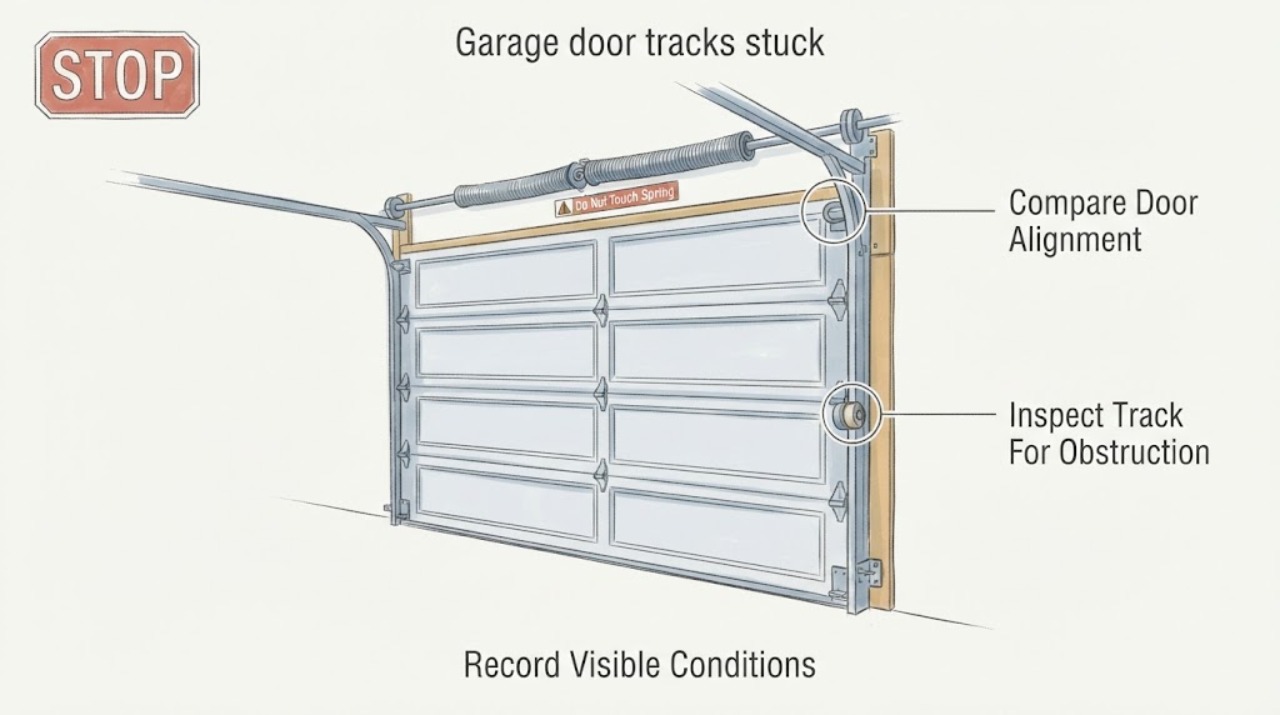
If an Amarr garage door is stuck in its tracks, stop pressing the opener and keep people, pets, and vehicles clear. With the door closed and stable, inspect both tracks for pebbles, dirt, a bent or loose rail, and a roller that is out of the track; look for a crooked panel, rubbing edge, loose hinge, damaged cable, or broken spring. A small obstruction may be removed from outside the track, but a displaced roller, bent track, heavy or uneven door, or door that will not move smoothly points to a system fault. Amarr says debris can disrupt roller travel and track alignment, while springs, cables, balance, and track repair need a qualified technician. Do not force the door, hammer or bend the rail, pull a roller into place, loosen red hardware or bottom brackets, or run repeated opener cycles. Arrange service before movement for an off-track or unstable door, broken spring or cable, damaged track, failed safety reversal, or any sudden drop.
Before you begin
Safety first
- This article supports stopping the opener, clearing the area, photographing a closed and stable door, removing loose debris away from hardware, and making only a cautious manual observation when the Amarr manual permits it. A trained technician must handle roller or hinge removal, track alignment, spring and cable work, bottom brackets, balance, opener adjustment, and final safety testing.
Work through in order
Diagnostic checks
Use only checks that match the exact appliance or system and its official guide.
-
Check 1
Stop using the opener and clear the doorway; note the door's position and the exact point where it stops without pulling on the door or placing fingers between sections.
Expected result: Record fully closed, partly open, one side lower, a roller outside the track, a door hanging or dropping, or an opener that continues straining or reversing.
Next step: Leave the opener unused and choose a branch below. Arrange trained service before any movement for an unstable, off-track, partly open, or suddenly heavy door.
Stop if: Do not release a partly open door, stand underneath it, or pull it down by a panel edge.
Why this matters
Why: A stable closed door permits cautious visual checks. A partly open, uneven, off-track, dropping, or strained door can involve a loaded spring, cable, roller, track, panel, or balance system and should not be forced.
-
Check 2
With the door closed and the opener off, inspect both vertical tracks and the horizontal track area from outside the moving path; remove only loose debris that is clearly accessible without tools.
Expected result: Record a clear straight track, a pebble or twig, dirt buildup, a bent or warped rail, loose mounting hardware, a shiny rub mark, or a gap between the roller and rail.
Next step: Clear loose debris and wipe the track with a damp cloth only when the door is closed and stable. Leave the door out of service for a bent, loose, or damaged track or any obstruction that cannot be removed without force.
Stop if: Do not hammer, bend, shim, drill, or loosen the track, and do not run the opener to test a rail that looks damaged.
Why this matters
Why: A small loose obstruction can stop a roller, while a warped rail, loose mount, rub mark, or gap indicates alignment or impact damage. Amarr says debris can disrupt roller travel and buildup can compromise track integrity.
-
Check 3
From a safe distance, compare the rollers, hinges, and panel edges along the stuck side with the opposite side; do not pull a roller or tighten hardware near a loaded section.
Expected result: Look for a cracked or worn roller, tilted stem, bent hinge, pulled screw, bowed panel, section gap, or edge rubbing the track.
Next step: Photograph the component and request trained service for a worn or displaced roller, damaged hinge, pulled fastener, bowed panel, or rubbing edge. If no defect is visible, continue only with the tensioned-hardware observation.
Stop if: Do not pull the roller from the rail, straighten the hinge, drill the panel, or place fingers between sections.
Why this matters
Why: A damaged roller, hinge, or panel can bind inside a sound-looking track and can shift the door load to neighboring parts. A single visible defect does not make removal safe while the section is installed.
-
Check 4
From outside the door path, visually inspect springs, lift cables, bottom brackets, pulleys, and visible supports for a break, fraying, slack, displacement, or rust; do not touch or adjust them.
Expected result: Record intact-looking parts, a separated spring, frayed cable, loose or damaged bottom bracket, missing safety cable where applicable, or one side carrying a different load.
Next step: Keep the door and opener out of service and arrange a trained inspection for any abnormal spring, cable, bracket, pulley, or support observation. Report the stuck position and whether the condition followed impact, weather, or a prior repair.
Stop if: Do not loosen red fasteners, bottom brackets, spring plates, cable connections, or supports, and do not lift the door by hand.
Why this matters
Why: Counterbalance or cable damage can make a track appear stuck because the door is no longer supported evenly. Amarr identifies springs as dangerous, warns about high tension, and directs damaged cable and spring work to professional service.
-
Check 5
Only when the door is fully closed, stable, and free of visible track, roller, hinge, panel, spring, cable, and bracket damage, use the emergency release and attached handles for a gentle manual movement observation as described by the Amarr manual.
Expected result: Record smooth movement, a stop at one track point, binding, scraping, twisting, unusual effort, one side rising first, or a door that will not remain balanced when released at the manual-check position.
Next step: Stop at the first resistance or uneven movement and arrange trained service. Do not reconnect the opener until the door is aligned, balanced, and safe.
Stop if: Do not force the door, release it while partly open, test balance on a damaged door, or operate below an unsupported section.
Why this matters
Why: Smooth movement makes a small obstruction more plausible but does not prove the track or roller is healthy. Binding, twisting, imbalance, or unusual effort points to track, roller, panel, hinge, cable, spring, or opener-load trouble.
-
Check 6
After trained service has corrected the obstruction, alignment, or hardware issue and confirmed the door is balanced, test the opener's photo-eye and reversal functions only as described in the opener manual, with no person under the door.
Expected result: Record smooth travel, reversal during the approved obstruction test, refusal to close when the photo-eye path is interrupted, or renewed stopping, rubbing, noise, or uneven movement.
Next step: Leave the opener out of service and contact the technician again for failed safety response, renewed binding, noise, or section shift. Keep the door in sight during supervised testing.
Stop if: Do not bypass sensors, change force settings, hold the wall button to defeat a safety response, or repeat tests on an unpredictable door.
Why this matters
Why: A failed reversal or renewed track bind means the system is not ready for normal use even if it moves once. A passed test confirms only the observed safety functions and not every track or counterbalance component.
Use your observations
Decision map
Find the observation that best matches what you see, then follow the next safe action.
-
PATH 01Safety boundary
What you see
The door is fully closed and stable, the track is straight, the roller is seated, and a small loose obstruction or dirt buildup is visible without damage or uneven movement.
Do this next
Remove only the loose obstruction and wipe the track with a damp cloth. Make one cautious manual observation only if the door remains stable; call service if it still binds or the noise returns.
Why this path and its safety boundary
Why it matters: A removable obstruction is more likely than a balance or hardware failure, but the track may still have hidden wear if the door remains stuck after cleaning.
Safety stop: Stop for a bent rail, displaced roller, scraping, sudden resistance, panel shift, or any need to use force or tools.
-
PATH 02Safety boundary
What you see
The track looks usable but one roller, hinge, panel edge, or section joint is damaged, pulled out, rubbing, bowed, or out of line.
Do this next
Keep the opener off and request trained service to inspect the roller, hinge, panel, track, and balance before parts are removed. Do not tighten or replace the visible part while the section is installed.
Why this path and its safety boundary
Why it matters: A local roller, hinge, or panel fault is more likely than dirt alone and may be transferring load into the track or neighboring sections.
Safety stop: Do not pull the roller into place, straighten the hinge, drill the panel, or force the door past the bind.
-
PATH 03Safety boundary
What you see
A rail is bent or loose, the roller is outside the track, the door is crooked, or shiny rub marks and scraping show that the sections are no longer traveling squarely.
Do this next
Do not operate or lift the door. Keep the opening clear and arrange trained service to secure and realign the complete system.
Why this path and its safety boundary
Why it matters: Track alignment or impact damage is more likely, possibly involving the section, roller, hinge, bracket, or cable. Continued movement can let the door leave the rail or damage the opener.
Safety stop: Do not hammer or bend the rail, reposition the roller, loosen track hardware, or stand below a partly open door.
-
PATH 04Safety boundary
What you see
The door is unusually heavy, one side rises first, it drops or will not hold position, a spring or cable is broken or slack, or the opener strains and reverses.
Do this next
Keep the door and opener out of service, isolate the area, and arrange a trained inspection. Tell the technician which part looked abnormal without touching it.
Why this path and its safety boundary
Why it matters: A counterbalance, cable, bottom-bracket, or opener-load fault is more likely than a track-only blockage. The door may fall or move unexpectedly.
Safety stop: Do not touch springs or cables, loosen red fasteners or bottom brackets, adjust the opener, or reconnect it.
-
PATH 05Safety boundary
What you see
The door moves manually but the opener stalls, reverses, strains, or fails its photo-eye or obstruction response after the track path appears clear.
Do this next
Leave the opener disconnected and arrange trained service to verify balance, attachment, force, travel, sensors, and the door system together.
Why this path and its safety boundary
Why it matters: An opener setting, attachment, sensor, door reinforcement, or balance problem is more likely than a simple track obstruction. A freely moving door does not make the opener safe if its protection fails.
Safety stop: Do not raise force settings, defeat sensors, hold the wall button, or use repeated cycles to overcome a stall.
Helpful context
Understand the symptom
A stuck track is a symptom, not necessarily the failed part
The rollers follow the tracks while hinges let the door sections flex. A twig or buildup can block travel, but a roller, hinge, panel, track hanger, cable, spring, or opener can also make the door stop at one point. The location of the stop, whether one side is higher, and whether the door is heavy when manually moved help separate a simple visible obstruction from a loaded system fault.
Start with the door closed and the tracks untouched
Amarr recommends beginning with visual inspection and says its maintenance check is not a reason to attempt repair procedures. Look for debris, warped rails, loose hardware, damaged rollers, and door imbalance. Use only the exact owner manual for lubrication: the Amarr owner manual limits lubrication by component and warns that a technician must replace worn tracks, cables, springs, rollers, and hinges.
Counterbalance hardware sets a firm stop boundary
A sectional door is heavy even when the spring system is working. Amarr states that an unbalanced door needs service and warns not to remove, repair, or adjust springs or high-tension fasteners. If the door is off-track, partly open, or suddenly heavy, leave it where it is if safe and call a trained technician rather than trying to make the track fit the door.
Safety boundary
Stop conditions
- Keep the opener off for an off-track, sagging, unstable, partly open, crooked, binding, or unexpectedly heavy door, or when a roller or track is displaced.
- Stop for a broken or frayed spring or cable, damaged bottom bracket, loud impact, sudden drop, sharp scraping, smoke, or any unpredictable movement.
- Do not loosen or adjust springs, cables, bottom brackets, red fasteners, track brackets, rollers, hinges, or opener force controls; these repairs require trained service.
- Never place fingers between sections, force a roller into a rail, bypass opener sensors, or keep cycling a door that does not move smoothly.
Only after diagnosis
Potential parts
- Amarr garage door roller
Consider a roller only when inspection confirms a worn, damaged, displaced, or seized roller and the track, hinge, section, and balance system are suitable.
Confirm the exact Amarr model, roller stem, wheel material and dimensions, bearing arrangement, track configuration, and section thickness before selection. - Amarr garage door track or track hardware
Consider this category only when trained inspection confirms a bent, warped, loose, or damaged rail or mounting component linked to the stuck condition.
Confirm track size, radius or lift configuration, section thickness, mounting hardware, clearances, and exact door model; do not use a generic rail to compensate for a balance fault. - Amarr garage door hinge or panel attachment
Consider this category only when inspection confirms a damaged hinge, pulled fastener, or failed panel attachment that is causing the section to bind.
Match hinge position, section profile, roller arrangement, fastener pattern, and exact door model; do not infer fit from the stuck location alone. - garage door spring, cable, bottom bracket, or opener component
Consider this category only after trained testing identifies a counterbalance, cable, bottom-bracket, reinforcement, or opener fault that explains the load or movement problem.
Do not select or install tensioned parts from a symptom. Confirm door weight, dimensions, spring and cable arrangement, bracket, opener model, and current manufacturer instructions through trained service.
When checks do not resolve it
Need a professional?
Arrange trained Amarr garage-door service before moving the door when a track is bent or loose, a roller is outside its track, the door is crooked or binds, a hinge or panel is damaged, the door is heavy or unbalanced, a spring or cable looks abnormal, or the opener safety response fails. A small loose obstruction can be cleared only with the door closed and stable; call if the door remains stuck, the obstruction is not safely accessible, or the noise or resistance returns.
Safety scope: This article supports stopping the opener, clearing the area, photographing a closed and stable door, removing loose debris away from hardware, and making only a cautious manual observation when the Amarr manual permits it. A trained technician must handle roller or hinge removal, track alignment, spring and cable work, bottom brackets, balance, opener adjustment, and final safety testing.
Common questions
FAQ
Why is my Amarr garage door stuck in the track?
A pebble, twig, or buildup can block a roller, but a damaged or displaced roller, bent track, hinge, panel, cable, spring, or balance issue can produce the same symptom. With the door closed and stable, inspect without touching loaded hardware. Keep the opener off for uneven, off-track, or heavy movement.
Can I force an Amarr garage door past a stuck spot?
No. Forcing it can move a roller out of the rail or transfer load into the hinge, cable, spring, or opener. Remove only loose debris that is clearly accessible with the door closed and stable. A bent track, displaced roller, resistance, or uneven door needs trained service.
Should I loosen the Amarr track brackets to realign the door?
Do not loosen track brackets or other hardware to make a stuck door fit. Track alignment, section geometry, rollers, and counterbalance work together, and adjustment can create a falling or off-track door. Keep the opener off and arrange trained inspection.
Can a broken Amarr spring make the door look stuck?
Yes. Amarr says worn or broken springs can make the door heavy and increase the opener load, while a spring or cable problem can make movement uneven. Do not touch springs, cables, bottom brackets, or red fasteners; isolate the area and call a trained technician.
What should I tell an Amarr garage-door technician?
Report where the door stops, whether it is closed or partly open, which track side is affected, debris or rub marks, roller and hinge observations, door level and manual effort, spring or cable appearance, opener strain or reversal, and any impact, weather, or prior service. Do not touch tensioned parts while collecting information.
Read the exact guide
Official sources
- Residential Conventional Hardware Installation InstructionsAmarr · Official Amarr installation instructions; hardware and track configuration vary by installed model.
- Automatic Garage Door Opener Safety & Maintenance GuideDoor & Access Systems Manufacturers Association International · Industry safety guide for automatic garage doors and openers; installed door and opener manuals remain model-specific.
- SafetyAmarr · Official Amarr safety guidance; use the exact owner manual for installed-door details.
- FAQsAmarr · Official Amarr FAQ; specific track and door arrangements vary by model.
- Residential Owner's ManualAmarr · Official Amarr residential owner manual; exact hardware and opener configuration vary by model.
- How To Do a Garage Door Inspection (and Why It's Important)Amarr · Official Amarr inspection article; it is general guidance and does not replace the exact door manual.
- Garage Door Care and MaintenanceAmarr · Official Amarr care guidance; lubrication and inspection details vary by exact model and component.
Community feedback
Share a repair observation
Share a plain-text repair observation. Accepted observations are published automatically; this page may take a moment to update.