
On this page
Start here
Quick answer
Keep people and vehicles clear and watch the closed door from a safe position to identify when the noise occurs: at one track location, throughout travel, only during the opener's operation, or near springs and cables. Amarr says springs, rollers, and hinges can squeak with normal use, while dirt or debris in rollers, loose hardware, track misalignment, and damaged rollers can create excessive noise or jerky movement. With the door closed and not moving, clean visible track dirt with a damp cloth; do not lubricate tracks, and do not put lubricant on nylon rollers. If the exact manual permits it and the roller type is known, a garage-door lubricant may be applied only to accessible moving parts without reaching near springs, cables, brackets, or the moving door. Stop for a door off track, broken or frayed cable, damaged spring, heavy or jerky movement, grinding, snapping, or a noise that persists after safe cleaning, and call a trained garage-door technician. Do not loosen spring fasteners, adjust tracks, replace rollers near a loaded door, disconnect the opener as a guess, or stand under the door.
Before you begin
Safety first
- Owner checks are limited to watching from outside the travel path, visual inspection with the door closed, wiping accessible track surfaces, and model-supported lubrication of safe moving parts only when the roller type and manual permit it. A trained technician must handle roller removal, track alignment, fasteners near tensioned parts, springs, cables, bottom brackets, balance, opener force, travel limits, and any door that is heavy, off track, or damaged.
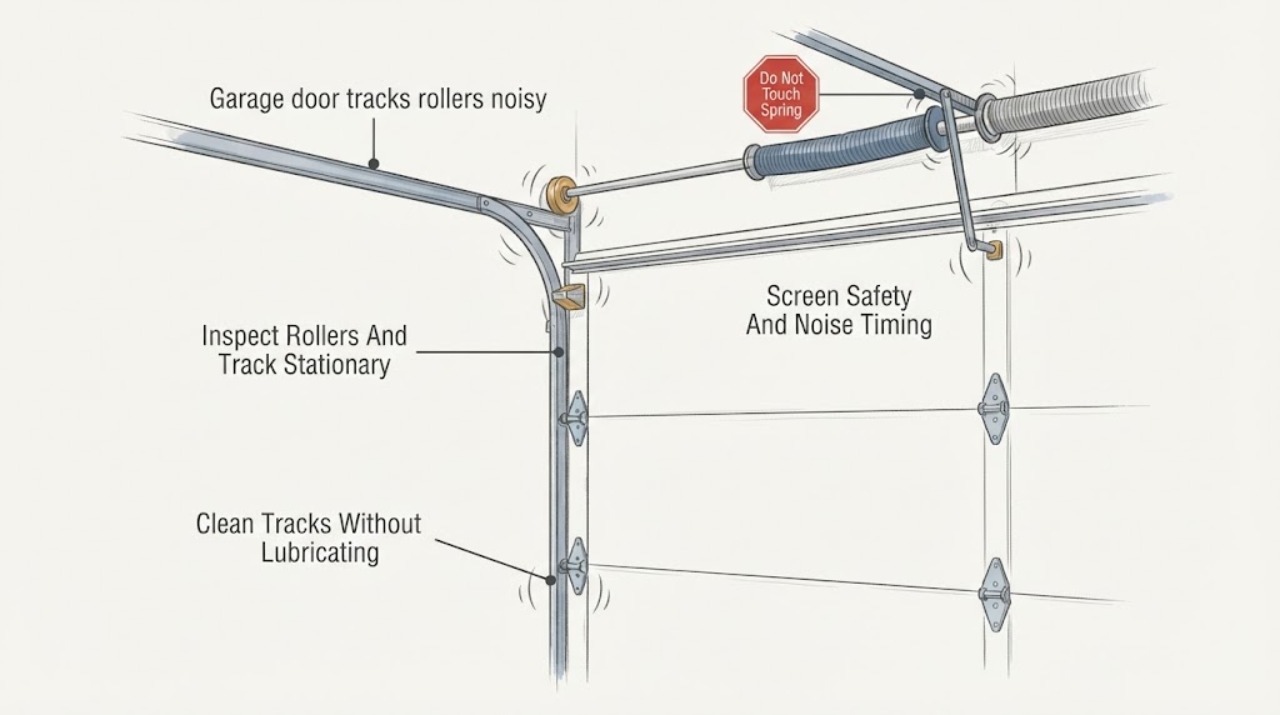
Work through in order
Diagnostic checks
Use only checks that match the exact appliance or system and its official guide.
-
Check 1
With the door closed, inspect from a safe position for a broken or frayed cable, damaged spring, roller out of the track, bent rail, hanging hardware, or a door that is crooked. If no hazard is visible, watch one normal opening or closing cycle while standing clear and keeping children and vehicles away.
Expected result: The noise occurs at one track point, throughout travel, only when the opener runs, or with jerking, binding, slamming, heavy movement, or a sudden snap.
Next step: Continue only with stationary visual cleaning when the door operates normally. Stop cycling the door and call a trained technician for any structural, spring, cable, off-track, or sudden-change symptom.
Stop if: Stop immediately for a broken or frayed cable, damaged spring, door off track, uncontrolled movement, a loud snap, heavy or crooked door, or a person or vehicle in the path.
Why this matters
Why: A location-specific squeak or rub can involve one roller, hinge, fastener, or rail. Opener-only noise may be in the drive unit. Jerky, heavy, crooked, snapping, or off-track behavior can involve springs, cables, balance, or alignment and is unsafe for owner repair.
-
Check 2
With the door fully closed and stationary, visually inspect the rollers, roller stems, track edges, hinges, and visible fasteners from the side. Do not put fingers between sections, reach behind rollers, climb, or loosen any fastener.
Expected result: A roller is cracked, worn, seized, dirty, outside the rail, or visibly loose; the track is bent or displaced; or only surface dirt is visible.
Next step: Photograph the condition from a safe distance and call a technician for damage, wear, misalignment, or a loose roller. Only surface dirt should proceed to the stationary cleaning step.
Stop if: Stop for a roller outside the rail, bent or loose track, damaged hinge, sharp metal, a loose bottom bracket, or any need to move the door or hardware by hand.
Why this matters
Why: Amarr says damaged rollers can create noise or stop operation, while dirt and track misalignment can create friction and rubbing. A roller outside the track or a displaced rail is not a lubrication problem.
-
Check 3
With the door closed, wipe accessible track surfaces with a damp cloth or soft duster to remove dust, cobwebs, and loose buildup. Keep the cloth away from the rollers, cables, springs, and any moving part; do not spray lubricant into the tracks.
Expected result: Surface dirt comes away, buildup remains, the track is bent or loose, or the noise is unchanged after cleaning.
Next step: If only loose dirt was present, make one normal observation of the door. If buildup remains, the track is displaced, or noise persists, stop and arrange technician service rather than scraping or adjusting the rail.
Stop if: Stop for a track that is difficult to reach, sharp, bent, loose, oily with unknown product, or close to a spring, cable, bottom bracket, or moving door.
Why this matters
Why: Loose track dirt can add friction, but cleaning cannot correct rail alignment, a damaged roller, a bearing, or a loaded hardware fault. Amarr cautions that lubricating tracks can attract more dirt and its manual says not to lubricate them.
-
Check 4
Without removing a roller or reaching into the track, identify whether the visible roller appears to be a type that the exact Amarr manual permits lubricating. If the type or lubricant is uncertain, do not apply anything; never lubricate nylon rollers or tracks.
Expected result: The manual supports lubricant on an accessible moving part, the roller appears nylon, the roller type is unknown, or the noise is near springs, cables, or brackets.
Next step: Skip lubricant when type or manual guidance is unclear. If an exact manual-supported application is accessible without entering the door path or touching tensioned parts, use only the specified product sparingly; otherwise call a technician.
Stop if: Stop for nylon or unknown rollers, any spring, cable, bottom bracket, red fastener, moving door, or a need to spray broadly or reach behind the rail.
Why this matters
Why: Amarr's guidance differs by part: some moving hardware may use a garage-door lubricant, while the owner manual excludes nylon rollers and tracks. Uncertainty or proximity to tensioned parts makes lubrication unsafe as a guess.
-
Check 5
From outside the travel path, listen for rattling hardware, a scrape at one rail section, a squeak from hinges or springs, or a hum, grinding, or clicking from the opener. Do not tighten bolts, alter opener force, or remove a cover to isolate the sound.
Expected result: Noise follows one roller or track point, is a loose-panel rattle, is a spring or hinge squeak, or comes from the opener while the door itself moves smoothly.
Next step: Record the location and timing. A persistent noise, opener grinding, or any noise with jerky travel needs a trained technician; do not chase it by tightening hardware near tensioned assemblies.
Stop if: Stop for grinding, snapping, a loose hanging panel, abnormal opener behavior, a door that changes speed, or any need to open the opener or adjust force or limits.
Why this matters
Why: Different sound locations imply different service areas. Amarr notes that springs, rollers, hinges, tracks, loose hardware, and the opener can each contribute to noise; the sound alone does not identify a failed component.
-
Check 6
Do not disconnect the opener or lift a heavy door as a diagnostic experiment. Instead, observe whether the powered door rises and lowers evenly, stays level, and stops without slamming or straining; stop the cycle if movement becomes abnormal.
Expected result: The door is level and smooth, rises unevenly, feels or sounds strained, slams, reverses unexpectedly, or will not complete travel.
Next step: Keep the door unused as needed and call a trained garage-door technician for any abnormal movement. Do not increase opener force, adjust springs, or manually lift a door that is heavy or off balance.
Stop if: Stop for uneven travel, slamming, reversal, a door that will not stay or complete travel, a broken spring or cable, or any need to release the opener or handle tensioned parts.
Why this matters
Why: Smooth level travel makes a simple roller or track-surface issue more plausible. Uneven, strained, slamming, reversing, or incomplete travel can indicate balance, spring, cable, track, opener, or safety problems.
-
Check 7
Record the Amarr door model if already visible, noise type and location, whether it occurs at one travel point or throughout movement, roller and track condition, cleaning or lubricant history, door movement, and any cable, spring, or hardware concern. Do not remove parts to obtain model information.
Expected result: Noise improves after safe surface cleaning or model-supported lubrication, remains unchanged, returns quickly, or is accompanied by damaged or unsafe movement.
Next step: Call a trained Amarr dealer or garage-door technician and provide the record and safe photos. Keep people clear and stop operating the door when damage, imbalance, or tensioned-part symptoms are present.
Stop if: Stop owner work after the stationary visual, track-cleaning, and safe observation checks; do not continue into roller removal, track adjustment, spring or cable work, or opener modification.
Why this matters
Why: A limited maintenance correction may reduce surface friction, but persistent or recurring noise and any safety symptom require inspection of the complete door system and opener.
Use your observations
Decision map
Find the observation that best matches what you see, then follow the next safe action.
-
PATH 01Next step
What you see
The door stays level and smooth, noise is a light squeak or rattle, and only surface dirt or an accessible model-approved moving-part lubrication need is visible.
Do this next
Clean accessible tracks with a damp cloth and follow the exact manual's lubricant boundary. Do not lubricate tracks or nylon rollers; call service if the noise persists.
-
PATH 02Next step
What you see
Noise repeats at one track location and inspection shows a worn roller, buildup, bent rail, gap, or displaced hardware.
Do this next
Stop adjusting the rail or removing the roller. Photograph the location and call a trained technician for alignment, hardware, or roller service.
-
PATH 03Next step
What you see
Noise occurs through most of the cycle, several rollers or hinges show wear, or the opener strains while the door remains generally aligned.
Do this next
Keep operation to a minimum and arrange a full door and opener service check. Do not increase motor force or replace springs or rollers without professional diagnosis.
-
PATH 04Next step
What you see
The door is crooked, heavy, jerky, slow, slams, reverses, binds, or does not stay or complete travel while the noise occurs.
Do this next
Stop cycling the door and call a trained garage-door technician. Do not disconnect the opener as a guess, lift the door, adjust springs, or alter force and travel settings.
-
PATH 05Next step
What you see
A spring is broken or visibly damaged, a cable is frayed or off the drum, a bottom bracket or red fastener is loose, or a loud snap occurred.
Do this next
Keep everyone out of the garage-door path and call a qualified technician. Do not operate the door or touch, remove, or adjust the tensioned assembly.
-
PATH 06Next step
What you see
The door moves smoothly and remains aligned, but hum, grinding, clicking, or rattling comes from the opener rather than the rollers or tracks.
Do this next
Stop opening the opener housing or changing force and limits. Arrange opener and door service, especially if the noise is new, worsening, or accompanied by incomplete travel.
Helpful context
Understand the symptom
Noise timing is more useful than noise volume
A click or squeak at one point in travel can follow a particular roller, hinge, fastener, or track section. A steady rumble throughout travel can involve multiple rollers or the opener. A snap, scrape, or sudden change after an impact is a stop signal. Amarr describes rollers as the wheels that guide the door in its tracks and notes that dirt, damage, and misalignment can affect smooth travel, so listen while watching from a safe distance rather than touching the system while it moves.
Clean tracks; do not treat the track as a bearing
Amarr's maintenance checklist recommends a damp cloth for dust, cobwebs, and buildup in the tracks, while its owner manual says not to lubricate tracks or nylon rollers. Track lubricant can collect more dirt and does not correct a bent or misaligned rail. Clean only with the door closed and stationary, and stop if a track is bent, loose from the wall, or difficult to reach safely.
Roller type and spring access change what is safe
Some Amarr guidance recommends a garage-door lubricant for noisy moving hardware, but the owner manual distinguishes metal moving parts from nylon rollers and says not to lubricate nylon rollers or tracks. Identify the roller material without removing it; if it is unclear, skip lubricant. Springs, cables, bottom brackets, and red or high-tension fasteners are not owner lubrication or adjustment points. A professional can determine whether a noisy roller needs cleaning, a sleeve, replacement, or an alignment repair.
A noisy door may be an unbalanced or unsafe door
If the door rises unevenly, feels heavy, slams, binds, or will not stay where it is placed, the noise is not a simple roller-maintenance problem. Amarr says worn springs increase the opener load and that a trained technician should check springs, rollers, and the opener. Do not compensate by increasing opener force or loosening track or spring hardware; preserve the symptom for the technician.
Safety boundary
Stop conditions
- Stop immediately for a broken or frayed cable, damaged spring, door off track, loud snap, uncontrolled or falling movement, heavy or crooked door, slamming, or a person or vehicle in the travel path; keep everyone clear and obtain qualified service.
- Do not adjust or remove springs, cables, bottom brackets, red or high-tension fasteners, tracks, rollers, opener force, or travel limits. Do not disconnect the opener or manually lift a heavy door as a guess.
- Do not lubricate tracks or nylon rollers, spray broadly into the door system, or apply a product when the roller type or exact Amarr manual is unknown. Keep lubricant away from the floor and safety sensors.
- Stop owner troubleshooting after safe stationary visual inspection, track cleaning, and model-supported observation. Persistent noise, abnormal movement, opener grinding, damage, or alignment concerns need a trained garage-door technician.
Only after diagnosis
Potential parts
- garage-door roller
Relevant only when inspection confirms a cracked, worn, seized, noisy, or out-of-track roller and a technician verifies the replacement need.
Confirm exact door model, roller material, stem and bearing arrangement, track design, and load requirements; roller removal near a loaded door is professional work. - noise-dampening roller sleeve
Relevant only when a dealer confirms that noise reduction is appropriate after inspecting the door and rollers; it is not a substitute for alignment or damage repair.
Confirm the door model, roller carrier, sleeve arrangement, and dealer installation requirements; do not add a sleeve to a damaged or misaligned roller. - garage-door track or track fastener
Relevant only when a trained technician confirms a bent, displaced, corroded, or improperly supported track or fastener.
Match door height, track radius, headroom, mounting configuration, and safety hardware; track alignment and fasteners can affect a loaded door and are not owner adjustments. - garage-door hinge or bearing
Relevant only when noise or visual inspection identifies a worn, cracked, seized, or loose hinge or bearing after the door is safely assessed.
Confirm door section, hinge position, roller stem, load, and exact parts information; do not remove hardware from a moving or tension-loaded door. - garage-door spring or lift cable service
Relevant only when a trained technician confirms spring or cable wear or failure; noise alone does not justify either part.
Spring and cable selection depends on door weight, dimensions, lift type, and hardware; high-tension replacement is not an owner procedure.
When checks do not resolve it
Need a professional?
Call a trained garage-door technician when noise persists after safe surface cleaning, a roller or track is worn, damaged, loose, or misaligned, the door is heavy, crooked, jerky, slow, or slamming, a spring or cable is damaged, the opener strains or grinds, or any track, roller, fastener, balance, opener, spring, cable, or travel adjustment is needed.
Safety scope: Owner checks are limited to watching from outside the travel path, visual inspection with the door closed, wiping accessible track surfaces, and model-supported lubrication of safe moving parts only when the roller type and manual permit it. A trained technician must handle roller removal, track alignment, fasteners near tensioned parts, springs, cables, bottom brackets, balance, opener force, travel limits, and any door that is heavy, off track, or damaged.
Have this ready
- Provide the Amarr door model if already visible, exact noise location and timing, whether it repeats at one track point, roller and track observations, door movement and balance symptoms, opener behavior, lubricant or cleaning history, recent impact or weather event, and safe photos. Do not remove parts to gather information.
Common questions
FAQ
Why are my Amarr garage door rollers noisy?
Dirt, roller wear, track friction or misalignment, hinges, loose hardware, springs, and the opener can all make noise. A squeak does not identify one failed part. Watch where and when it occurs, clean only accessible track dirt with the door closed, and call service for persistent or abnormal noise.
Can I lubricate Amarr garage door tracks?
No. Amarr's owner guidance says not to lubricate tracks, and its maintenance checklist recommends wiping track dirt with a damp cloth. Track lubricant can attract more debris and does not correct a bent or misaligned rail.
Should I lubricate Amarr garage door rollers?
Only when the exact manual and roller type support it. Amarr distinguishes lubricant guidance for moving hardware from nylon rollers, which should not be lubricated. If the roller type is unknown or near springs, cables, or brackets, skip lubricant and call a technician.
What if one spot on the Amarr track rubs or squeaks?
A specific roller, hinge, fastener, buildup, bend, or alignment issue may be repeating at that point. Do not adjust the rail or remove the roller. Photograph the location with the door closed and ask a trained technician to inspect it.
Can a dirty track make an Amarr door noisy?
Yes. Amarr says dirt, dust, and cobwebs can collect in tracks. Wipe accessible track surfaces with a damp cloth while the door is closed and stationary. Do not scrape, spray the track, or reach near moving rollers.
Why is my Amarr garage door noisy and jerky?
Jerky movement can involve poor maintenance, a worn roller, track misalignment, door balance, springs, cables, or the opener. Stop cycling a heavy, crooked, slamming, or binding door and call a trained technician; do not increase opener force or adjust springs.
Is a squeaky Amarr spring an emergency?
A squeak alone does not prove a spring needs replacement, but a damaged or broken spring, cable wear, loud snap, heavy door, or uncontrolled movement is a stop condition. Keep clear and call a professional; do not touch or adjust high-tension hardware.
Should I replace noisy Amarr rollers with nylon rollers?
Do not choose a roller conversion from noise alone. A dealer should confirm the door model, roller carrier, track, load, alignment, and whether a noise-dampening option or a different repair is appropriate. Nylon rollers should not be lubricated.
Why does the opener sound noisy but the door looks smooth?
The opener drive, mounting, chain, belt, screw, or control may be the source instead of the Amarr rollers or tracks. Do not open the opener housing or adjust force and limits as a guess; arrange door and opener service if the noise persists or worsens.
What information should I give the garage-door technician?
Share the Amarr model if visible, noise location and timing, whether it repeats at one track point, roller and track condition, door movement, opener behavior, cleaning or lubricant history, recent impact or weather, and safe photos. Do not remove parts to collect more information.
Read the exact guide
Official sources
- Garage Door SafetyAmarr · Manufacturer safety guidance for keeping clear of moving doors and tensioned springs, watching operation, and using trained professionals for service
- Amarr Residential Garage Door Owner's ManualAmarr · Amarr owner manual requiring trained technicians for worn door parts, distinguishing lubrication for rollers from nylon rollers and tracks, and describing safe operation boundaries
- Garage Door Troubleshooting: Identify and Fix Common IssuesAmarr · Manufacturer troubleshooting article describing rollers, tracks, noisy operation, limited homeowner tasks, and spring safety
- Garage Door Maintenance Checklist: How To Care For Your Garage DoorAmarr · Manufacturer maintenance checklist recommending damp-cloth track cleaning, visual roller inspection, and technician replacement of damaged rollers
- Residential Garage Door and Commercial Door FAQsAmarr · Manufacturer FAQ explaining noisy springs, rollers and hinges, garage-door lubricant limits, persistent-noise service, jerky operation, photo eyes, and cable safety
Community feedback
Share a repair observation
Share a plain-text repair observation. Accepted observations are published automatically; this page may take a moment to update.