
On this page
Start here
Quick answer
If your C.H.I. garage door rollers or tracks are noisy, first identify whether the sound is a squeak, rattle, scrape, grinding noise, or a bang and whether it follows one roller, one track side, the hinges, or the opener. With the door closed, inspect the tracks for debris, warping, loose hardware, and a roller that is no longer seated; also look for a bent hinge, rubbing panel, frayed cable, or spring damage. C.H.I. recommends visual checks of hinges, rollers, tracks, and loose hardware, and DASMA warns that springs, cables, bottom brackets, and counterbalance parts require trained service. You may clean visible dust or loose debris and perform only the lubrication specified by the exact owner manual when the door is stable, but do not bend a track, pull a roller into place, loosen brackets, or keep cycling a door that binds. Stop for an off-track, sagging, unbalanced, or partly open door, a broken spring or cable, scraping metal, sharp movement, or failed opener safety response.
Before you begin
Safety first
- This article supports stopping the opener, keeping the area clear, photographing a closed and stable door, removing loose debris away from hardware, and following only manual-approved care. A trained technician must handle roller or hinge removal, track alignment, spring and cable work, bottom brackets, opener adjustment, balance, and final safety testing.
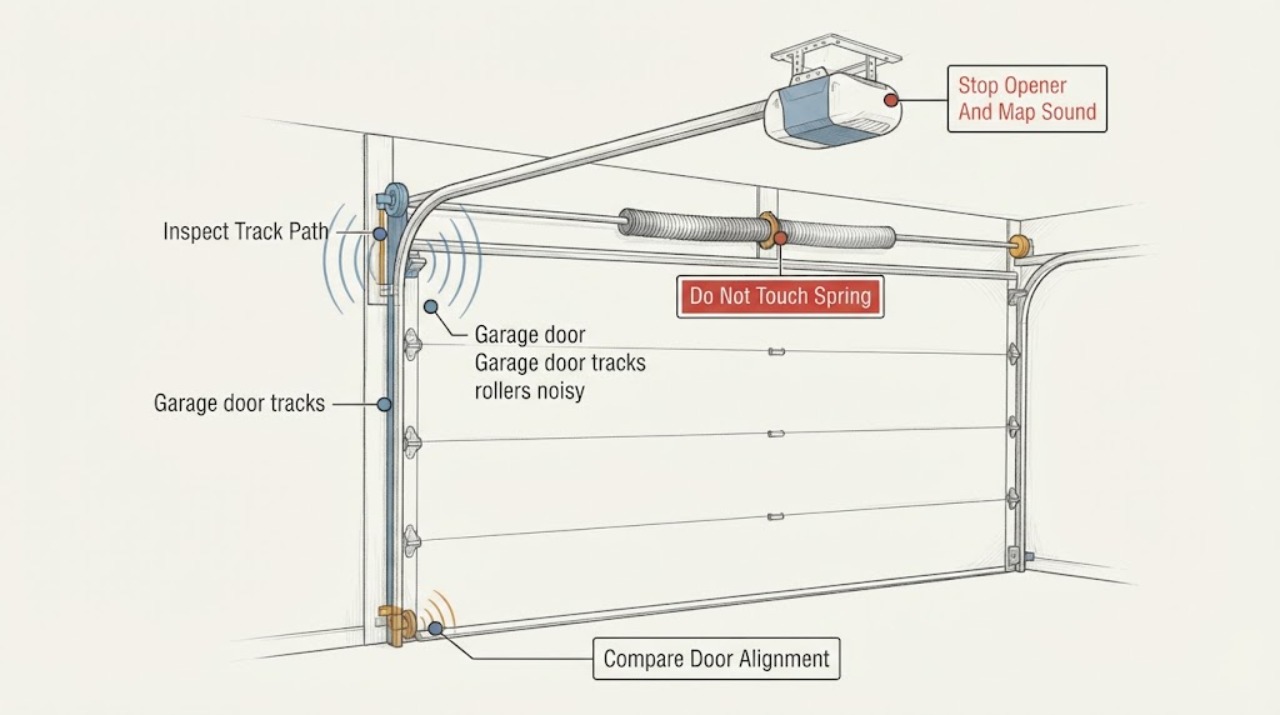
Work through in order
Diagnostic checks
Use only checks that match the exact appliance or system and its official guide.
-
Check 1
Stop automatic cycling and listen from a safe position with the door closed; if the door is stable, note the sound while someone else operates the wall control only long enough to locate the general area, keeping everyone clear of the door.
Expected result: Classify the sound as squeak, rattle, scrape, grinding, popping, or bang, and note whether it comes from one roller, one track side, a hinge line, the opener, or the spring and cable area.
Next step: Keep the opener off when the noise is new, loud, or paired with uneven travel. Use the location and timing to select a branch below and make only the visual checks that follow.
Stop if: Stop immediately for a bang, grinding, off-track movement, smoke, burning odor, sparking, a falling door, or a cable or spring that looks broken.
Why this matters
Why: A squeak may follow a hinge or roller bearing, a rattle may follow loose hardware or a track, and a scrape or bang may indicate contact, displacement, or a panel or track problem. A sound from springs, cables, or the opener needs a wider system inspection.
-
Check 2
With the door closed and the opener unused, inspect both vertical tracks and the horizontal track area from outside the path; remove only loose dust or debris that is clearly away from the hardware and does not require tools.
Expected result: Record a clear straight track, dirt or a small loose object, a bent or warped rail, loose track hardware, a track gap, a shiny rub mark, or a roller that is outside its track.
Next step: Leave the door out of service and arrange trained inspection for a bent or loose track, rub mark, gap, or displaced roller. Do not hammer, bend, shim, or loosen the track.
Stop if: Do not reach behind the track, pull a roller into place, remove track brackets, or operate the door to see if it clears.
Why this matters
Why: Loose debris can create noise, but a warped or loose track, rub mark, or displaced roller suggests alignment or impact damage. A track and section must work together, so correcting one by force can create a second failure.
-
Check 3
From a safe distance, compare the visible rollers and hinges along the noisy side with the quiet side; keep fingers, tools, and clothing away from section joints and do not remove a roller or hinge.
Expected result: Look for a roller with a chipped or flattened surface, a visibly tilted stem, a hinge that is bent or cracked, a pulled fastener, a panel edge rubbing the track, or a section that sits out of line.
Next step: Photograph the part and request trained service for any damaged roller, hinge, fastener, panel edge, or section alignment. If all visible parts look normal, continue to check balance and tensioned hardware without touching them.
Stop if: Do not pull a roller from the track, tighten a hinge near a loaded section, straighten a stem, or place fingers between panels.
Why this matters
Why: A worn roller, bent hinge, pulled fastener, or rubbing panel can load the track and produce noise. A single visibly abnormal part does not establish that it is safe to replace while installed because the section may be carrying door weight.
-
Check 4
Only when the door is fully closed, stable, and free of visible track, roller, hinge, cable, and spring damage, use suitable handles and the manual disconnect as described by the opener manual for a gentle movement observation; never lift from a panel edge.
Expected result: Record smooth travel, a squeak that follows one section, scraping, binding, twisting, unusual effort, one side rising first, or a door that will not remain balanced when stopped.
Next step: Stop at the first resistance or uneven motion and arrange trained service. Do not continue a manual test on a door that shifts, drops, or cannot hold a position.
Stop if: Do not release a partly open door, force it through resistance, test balance on a damaged door, or operate beneath an unsupported section.
Why this matters
Why: Smooth motion makes a minor dry or loose component more plausible but does not prove the track and roller are healthy. Binding, twisting, imbalance, or excess effort points to alignment, panel, hinge, roller, track, or counterbalance trouble.
-
Check 5
From outside the moving path, inspect the springs, lift cables, bottom brackets, and opener connection for a break, gap, fraying, displacement, or a loose-looking attachment; do not touch tensioned parts or change opener settings.
Expected result: Record intact-looking hardware, a separated spring, slack or frayed cable, damaged bottom bracket, loose connection, opener strain, or a door that stops and reverses under load.
Next step: Leave the opener disconnected from use and keep the area clear for any abnormal tensioned hardware or opener behavior. Arrange trained service for system inspection rather than replacing a noisy roller first.
Stop if: Do not loosen spring or cable hardware, bottom brackets, supports, or opener force controls, and do not reconnect the opener after a failed or unstable manual observation.
Why this matters
Why: Spring, cable, bottom-bracket, or opener problems can make rollers and tracks noisy because the door load is no longer distributed normally. DASMA warns that springs, cables, and bottom brackets carry dangerous tension and require trained service.
-
Check 6
If the door remains closed and stable, no part is damaged, and the exact C.H.I. owner manual permits lubrication, apply only the specified product to the specified moving point; otherwise clean only visible dust with a dry cloth and make one supervised movement observation.
Expected result: Record quieter travel, unchanged noise, a noise that shifts to another section, or new scraping, binding, vibration, or abnormal opener effort.
Next step: Stop using the door and arrange trained service when noise remains, returns quickly, or is paired with binding, uneven travel, or hardware damage. Give the technician the original sound location and any change after the manual-specific care.
Stop if: Do not lubricate the track unless the exact manual says to, spray unknown products, remove parts, or keep cycling to make the sound disappear.
Why this matters
Why: A quieter result supports a dry or dirty permitted moving point, but it does not prove a roller, hinge, or bearing is sound. Unchanged or worsening noise, especially with altered travel, needs a complete door-system diagnosis.
Use your observations
Decision map
Find the observation that best matches what you see, then follow the next safe action.
-
PATH 01Safety boundary
What you see
The sound is a light squeak or rattle, the door is level and smooth, the track is straight, rollers and hinges show no damage, and loose debris is visible away from loaded hardware.
Do this next
Clear only loose debris, follow the exact C.H.I. manual for any permitted moving-part care, and make one supervised observation. Arrange service if the sound persists, returns, or changes to scraping or grinding.
Why this path and its safety boundary
Why it matters: Surface debris or a permitted lubrication need is more likely than an immediate alignment or counterbalance failure, but the visual result does not prove the bearing is healthy.
Safety stop: Stop for any new binding, panel shift, uneven travel, sharp noise, or spring, cable, roller, hinge, or track damage.
-
PATH 02Safety boundary
What you see
Noise follows one roller or hinge and there is a chipped roller surface, bent hinge, pulled fastener, rubbing panel edge, or section out of line.
Do this next
Keep the opener off and request trained service to inspect the roller, hinge, fasteners, panel, track, and balance before any part is removed. Do not tighten or replace a component while the section is installed.
Why this path and its safety boundary
Why it matters: A worn or damaged roller or hinge and its panel attachment are more likely than a simple dry track. The local fault may be loading the track and neighboring sections.
Safety stop: Do not pull the roller out, straighten a hinge, drill the panel, or place fingers between sections.
-
PATH 03Safety boundary
What you see
The noise is a scrape or grind, a roller is out of the track, a rail is bent or loose, shiny rub marks appear, or the door twists, binds, or sits lower on one side.
Do this next
Do not operate or manually lift the door. Keep people and vehicles clear and arrange trained service to secure and align the complete system.
Why this path and its safety boundary
Why it matters: Track alignment or impact damage is more likely, possibly involving the roller, hinge, section, bracket, or cable. The door may leave the track or fall if operated.
Safety stop: Do not hammer, bend, shim, or loosen the track, pull a roller into place, or stand under a partly open door.
-
PATH 04Safety boundary
What you see
The door is unusually heavy, one side rises first, it will not hold position, a spring or cable looks broken or slack, the opener strains, or the sound occurs at startup with a hard bang.
Do this next
Keep the door and opener out of service, isolate the area, and arrange trained inspection. Report the noise timing, door position, visible hardware, and any impact or storm event.
Why this path and its safety boundary
Why it matters: A counterbalance, cable, bottom-bracket, or opener problem is more likely than a roller-only issue. The door's load may be uncontrolled even when the noisy roller appears intact.
Safety stop: Do not touch springs or cables, loosen bottom brackets, adjust opener force, or reconnect the opener.
-
PATH 05Safety boundary
What you see
The door makes noise and also fails to reverse, ignores the photo-eye, moves unpredictably, closes unevenly, or reopens without a clear obstruction.
Do this next
Keep the opener off and arrange trained door-system service before further testing. Do not use the door as a daily entry until the movement and safety response are confirmed.
Why this path and its safety boundary
Why it matters: The opener safety or door mechanics cannot be assumed reliable. A noisy track or roller may be part of a larger alignment, balance, sensor, or control problem.
Safety stop: Do not bypass the photo-eye, hold the wall button to defeat a safety response, change force settings, or repeat cycles on an unpredictable door.
Helpful context
Understand the symptom
Follow the noise instead of lubricating everything
A roller rides in a track while the hinges let the sections flex. Dust or a dry bearing can squeak, a loose track or fastener can rattle, and a bent track or displaced roller can scrape or grind. Springs, cables, and the opener can transmit sound through the same door, so a noise heard at one section does not prove that its roller is the failed part. Listen from the side with the door closed and record which motion produces the sound.
A track is part of a matched moving system
C.H.I. doors use sections, hinges, rollers, tracks, struts, and counterbalance hardware together. A track that is loose or warped can change how a roller loads the section; a panel or hinge that is bent can make a straight track sound defective. C.H.I. and DASMA both emphasize visual checks and safe operation, while repairs and adjustments belong to trained service when the door no longer travels freely.
Keep high-tension and opener work out of owner checks
You can inspect a closed door, clear loose debris away from the track, and consult the exact owner manual for permitted lubrication. Do not remove rollers, loosen track brackets, adjust springs or cables, change opener force, or reach between sections. A noisy door that is also heavy, uneven, off-track, or difficult to move is a safety problem, not a lubrication project.
Safety boundary
Stop conditions
- Keep the opener off for an off-track, sagging, unstable, binding, twisting, partly open, or uneven door, or for a door with a displaced roller or bent track.
- Stop for a broken or slack spring or cable, damaged bottom bracket, sharp scraping, loud bang, smoke, burning odor, sparking, or a door that falls or shifts unexpectedly.
- Do not loosen or adjust springs, cables, bottom brackets, supports, track brackets, hinges, rollers, or opener force controls; these repairs require trained service.
- Never place fingers between sections, force a roller into a track, operate without the correct safety response, or keep cycling to mask a noise.
Only after diagnosis
Potential parts
- C.H.I. garage door roller
Consider a roller only when inspection confirms a worn, damaged, displaced, or noisy roller and the track, hinge, section, and balance system are also suitable.
Confirm the exact C.H.I. door model, roller stem, wheel material and dimensions, bearing arrangement, track configuration, and section thickness before selection. - C.H.I. garage door track or track hardware
Consider this category only when trained inspection confirms a bent, warped, loose, or otherwise damaged track or track hardware linked to the noise.
Confirm track size, radius or lift configuration, section thickness, mounting hardware, clearances, and exact door model; do not use a generic rail to compensate for a balance fault. - C.H.I. garage door hinge or fastener
Consider this category only when inspection confirms a bent hinge, damaged fastener, or failed panel attachment at the noisy section.
Match hinge position, section profile, roller arrangement, fastener pattern, and exact door model; a hinge should not be selected from noise alone. - garage door spring, cable, bottom bracket, or opener component
Consider this category only after trained testing identifies a counterbalance, cable, bottom-bracket, or opener fault that explains the noise or uneven load.
Do not select or install tensioned parts from a symptom. Confirm exact door weight, dimensions, spring and cable arrangement, bracket, opener model, and manufacturer instructions through trained service.
When checks do not resolve it
Need a professional?
Arrange trained C.H.I. garage-door service before moving the door when a roller is displaced or damaged, a track is bent or loose, a hinge or panel rubs or shifts, the door binds or becomes heavy, a spring or cable looks abnormal, or the opener safety response fails. A light squeak or rattle may be checked for loose debris and manual-approved care only when the door remains level and smooth; call if the sound persists, returns, or changes to scraping, grinding, or banging.
Safety scope: This article supports stopping the opener, keeping the area clear, photographing a closed and stable door, removing loose debris away from hardware, and following only manual-approved care. A trained technician must handle roller or hinge removal, track alignment, spring and cable work, bottom brackets, opener adjustment, balance, and final safety testing.
Common questions
FAQ
Why are my C.H.I. garage door rollers noisy?
The noise may follow debris, a roller bearing or wheel, a hinge, loose hardware, a bent track, a rubbing panel, or a wider balance problem. Identify the sound location and timing with the door closed, then inspect only visible tracks, rollers, hinges, and tensioned hardware. A displaced roller or altered movement needs trained service.
Can I lubricate the tracks on my C.H.I. garage door?
Follow the exact C.H.I. owner manual for lubrication points and products. Do not spray an unknown product onto the track or use lubrication to hide scraping, grinding, or a displaced roller. Clear loose debris only when the door is closed and stable, and arrange service if the noise remains.
Should I replace a noisy C.H.I. roller myself?
Do not remove a roller from an installed sectional door based on noise alone. The section can be heavy and the track, hinge, cable, spring, and balance system may be loaded. Have a trained technician confirm the roller and check the surrounding system before replacement.
What if the noisy roller is outside the track?
Do not operate or lift the door. Keep people and vehicles clear, do not pull the roller into place or loosen the track, and arrange trained service. An out-of-track roller can involve a bent rail, hinge, panel, cable, spring, or balance issue.
What should I tell a technician about the C.H.I. door noise?
Report the sound type, first location, timing during opening or closing, noisy section or track side, photos of rub marks or hardware, track and roller seating, door level and manual effort, spring or cable observations, opener strain, and any impact or storm. Do not touch tensioned parts while collecting this information.
Read the exact guide
Official sources
- Garage Door Safety ChecklistCHI Overhead Doors (C.H.I.) · Official C.H.I. residential safety checklist; exact door and opener procedures vary by model.
- DASMA Releases Updated Checklist for InspectionsDoor & Access Systems Manufacturers Association International · Official DASMA technical guidance describing consumer inspection limits.
- How Can I Extend the Life of My Garage Door?CHI Overhead Door (C.H.I.) · Official C.H.I. maintenance article; general care guidance does not replace the exact model manual.
- Automatic Garage Door Opener Safety & Maintenance GuideDoor & Access Systems Manufacturers Association International · Industry safety guide for automatic garage doors and openers; installed door and opener manuals remain model-specific.
- Safety Tips For Garage Door SystemsDoor & Access Systems Manufacturers Association International · Official DASMA safety guidance; it is general industry information and does not replace the C.H.I. model manual.
Community feedback
Share a repair observation
Share a plain-text repair observation. Accepted observations are published automatically; this page may take a moment to update.