
On this page
Start here
Quick answer
Noisy garage-door tracks or rollers can come from surface debris, a dry or worn roller, loose visible hardware, or a track that is bent or out of alignment. From a safe position, observe where the sound occurs, inspect only what is visible from the floor, and clean accessible track surfaces without reaching into the track. Use lubricant only at a manufacturer-approved moving point and only when the exact owner guidance permits it; do not adjust tracks or touch springs, cables, or bottom brackets. A crooked, stuck, jerky, grinding, or suddenly loud door, or any damaged cable, spring, roller, or track, is a reason to stop using it and call a qualified garage-door technician.
Before you begin
Safety first
- The homeowner scope is safe observation and accessible surface cleaning or model-approved lubrication only. Do not remove bottom brackets, springs, cables, rollers, hinges, or track hardware; do not realign tracks, force the door, or change opener settings.
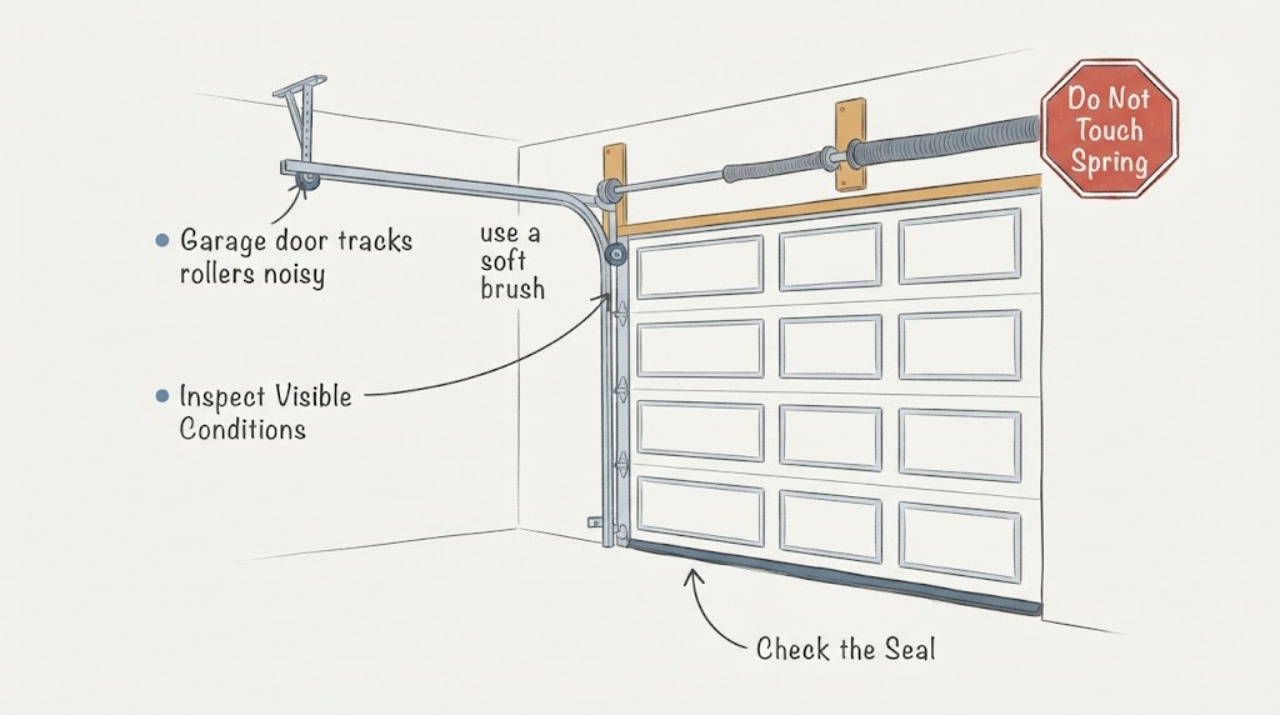
Work through in order
Diagnostic checks
Use only checks that match the exact appliance or system and its official guide.
-
Check 1
From a clear distance, observe a single normal operating cycle only if the door is stable, the opening is clear, and there is no visible cable, spring, or track damage. Note whether the sound occurs at the start, stop, on one side, or as a roller passes a particular section.
Expected result: A repeatable sound at one location may localize the area for service; a sound accompanied by jerking, one-sided travel, scraping, a loud bang, or a door that stops or becomes crooked is not a routine noise pattern.
Next step: If the motion stays smooth and the door remains level, continue with the floor-level visual checks. If movement changes or the noise becomes abrupt or severe, stop using the opener and arrange a technician inspection.
Stop if: Stop immediately for a crooked, stuck, jerky, off-track, suddenly loud, or visibly damaged door, or for a cable or spring that looks displaced, slack, frayed, or broken.
Why this matters
Why: The timing and location help a technician distinguish a roller-area symptom from a broader tracking or drive problem, but they do not prove which part has failed.
-
Check 2
With the door stationary and from floor level, look at the visible faces and edges of both tracks, the roller areas, and nearby hardware without touching or reaching into the track.
Expected result: Record loose dirt, a small object, rust, a visibly bent or twisted track, a roller that is displaced or visibly worn, or hardware that appears loose or shifted. Also note whether the same condition is present on one side or both.
Next step: Only if the door is stable and the finding is limited to accessible surface debris, proceed to gentle surface cleaning. Otherwise preserve the observation and call a technician.
Stop if: Do not touch or continue if the track is bent or twisted, a roller is out of its track, a bracket is moving, a fastener appears loose in a load-bearing area, or the inspection would require a ladder or contact with tensioned parts.
Why this matters
Why: Loose surface debris can contribute to noise, while a bent track, displaced roller, shifted hardware, or unequal side condition needs professional assessment rather than a home alignment attempt.
-
Check 3
If the door is stationary and the track surface is reachable from the floor, use a soft brush and a damp cloth to remove loose debris from the accessible track surface only; do not reach between the roller and track or remove hardware.
Expected result: Note whether loose material comes away without force and whether the track surface looks clear afterward. Do not scrape, pry, bend, or use the cleaning step to move the door.
Next step: After the surface is dry and the area is clear, use the owner manual to determine whether any approved lubrication point applies to this exact door. If the noise remains or cleaning is not clearly safe, arrange service.
Stop if: Stop if debris is trapped, the track is damaged, the door must be moved, or cleaning would require reaching above shoulder height, climbing, force, or contact with rollers, springs, cables, or brackets.
Why this matters
Why: Surface debris may have contributed to the sound, but cleaning cannot correct a bent track, worn roller, misalignment, or a loose high-load connection.
-
Check 4
Check the exact owner manual before any lubrication. If it permits a reachable moving point and the door is stationary, apply only the specified lubricant to the approved roller or hinge point; do not spray the track surface, cables, springs, or bottom bracket, and do not guess about roller material.
Expected result: On a later normal cycle, if the door still moves smoothly, note whether the same sound is reduced, unchanged, or worse. A temporary change does not establish that the underlying component is sound.
Next step: If the point is not explicitly approved, is hidden, or cannot be reached without a ladder or disassembly, skip lubrication and call a technician. Persistent noise after approved care also warrants service.
Stop if: Stop for grinding, burning smell, smoke, a loud bang, abnormal vibration, jerky travel, a crooked or stuck door, or any need to touch a spring, cable, bottom bracket, track fastener, or concealed mechanism.
Why this matters
Why: Improvement may indicate friction at an approved moving point, while no change or worsening points toward wear, alignment, contamination, or another fault that needs diagnosis. Nylon-roller guidance varies by door and manual, so the model-specific instruction controls.
-
Check 5
From a safe distance, compare the door's travel on the two sides during the same permitted observation and look for visible cable slack or fraying, a broken or separated spring, a displaced roller, or track movement.
Expected result: A level, smooth door with no visible tension-component concern is different from one side lagging, the door skewing, a cable hanging or damaged, a spring visibly separated, or a track shifting.
Next step: Keep the door closed if it is safe to leave it there, keep the area clear, and give the technician the observed side, sound timing, and any visible damage. Do not attempt to release, lift, realign, or secure the mechanism.
Stop if: Stop all operation for any cable, spring, bottom-bracket, off-track, severe alignment, or structural concern and call a qualified technician.
Why this matters
Why: Those abnormal signs can involve stored force or a load-bearing alignment problem. They are not lubrication or adjustment tasks for a homeowner.
Use your observations
Decision map
Find the observation that best matches what you see, then follow the next safe action.
-
PATH 01Safety boundary
What you see
The door stays level and moves smoothly, and the only finding is loose debris on an accessible track surface.
Do this next
Clean only the accessible surface with a soft brush and damp cloth, then consult the exact owner manual about any approved lubrication point. Escalate if the noise persists.
Why this path and its safety boundary
Safety stop: Stop if the door changes behavior or cleaning requires reaching into the track, force, a ladder, or contact with loaded hardware.
-
PATH 02Safety boundary
What you see
The sound follows one roller or remains after safe surface cleaning or explicitly approved lubrication.
Do this next
Call a technician and report the noise location, timing, door movement, visible roller/track condition, and the model information from the manual or opener label.
Why this path and its safety boundary
Safety stop: Do not keep cycling the door to test it and do not replace or remove a loaded component based on sound alone.
-
PATH 03Safety boundary
What you see
A track is bent or shifted, a roller is displaced, the door is crooked or stuck, or visible hardware is moving.
Do this next
Stop using the door and arrange professional garage-door service; keep people and vehicles clear of the opening.
Why this path and its safety boundary
Safety stop: No track realignment, fastener adjustment, roller removal, lifting, or forceful operation.
-
PATH 04Safety boundary
What you see
A cable is slack or frayed, a spring is broken or separated, a bottom bracket looks abnormal, or the door makes a loud bang or develops severe vibration.
Do this next
Leave the system alone and call a qualified technician. If the door is not safely closed, keep clear and explain its position when requesting service.
Why this path and its safety boundary
Safety stop: Do not touch, restrain, disconnect, cut, adjust, or lubricate the spring, cable, or bottom-bracket assembly.
-
PATH 05Safety boundary
What you see
The only possible next step requires a ladder, hidden access, door lifting, disassembly, or changing opener or track settings.
Do this next
Stop the homeowner checks and request professional inspection instead.
Why this path and its safety boundary
Safety stop: Do not proceed beyond floor-level observation and accessible surface care.
Helpful context
Understand the symptom
What the noise can tell you
A squeak or rattle that repeats as a roller passes one area can point toward a roller, debris, or a local track condition, while a sound that starts with uneven door travel raises more concern about alignment or a damaged component. Sound alone cannot identify the failed part. Keep people, pets, and vehicles clear and treat the opener and door as a moving system; the checks below are observations and low-risk surface care, not track, spring, cable, or bracket repair.
Safe boundary
Do not remove a bottom bracket, loosen track fasteners, alter travel or force settings, handle springs or cables, lift the door to test it, reach between a roller and track, climb to reach hardware, or continue operating a door that is off-track or unstable. If a check would require any of those actions, stop and arrange professional service.
After the observations
If the door remains straight and stable and the only finding is loose surface debris, accessible cleaning may be reasonable. If noise persists after the owner-manual-approved care, treat that as evidence for a technician to inspect roller wear, track alignment, and hardware rather than adding more lubricant or repeated cycles.
Only after diagnosis
Potential parts
- garage door rollers
Consider this category only after the exact door and roller condition have been identified by the owner manual or a technician as worn, damaged, or incompatible with the track system; noise alone is not enough.
Match the door's roller style, stem, dimensions, and material to the exact manufacturer and model guidance or technician diagnosis before ordering. - garage door hinge
Consider this category only if a visible or professional inspection identifies a bent or worn hinge contributing to uneven roller movement; do not remove a loaded hinge based on sound alone.
Confirm hinge position, gauge, fastener pattern, and door model with the manufacturer or technician before selecting a replacement. - garage door track lubricant
Consider lubricant only when the exact owner manual permits it for an accessible moving point and no track, spring, cable, or bracket damage is present; lubricant is not a repair for alignment or wear.
Use only the product type and application points named by the exact door manufacturer; do not assume a generic spray is suitable for every roller or hardware material.
When checks do not resolve it
Need a professional?
Call a qualified garage-door technician for persistent or worsening noise, a bent or shifted track, a displaced roller, crooked or stuck travel, jerking, loud impact, abnormal vibration, visible cable or spring damage, bottom-bracket concerns, or any repair requiring loaded hardware, lifting, a ladder, or disassembly.
Safety scope: The homeowner scope is safe observation and accessible surface cleaning or model-approved lubrication only. Do not remove bottom brackets, springs, cables, rollers, hinges, or track hardware; do not realign tracks, force the door, or change opener settings.
Have this ready
- Provide the door and opener model if available, a safe-distance recording if safe, when the sound occurs, which side or track area it comes from, whether the door stays level, and any visible debris, displacement, fraying, spring separation, or track damage.
Common questions
FAQ
Should I lubricate the garage-door track when the rollers are noisy?
Not automatically. Check the exact owner manual first. If it permits care at an accessible moving point, follow that instruction; do not spray the track surface or use lubricant to mask a bent track, worn roller, or alignment problem.
Can I keep using the door if it is noisy but still opens?
Only a stable door with smooth, level movement and no visible cable, spring, roller, or track concern should receive limited observation. Stop for grinding, a bang, jerking, crooked or stuck travel, visible damage, or worsening noise and arrange professional service.
What information will help a garage-door technician?
Tell them when the sound occurs, which side or track area is involved, whether travel stays level, what was visible from the floor, the model information, and whether safe surface cleaning or manual-approved lubrication changed the symptom.
Read the exact guide
Official sources
- Garage Door Maintenance GuideClopay · Manufacturer guidance on rollers, tracks, safe maintenance, and when springs, cables, and track work should go to a professional.
Community feedback
Share a repair observation
Share a plain-text repair observation. Accepted observations are published automatically; this page may take a moment to update.