
On this page
Start here
Quick answer
Noisy Amarr garage-door hinges or rollers are often caused by dry moving joints, debris or misalignment in the tracks, worn rollers, loose hardware, or a door that is out of balance. First stop the door if the noise includes a snap, grinding with jerking, a cable coming off, a broken spring, scraping metal, or uneven movement. From a safe position, identify whether the sound follows a hinge, roller, track, opener, spring, or cable and look for visible cracks, wear, debris, gaps, or displacement without touching moving parts. Amarr recommends model-specific care and lubrication of appropriate moving parts, but says not to lubricate plastic rollers or tracks; a damaged roller, hinge, cable, spring, or track needs professional attention. Do not loosen hinges, roller brackets, bottom brackets, springs, cables, or track fasteners to quiet the door. If noise persists after an approved visual clean-and-lubricate check, or the door binds, tilts, slams, or will not stay balanced, keep it out of service and arrange qualified garage-door service.
Before you begin
Safety first
- A qualified technician should inspect and repair rollers, hinges, tracks, panel attachments, opener connections, cables, pulleys, springs, bottom brackets, balance, and safety reversal. Homeowner work should remain visual and limited to manual-approved cleaning or lubrication of accessible non-hazardous moving points; do not adjust high-tension or load-bearing hardware.
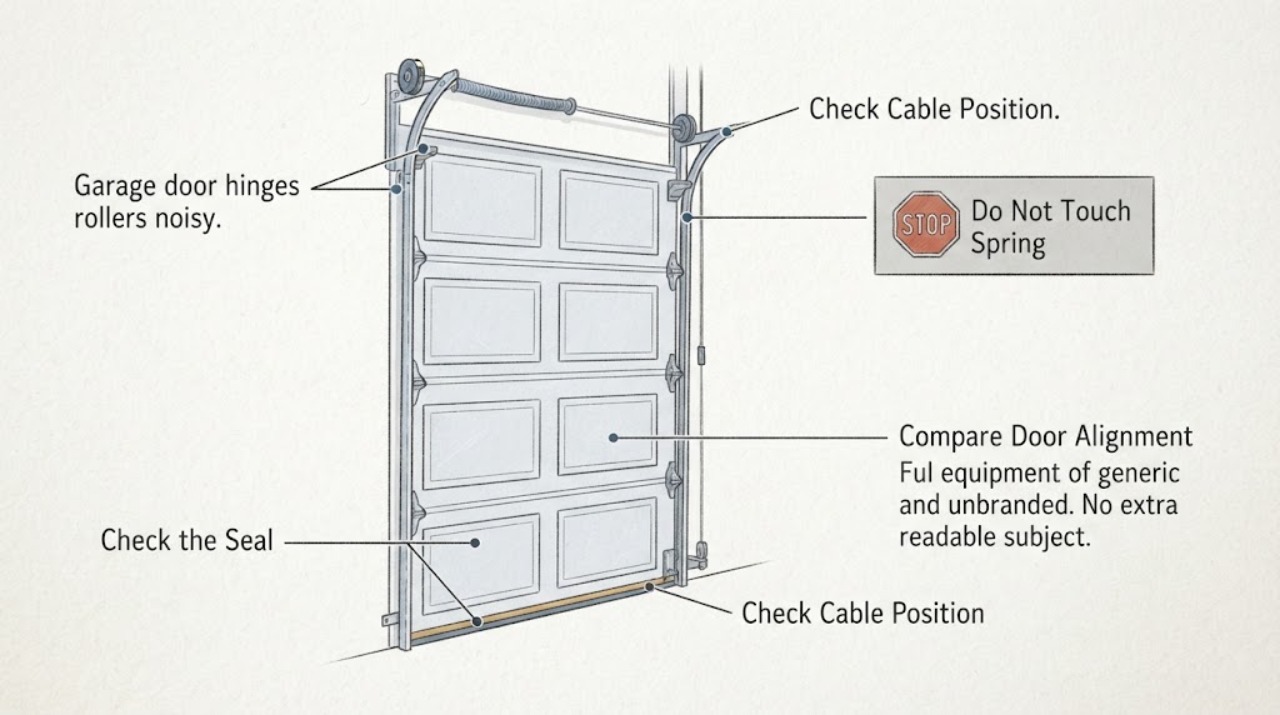
Work through in order
Diagnostic checks
Use only checks that match the exact appliance or system and its official guide.
-
Check 1
Stop the opener and keep people, pets, and vehicles out of the travel area if the door snaps, grinds while jerking, scrapes metal, tilts, slams, hangs unevenly, or shows a broken spring, slack cable, displaced roller, or bent track.
Expected result: The sound is a mild squeak with smooth travel, or it is accompanied by sudden impact, uneven movement, a loose or frayed cable, spring damage, a roller out of the track, or a door that will not move safely.
Next step: For any abnormal movement or hardware damage, leave the door in its current position, disable the opener without reaching into the mechanism, and arrange qualified garage-door service. Do not pull the emergency release or lift the door to investigate.
Why this matters
Why: A mild squeak can be routine friction, but noise with movement or counterbalance symptoms can signal a falling-door or stored-energy hazard beyond lubrication.
-
Check 2
From outside the travel path, listen during one normal observation only if the door is moving smoothly and safely; note whether the sound occurs at a particular panel joint, roller location, track section, spring area, or opener.
Expected result: The sound repeats at one hinge or roller, follows a track spot, comes from the opener, is a spring or cable snap, or cannot be localized.
Next step: Stop operation for a snap, pop, grinding, or uneven travel. Otherwise photograph and describe the sound location for service; do not put hands near the moving joint or wheel.
Why this matters
Why: A location-specific sound narrows the next visual check, while an opener-only hum or spring/cable sound may not be a hinge or roller issue. An unlocalized noise should not be chased by disassembly.
-
Check 3
With the door safely still, visually inspect the accessible rollers, hinge leaves, track surfaces, and visible fasteners for cracks, flat spots, rust, debris, rubbing marks, gaps, or a roller no longer seated in the track.
Expected result: The roller or hinge is visibly worn or cracked, debris is packed in the track, the track is bent or displaced, a fastener is loose, or no visible defect appears.
Next step: Do not tighten hardware near springs, bottom brackets, hinges, or rollers. Clean only loose surface debris when the manual allows and the door is stable; arrange professional inspection for wear, cracks, displacement, or persistent noise.
Why this matters
Why: Worn rollers or hinge pivots can create recurring friction and noise; debris or track displacement can make a roller rub or jump. No visible defect does not rule out a bearing, alignment, or opener problem.
-
Check 4
Check the roller material and the exact Amarr manual before applying any lubricant; if the manual permits it, apply only the specified garage-door lubricant to accessible metal hinge or roller moving points while keeping hands clear.
Expected result: The rollers are nylon or another plastic material, the manual identifies a permitted metal pivot or bearing, lubricant reduces the squeak, or the sound remains or becomes rougher.
Next step: Do not lubricate a plastic roller or track to mask the sound. Stop if access is awkward or the sound persists, and arrange technician evaluation of the roller, hinge, track, and door alignment.
Why this matters
Why: Amarr residential guidance says not to lubricate nylon rollers or tracks, while suitable moving-point lubrication can reduce ordinary squeak. Persistent or rough noise indicates wear, contamination, or alignment rather than a simple dry joint.
-
Check 5
Visually compare the door's travel and panel alignment from a safe distance: look for one side moving first, a section rubbing the jamb, roller gaps, a track bend, a door that pauses, or an opener arm that contacts the door.
Expected result: The door stays square and moves smoothly, or it binds, rises unevenly, shifts sideways, slams, leaves its track, or the opener connection touches the panel or reinforcement.
Next step: Do not change opener force or travel, bend the track, loosen the top bracket, or adjust springs. Keep the door out of service and arrange qualified inspection for any abnormal travel.
Why this matters
Why: Smooth travel makes a minor friction issue more plausible. Binding, racking, slamming, or opener contact indicates alignment, balance, panel, track, or installation trouble that can damage rollers and hinges.
-
Check 6
Look at the visible springs, lifting cables, pulleys, and brackets for fraying, separation, a gap, or fresh rubbing while staying clear of the system and not touching red or high-tension hardware.
Expected result: A cable is frayed or off the drum, a spring is broken or stretched abnormally, a bracket is displaced, or the counterbalance components appear undisturbed.
Next step: For any cable, spring, pulley, or bracket abnormality, do not operate the door and arrange immediate qualified garage-door service. Never remove, repair, wind, or adjust these parts as a noise fix.
Why this matters
Why: Counterbalance damage can make rollers and hinges noisy because the door is carrying the wrong load; it also creates serious stored-energy risk. An apparently normal spring does not clear a noisy, unbalanced door.
-
Check 7
After an approved minor maintenance check or professional repair, observe one controlled cycle from outside the travel path and confirm the original noise, alignment, roller seating, and safety behavior have been corrected.
Expected result: The door is quiet and smooth, or the sound returns, shifts to another location, the door binds or rattles, a roller leaves the track, or the opener safety response is abnormal.
Next step: Stop operation for any recurrence or abnormal behavior and contact the servicing professional. Do not compensate by changing opener force, travel, spring tension, cables, or track position.
Why this matters
Why: A quiet aligned cycle supports a successful maintenance result, but recurrence or new movement symptoms indicates an unresolved roller, hinge, track, balance, opener, or counterbalance problem.
Use your observations
Decision map
Find the observation that best matches what you see, then follow the next safe action.
-
PATH 01Next step
What you see
A mild squeak occurs at a hinge or permitted metal moving point, the door stays square, and no wear, cable, spring, or track damage is visible.
Do this next
Follow the exact Amarr manual for an approved light lubrication check, avoiding plastic rollers and tracks. If the squeak persists or travel changes, arrange service.
Why this path and its safety boundary
Why it matters: Ordinary dry-joint friction is more likely than structural or counterbalance failure.
-
PATH 02Next step
What you see
The noise follows a roller and there is debris, rubbing, a flat spot, cracked wheel, gap, or track displacement.
Do this next
Keep hands out of the track, remove only loose surface debris when safe and manual-approved, and arrange qualified inspection for a worn roller, track, or attachment. Do not bend or lubricate the track.
Why this path and its safety boundary
Why it matters: A roller or track friction/alignment problem is more likely than a hinge-only squeak and may worsen as the door cycles.
-
PATH 03Next step
What you see
Noise is accompanied by a snap, frayed or slack cable, broken spring, roller out of the track, bent track, panel movement, slamming, or a door that will not stay balanced.
Do this next
Leave the door and opener out of service, clear the area, and arrange qualified garage-door service. Do not pull the release, lift the door, or adjust springs, cables, brackets, or track hardware.
Why this path and its safety boundary
Why it matters: The symptom indicates counterbalance, track, panel, or hardware risk rather than routine lubrication; the door may move unexpectedly or fall.
-
PATH 04Next step
What you see
The sound is strongest at the opener, an opener arm, or the top section rather than at the hinges or rollers, especially if the arm contacts the door or the door closes hard.
Do this next
Stop cycling the door and have a trained technician inspect the opener connection, top section, reinforcement, track, and counterbalance. Do not change force or limit settings to hide the sound.
Why this path and its safety boundary
Why it matters: An opener attachment, limit, installation, panel-reinforcement, or door-balance problem is more likely than a roller bearing alone.
-
PATH 05Next step
What you see
A permitted lubrication check briefly quiets the door but noise returns, changes location, or is joined by rubbing, vibration, uneven travel, or visible wear.
Do this next
Keep a note of where and when the noise returns and arrange inspection of the complete door system. Do not continue applying lubricant or replace parts by sound alone.
Why this path and its safety boundary
Why it matters: Lubrication may have reduced a symptom without correcting a worn roller, hinge, track, balance, or opener issue.
Helpful context
Understand the symptom
The sound helps locate the problem
A squeak that occurs at each panel joint can point toward hinge pivots or dry hardware, while a repetitive click or rumble that follows a wheel can point toward a roller or track. Scraping, popping, or a sudden loud snap broadens the concern to a displaced roller, bent track, cable, spring, panel, or opener connection. Noise alone does not identify a replaceable part, so listen and observe from outside the travel path rather than reaching into the moving system.
Clean and lubricate only within the Amarr boundary
Amarr maintenance guidance allows regular lubrication of appropriate moving parts, but its residential manual says not to lubricate nylon rollers or tracks. A damp cloth can remove loose debris from a track when the door is safely still; lubricant on a track can attract more dirt and hide a geometry problem. Follow the exact owner manual if the roller material or hardware is uncertain.
Noise can be a balance or alignment symptom
A door that rises unevenly, rubs one side, slows at one spot, slams shut, or leaves a roller gap at the track may be out of balance or misaligned. Springs and lifting cables carry the door's load, while rollers and hinges guide the sections. Do not correct that relationship by tightening a bracket or changing spring tension; a professional must assess the whole system.
Verify the cause before replacing parts
If the sound stops after an approved clean-and-lubricate check and the door remains smooth and aligned, continue the model's routine maintenance. If the noise returns, changes to grinding or popping, or appears with wear, displacement, or abnormal travel, the next step is inspection of the roller, hinge, track, cable, spring, panel, and opener—not a generic roller or hinge purchase.
Safety boundary
Stop conditions
- Do not operate the opener or manually move the door for a snap, grinding with jerking, scraping metal, uneven hanging, slamming, a roller out of the track, bent track, frayed or slack cable, or broken spring.
- Do not loosen or remove hinges, roller brackets, bottom brackets, cables, pulleys, springs, red fasteners, track fasteners, or opener attachments; these components can carry door weight or stored spring force.
- Do not lubricate tracks or plastic or nylon rollers, change opener force or travel, bend a track, pull the emergency release on a damaged door, or keep cycling the door to reproduce the noise.
- Arrange qualified garage-door service for persistent noise, visible wear, imbalance, panel or reinforcement damage, opener contact, displaced hardware, or any uncertainty about the exact Amarr model and maintenance instructions.
Only after diagnosis
Potential parts
- garage-door roller
Consider this only when inspection confirms a worn, cracked, seized, or displaced roller and the track, hinge, balance, and door section are suitable; noise alone does not identify roller failure.
Confirm the exact Amarr door model, roller material, stem and track arrangement, hinge position, load, and manufacturer service requirements before ordering or installing. - garage-door hinge
Consider this only when a technician confirms a cracked, bent, or worn hinge or pivot is causing the sound; a squeak can also come from a roller, track, balance, or opener.
Match the exact Amarr section, hinge position, fastener pattern, roller support, door construction, and installation instructions. - garage-door track or track hardware
Consider this only when inspection confirms a bent, displaced, or incompatible track or attachment after debris and roller condition are evaluated; do not bend a track to quiet the door.
Confirm the exact door size, lift configuration, track radius, roller arrangement, mounting, and manufacturer specifications before replacement. - garage-door cable or spring system component
Consider this only after a qualified technician confirms counterbalance wear or damage; noisy rollers can be a secondary symptom and spring or cable selection cannot be made from sound alone.
Match door weight, height, track hardware, spring type, cable routing, and exact Amarr installation specifications; high-tension work is professional service.
When checks do not resolve it
Need a professional?
Safety scope: A qualified technician should inspect and repair rollers, hinges, tracks, panel attachments, opener connections, cables, pulleys, springs, bottom brackets, balance, and safety reversal. Homeowner work should remain visual and limited to manual-approved cleaning or lubrication of accessible non-hazardous moving points; do not adjust high-tension or load-bearing hardware.
Common questions
FAQ
Why are my Amarr garage-door rollers and hinges noisy?
Possible causes include dry hinge or roller moving points, debris in the tracks, worn or cracked rollers, track misalignment, loose or displaced hardware, an unbalanced door, or an opener connection problem. Identify where the sound occurs from a safe position and inspect visually before considering any manual-approved lubrication.
What can I lubricate on an Amarr garage door?
Follow the exact Amarr manual. Its residential guidance allows lubrication of appropriate moving parts such as certain hinges, springs, rollers, or bearings, but says not to lubricate nylon or plastic rollers or tracks. If the material or access is uncertain, stop at visual inspection and ask a technician.
Should I lubricate the track to stop an Amarr garage-door noise?
No. Clean loose debris from a safely stationary track only as the manual permits, but do not add lubricant to the track; Amarr guidance says track lubricant can attract dirt and its residential manual excludes tracks. A bent, displaced, or rubbing track needs professional inspection.
When is noisy roller or hinge operation dangerous?
Stop using the door for a snap, pop, grinding with jerking, scraping metal, uneven travel, slamming, a roller out of the track, a bent track, slack or frayed cable, a broken spring, or a door that will not stay balanced. Keep people clear and arrange qualified garage-door service rather than adjusting tension or brackets.
Can I replace an Amarr garage-door roller or hinge myself?
Do not remove roller, hinge, bottom-bracket, cable, spring, or track hardware as a routine noise fix. A roller or hinge is attached to a heavy moving door and may be affected by balance and spring force. Have a qualified technician confirm the failed component, exact model fit, and safe repair scope.
Read the exact guide
Official sources
- Homeowner's Owner's ManualAmarr · Specifies visual inspection of tracks, cables, springs, brackets, rollers, and hinges; warns against spring or cable work; and distinguishes lubrication of appropriate moving parts from nylon rollers and tracks.
- Garage Door Maintenance Checklist: How To Care For Your Garage DoorAmarr · Explains that lubrication can reduce noise, tracks should be cleaned rather than lubricated, rollers should be checked for cracks or wear, and damaged rollers should be replaced by a technician.
- Everything You Need To Know About Garage Door RepairAmarr · Connects noisy or slow movement with inadequate lubrication, dirty or misaligned tracks, and rollers off the track, while warning that springs and cables require trained service.
- Garage Door Care and MaintenanceAmarr · Directs visual inspection of springs, cables, rollers, pulleys, and hardware; says not to lubricate plastic rollers, recommends model-specific manuals, and sends significant repair to qualified dealers.
- FAQsAmarr · States that debris and friction in rollers or tracks can make a door noisy, that springs, rollers, and hinges may squeak, and that spring and cable work belongs with a professional.
Community feedback
Share a repair observation
Share a plain-text repair observation. Accepted observations are published automatically; this page may take a moment to update.