
On this page
Start here
Quick answer
A noisy sectional garage door often needs the sound localized before anyone considers lubrication or a part. With the door closed and from a safe position, look for damaged hinges, rollers, panels, or a visibly obstructed track, then note whether the sound is a squeak, scrape, rattle, pop, or grinding noise and where it occurs. Do not remove a bottom bracket, adjust springs or cables, force the door, or work inside the moving system; if the door binds, looks unbalanced, jumps, or makes a grinding noise, stop using it and call a trained garage-door technician.
Before you begin
Safety first
- Do not remove the bottom bracket, adjust springs or cables, lift the door, loosen or straighten tracks, detach hinges or rollers, bypass safety devices, force a cycle, or open the opener housing.
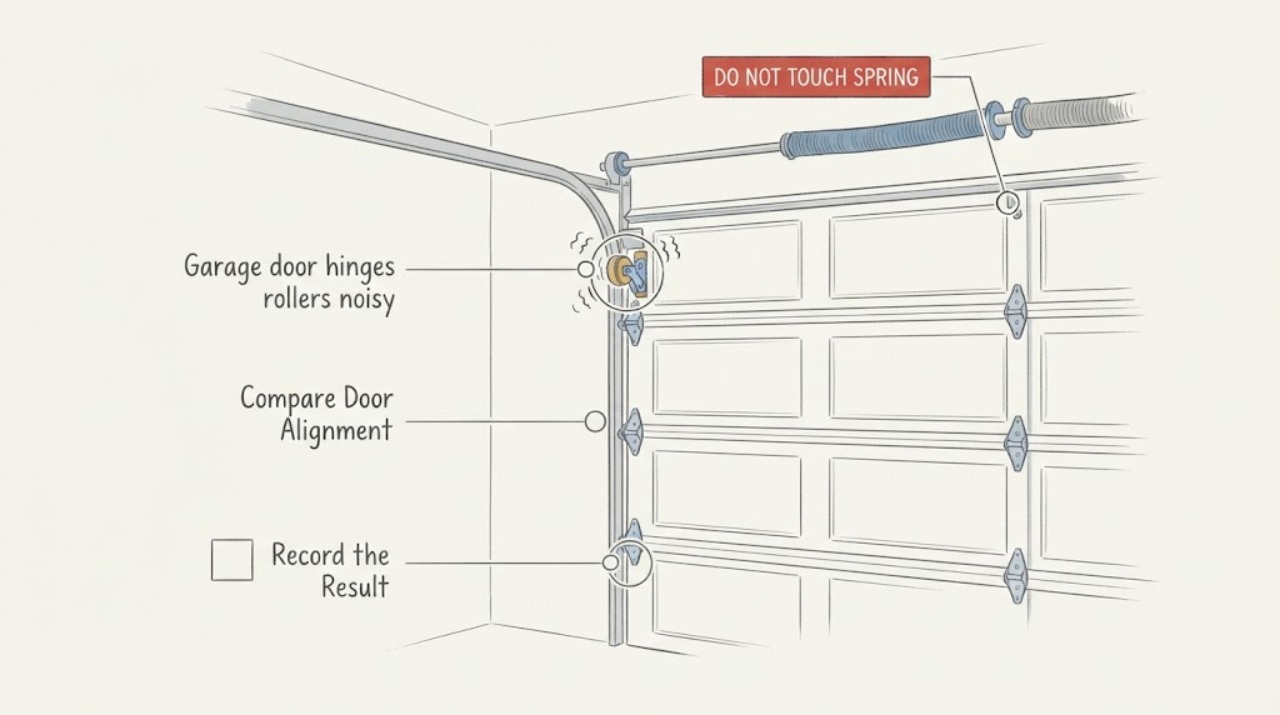
Work through in order
Diagnostic checks
Use only checks that match the exact appliance or system and its official guide.
-
Check 1
With the door fully closed, stand clear of the door and look along the visible hinges, roller stems, panel edges, and track openings without touching, loosening, or removing any hardware.
Expected result: Note a bent hinge, cracked or loose-looking roller, displaced panel edge, visible obstruction, rust, rubbing mark, or a track that appears damaged or out of line. Photograph the area from the side.
Next step: Record the exact hinge or roller location and provide the photo to a trained garage-door technician; do not remove the bottom bracket or attempt an adjustment.
Stop if: Stop immediately if a spring, cable, bottom bracket, roller, or track appears displaced or damaged, or if any part is under visible tension or could fall.
Why this matters
Why: Visible damage changes the issue from routine noise to a technician assessment. A clean-looking exterior does not rule out a worn bearing, concealed damage, or a door that is out of balance.
-
Check 2
If the door is already operated normally and no hazard is visible, listen from the side of the closed garage opening during one ordinary commanded movement; stay out of the doorway and away from all moving parts.
Expected result: Classify the sound as a brief squeak, repeated click, roller rumble, track scrape, loud rattle, pop, or grinding noise, and note whether it occurs on opening, closing, or at one panel position.
Next step: Stop further cycles when the noise is severe, new, worsening, or paired with hesitation, and send the sound description to the technician.
Stop if: Do not operate the door if it binds, jumps, sags, moves unevenly, reverses unexpectedly, or makes grinding or impact sounds; keep people and vehicles clear.
Why this matters
Why: A location- and direction-specific sound helps the technician separate hinge/roller noise from track, panel, or opener vibration. Grinding, popping, or a sound paired with hesitation is not a lubrication experiment.
-
Check 3
Compare the noise location with the door's panel joints and roller positions from a safe side view, without following the moving door, reaching toward the track, or placing a hand on a hinge or roller.
Expected result: Note whether the sound repeats at one panel joint, follows one side, occurs at both sides, or continues when the door is stationary as a vibration from the opener or rail.
Next step: Give the technician the side, panel position, and movement direction rather than attempting to isolate the part by disassembly.
Stop if: Stop if you would need to remove a cover, detach the door, reach into a track, or move the door manually to continue the check.
Why this matters
Why: A repeat at one joint can focus the assessment on a hinge or roller; a noise on both sides or at one height can involve alignment or track conditions; a stationary vibration may not originate at the door hardware.
-
Check 4
From outside the path of the door, inspect the floor area and the visible lower track for loose debris, an object in the path, water, or a new impact mark; do not clean inside the track or insert a tool.
Expected result: Record whether the noise began after an impact, storm, vehicle contact, or a visible obstruction, and whether the track looks bent, separated, or pulled away from its normal support.
Next step: Keep the door out of service if the track or door looks distorted, and tell the technician the event and the affected side.
Stop if: Do not touch, straighten, loosen, or tighten the track, and stop using the door if the track is visibly damaged or a roller is outside its path.
Why this matters
Why: An impact or visibly distorted track can make rollers noisy and can create a derailment or balance hazard. A clear floor does not clear a damaged roller, hinge, spring, cable, or track.
-
Check 5
Check from a safe distance whether the door appears to travel smoothly and remain aligned during the ordinary observation; do not disconnect, lift, or balance-test the door yourself.
Expected result: Answer yes only if the door stays aligned with no binding, jumping, sagging, unusual vibration, or visible separation; answer no if any of those signs appears.
Next step: For no, stop using the door and call a trained technician. For yes, provide the sound and location record and ask whether a model-specific inspection or lubrication is appropriate.
Stop if: Stop all operation for binding, imbalance, unexpected reversal, a falling panel, damaged hardware, or any contact with a spring, cable, bottom bracket, or moving part.
Why this matters
Why: A no result indicates an operation or safety problem that takes priority over noise reduction. Even a yes result only describes the observed cycle and does not prove the hardware is safe to service.
Use your observations
Decision map
Find the observation that best matches what you see, then follow the next safe action.
-
PATH 01Next step
What you see
A hinge, roller, panel, spring, cable, bottom bracket, or track looks damaged or displaced.
Do this next
Call a trained garage-door technician and provide the affected side, panel position, photographs, and when the noise began.
Why this path and its safety boundary
Why it matters: Treat the noise as a door-system safety concern rather than a lubrication task. Keep the door out of use and do not remove or adjust the affected hardware.
-
PATH 02Next step
What you see
The sound is grinding, popping, or accompanied by binding, jumping, sagging, or uneven travel.
Do this next
Keep people and vehicles clear and arrange technician assessment before another cycle.
Why this path and its safety boundary
Why it matters: Stop operation. These observations can indicate a mechanical or balance problem that can worsen under the door's weight.
-
PATH 03Next step
What you see
The door remains aligned and the noise is a mild, repeatable squeak with no visible damage.
Do this next
Ask the technician or consult the exact owner documentation before applying any conditional lubricant category.
Why this path and its safety boundary
Why it matters: A model-specific maintenance check may be appropriate, but lubricant choice and locations must follow the door and opener manufacturer's guidance. Do not spray the opener rail or use maintenance as a substitute for diagnosis.
-
PATH 04Next step
What you see
The noise follows one panel joint or one side but the source cannot be seen safely.
Do this next
Stop at observation and provide the location record to a technician rather than removing a hinge, roller, or bottom bracket.
Why this path and its safety boundary
Why it matters: The location is useful evidence but does not identify a replaceable part. Accessing it may involve the door's weight or high-tension hardware.
-
PATH 05Next step
What you see
The noise appears to come from the opener or rail while the door hardware looks quiet.
Do this next
Describe the stationary or moving vibration to a trained technician and avoid opening the opener or changing settings.
Why this path and its safety boundary
Why it matters: Do not assume the door rollers are the cause. Opener and door systems can transmit vibration, and the correct inspection depends on the model and drive type.
Helpful context
Understand the symptom
Why hinges and rollers can sound alike
Each sectional door panel is connected by hinges and guided by rollers in tracks, so vibration can travel along the entire door. A hinge-area squeak, a roller rumble, a track rattle, and an opener sound can be confused when heard from inside the garage. The useful first step is a safe visual and sound record, not a teardown.
Keep high-tension parts out of the homeowner check
Manufacturer guidance warns that springs are under high tension and says a trained door-systems technician should handle signs of damage or improper operation. Do not remove the bottom bracket, loosen hinge or track hardware, adjust a spring or cable, lift a door by hand, or bypass safety devices to chase a noise.
A diagnosis before a part
A roller, hinge, or lubricant category is only conditional. The correct choice depends on the door's design, the existing hardware, the type of noise, and whether the underlying door is binding or damaged. A replacement part or lubricant cannot make an unsafe or unbalanced door safe.
Only after diagnosis
Potential parts
- garage door rollers
Only consider this category if a professional confirms that a roller is the source of the noise and is suitable for replacement after checking the door design and condition.
Confirm the door system, roller dimensions, stem, load, and manufacturer guidance before selecting a part; do not remove a roller or bottom bracket as a homeowner. - garage door hinge
Only consider this category if the technician identifies a damaged or worn hinge as the noise source and confirms replacement is appropriate.
Confirm the section position, hinge type, door construction, and fitment with the technician or manufacturer; hinge work can affect door alignment. - garage door track lubricant
Only consider this category after the door is confirmed safe and the exact owner guidance permits lubrication for the identified hinge or roller condition; lubricant cannot repair damage or imbalance.
Follow the specific door and opener manufacturer's maintenance guidance and keep lubricant away from surfaces or components where it is not approved.
When checks do not resolve it
Need a professional?
Call a trained garage-door technician for a noisy hinge or roller when the sound is new, worsening, severe, or paired with visible damage, binding, imbalance, jumping, sagging, or track displacement. Stop use immediately for grinding, popping, or unsafe travel.
Safety scope: Do not remove the bottom bracket, adjust springs or cables, lift the door, loosen or straighten tracks, detach hinges or rollers, bypass safety devices, force a cycle, or open the opener housing.
Have this ready
- Provide the sound description, opening or closing direction, affected side and panel position, safe-distance photos, any impact or weather history, and whether the door remained aligned. Do not remove the bottom bracket or alter springs, cables, hinges, tracks, or opener settings.
Common questions
FAQ
Can I remove the bottom bracket to reach a noisy roller?
No. Leave the bottom bracket and connected hardware in place. A garage door can carry significant weight and the bracket area can be part of a high-tension system; have a trained technician inspect or replace the roller.
Should I lubricate the noisy hinge or roller?
Only after the door is confirmed safe and the exact owner documentation permits lubrication for that component. Lubricant cannot correct a damaged roller, bent track, imbalance, or a failing hinge, and it should not be used to mask grinding or binding.
How can I tell whether the rollers or hinges are making the noise?
From a safe position, note the sound type, the side, the panel position, and whether it occurs on opening or closing. Do not touch or disassemble the hardware to isolate it; a technician can use the location record during a safe inspection.
When should I stop operating the garage door?
Stop for grinding or popping, binding, jumping, sagging, uneven travel, visible damage, a displaced roller or track, unexpected reversal, or any sign that the door is not balanced. Keep people and vehicles clear and arrange trained technician help.
Read the exact guide
Official sources
- Quiet Garage Door OpenersLiftMaster · Used only to explain that opener drive design can affect perceived vibration and noise; it is not used as a model-specific diagnosis.
- WLED Elite Series LED Wi-Fi Garage Door Opener User's GuideLiftMaster · Used as corroboration for observing hinges, rollers, door travel, balance concerns, and the manufacturer's high-tension warning.
- 8164W Wi-Fi Garage Door Opener Contractor Series Chain Drive Owner's ManualLiftMaster · Used for the safety boundary around high-tension springs, visible wear checks, door operation observations, and trained technician escalation.
Community feedback
Share a repair observation
Share a plain-text repair observation. Accepted observations are published automatically; this page may take a moment to update.