
On this page
Start here
Quick answer
A noisy CHI garage door is often narrowed by whether the sound follows the moving door, one hinge or roller location, the track, or the opener. With the door closed and people and vehicles clear, listen from a safe position and inspect only visible hinges, roller wheels, track edges, hardware, and debris; do not reach into a track, remove a roller or hinge, loosen brackets, or work on springs, cables, drums, or the opener. If the door is jerky, crooked, binding, unusually heavy, grinding, or makes a bang, keep it out of service and arrange a qualified garage-door inspection. If the door is structurally sound and the model care instructions permit it, use only the specified lubricant on accessible moving points with the door stationary; lubrication cannot correct a bent track, cracked hinge, damaged roller, imbalance, or worn opener.
Before you begin
Safety first
- This article supports safe listening and ordinary-access visual inspection, plus model-approved owner lubrication only when the door is closed and stationary. Do not disassemble or adjust door hardware, tracks, springs, cables, counterbalance components, or opener parts.
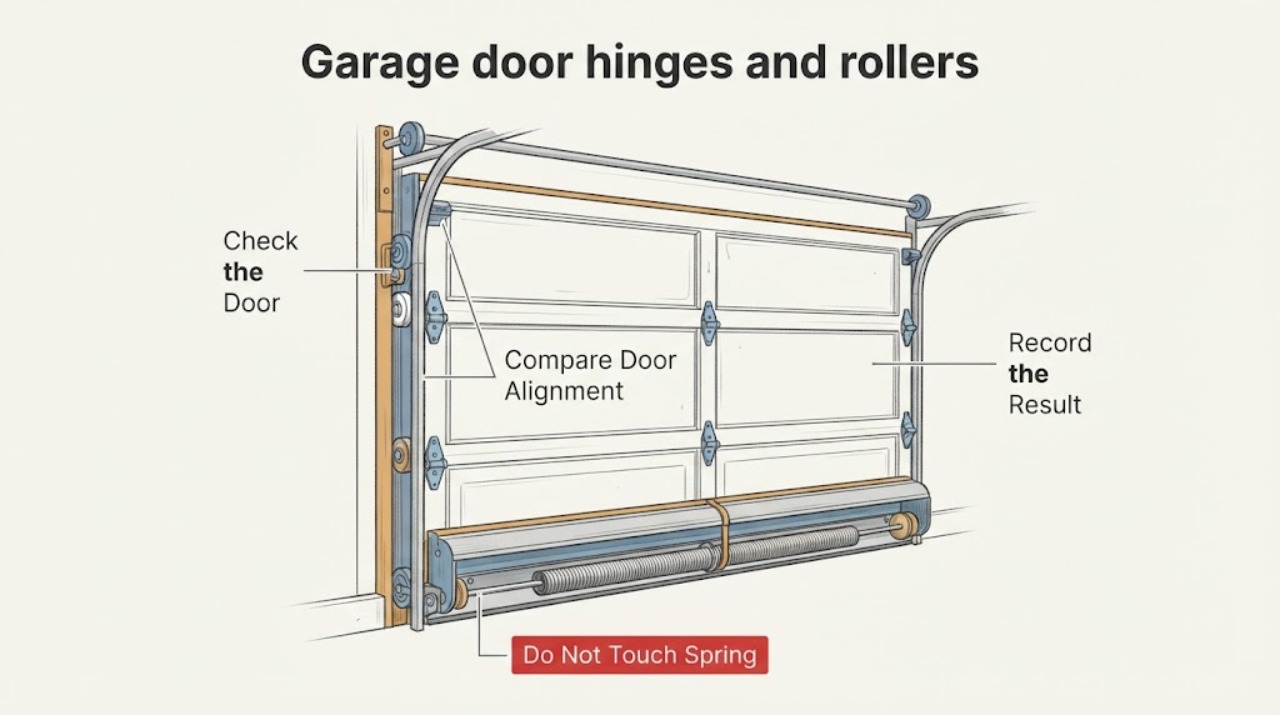
Work through in order
Diagnostic checks
Use only checks that match the exact appliance or system and its official guide.
-
Check 1
Stop the door with the normal wall control, keep the opening clear, and listen from a safe standing position without touching the panels, tracks, rollers, hinges, springs, or opener. Record whether the sound occurs during opening, closing, startup, stopping, direction change, or while the door is stationary.
Expected result: The sound is a squeak, scrape, grind, rattle, click, pop, or bang, and is strongest at one hinge or roller, along a track, across the door, or at the opener.
Next step: Document the sound and timing, then proceed only to the closed-door visual checks if there is no jerking, crooked movement, binding, falling, or other hazard.
Stop if: Do not keep cycling the door to reproduce a bang, grind, slam, uncontrolled movement, or severe vibration; keep it out of service and arrange qualified inspection.
Why this matters
Why: A location tied to door travel makes a hinge, roller, track, section, or hardware issue more likely; an opener-only hum or gear sound points to the powered operator. A bang, grinding sound, or sudden change is a stop condition rather than a lubrication-only clue.
-
Check 2
With the door fully closed and stationary, inspect visible hinge leaves, hinge plates, roller wheels and stems, section joints, and fasteners from outside the track path. Look without reaching into the track or placing fingers near a pinch point.
Expected result: A hinge is cracked, warped, loose-looking, or uneven; a roller wheel is chipped, split, seized-looking, or out of the track; a fastener is missing; or the visible hardware appears intact.
Next step: Photograph the affected location and keep the door closed for any crack, displacement, missing hardware, or suspected roller failure; request a door professional rather than replacing one part by guesswork.
Stop if: Do not remove a roller, hinge, bracket, bottom fixture, cable, or fastener, and do not put a hand inside the track or between door sections.
Why this matters
Why: A damaged or displaced roller or hinge can create localized squeaking, scraping, clicking, or vibration and may let a section move out of alignment. Intact visible hardware does not rule out a worn bearing, hidden damage, or a track or counterbalance fault.
-
Check 3
From outside the track path, visually follow both vertical and horizontal tracks with the door closed. Check for loose-looking supports, debris, dents, warping, a track pulling away from the frame, or a door section that sits unevenly; do not push or realign anything.
Expected result: The track is visibly bent, separated, obstructed, or uneven; a roller appears to rub or sit outside its track; or both tracks and the closed door look aligned.
Next step: Remove only loose debris that is fully outside the track and cannot fall into the door path. Leave the door closed and arrange service for warping, separation, roller displacement, rubbing, or unresolved noise.
Stop if: Do not bend or loosen the track, move brackets, tap a roller back into place, or use the door to force past an obstruction.
Why this matters
Why: A bent, loose, obstructed, or misaligned track can load rollers and hinges unevenly and cause noise or binding. A visually clear track with persistent noise keeps roller bearings, hinges, door balance, and the opener in consideration.
-
Check 4
From a safe distance, note whether the sound follows the door's physical travel or remains at the opener housing, chain or belt path, or drive area. Do not remove the opener cover or disconnect the door to perform a manual force or balance test.
Expected result: Noise is present only while the door sections and rollers travel, only from the powered operator, or in both places; note whether the door also jerks, reverses, slows, or strains.
Next step: Keep the door out of service for strain, reversal, binding, or sudden movement and ask a qualified technician to assess both the door and operator as a system.
Stop if: Do not open the operator housing, adjust force or travel settings as a noise test, pull the emergency release while the door is not safely supported, or operate a door that is off its track.
Why this matters
Why: Travel-linked noise keeps hinges, rollers, tracks, sections, and alignment in focus. Opener-local noise may involve the operator drive, mounting, or controls. Noise plus strain, reversal, jerking, or a crooked door may indicate imbalance or binding and should not be treated as an opener adjustment alone.
-
Check 5
Only if the door is closed, stationary, structurally intact, and the exact CHI care instructions permit owner lubrication, use the specified product on the accessible hinge or roller points named by those instructions. Keep hands, clothing, and the product away from springs, cables, drums, bottom fixtures, electrical parts, and the door path.
Expected result: The noise becomes quieter and the door remains smooth, the sound is unchanged, or a new leak, residue, binding, or movement problem appears.
Next step: Stop after the permitted application and compare only during a normal, supervised cycle if no warning sign exists. Arrange service when the sound persists, returns quickly, or the instructions are unavailable or unclear.
Stop if: Do not spray indiscriminately, use grease or an unapproved solvent, lubricate the track surface contrary to the care instructions, or lubricate springs, cables, drums, or electrical components as a guess.
Why this matters
Why: A temporary improvement supports friction at an approved moving point but does not prove that a roller or hinge is sound. No improvement, recurring noise, or new binding means the cause may be worn hardware, a track, balance, or the opener.
-
Check 6
Collect the CHI model or door documentation from an already accessible location, the sound recording, the loudest hinge or roller location, track and hardware observations, whether the opener is involved, and any history of impact, weather, installation, or recent adjustment.
Expected result: Noise remains after permitted care, returns quickly, occurs with visible damage, or is accompanied by binding, crooked travel, unusual weight, slamming, reversal, or a broken spring or cable.
Next step: Keep the door closed and arrange qualified garage-door service. Give the technician the evidence record and do not order a roller, hinge, track, spring, cable, or opener component from the noise alone.
Stop if: Do not continue cycling a damaged or binding door, climb a ladder to reach hardware, or attempt spring, cable, track, hinge, roller, or opener repair.
Why this matters
Why: These patterns require a complete door and operator inspection because a noisy roller or hinge can be secondary to alignment, balance, track support, damaged sections, or counterbalance trouble.
Use your observations
Decision map
Find the observation that best matches what you see, then follow the next safe action.
-
PATH 01Safety boundary
What you see
The door is aligned and moves without jerking or binding, the noise is localized to an accessible hinge or roller area, and the hardware is not cracked, displaced, or missing.
Do this next
Follow only the exact CHI care instructions for an owner-permitted lubricant, then stop and arrange service if the sound remains or returns.
Why this path and its safety boundary
Why it matters: Friction or routine movable-part maintenance is plausible, but a bearing, hinge, or track problem cannot be confirmed by sound alone.
Safety stop: Do not remove hardware, spray the entire track or spring assembly, or continue cycling a door that develops jerking, binding, or a new bang.
-
PATH 02Safety boundary
What you see
A hinge is cracked or warped, a roller is damaged or out of the track, a fastener is missing, or one section rubs or jumps while traveling.
Do this next
Keep the door closed, photograph the affected area without touching it, and arrange qualified garage-door inspection of the hinge, roller, section, and track.
Why this path and its safety boundary
Why it matters: The noise is more consistent with damaged or displaced door hardware than with simple dry friction, and continued operation can worsen alignment or loading.
Safety stop: Do not pull the roller into place, remove a hinge or fastener, or operate the door to see if it settles.
-
PATH 03Safety boundary
What you see
The track is visibly bent, loose, separated, obstructed, or out of alignment, or a roller rubs the track rather than traveling smoothly.
Do this next
Remove only loose debris that is safely outside the track, leave the door closed, and request professional track and door alignment service.
Why this path and its safety boundary
Why it matters: Track geometry or support is likely contributing to roller and hinge loading; lubrication cannot restore a bent or loose track.
Safety stop: Do not bend, shim, loosen, drill, or re-anchor the track, and do not force the door past an obstruction.
-
PATH 04Safety boundary
What you see
The door is crooked, binds, sticks, reverses, strains, slams, feels unusually heavy, or will not stay safely in position, with or without a loud roller or hinge sound.
Do this next
Stop operating the door, keep people and vehicles clear, and arrange professional service for the door and counterbalance system.
Why this path and its safety boundary
Why it matters: The problem may involve balance, tracks, sections, cables, or the spring counterbalance rather than a replaceable roller or hinge alone. An unbalanced door can move unexpectedly.
Safety stop: Do not disconnect the opener for a manual lift test, adjust springs or cables, or keep cycling a binding or heavy door.
-
PATH 05Safety boundary
What you see
The door travels smoothly and the hinge and roller areas appear intact, but the loudest sound is at the opener housing or drive path.
Do this next
Stop repeated testing and arrange opener and door-system service; provide the timing, sound type, and whether the noise changes with direction or load.
Why this path and its safety boundary
Why it matters: The powered operator, its mounting, drive, or controls may be the source, while a door-hardware replacement would not address the sound.
Safety stop: Do not open the operator housing, adjust force or travel, or touch energized wiring as a homeowner diagnosis.
Helpful context
Understand the symptom
A roller noise is a symptom, not proof that the roller is the only problem
On a sectional CHI door, rollers travel in tracks while hinges connect the door sections. A squeak, scrape, rattle, or click can come from a roller, hinge, track, loose hardware, a door section, or the opener transmitting vibration. The useful first distinction is where and when the noise occurs: at one section, along the curve, throughout travel, only at the motor, or only when the door changes direction. Keep the door stationary for visual inspection and do not pull hardware apart to find the source.
Use CHI's maintenance guidance without turning it into a repair
CHI's maintenance guidance calls for care of movable parts, visual inspection for track debris, loose hardware, warping, and damaged hinges, and a lubricant specified by the door's care instructions. That supports a limited closed-door inspection and, only when the exact instructions permit it, careful owner lubrication of accessible points. It does not make it safe to loosen a hinge, move a track, remove a roller, or work around the spring and cable system.
Binding and imbalance change the service decision
A door that sticks, binds, moves crookedly, drops, or feels unusually heavy has more than a noise complaint. The CPSC warns that an unbalanced door can unexpectedly fall and directs professional service for an unbalanced, binding, or sticking door. Treat a loud bang, sudden change, or movement problem as a reason to stop operation rather than as a reason to apply more lubricant or force the door through its track.
Keep springs, cables, and powered parts behind the service boundary
CHI specifications describe a spring counterbalance and lift cables, and identify roller and hinge arrangements that vary with the door design and weight. Those parts carry or guide a heavy moving door. Do not unwind or adjust springs, move cables, remove bottom fixtures, disassemble hinges, or open the opener cover as a homeowner noise test. Give a technician the exact CHI model or door documentation, the sound location, and the movement pattern.
Safety boundary
Stop conditions
- Keep the door closed and stop operation for a bang, grinding, slamming, severe vibration, crooked travel, binding, reversal, unusual weight, or a door that is off its track.
- Do not remove or adjust hinges, rollers, brackets, bottom fixtures, tracks, cables, drums, springs, or opener components as a noise test.
- Do not disconnect the opener for a manual lift test, force the door past an obstruction, or cycle a damaged or binding door to reproduce the sound.
- Use lubricant only when the exact CHI care instructions permit owner application; do not spray indiscriminately or substitute an unapproved solvent or grease.
- Keep children, people, vehicles, and tools out of the door path and arrange qualified service when visible damage, imbalance, binding, or persistent noise remains.
Only after diagnosis
Potential parts
- garage-door roller assembly
Consider this category only when a qualified inspection confirms a worn, damaged, seized, or displaced roller and identifies the correct assembly for the door.
Confirm the CHI door model, roller dimensions, stem and bearing design, track arrangement, and manufacturer or professional fit information before ordering. - garage-door hinge
Consider this category only when inspection confirms a cracked, warped, loose, or otherwise failed hinge and identifies the section position and correct replacement.
Confirm the CHI door model, section position, hinge pattern, fasteners, and professional fit information; do not use a generic hinge to correct alignment or balance. - garage-door track or support hardware
Consider this category only when a qualified professional confirms track damage, separation, or support failure rather than a roller-only issue.
Confirm track type, lift configuration, door size and weight, support geometry, and manufacturer installation requirements before selecting any hardware. - garage-door opener drive component
Consider this category only when the door hardware is sound and a qualified diagnosis identifies the opener drive or mounting as the noise source.
Confirm the exact opener model, drive system, controls, and manufacturer fit information; do not adjust or replace an opener component from sound alone.
When checks do not resolve it
Need a professional?
Arrange qualified garage-door service when noise persists after the exact owner-permitted care procedure, returns quickly, or comes from a damaged roller, cracked or warped hinge, bent or loose track, opener, or door section. Keep the door closed and seek prompt service for binding, crooked travel, unusual heaviness, slamming, reversal, a broken or damaged spring or cable, or a roller out of the track. Do not attempt spring, cable, track, hinge, roller, or opener repair as a homeowner noise test.
Safety scope: This article supports safe listening and ordinary-access visual inspection, plus model-approved owner lubrication only when the door is closed and stationary. Do not disassemble or adjust door hardware, tracks, springs, cables, counterbalance components, or opener parts.
Common questions
FAQ
Can I lubricate noisy CHI garage-door rollers and hinges?
Only when the exact CHI care instructions permit owner lubrication, the door is closed and stationary, and the points are accessible without reaching into the track or near springs and cables. Use only the specified product and stop if the noise persists, returns, or the door binds or moves unevenly.
Why does my CHI garage door squeak or grind at one section?
A localized sound can involve a roller, hinge, track contact, loose-looking hardware, or a damaged section. Inspect only from a safe position with the door closed. A cracked or displaced part, a roller out of the track, or a sound with jerking or binding requires professional inspection rather than a part replacement by guesswork.
Should I loosen a hinge or move the track to stop the noise?
No. Loosening or moving a hinge, bracket, track, roller, cable, or counterbalance component can change how the heavy door is supported. Leave the door closed and arrange qualified service for warping, separation, misalignment, binding, or missing hardware.
When is a noisy garage door unsafe to keep using?
Stop using it for a bang, grinding, slamming, severe vibration, crooked travel, binding, reversal, unusual heaviness, a roller outside the track, or a damaged spring or cable. Keep people and vehicles clear and arrange professional service; do not keep cycling the door to reproduce the sound.
Read the exact guide
Official sources
- Section 08360 - Overhead DoorsC.H.I. Overhead Doors · C.H.I. specification used to explain why roller and hinge fit varies by door design and why counterbalance components remain professional-service items.
- Publication 523: Non-Reversing Automatic Garage Door Openers Are a HazardU.S. Consumer Product Safety Commission · Government safety publication used for the stop rule around unbalanced, binding, sticking, or unexpectedly moving doors.
- 5 maintenance tips to maximize the lifespan of your garage doorC.H.I. Overhead Doors · Manufacturer maintenance guidance used for the limited visual inspection and conditional lubrication branch.
- Celebrate Garage Door Safety Month with These 10 Safety TipsC.H.I. Overhead Doors · Manufacturer safety guidance used to identify visible hinge, bracket, track, and spring warning signs and to keep people clear of a moving door.
Community feedback
Share a repair observation
Share a plain-text repair observation. Accepted observations are published automatically; this page may take a moment to update.