
On this page
Start here
Quick answer
A noisy C.H.I. garage door is not automatically a bad roller. First identify whether the sound follows one section or roller, the whole track, the hinges, or the opener, and check from a safe position for debris, a warped or loose track, a displaced roller, or a crooked or binding door. C.H.I. recommends using only the track-lubrication product specified by the door's care instructions, inspecting tracks and hinges, and using professionals for repairs. Do not force a roller back into a track, adjust springs or cables, or keep cycling a door that grinds, binds, moves unevenly, drops, or will not stay open; those symptoms need qualified garage-door service.
Before you begin
Safety first
- The technician should determine whether the cause is a roller assembly, hinge, track, fastener, balance or counterbalance component, opener, or a combination before selecting parts.
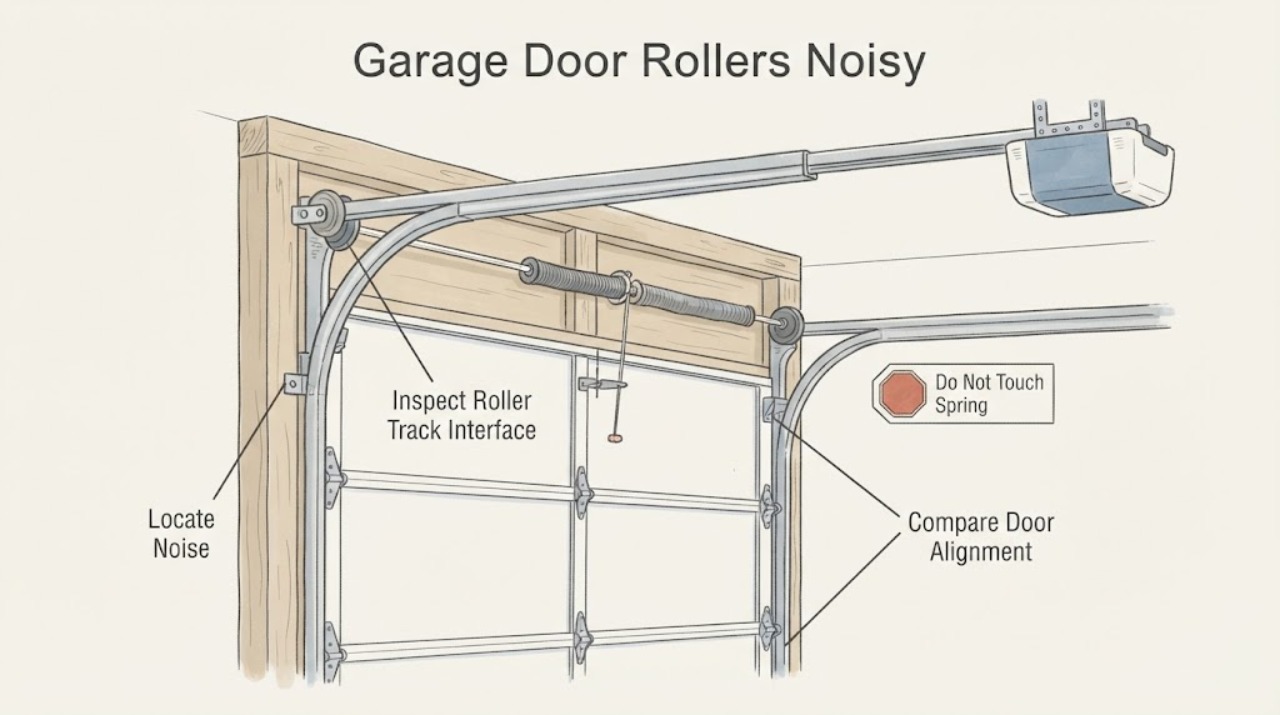
Work through in order
Diagnostic checks
Use only checks that match the exact appliance or system and its official guide.
-
Check 1
If the door is square, unobstructed, and not showing any stop-use sign, observe one normal opening or closing cycle from well outside the travel path; otherwise leave it still and use its last known operation to locate the sound.
Expected result: Record whether the noise is a squeak, click, rattle, scrape, grind, or pop; whether it repeats at one height, follows one section, occurs throughout travel, or comes from the opener area; and whether movement remains smooth.
Next step: Use the sound pattern to choose the next visual check and do not repeat cycles merely to reproduce a noise. Stop use if the door begins to bind, scrape, stall, move crookedly, or drop.
Stop if: Do not operate a door that is visibly off the track, distorted, loose, heavy, dropping, or associated with a damaged cable, spring, hinge, or track.
Why this matters
Why: A repeatable sound at one section or track location makes a roller, hinge, or local track issue more plausible. A whole-cycle rumble can involve several rollers or track maintenance, while an opener-only sound or a noise paired with jerky or crooked movement points away from a simple roller replacement.
-
Check 2
With the door stationary, inspect each accessible roller and its track relationship from the side, without placing fingers near moving parts or trying to turn, pull, or reseat a roller.
Expected result: Look for a roller that is visibly cracked, flattened, displaced, rubbing the track edge, missing its shaft, or sitting differently from neighboring rollers; also note a roller that cannot be judged without moving the door.
Next step: Photograph the abnormal location and ask a qualified technician to inspect the roller, shaft, hinge, and track as a matched assembly rather than ordering a generic wheel.
Stop if: Do not pull the roller from the track, straighten a holder, loosen a hinge, or reach between sections or into the track.
Why this matters
Why: One visibly abnormal roller or a local rub supports a roller or local hardware inspection. A roller that looks normal does not rule out a worn bearing, because the noise may be in the shaft or may be caused by track alignment, hinge movement, or another section.
-
Check 3
From a safe standing position, inspect the visible vertical and horizontal track, hinges, brackets, and fasteners for dust or debris, loose-looking hardware, warping, cracking, rust, or uneven hinge movement; do not tighten or bend anything.
Expected result: The track looks clean and straight, debris is present, hardware appears loose, the track is warped or separating, a hinge is bent or cracked, or the condition is hidden or uncertain.
Next step: Remove only loose debris that can be reached without entering the travel path and only as the care instructions allow; arrange service for any hardware, hinge, track, or rust concern.
Stop if: Do not tighten track brackets or hinges, hammer a track straight, move a bracket, or work near a spring or cable.
Why this matters
Why: Debris or a documented maintenance issue can explain rubbing or rattling, but a warped, separating, cracked, or rust-damaged track or hinge changes the problem from a roller-noise check to a safety and alignment inspection. C.H.I. specifically flags track debris, loose hardware, and warping for attention.
-
Check 4
If the track is straight, the door is aligned, and the noise is a light squeak or rub without grinding, compare the exact C.H.I. care instructions with the maintenance already performed; do not apply a product by guesswork.
Expected result: The care instructions specify an approved track-lubrication product and the track has visible dry friction or debris, the instructions are unavailable, or the noise is grinding, scraping, or unchanged after the approved maintenance step.
Next step: Follow only the exact care instructions for any permitted maintenance, then make one cautious observation of the result; request professional diagnosis if the sound persists or changes character.
Stop if: Do not flood the track, spray sealed roller bearings, use solvents or household oils without approval, or lubricate a door that binds or moves unevenly as a substitute for repair.
Why this matters
Why: A light noise with a clean, aligned track may be compatible with a manufacturer-directed maintenance step. Missing instructions, an unknown product history, grinding, or unchanged noise leaves a roller bearing, hinge, track, or opener fault unresolved and is not a reason to add more lubricant.
-
Check 5
Without disconnecting the opener or manually lifting the door, review the last safe operation and visually check for balance or opener warning signs such as unusual heaviness, a door that will not stay open, crooked travel, straining, or a loud bang.
Expected result: No balance or opener warning is known, or the door was heavy, jerky, crooked, dropped, failed to stay open, strained the opener, or made a loud bang.
Next step: Keep the door and opener unused for any balance, drop, binding, or loud-bang symptom and arrange qualified service for the complete door, counterbalance, track, rollers, and opener.
Stop if: Do not pull the emergency release, lift the door, adjust springs or cables, or continue cycling a door with abnormal weight or movement.
Why this matters
Why: A roller-only noise is less likely when the door has balance, counterbalance, or opener symptoms. The CPSC says an unbalanced door can crash and that binding or sticking requires professional service; C.H.I. also identifies springs and other moving metal parts as hazards when damaged.
-
Check 6
Prepare a service record with the C.H.I. door model or paperwork if safely available, the noise location and type, photos of the rollers and tracks, and the last known operating condition.
Expected result: The model and hardware identity are clear, only the C.H.I. brand is known, or several rollers, sections, hinges, tracks, or the opener may be involved.
Next step: Give the record to a qualified garage-door provider and request inspection of the rollers, shafts, hinges, tracks, balance, and opener before ordering a part.
Stop if: Do not remove a roller or panel to identify it, order a generic roller based on appearance, or make a repair while the door is under load.
Why this matters
Why: Clear identity and a localized pattern help a technician check the correct roller assembly and related hardware. Brand-only information or a whole-door noise pattern does not establish compatibility or prove that a single roller is the cause.
Use your observations
Decision map
Find the observation that best matches what you see, then follow the next safe action.
-
PATH 01Next step
What you see
The noise is a light squeak or rub at one repeatable location, the door remains square and smooth, no roller or track damage is visible, and the C.H.I. care instructions identify a permitted maintenance step.
Do this next
Follow only the exact C.H.I. care instruction, observe the result once, and request service if the noise persists, returns quickly, or changes to grinding or scraping.
Why this path and its safety boundary
Why it matters: A manufacturer-directed maintenance issue is plausible, but the sound is not proof that a roller needs replacement.
-
PATH 02Next step
What you see
The sound follows one section or height and one roller, shaft, hinge, or local track area looks different, while the door's alignment and last known movement were normal.
Do this next
Send the location photos and door identity for a targeted inspection; do not reseat, bend, loosen, or replace the roller yourself.
Why this path and its safety boundary
Why it matters: A localized roller, shaft, hinge, or track problem is more likely than a whole-door balance fault, but a technician must confirm which assembly is responsible.
-
PATH 03Next step
What you see
The sound is scraping or grinding, the track is warped or separating, hardware or hinges look loose or bent, a roller rubs an edge, or the door moves crookedly or binds.
Do this next
Keep the travel area clear, stop using the door and opener, and arrange prompt qualified garage-door inspection.
Why this path and its safety boundary
Why it matters: Track or alignment stress is more likely than ordinary roller noise, and continued operation can let the door leave the track or damage connected parts.
-
PATH 04Next step
What you see
Noise is accompanied by unusual heaviness, jerky or uneven travel, a door that drops or will not stay open, a loud bang, or visible spring or cable damage.
Do this next
Do not operate or lift the door; keep people and vehicles clear and request urgent qualified service for the door and counterbalance system.
Why this path and its safety boundary
Why it matters: Counterbalance or tensioned hardware is involved or cannot be ruled out. This is a safety condition, not a roller-lubrication decision.
-
PATH 05Next step
What you see
The door itself appears aligned and quiet at the sections and tracks, but the noise is concentrated at the opener or occurs without a matching roller or track sound.
Do this next
Stop using the opener if it strains, stalls, or behaves unpredictably and arrange opener and door service with the noise recording and door history.
Why this path and its safety boundary
Why it matters: An opener, drive, mounting, or safety-control issue is more plausible than a roller fault; a roller replacement is unlikely to solve it.
-
PATH 06Next step
What you see
The source cannot be localized safely, the model or hardware identity is unknown, several rollers or sections are noisy, or the noise changes after weather or an impact.
Do this next
Keep operation limited or stopped according to the symptoms and give a qualified technician the photos, model information, timing, and noise description.
Why this path and its safety boundary
Why it matters: A one-part diagnosis and compatibility claim are not supportable from appearance alone; the full door and hardware need an assessment.
Helpful context
Understand the symptom
The sound's location changes the diagnosis
A roller noise usually travels with the door section as it moves through the vertical and curved parts of the track, but similar sounds can come from a hinge, loose track hardware, a bent track, the opener, or an out-of-balance door. Listen for whether the sound happens at one repeatable spot, during the whole travel, only near the opener, or only when the door is crooked or under strain. A sound alone cannot confirm that a roller is the failed part.
Use care instructions rather than a guessed lubricant
C.H.I. directs owners to use the track-lubrication product recommended by the door's care instructions and to inspect the track for debris, loose hardware, or warping. Do not spray an unknown product into roller bearings, flood the track, or use lubrication to mask grinding or misalignment. If the approved maintenance step does not change the noise, the next decision is inspection rather than more product.
A noisy roller can be a symptom of a larger door problem
C.H.I. identifies warped or cracked moving parts and tracks as safety concerns, while the CPSC warns that a door that binds, sticks, or is not balanced should receive professional service. A roller that is out of the track, a door that moves crookedly, a frayed cable, a spring problem, or a door that drops is not a routine noise-only condition. Keep the travel area clear and hand the whole system to a qualified technician.
Safety boundary
Stop conditions
- Stop using the door and opener for grinding, scraping, binding, crooked travel, a displaced roller, a warped or separating track, a door that drops, or a door that will not stay open.
- Do not remove or reseat a roller, loosen or straighten a track, adjust hinges or brackets, pull a cable, or work on springs or counterbalance hardware.
- Do not use guessed lubricants, solvents, household oils, or excess spray to hide a persistent noise; follow the exact C.H.I. care instructions only.
- Keep people, pets, and vehicles out of the travel area and request qualified garage-door service for balance, opener, track, spring, cable, or unresolved roller concerns.
Only after diagnosis
Potential parts
- garage door roller assembly
Consider this only after a qualified inspection confirms that a roller or its shaft is the noise source and identifies the door's exact model, hardware, roller position, and surrounding track and hinge condition.
Do not assume a generic wheel or roller fits a C.H.I. door. Confirm the exact assembly, shaft, load, track, and installation requirements with the manufacturer documentation or service provider before ordering.
When checks do not resolve it
Need a professional?
Use prompt service for persistent or localized roller noise. Treat grinding or scraping with misalignment, a displaced roller, a dropping or heavy door, a loud bang, visible spring or cable damage, or an opener safety problem as urgent and keep the door unused.
Safety scope: The technician should determine whether the cause is a roller assembly, hinge, track, fastener, balance or counterbalance component, opener, or a combination before selecting parts.
Have this ready
- The C.H.I. model or paperwork if safely available and photos of the whole door, rollers, hinges, and tracks
- A short description or recording of the noise, where it occurs, and whether it repeats at one height
- Whether the sound is a squeak, click, rattle, scrape, grind, or pop and whether it changed after maintenance
- Any crooked, binding, heavy, jerky, dropping, or opener-straining movement
- Any impact, storm, rust, debris, or prior repair history
Common questions
FAQ
Are noisy garage door rollers always worn out?
No. Similar sounds can come from a hinge, track debris, loose or warped track hardware, the opener, or an unbalanced door. A repeatable sound location and safe visual inspection help narrow the cause, but they do not prove which part needs replacement.
Can I lubricate noisy C.H.I. garage door rollers?
Use only the track-lubrication product and procedure specified by the exact C.H.I. care instructions. Do not spray an unknown product into roller bearings or use lubrication to hide grinding, scraping, binding, or misalignment; persistent noise needs service.
What does grinding or scraping from the roller area mean?
Grinding or scraping, especially with a displaced roller, warped track, unequal gaps, crooked travel, or binding, points to a track, roller, hinge, or alignment problem rather than a routine squeak. Stop operating the door and arrange qualified inspection.
Should I replace one noisy roller myself?
Do not remove or reseat a roller yourself. The roller is connected to the door section and track, and a professional should confirm the shaft, hinge, track, and balance before selecting a compatible assembly.
When is noisy garage door service urgent?
Keep the door unused and request urgent service for a door that drops, becomes heavy, binds, moves crookedly, will not stay open, makes a loud bang, has a damaged spring or cable, or has a displaced or warped track or roller.
Read the exact guide
Official sources
- 5 maintenance tips to maximize the lifespan of your garage doorC.H.I. Overhead Doors · Supports using the care-instruction-recommended track lubricant, inspecting tracks for debris, loose hardware, and warping, and using professionals for repairs and service.
- Publication - 523 Non-Reversing Automatic Garage Door Openers Are a HazardU.S. Consumer Product Safety Commission · Supports keeping a door out of service when its reversal fails and obtaining professional service for a door that is unbalanced, binds, sticks, or can crash.
- Garage Door Safety ChecklistC.H.I. Overhead Doors · Supports inspecting hinges, brackets, springs, tracks, and safety features; recognizing sharp, warped, or rusted components; and escalating unsafe operation.
Community feedback
Share a repair observation
Share a plain-text repair observation. Accepted observations are published automatically; this page may take a moment to update.