
On this page
Start here
Quick answer
A noisy Amarr garage door is often caused by friction, dirt, a worn roller, loose hardware, a track problem, or an opener that is transmitting noise. With the door closed and stationary, note where the sound starts, inspect the rollers, hinges, track, cables, springs, and fasteners without touching tensioned parts, and clean the track with a damp cloth. Lubricate only the components and roller type allowed by your Amarr manual; do not lubricate nylon rollers or tracks. If a roller is cracked or loose, the door binds, moves unevenly, is off its track, a cable is frayed, a spring is broken, or the noise persists, stop operating it and have a trained garage-door technician inspect it.
Before you begin
Safety first
- This article supports safe listening, stationary visual inspection, track cleaning, and only manual-approved lubrication or manual movement using safe handles. It does not authorize roller or track removal, spring or cable work, bottom-bracket adjustment, opener-cover removal, force/travel changes, or safety-device bypasses.
Work through in order
Diagnostic checks
Use only checks that match the exact appliance or system and its official guide.
-
Check 1
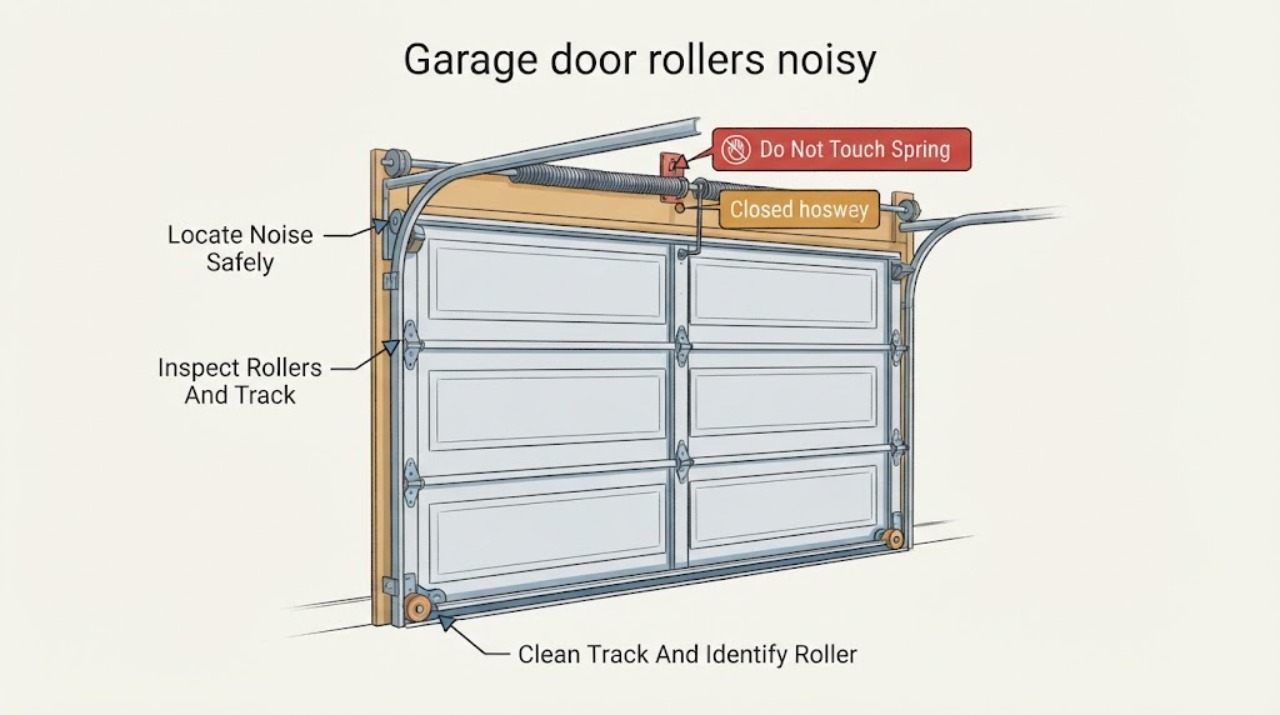
With the door stationary and the opening clear, observe one complete open-and-close cycle from a safe position and listen for whether the sound comes from one roller position, several hinges, the track, the springs, or the opener motor and drive.
Expected result: Record whether the noise is a light squeak, a repeated click at one section, a scrape or grind, a rattle, or a motor/chain/belt sound; note whether it occurs during manual movement, powered movement, or both.
Next step: Use the sound pattern to choose the visual inspection below; do not keep cycling the door to reproduce a severe noise or operate it if the door is crooked, binding, or unstable.
Stop if: Keep hands and people away from the moving door and all pinch points. Stop immediately for an off-track door, hanging section, loose cable, broken spring, or uncontrolled movement.
Why this matters
Why: A sound synchronized with one section or roller makes local roller, hinge, fastener, or track friction more likely. A sound only during powered operation keeps the opener and its connection in the diagnostic path. Scraping, grinding, jerking, or a sudden loud change is more concerning than a gradual squeak.
-
Check 2
Start with the door fully closed and use a flashlight to inspect each visible roller, roller stem, hinge, bracket, track, and fastener from outside the path of the door. Look for cracks, flat spots, missing or loose hardware, rust, debris, a roller sitting out of the track, or a track that is bent or visibly displaced.
Expected result: Record whether the roller is intact and seated, dirty but undamaged, visibly cracked or worn, loose at its bracket, or unable to follow the track; also record any bent track, damaged panel, frayed cable, or spring damage.
Next step: If only removable surface debris is present, clean the track without changing its alignment. If a roller, bracket, track, cable, spring, panel, or mounting surface is damaged or displaced, leave the door closed and arrange trained service.
Stop if: Do not remove a roller, loosen a bracket or red fastener, bend a track back, touch a cable or spring, or reach between door sections or into a moving assembly.
Why this matters
Why: Dirt or buildup can create friction, while a damaged roller, loose bracket, track displacement, or panel damage can create repeated noise and an unsafe load. A cable or spring defect is not a roller-cleaning problem and can allow the door to fall or become unbalanced.
-
Check 3
If the visual inspection found no damage, wipe dirt and cobwebs from the track with a damp cloth while the door remains closed, then identify whether the rollers are nylon or another type from the manual or visible construction. Do not spray the track or roller indiscriminately.
Expected result: Note whether the noise changes after loose dirt is removed, whether a roller is visibly plastic/nylon, and whether the owner's manual permits lubricant on that roller and its bearing or stem.
Next step: Apply only the manual-approved garage-door lubricant to the permitted moving component, sparingly and with the door stationary; if the manual does not identify the component or the noise remains, stop and request service.
Stop if: Do not lubricate nylon rollers or tracks, flood the assembly with spray, use lubricant as a substitute for a damaged-part repair, or put fingers near hinges, rollers, springs, or cables.
Why this matters
Why: A cleaner track can remove a simple source of friction, but it does not correct a bent track or worn roller. Amarr's manual specifically excludes nylon rollers and tracks from lubrication, so the roller material changes the safe next step.
-
Check 4
Only when the door is closed, no damage is visible, and safe gripping points are available, disengage the opener using its instructions and gently move the door by the handles or suitable gripping points; do not strain or place fingers between sections.
Expected result: Record whether the door moves freely and quietly, binds at one height, feels unusually heavy, drops or rises, stays partially open around 3 to 4 feet above the floor, or has rollers that leave the track.
Next step: Reconnect the opener only as its manual directs if the door moved normally; otherwise leave the opener disconnected and arrange a technician with the exact movement pattern and sound location.
Stop if: Do not force the door, adjust springs or cables, loosen bottom brackets, repair a track, or continue if the door is heavy, drops, rises, crooked, or difficult to control.
Why this matters
Why: Free, balanced manual movement with noise only under power shifts attention toward the opener or its connection. Binding, excessive resistance, failure to balance, or a roller leaving the track indicates a door, track, roller, or counterbalance condition that needs trained assessment.
-
Check 5
After the door has passed the safe visual and manual checks, compare a short powered cycle with the door movement sound; observe the opener housing and the connection arm from a safe distance without opening the opener or adjusting its force, travel, chain, belt, or wiring.
Expected result: Record whether the door is quiet when manually moved but noisy only under power, whether the opener vibrates, whether the connection rattles, or whether the same roller-area noise remains in both modes.
Next step: Give the technician the manual-versus-powered comparison and any visible vibration; arrange opener or door service rather than changing force or travel settings yourself.
Stop if: Do not remove opener covers, alter force or travel settings, defeat photo eyes, test under an unsafe door, or operate a door that does not reverse or moves unpredictably.
Why this matters
Why: Noise confined to powered operation makes opener drive, mounting, or connection service more likely. Noise in both modes keeps roller, hinge, track, panel, or balance causes in scope. A safety reversal failure is a separate urgent reason to stop using the opener.
Use your observations
Decision map
Find the observation that best matches what you see, then follow the next safe action.
-
PATH 01Safety boundary
What you see
The door remains aligned and balanced, no component is damaged, and the squeak becomes quieter after track cleaning or manual-approved lubrication of a permitted moving part.
Do this next
Monitor the next few normal cycles from a safe position and follow the Amarr maintenance interval and manual; book service if the noise returns quickly or changes character.
Why this path and its safety boundary
Why it matters: Surface dirt or ordinary friction is more likely than a failed roller, but improvement does not prove that a bearing, hinge, or track is sound.
Safety stop: Do not keep adding lubricant to mask grinding, binding, or visible wear.
-
PATH 02Safety boundary
What you see
The sound repeats at one door section or roller location, and inspection finds a cracked, worn, loose, or noisy roller, hinge, bracket, or local track problem.
Do this next
Leave the door in a safe position and have a trained garage-door technician identify and replace or correct the failed component and verify alignment.
Why this path and its safety boundary
Why it matters: The local hardware is a stronger suspect than a general opener setting; a damaged roller can add friction and affect how the door travels.
Safety stop: Do not pull the roller out of its bracket, loosen hinge or bottom-bracket fasteners, or straighten the track yourself.
-
PATH 03Safety boundary
What you see
The door moves freely and quietly by hand, but the noise appears only when the opener runs or the opener visibly vibrates.
Do this next
Stop at the comparison and request opener/door service with the manual-versus-powered result; do not open or adjust the opener.
Why this path and its safety boundary
Why it matters: The opener drive, mounting, connection, or powered adjustment is more likely than the rollers alone, although the door system still needs to remain balanced and safe.
Safety stop: Do not alter opener force or travel, tighten hidden mounts, remove covers, or bypass safety devices without the opener manual and qualified service.
-
PATH 04Safety boundary
What you see
The door is crooked, binds, is unusually heavy, drops or rises, will not stay partially open, leaves the track, has a frayed cable or broken spring, or has a loose bottom bracket.
Do this next
Keep people clear, leave the door closed if it can safely remain there, disconnect power only as the equipment instructions require, and call a trained door-systems technician.
Why this path and its safety boundary
Why it matters: This pattern indicates a possible track, panel, roller, mounting, or counterbalance fault and can make continued operation unsafe; it is not a lubrication decision.
Safety stop: Do not operate the door, adjust springs or cables, loosen red fasteners or bottom brackets, or attempt to catch or realign a falling or off-track door.
Helpful context
Understand the symptom
Use the sound to separate roller noise from opener noise
A squeak that follows individual door sections or rollers is different from a steady motor, chain, or belt sound that occurs only while the opener runs. Listen from a safe position with people and vehicles clear of the opening. Do not put a hand near a moving door, hinge, roller, spring, cable, or track. A noise location is a clue for the next inspection, not proof that one part needs replacement.
Amarr-specific lubrication has an important exception
Amarr's manual calls for lubrication of hinges, springs, rollers, and bearings with the product or equivalent it specifies, while explicitly excluding nylon rollers and tracks. Amarr's web maintenance guidance also says to consult the owner's manual and not lubricate plastic rollers or idler bearings. Identify the roller material and follow the manual for the exact door before applying anything; spraying the track can attract dirt and hide a developing alignment problem.
The professional boundary is part of the diagnosis
Roller replacement, track correction, cable or spring work, bottom-bracket work, and balance adjustment are not ordinary lubrication tasks. DASMA warns that springs and spring hardware are under high tension and says repairs and adjustments should be performed by a trained door-systems technician. Amarr likewise directs damaged rollers, abnormal balance, and significant repairs to trained service personnel.
Safety boundary
Stop conditions
- Do not remove or replace rollers, loosen hinges, brackets, cables, springs, or track fasteners, or adjust any counterbalance component as a homeowner repair.
- Do not operate a door that is off its track, crooked, binding, unusually heavy, dropping, rising, or showing a broken spring, frayed cable, damaged panel, or loose bottom bracket.
- Do not lubricate tracks or nylon rollers, and do not use lubricant to hide grinding, a damaged bearing, misalignment, or unsafe movement.
- Keep hands, children, vehicles, and bystanders clear of moving sections, hinges, rollers, springs, cables, and pinch points; use handles or suitable gripping points only for a safe manual check.
- Arrange trained garage-door service when noise persists after permitted cleaning, a roller or track is damaged, the door is not balanced, the opener is the noise source, or any repair or adjustment is indicated.
Only after diagnosis
Potential parts
- garage-door roller
Consider this category only if inspection or technician diagnosis identifies a cracked, worn, seized, noisy, or out-of-track roller; noise alone does not establish the correct roller type.
Confirm the Amarr door model, roller material, stem and carrier details, track arrangement, and technician recommendation before ordering; do not infer fit from appearance. - noise-dampening roller sleeve
Consider this only after the door and rollers are inspected and found safe, aligned, and serviceable, and persistent operating noise is confirmed as an appropriate noise-control issue.
Amarr describes its Quiet Door sleeve as a dealer-installed option whose suitability varies by door model; have the dealer confirm applicability rather than modifying roller hardware yourself.
When checks do not resolve it
Need a professional?
Call a trained garage-door technician when the noise persists after a safe visual inspection and manual-approved maintenance, when a roller is cracked, worn, loose, or out of the track, when the track or panel is damaged, when the door binds or is out of balance, when cables or springs show damage, or when the opener is noisy or fails a safety function. Keep the door out of service for an off-track, dropping, crooked, or uncontrolled door.
Safety scope: This article supports safe listening, stationary visual inspection, track cleaning, and only manual-approved lubrication or manual movement using safe handles. It does not authorize roller or track removal, spring or cable work, bottom-bracket adjustment, opener-cover removal, force/travel changes, or safety-device bypasses.
Common questions
FAQ
Should I lubricate noisy Amarr garage door rollers?
Only after the door is stationary, the roller and track are undamaged, and the Amarr manual identifies the component as lubricatable. The Amarr residential manual says not to lubricate nylon rollers or tracks; follow the installed manual instead of spraying every part.
How can I tell whether the rollers or the opener are making the noise?
Compare the sound during a safe manual movement and a short powered cycle only after the door passes the visual safety check. Noise present in both modes keeps rollers, hinges, track, and balance in scope; noise only under power points more toward the opener or its mounting and connection.
Can I replace an Amarr garage door roller myself?
Do not treat roller replacement as a routine parts swap. The roller is connected to door hardware, and nearby brackets, cables, and springs can be under high tension. Have a trained garage-door technician diagnose the roller and verify the replacement and alignment.
When is noisy operation unsafe?
Stop using the door and arrange trained service if it is crooked, off its track, binding, unusually heavy, dropping, rising, fails to stay balanced, or shows a damaged spring, frayed cable, damaged panel, or loose bracket. Persistent grinding or a sudden loud change also warrants service instead of repeated cycling.
Read the exact guide
Official sources
- Amarr Residential Owner's ManualAmarr · Amarr residential door owner's manual; instructions vary by door and opener configuration, so the installed model manual controls.
- Garage Door Care and MaintenanceAmarr · Amarr garage-door care guidance; use the owner's manual for the exact door and opener model and treat damaged components as technician work.
- Automatic Garage Door Opener Safety & Maintenance GuideDoor & Access Systems Manufacturers Association International · DASMA maintenance guide for automatic residential garage-door systems; follow the specific door and opener manuals.
- Safety Tips For Garage Door SystemsDoor & Access Systems Manufacturers Association International · DASMA safety guidance for residential garage-door systems; the manufacturer's manual and local requirements control a specific installation.
- FAQsAmarr · Amarr dealer FAQ for residential garage doors; exact maintenance and parts decisions depend on the installed door and opener model.
- Residential Sectional Garage Door and Electric Operator Checklist for Home Inspectors and ConsumersDoor & Access Systems Manufacturers Association International · DASMA checklist for residential sectional doors with electric operators; it is an inspection aid, not a substitute for the individual manufacturer's instructions.
Community feedback
Share a repair observation
Share a plain-text repair observation. Accepted observations are published automatically; this page may take a moment to update.