
On this page
Start here
Quick answer
Noisy rollers or tracks on a Clopay garage door can result from dirt, a dry roller bearing, worn or damaged rollers, loose hardware, a bent or misaligned track, an unbalanced door, or an opener or spring problem that is being heard through the track. First keep people and vehicles out of the travel path, listen from a safe position to locate the sound, and inspect the closed door for debris, rubbing marks, roller gaps, cracks, displacement, or frayed cables. Clopay allows model-appropriate maintenance such as cleaning tracks and lubricating suitable moving points, but a track should not be bent or repositioned and high-tension springs, cables, bottom brackets, and balance adjustments are professional work. Do not put hands in the track, loosen load-bearing hardware, pull the emergency release on a damaged door, or keep cycling a door that jerks, tilts, slams, pops, or has a roller out of the track. If the noise persists after a safe, manual-approved clean and lubrication check, arrange qualified garage-door service to inspect the rollers, tracks, hinges, balance, opener, springs, and cables together.
Before you begin
Safety first
- A qualified technician should inspect and repair rollers, tracks, hinges, panel attachments, opener connections, cables, pulleys, springs, bottom brackets, balance, and safety reversal. Homeowner work should remain visual and limited to manual-approved cleaning or lubrication of accessible non-hazardous moving points; do not adjust high-tension or load-bearing hardware.
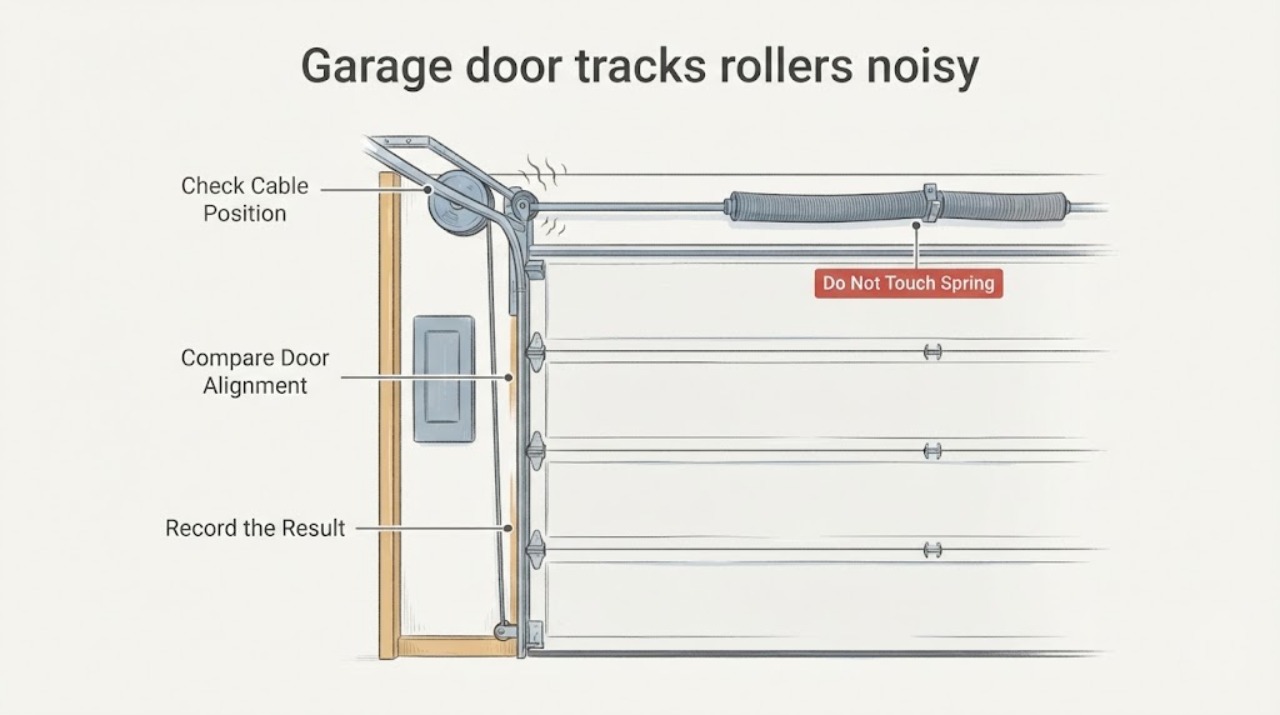
Work through in order
Diagnostic checks
Use only checks that match the exact appliance or system and its official guide.
-
Check 1
Stop the opener and clear the travel path if the Clopay door snaps, grinds while jerking, scrapes metal, tilts, slams, hangs unevenly, leaves a roller out of the track, or shows a broken spring, slack or frayed cable, or a bent track.
Expected result: The door makes only a mild squeak while remaining square and smooth, or the noise is accompanied by impact, sudden movement, visible damage, or counterbalance symptoms.
Next step: For any abnormal movement or damaged hardware, leave the door in its current position, keep the opener out of use, and arrange qualified garage-door service. Do not pull the emergency release, lift the door, or reach into the track to investigate.
Why this matters
Why: A mild squeak can be ordinary friction, but noise with abnormal movement or spring, cable, roller, or track damage can indicate a falling-door or stored-energy hazard.
-
Check 2
With the door safely closed and the opener stopped, listen from outside the travel path during one normal observation only if movement has been smooth; note whether the sound follows one roller, one track section, a hinge, the opener, or a spring or cable area.
Expected result: The sound repeats at one wheel or track spot, occurs at several panel joints, comes from the opener, is a sudden pop or snap, or cannot be localized.
Next step: Stop operation for a pop, snap, grind, or uneven travel. Otherwise record the location and sound type for service; keep hands and tools out of the moving system.
Why this matters
Why: A location-specific squeak or scrape narrows the visual inspection to that roller, track, or joint. An opener hum, spring or cable pop, or unlocalized vibration may not be a roller fault and should not be chased by disassembly.
-
Check 3
Inspect the accessible track interiors, roller wheels, stems, hinge leaves, and visible hardware with the door closed; look for leaves, grit, rust, cracked wheels, flat spots, rubbing marks, roller gaps, bent metal, or displaced fasteners without loosening anything.
Expected result: Debris is packed in the track, a roller is cracked or visibly worn, the wheel is rubbing one wall, the track is bent or twisted, hardware is visibly displaced, or no defect is apparent.
Next step: When the door is stable and the Clopay instructions allow it, remove only loose surface debris with a small brush or damp cloth and dry the area. Do not bend, reposition, or loosen a track or load-bearing bracket; arrange service for wear, displacement, or persistent noise.
Why this matters
Why: Debris and worn rollers can create friction; a bent or misaligned track can make the roller rub or bind. A normal visual check does not rule out a bearing, hidden alignment, opener, balance, spring, or cable problem.
-
Check 4
Check the exact Clopay owner or maintenance instructions and identify whether the noisy roller is steel, nylon, or another material; if the manual permits it and access is safe, apply only the specified garage-door lubricant to the roller bearing or shaft interface, not the tire or an unapproved track surface.
Expected result: The manual identifies an approved moving point, the roller is visibly dry but intact, the sound improves briefly, or the noise remains rough or returns quickly.
Next step: Do not spray blindly into the track or continue adding lubricant to mask a persistent sound. Stop if the roller is damaged or access is awkward, and arrange qualified inspection of the roller, track, hinge, and door alignment.
Why this matters
Why: Appropriate lubrication can reduce ordinary bearing friction, but it cannot repair a worn wheel, bent track, displaced hardware, or balance problem. The exact manual controls product and location because Clopay guidance distinguishes moving parts from surfaces that should not be coated indiscriminately.
-
Check 5
Compare both sides of the door and observe the panel alignment from a safe distance: look for one side leading, a section rubbing the jamb, a wheel climbing or leaving the track, a track gap, a pause at one point, or opener hardware contacting the top section.
Expected result: The door stays level and moves smoothly, or it shakes, binds, shifts sideways, pauses, closes hard, or shows a roller or opener connection out of position.
Next step: Do not change opener force or travel, loosen top or bottom brackets, bend the track, or adjust springs. Keep the door out of service and arrange qualified inspection for abnormal travel.
Why this matters
Why: Smooth travel keeps routine friction more likely. Racking, binding, slamming, or contact indicates alignment, panel, track, opener, or balance trouble that can overload rollers and hinges.
-
Check 6
From a safe position, inspect visible springs, lift cables, pulleys, and brackets for fraying, a broken coil, a cable off its drum, separation, or a displaced support; do not touch, wind, disconnect, or test these components.
Expected result: A cable is frayed or slack, a spring is broken or abnormal, a bracket is displaced, or no counterbalance defect is visible.
Next step: For any cable, spring, pulley, or bracket abnormality, do not operate the door and arrange immediate qualified garage-door service. Do not remove a bottom bracket or attempt a spring or cable adjustment as a noise fix.
Why this matters
Why: Counterbalance damage can make rollers and tracks noisy because the door is carrying the wrong load, and it creates a high-tension injury risk. An apparently normal spring does not clear a door that is noisy and unbalanced.
-
Check 7
After a manual-approved clean and lubrication check or a professional repair, observe one controlled cycle from outside the travel path and compare the original sound location, roller seating, track clearance, alignment, and safety response.
Expected result: The door is quiet and smooth, or the noise returns, changes to grinding or popping, a roller shifts, the door binds, or the opener safety response is abnormal.
Next step: Stop operation for recurrence or abnormal behavior and contact the servicing professional with the observation log. Do not compensate by changing force or travel, repositioning the track, or repeatedly lubricating the same part.
Why this matters
Why: A quiet, aligned cycle supports a successful maintenance result. Recurrence or new movement means the underlying roller, track, hinge, balance, opener, spring, or cable issue remains unresolved.
Use your observations
Decision map
Find the observation that best matches what you see, then follow the next safe action.
-
PATH 01Next step
What you see
A mild squeak comes from one intact roller or bearing, the track is straight and clean, and the door stays level and smooth.
Do this next
Follow the exact Clopay instructions for an approved light lubrication check at the roller bearing or shaft interface. If the sound persists or travel changes, arrange service rather than applying more lubricant.
Why this path and its safety boundary
Why it matters: Routine dry-bearing or moving-point friction is more likely than a track or counterbalance failure.
-
PATH 02Next step
What you see
The noise follows a roller and there is debris, rubbing, a flat spot, cracked wheel, roller gap, or track displacement.
Do this next
Keep hands out of the track, remove only loose surface debris when safe and manual-approved, and arrange qualified inspection for the roller, track, and attachment. Do not bend or reposition the track.
Why this path and its safety boundary
Why it matters: A roller or track friction and alignment problem is more likely than a hinge-only squeak and may worsen with each cycle.
-
PATH 03Next step
What you see
Noise is accompanied by a snap, frayed or slack cable, broken spring, roller out of the track, bent track, panel movement, slamming, or a door that will not stay balanced.
Do this next
Leave the opener and door out of service, clear the area, and arrange qualified garage-door service. Do not pull the release, lift the door, or adjust springs, cables, brackets, or track hardware.
Why this path and its safety boundary
Why it matters: The pattern indicates counterbalance, track, panel, or hardware risk rather than routine lubrication; the door may move unexpectedly or fall.
-
PATH 04Next step
What you see
The sound is strongest at the opener, top section, or mounting hardware rather than at the roller, especially when the door contacts or strains against the opener connection.
Do this next
Stop cycling the door and have a qualified technician inspect the opener connection, top section, track, balance, and counterbalance. Do not change force or limit settings to hide the sound.
Why this path and its safety boundary
Why it matters: An opener attachment, reinforcement, panel, balance, or installation problem is more likely than a roller bearing alone.
-
PATH 05Next step
What you see
An approved lubrication check briefly quiets the door but the sound returns, shifts location, or is joined by vibration, rubbing, uneven travel, or visible wear.
Do this next
Keep a note of where and when the noise returns and arrange inspection of the complete door system. Do not continue spraying or order a replacement part based on sound alone.
Why this path and its safety boundary
Why it matters: Lubrication reduced a symptom without correcting a worn roller, track, hinge, balance, opener, spring, or cable problem.
Helpful context
Understand the symptom
Track noise and roller noise are related but not identical
A roller is the wheel that travels inside the track, so a dry bearing, worn wheel, dirt, or a displaced roller can sound like a track problem. A bent, twisted, rusty, or misaligned track can make the roller rub, chatter, or bind. A squeak at one wheel, a scrape at one track section, a rattle from loose hardware, and a pop from a spring or cable do not point to the same repair. Listen and look from outside the travel path rather than reaching toward the moving wheel.
Start with the door stopped and closed
A closed door gives safer access to visible roller and track surfaces, but it does not make spring, cable, bottom-bracket, or track adjustments safe. Clopay maintenance guidance supports cleaning accessible tracks and lubricating appropriate moving parts according to the door instructions. It also says not to adjust springs or remove bottom brackets under tension. If the door is crooked, heavy, stuck, or damaged, skip maintenance and arrange service.
The door’s movement is diagnostic evidence
A door that stays square and moves smoothly with a mild squeak is a different situation from one that pauses at one track point, shakes, leaves a roller gap, slams, or rises unevenly. Movement problems can involve track alignment, roller or hinge wear, panel damage, balance, cables, springs, or opener force. Noise alone cannot select a roller or track replacement.
Quieting the sound is not the same as correcting the cause
An approved lubrication check may reduce ordinary bearing or hinge squeak, but it cannot correct a bent track, worn wheel, loose attachment, unbalanced door, or failing counterbalance. Verify that the door remains aligned, quiet, and safe through a controlled observation. If the noise returns or changes character, stop treating it as routine lubrication and have the complete system inspected.
Safety boundary
Stop conditions
- Do not operate the opener or manually move the door for a snap, grinding with jerking, scraping metal, uneven hanging, slamming, a roller out of the track, bent or twisted track, frayed or slack cable, broken spring, or a door that will not stay balanced.
- Do not loosen or remove hinges, roller brackets, bottom brackets, cables, pulleys, springs, track supports, track fasteners, or opener attachments; these parts can carry door weight or stored spring force.
- Do not bend or reposition a track, change opener force or travel, pull the emergency release on a damaged door, reach into a moving track, or keep cycling the door to reproduce noise.
- Arrange qualified garage-door service for persistent noise, visible wear, imbalance, panel or reinforcement damage, opener contact, displaced hardware, or uncertainty about the exact Clopay model and maintenance instructions.
Only after diagnosis
Potential parts
- garage-door roller
Consider this only when inspection confirms a worn, cracked, seized, or displaced roller and the track, hinge, balance, and door section are suitable; noise alone does not identify roller failure.
Confirm the exact Clopay door model, roller material, stem and track arrangement, hinge position, load, and manufacturer service requirements before ordering or installing. - garage-door track or track hardware
Consider this only when inspection confirms a bent, twisted, displaced, or incompatible track or attachment after debris and roller condition are evaluated; do not bend a track to quiet the door.
Confirm door size, lift configuration, track radius, roller arrangement, mounting, and Clopay specifications before replacement; track alignment is not a generic part swap. - garage-door hinge
Consider this only when a technician confirms a cracked, bent, or worn hinge or pivot is contributing to the sound; a squeak can also come from a roller, track, balance, or opener.
Match the exact Clopay section, hinge position, fastener pattern, roller support, door construction, and installation instructions. - garage-door cable or spring system component
Consider this only after a qualified technician confirms counterbalance wear or damage; noisy rollers can be a secondary symptom and spring or cable selection cannot be made from sound alone.
Match door weight, height, track hardware, spring type, cable routing, and exact Clopay installation specifications; high-tension work is professional service.
When checks do not resolve it
Need a professional?
Safety scope: A qualified technician should inspect and repair rollers, tracks, hinges, panel attachments, opener connections, cables, pulleys, springs, bottom brackets, balance, and safety reversal. Homeowner work should remain visual and limited to manual-approved cleaning or lubrication of accessible non-hazardous moving points; do not adjust high-tension or load-bearing hardware.
Common questions
FAQ
Why are my Clopay garage door rollers or tracks noisy?
Possible causes include dirt or rust in the track, a dry or worn roller bearing, a cracked or displaced roller, loose hardware, a bent or misaligned track, hinge friction, an unbalanced door, or an opener, spring, or cable problem being transmitted through the door. Locate the sound from a safe position and inspect only with the door safely stopped; do not select a replacement part from noise alone.
Can I lubricate noisy Clopay garage door rollers?
Clopay provides a roller lubrication procedure with the door closed, applying lubricant at the roller shaft and collar or wheel interface. Follow the exact instructions for your door and roller, keep lubricant off areas the manual excludes, and stop if the roller is damaged or the sound is rough, persistent, or accompanied by binding or displacement.
Should I lubricate the Clopay garage door track?
Clean the track with a small brush and damp cloth when the door is stable and the instructions allow it. Do not spray blindly into the track or use lubricant to hide a bent, twisted, or misaligned rail; follow the exact Clopay manual for your model and have track problems inspected rather than bending or repositioning the track yourself.
How do I know whether the roller or track is the problem?
A sound that repeats at one wheel with a visible flat spot, crack, gap, or rubbing mark keeps the roller in focus. A scrape or bind at one rail, a bent or twisted track, or a door that sticks at the same point keeps track alignment in focus. Uneven travel, slamming, or a cable or spring symptom broadens the issue to balance or counterbalance. A technician may need to inspect the complete system.
Can I adjust a Clopay garage door track to stop the noise?
Do not bend, reposition, loosen, or remove track supports, roller brackets, bottom brackets, springs, cables, or other load-bearing hardware as a noise fix. Track alignment affects the door and opener, and a wrong adjustment can create a falling-door or stored-energy hazard. Arrange qualified service when a track is bent, displaced, or causing binding.
When should I stop using a noisy Clopay garage door?
Stop for snapping or popping, grinding with jerking, scraping metal, uneven hanging, slamming, a roller out of the track, a bent track, a frayed or slack cable, a broken spring, or a door that will not stay balanced. Also arrange service when noise persists after an approved basic check, returns quickly, or is joined by visible wear, opener contact, or abnormal movement.
Read the exact guide
Official sources
- Lubricating Noisy Wheel RollersClopay · Clopay’s maintenance sheet shows lubrication at the roller shaft and collar or wheel interface with the door closed, while keeping the procedure limited to the roller and its bearing area.
- Clopay Garage Door InstallationClopay · Clopay calls for secure roller-track supports, inspection of rails, rollers, and cables, smooth operation and balance, and model-appropriate lubrication while identifying spring tension as a specialized task.
- Garage Door Troubleshooting TipsClopay · Clopay says noise may come from worn or loose parts, lack of lubrication, or misaligned tracks; it recommends inspecting rollers and using appropriate lubricant while avoiding unsafe repairs.
- Garage Door Replacement Parts GuideClopay · Clopay distinguishes roller inspection, track damage, lubrication, balance, and high-tension spring or cable work, directing damaged track and balance issues to professionals.
- How to Fix a Noisy Garage Door: Comprehensive Guide for HomeownersClopay · Clopay relates squeaks to dry or worn rollers and hinges, rattles to loose hardware, and track gaps or sticking to alignment; it identifies springs, cables, and persistent grinding as professional concerns.
- Garage Door Components - A Complete GuideClopay · Clopay explains that bent or misaligned tracks can cause noise, rollers can wear or collect dirt, and springs and cables should not be adjusted by a homeowner when damaged.
Community feedback
Share a repair observation
Share a plain-text repair observation. Accepted observations are published automatically; this page may take a moment to update.