
On this page
Start here
Quick answer
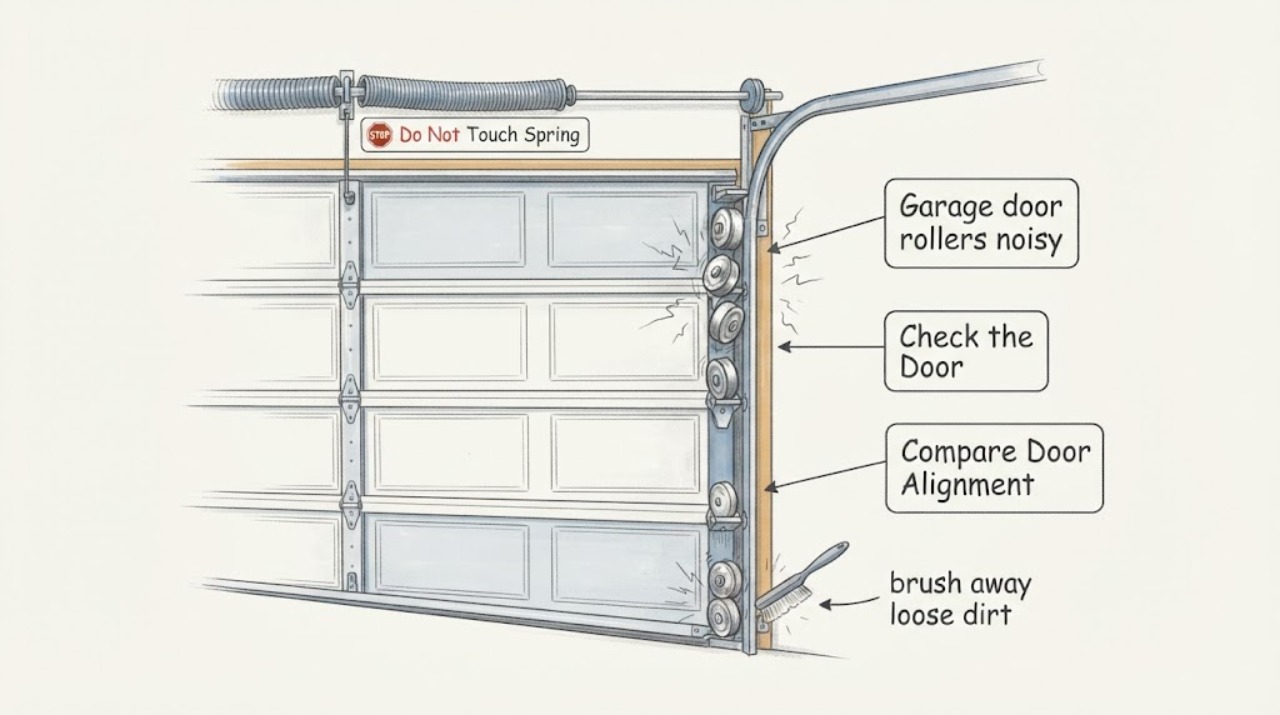
Noisy rollers on a Clopay garage door are often related to dirt, inadequate lubrication on rollers that require it, a worn or damaged roller, or a track or door alignment problem. Watch and listen from a safe position while the door moves: note whether the sound follows one roller, comes from a bent or dirty track, or appears with shaking, jerking, heavy movement, or an uneven door. With the door stopped, brush and wipe accessible tracks as Clopay directs, and use only the lubricant and procedure in the door or opener manual; Clopay says nylon rollers should not be lubricated. Do not adjust springs, cables, bottom brackets, tracks, or the operator yourself. If a roller is cracked, seized, loose, the door is unbalanced, safety reversal fails, or noise remains after safe maintenance, stop using the door and arrange qualified garage-door service.
Before you begin
Safety first
- The homeowner scope is limited to observing movement from outside the path, inspecting stationary visible parts, cleaning accessible tracks, and applying only manual-approved lubrication. Do not remove rollers, bottom brackets, springs, cables, tracks, or panels; adjust balance, force, or travel; bypass sensors; or work under a moving or tensioned door.
Work through in order
Diagnostic checks
Use only checks that match the exact appliance or system and its official guide.
-
Check 1
From outside the door's travel path, watch one complete opening and closing cycle with people, pets, and objects clear. Listen for whether the sound follows one roller, occurs at one section of track, changes when the opener is disengaged only if the manual says that observation is safe, or comes from the operator rather than the door.
Expected result: One roller is consistently loud, several rollers are noisy, the door shakes or travels unevenly, the track makes the sound, or the operator is the only noisy source.
Next step: Record the location and movement pattern, then inspect only the accessible stationary parts. Arrange professional diagnosis for uneven travel, operator noise, or any sound accompanied by binding or sudden movement.
Stop if: Stop the cycle if the door drops, reverses unexpectedly, binds, shakes severely, a cable is frayed, or anyone could enter its path.
Why this matters
Why: A single repeating location makes a local roller or hinge issue more likely; track or uneven movement points to alignment, hardware, or balance; operator-only noise shifts concern away from the rollers.
-
Check 2
With the door fully stopped, inspect the visible roller wheels and brackets without removing them. Look for a cracked or flat wheel, a seized-looking wheel, a roller that sits out of the track, loose hardware, rust, or a bent track; do not place fingers between rollers, hinges, and track surfaces.
Expected result: A roller is damaged, loose, out of the track, or visibly worn, the track is bent or twisted, or the rollers and track look intact.
Next step: Do not operate the door if a roller is out of the track, the track is bent, or hardware is loose in a way that affects alignment. Photograph the area and arrange qualified garage-door service.
Stop if: Do not remove a roller, bend a track, loosen a bottom bracket, or work on any part while the door is under spring or cable tension.
Why this matters
Why: Visible roller damage supports replacement with an exact compatible part; a bent track or loose structural hardware can overload the door and opener and is not corrected by lubricating the roller.
-
Check 3
If the track is straight and the manual permits user maintenance, brush away loose dirt from accessible track surfaces and gently wipe them with a damp cloth. For rollers that the Clopay or opener manual identifies as lubricatable, apply only the specified lubricant and amount to the moving part; do not lubricate nylon rollers unless the manual explicitly says otherwise.
Expected result: The noise decreases after permitted cleaning or lubrication, changes but remains, or does not change at all.
Next step: Run one cautious, supervised cycle with the path clear and compare the sound. If the noise remains, returns quickly, or movement is not smooth, stop self-maintenance and arrange service rather than adding more lubricant.
Stop if: Stop if the manual does not identify the part as user-serviceable, the wheel is damaged, lubricant reaches sensors or the operator, or cleaning requires removing panels or entering a pinch point.
Why this matters
Why: Improvement supports surface contamination or lubrication as a contributor; no improvement makes wear, alignment, bearing, hinge, balance, or operator faults more likely.
-
Check 4
Observe the door's movement for side-to-side differences, jerking, binding, unusual effort, or a door that will not remain in the position specified by the owner's manual. Visually check for frayed cables or broken springs, but do not disconnect the opener, lift a heavy door, or adjust spring tension just to test balance.
Expected result: The door moves evenly and quietly enough after safe care, or it is heavy, unbalanced, jerky, noisy at the springs or cables, or visibly damaged.
Next step: Keep the door out of normal use and arrange a qualified garage-door inspection for imbalance, spring, cable, track, hinge, or operator symptoms.
Stop if: Never adjust or remove springs, cables, bottom brackets, or other tensioned hardware yourself.
Why this matters
Why: Even movement after care lowers concern about a structural fault; heavy, uneven, or damaged movement points toward balance, spring, cable, track, hinge, or operator stress rather than a roller alone.
-
Check 5
Check the opener's photoelectric sensors and automatic reverse only according to the opener owner's manual and with the doorway clear. Confirm that the sensors are not obstructed or knocked out of position; do not change force or travel settings to mask roller noise.
Expected result: The door reverses and sensors respond as directed, a sensor is blocked or misaligned, or the door fails to reverse or behaves unpredictably.
Next step: Clear only an obvious obstruction or perform a manual-directed sensor check. If reversal fails, alignment will not hold, or the door behaves unpredictably, disconnect normal use and arrange qualified service.
Stop if: Do not repeatedly test a failing door, bypass sensors, alter force or travel limits, or stand under the moving door.
Why this matters
Why: Working safety features do not identify the noise source but reduce immediate operating risk; a failed or unreliable safety feature means the opener should not remain in normal use until professionally corrected.
Use your observations
Decision map
Find the observation that best matches what you see, then follow the next safe action.
-
PATH 01Safety boundary
What you see
One roller is noisy but remains seated, the track is straight, the door travels evenly, and the manual identifies that roller material as lubricatable.
Do this next
Clean the accessible track and apply only the manual-approved lubricant to the permitted roller area, then observe one supervised cycle; arrange service if the sound persists or returns.
Why this path and its safety boundary
Safety stop: Do not lubricate nylon rollers unless the exact manual permits it, and do not keep adding lubricant to a damaged or seized wheel.
-
PATH 02Safety boundary
What you see
A roller is cracked, flat, seized, loose, or out of the track, or multiple rollers are worn and the door is noisy or uneven.
Do this next
Stop normal operation and have a qualified technician confirm the correct roller type and inspect the track, hinges, brackets, and door alignment before replacement.
Why this path and its safety boundary
Safety stop: Do not remove rollers or brackets while the door is under tension or force a roller back into a track.
-
PATH 03Safety boundary
What you see
Noise comes from a bent, twisted, rusty, or loose track, or the door scrapes or binds at the same location.
Do this next
Keep the door out of use and arrange professional track and door inspection; cleaning cannot correct a structural track defect.
Why this path and its safety boundary
Safety stop: Do not bend, realign, remove, or loosen track fasteners as a DIY noise fix.
-
PATH 04Safety boundary
What you see
The door is noisy together with heavy lifting, jerking, side-to-side movement, an inability to stay balanced, a broken spring, or a frayed cable.
Do this next
Stop using the door and arrange qualified garage-door service for balance, spring, cable, hinge, track, and opener assessment.
Why this path and its safety boundary
Safety stop: Do not adjust springs, remove cables, loosen bottom brackets, or disconnect hardware while the door is in a hazardous position.
-
PATH 05Safety boundary
What you see
The door moves smoothly by the door hardware but the opener is the only noisy or irregular part, or the opener strains after the door is serviced.
Do this next
Have the operator and its mounting, drive, and controls inspected by a qualified technician; do not use force or travel adjustments to compensate for a door problem.
Why this path and its safety boundary
Safety stop: Stop if the opener fails to reverse, the door moves unpredictably, or a safety sensor is unreliable.
-
PATH 06Safety boundary
What you see
The door fails the manual-directed auto-reverse or photoelectric-sensor check, or people or pets could enter the door path during testing.
Do this next
Keep the opener out of normal use, keep the doorway clear, and arrange qualified inspection and repair of the safety system before relying on automatic operation.
Why this path and its safety boundary
Safety stop: Do not bypass sensors, repeatedly test a failing door, or stand beneath a moving door.
Helpful context
Understand the symptom
Locate the noise before choosing a part
A sound described as a noisy roller may actually come from the track, hinge, loose bracket, cable, spring, or opener. Observe the door from outside its path and note whether one end roller is loud, the door shakes or travels unevenly, or the noise occurs only when the operator is engaged. Clopay's maintenance guidance treats smooth, quiet roller movement as one check within a larger door inspection.
Lubricate only the parts and materials the manual allows
Clopay recommends lubricating hinges and rollers that are not nylon, while its maintenance guidance also calls for cleaning tracks with a small brush and damp cloth. A dirty track should be cleaned rather than packed with lubricant. Do not spray into the operator, cover photoelectric sensors, or apply an unknown product to a roller that the manual says not to lubricate.
Noise plus difficult movement is a safety symptom
A door that is loud and also jerks, binds, shakes, will not stay balanced, or has frayed cables is not a simple lubrication job. Clopay warns against working on springs, cables, bottom brackets, tracks, and other complicated hardware without proper training. The opener's reverse and photoelectric safety features also matter: if a safety feature fails, keep people clear and have the system inspected.
Only after diagnosis
Potential parts
- Clopay-compatible garage-door roller
Consider this category only after a damaged, seized, loose, or worn roller is confirmed and the exact door and track configuration are identified.
Match the exact door model, roller wheel material, stem length, track geometry, and load requirements; Clopay notes that nylon and other roller types have different lubrication guidance. - garage-door hinge or roller bracket
Consider this category only when a qualified technician confirms that a bent or worn hinge or bracket is causing roller misalignment or noise.
Match the exact door sections, hinge position, roller stem, fasteners, and tensioned-hardware requirements; do not remove bottom brackets as a DIY repair. - garage-door operator component
Consider this category only when the operator, rather than the rollers or track, is confirmed as the noise source by qualified diagnosis.
Operator parts depend on the exact opener model, drive system, safety controls, and mounting; do not infer a replacement from noise alone.
When checks do not resolve it
Need a professional?
Escalate for a damaged or out-of-track roller, bent track, frayed cable, broken or misadjusted spring, heavy or unbalanced door, operator-only noise, failed reversal or sensor, or any repair involving tensioned hardware.
Safety scope: The homeowner scope is limited to observing movement from outside the path, inspecting stationary visible parts, cleaning accessible tracks, and applying only manual-approved lubrication. Do not remove rollers, bottom brackets, springs, cables, tracks, or panels; adjust balance, force, or travel; bypass sensors; or work under a moving or tensioned door.
Have this ready
- Provide the Clopay door model if available, roller material and visible condition, exact noise location and timing, track or hinge observations, whether the door is smooth and balanced, any frayed cable or spring damage, opener behavior, safety-test result, and photos taken with the door stopped.
Common questions
FAQ
Why are my Clopay garage-door rollers noisy?
Clopay identifies rollers that do not move smoothly and quietly as candidates for lubrication or replacement, but noise can also come from a dirty or bent track, loose hardware, hinges, balance, cables, springs, or the operator. Locate the sound from a safe position before choosing a part.
Can I lubricate Clopay garage-door rollers?
Follow the exact door and opener manual. Clopay's general guidance permits lubrication of rollers except nylon rollers, along with other specified moving parts. Clean accessible tracks first and stop if the roller is damaged, the door moves unevenly, or the procedure requires disassembly.
Should I replace a noisy garage-door roller myself?
Only use a DIY procedure when the exact Clopay manual identifies it as safe for your door. A roller out of the track, a damaged bracket, bent track, spring, cable, or bottom bracket can put the door under hazardous force; have a qualified technician inspect those conditions.
Why is my garage door noisy and jerky?
Noise together with jerking, heavy movement, side-to-side travel, poor balance, a frayed cable, or a broken spring points beyond a simple roller lubricant issue. Stop normal use and arrange professional inspection rather than adjusting tensioned hardware.
When should I stop using the automatic garage door opener?
Stop normal automatic use if the door is out of the track, moves unpredictably, has damaged springs or cables, is unbalanced, or fails the manual-directed reversal or photoelectric-sensor check. Keep people and pets clear and arrange qualified repair.
Read the exact guide
Official sources
- Garage Door Operators/Gate OperatorsU.S. Consumer Product Safety Commission · CPSC information about automatic residential garage-door operator safety standards in the United States; follow the specific opener manual and current local requirements.
- Garage Door Maintenance GuideClopay · Clopay residential garage-door maintenance guidance; exact door and opener manuals control model-specific procedures.
Community feedback
Share a repair observation
Share a plain-text repair observation. Accepted observations are published automatically; this page may take a moment to update.