
On this page
Start here
Quick answer
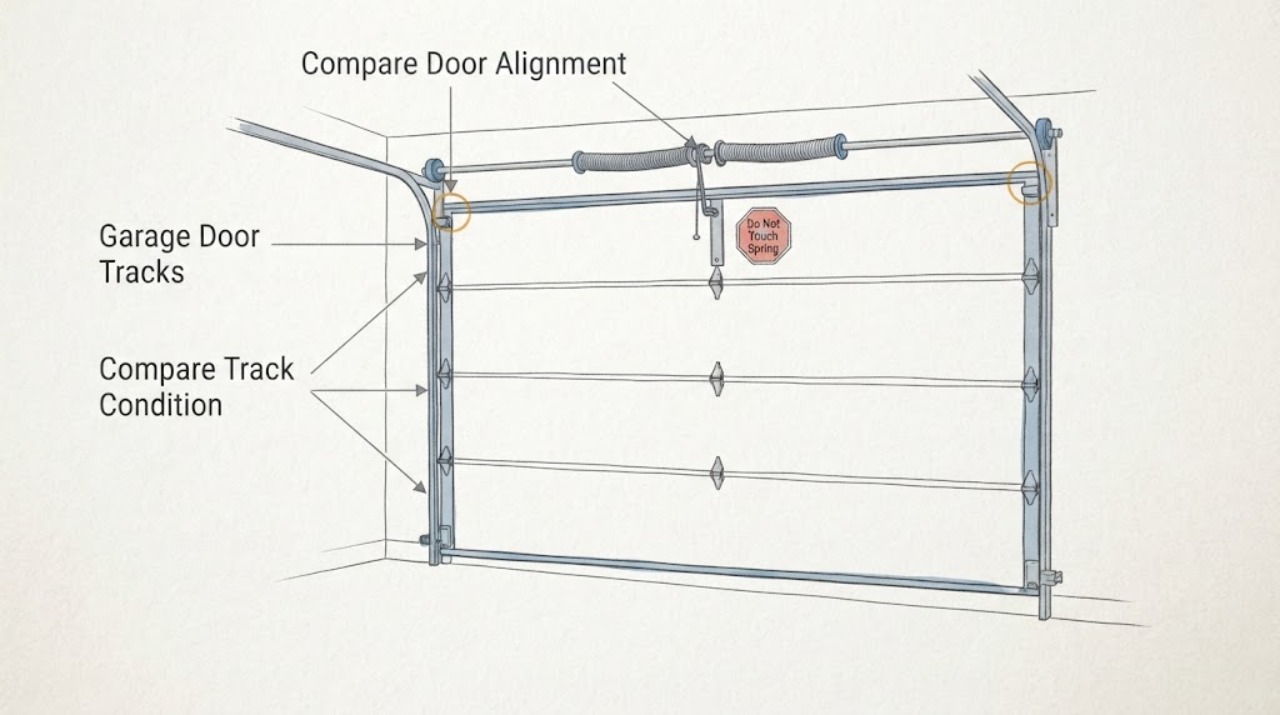
An Amarr garage door that closes unevenly may have a visible track obstruction, damaged or misaligned track, worn roller or hinge, an out-of-balance door, or a spring, cable, or opener problem. Do not assume the track is the only cause. Stop the opener and keep people clear if the door is crooked, rubs hard, comes off a track, slams, hangs, or shows a damaged spring or cable. With the door closed and from a safe position, compare both tracks, look for debris, bends, gaps, loose-looking brackets, and rollers that sit outside the rail, and note whether the unevenness occurs at one repeatable point or throughout travel. Remove only loose visible debris if it can be done without reaching into moving parts; do not bend a track, loosen structural hardware, lubricate the tracks, or adjust springs, cables, or opener force. Amarr recommends a trained garage-door technician for significant damage, track repair, balance correction, and other unsafe conditions.
Work through in order
Diagnostic checks
Use only checks that match the exact appliance or system and its official guide.
-
Check 1
From outside the doorway and well clear of the moving door, observe one normal closing attempt only if the door is not crooked, loose, or uncontrolled. Note whether one side reaches the floor first, a panel rubs, a roller catches at one point, the door reverses, or the opener stops.
Expected result: The door tilts or closes one-sided; it rubs at a repeatable track location; it jerks throughout travel; it reverses or stays open; or it closes normally after a single cycle.
Next step: Stop operating for a crooked, loose, slamming, binding, or uncontrolled door. If the door is stable, close it fully and perform only the visual checks below; do not keep cycling to reproduce the symptom.
Stop if: Never stand under or in front of the door, place hands near rollers or hinges, or operate it when a spring, cable, track, panel, or roller appears damaged.
Why this matters
Why: A one-sided or repeatable rub makes a track, roller, hinge, or panel alignment issue more likely. Jerking throughout travel keeps balance, spring, cable, and opener issues possible. Reversal or no-close behavior can involve photo eyes or opener safety functions, not only the tracks.
-
Check 2
With the door closed and the opener idle, compare the left and right tracks from a safe standing position. Look along the vertical and horizontal rails for loose debris, a visible bend, rust or damage, a changed gap from the door, or a bracket that no longer appears square; do not touch or loosen hardware.
Expected result: One rail has a bend, narrowing, gap, obstruction, displaced-looking bracket, or heavy rust; both rails look consistent; or the track cannot be viewed safely.
Next step: Remove only loose debris that is safely reachable with the door closed. For a bent, displaced, damaged, or rust-weakened track, leave the door unused and call a trained garage-door technician; do not realign it yourself.
Stop if: Do not strike, pry, bend, shim, loosen, or remove track brackets, and do not reach between the rail and a roller.
Why this matters
Why: A localized bend, obstruction, or altered spacing can cause a roller to bind and make the door close unevenly. Matching visual tracks make rollers, hinges, balance, panels, or the opener more likely. An inaccessible or unsafe track requires professional inspection.
-
Check 3
With the door closed, visually scan the rollers, hinges, panel edges, and visible brackets without moving the door. Look for a roller outside the rail, a cracked or flattened roller, a hinge pulled away, a panel dent, or fresh rubbing marks that line up with the uneven closing point.
Expected result: A roller is out of the rail or damaged; a hinge or panel is visibly bent; rubbing marks are localized; the parts appear intact; or the door cannot remain safely closed.
Next step: Do not operate the door when a roller is out, a panel is bent, a hinge is pulled away, or damage prevents a stable closed position. Photograph the condition from a safe distance and arrange technician service.
Stop if: Do not reseat a roller, remove hinge fasteners, straighten a panel, or place fingers between sections or near hinges.
Why this matters
Why: A roller, hinge, or dented panel can make one side lag or bind even when the track itself looks straight. A roller off the rail or a bent panel can let the door fall or worsen damage and is not a simple lubrication issue.
-
Check 4
From a safe distance, inspect the visible springs, lift cables, pulleys, and brackets for fraying, a gap or break, slack, displacement, or other wear. Do not release the opener, lift the door, or touch a spring or cable merely to test balance.
Expected result: A spring or cable is broken, frayed, slack, displaced, or visibly worn; the door is heavy or uneven from the start; or no damage is visible.
Next step: Keep the door closed and call a trained technician for any spring, cable, pulley, or balance concern. If no concern is visible, continue only with the photo-eye and opener observations, without manual lifting.
Stop if: Do not remove, loosen, adjust, cut, or lubricate high-tension springs or lift cables, and do not lift a door with a broken cable or spring.
Why this matters
Why: Spring, cable, and balance problems can load one side or the opener and mimic a track fault. Amarr treats these components as safety-critical and directs users to trained service when wear or damage is visible. No visible damage does not clear the track, roller, or opener path.
-
Check 5
If the door is mechanically stable and the complaint includes stopping or reversing near the floor, inspect the opener photo-eye path from a safe position. Look for a visible obstruction or obviously displaced eye, and note whether the opener reverses or stays open without repeatedly cycling the door.
Expected result: A photo-eye beam is blocked or an eye is visibly displaced; the photo-eye path looks clear; the opener reverses despite a clear path; or the door remains crooked or binds.
Next step: Remove only a visible obstruction and follow the opener manual for any safe external alignment check. If the symptom remains, stop using the opener and arrange service for the photo eyes, opener, and door together.
Stop if: Do not bypass the photo eyes, hold the wall button to defeat reversal, move wiring, or stand in the doorway during a test.
Why this matters
Why: An obstruction or misaligned photo eye can prevent a door from closing and may be mistaken for a track problem. A clear path with continued reversal, crooked travel, or binding points back to the door, opener, or another safety condition.
-
Check 6
Compare the visual findings with the Amarr owner manual for the exact door model and prepare a service report: uneven side, location of rubbing, track or roller condition, spring and cable observations, photo-eye result, and whether the problem began after impact or weather. Do not attempt structural adjustment.
Expected result: Only loose debris was found and the door now closes evenly; the uneven closure persists; the track or hardware is damaged; the door is crooked; or the cause is uncertain.
Next step: Leave a persistent or damaged system out of service and call a trained garage-door technician. Provide photos and the observation log; do not order a generic track or roller before the exact door and track configuration is identified.
Stop if: Do not realign tracks, change opener force or travel, replace springs or cables, or operate an off-track or unstable door.
Why this matters
Why: A resolved obstruction supports a minor external cause. Persistent uneven travel, damage, crookedness, or uncertainty requires a trained diagnosis because track geometry, door balance, rollers, springs, cables, and opener force interact.
Use your observations
Decision map
Find the observation that best matches what you see, then follow the next safe action.
-
PATH 01Next step
What you see
The door closes unevenly at the same height each time, and one track has visible debris, a bend, changed spacing, or a roller that catches at that point.
Do this next
Remove only loose debris that is safely reachable with the door closed. Leave bent, displaced, or damaged hardware untouched and arrange trained track or door service.
Why this path and its safety boundary
Why it matters: A localized track, roller, hinge, or panel interference is more likely than a whole-door balance problem.
-
PATH 02Next step
What you see
The door jerks or closes unevenly through most of its travel, feels heavy, or is uneven before it reaches the suspected track location while no localized obstruction is visible.
Do this next
Keep the door closed if it is heavy or unstable and arrange a trained technician to inspect balance, springs, cables, rollers, door hardware, and opener operation. Do not manually lift or adjust the system as a diagnostic shortcut.
Why this path and its safety boundary
Why it matters: Balance, spring, cable, roller, hinge, panel, or opener load is more likely than a single dirty track section.
-
PATH 03Next step
What you see
The door is not visibly binding, but the opener stops or reverses near closing and the photo-eye path is blocked or appears misaligned.
Do this next
Clear a visible obstruction and follow the opener manual for a safe external check. If reversal remains, stop operating and have the opener and door inspected; never bypass the eyes.
Why this path and its safety boundary
Why it matters: The opener safety-photo-eye path is more likely than a track geometry fault.
-
PATH 04Next step
What you see
A roller is outside the rail, a panel is bent, the door is crooked, a track bracket is displaced, or a spring or cable appears broken, frayed, or slack.
Do this next
Do not operate, lift, or attempt to re-seat or straighten the door. Keep people clear and call a trained garage-door technician.
Why this path and its safety boundary
Why it matters: This is a significant door-system safety fault. Amarr warns that off-track, crooked, spring, cable, and track conditions require trained service.
-
PATH 05Next step
What you see
The tracks and visible components look consistent, but uneven closing persists, the door will not remain safely closed, or the cause cannot be identified from a visual inspection.
Do this next
Leave the door out of service and provide the technician the model, symptom height, photos, travel behavior, and any recent impact or weather event. Do not replace track parts by appearance alone.
Why this path and its safety boundary
Why it matters: A hidden roller, hinge, balance, opener, track-geometry, or installation issue remains possible; a clean-looking track does not clear the system.
Helpful context
Understand the symptom
Confirm that the track is the first problem
Watch one closing cycle from outside the doorway, never standing in the path. Note whether one side leads, the door tilts, a panel rubs the track, a roller jumps, or the problem occurs at one location. A repeatable rub at one bend or obstruction supports a track or roller path; a door that is heavy, crooked from the start, or difficult throughout travel can instead reflect balance, spring, cable, or opener trouble.
Inspect without turning a visual check into track repair
With the door closed, compare the two vertical tracks and the visible horizontal sections. Look for a foreign object, rust, a bent rail, a widening gap between roller and rail, or a bracket that appears displaced. Clean only loose debris that is safely reachable. Amarr advises consulting the owner manual for model-specific information and leaving significant track, spring, cable, and hardware repairs to a trained technician.
Do not lubricate the track or adjust spring tension
Amarr separates moving-part lubrication from the track: its owner guidance says not to lubricate tracks or plastic rollers. A track that needs forceful alignment, a roller that is out of the rail, or a spring or cable showing wear is not a routine cleaning task. Leave the door closed and the opener unused while arranging service.
Safety boundary
Stop conditions
- Stop operating the door if it is crooked, off-track, binding, slamming, heavy, uncontrolled, or unable to stay safely closed; if a roller, hinge, panel, track, spring, cable, pulley, or bracket is damaged; or if the opener reverses unpredictably. Do not loosen or bend track hardware, re-seat rollers, adjust springs or cables, change opener force or travel, bypass photo eyes, or manually lift a door with a broken spring or cable. Arrange trained garage-door service for significant damage, balance or track correction, persistent uneven travel, or an uncertain cause.
Only after diagnosis
Potential parts
- garage-door track section or track hardware
Consider this only after a trained technician confirms a bent, damaged, or incorrect track or hardware configuration and identifies the exact door system requirements.
Track geometry, lift type, dimensions, and hardware vary by Amarr door model and installation. Do not select a generic track from appearance or attempt alignment without the exact documentation. - garage-door roller
Consider this only when inspection confirms a worn, cracked, flattened, or missing roller as the cause of localized binding and a technician verifies the replacement need.
Roller stem, wheel, bearing, and material must match the door and track system. Do not treat a roller that has left the rail as a do-it-yourself re-seating task. - garage-door hinge or panel hardware
Consider this only when the exact door inspection finds a damaged hinge, panel connection, or related hardware that is responsible for one-sided travel.
Hinge location, panel design, reinforcement, and hardware vary by model. Confirm the complete Amarr door identity and service procedure before selection.
When checks do not resolve it
Need a professional?
Call a trained garage-door technician when the door closes unevenly after loose debris is cleared, any track or roller is bent, displaced, damaged, or off-track, the door is crooked or heavy, springs or cables show wear, the opener reverses despite a clear photo-eye path, or the exact cause is uncertain. Use urgent service for a falling or uncontrolled door, broken spring or cable, exposed high-tension hardware, or a door blocking a required exit.
Have this ready
- Provide the Amarr door model if known, whether it is sectional or another configuration, the height where one side lags or rubs, photos of both tracks and rollers from a safe distance, spring and cable observations, photo-eye result, opener behavior, and whether an impact, storm, or recent installation preceded the symptom.
Common questions
FAQ
Why does my Amarr garage door close unevenly?
A visible track obstruction, bent or misaligned track, worn roller or hinge, dented panel, out-of-balance door, spring or cable problem, or opener safety response can all produce uneven closing. Compare both tracks and observe the symptom from a safe position, but do not assume the track is the only cause.
How can I tell if an Amarr track is misaligned?
With the door closed, look for a crooked door, a bent rail, changed spacing, a gap between a roller and rail, a displaced-looking bracket, or rubbing at one repeatable height. These observations support professional track or roller diagnosis; do not loosen or bend the track to test it.
Can dirt or debris make an Amarr garage door close unevenly?
Yes. Amarr notes that debris around rollers can create friction and contribute to track misalignment. Remove only loose, safely reachable debris with the door closed. Do not lubricate the track or reach between a roller and rail; persistent uneven movement needs service.
Should I lubricate Amarr garage door tracks?
No. Amarr's maintenance guidance distinguishes moving-part lubrication from the track and says not to lubricate plastic rollers or tracks. A track that binds, is bent, or has a displaced roller needs inspection rather than added lubricant.
What if one side of the Amarr door is crooked or a roller is off the track?
Do not operate, lift, or re-seat the door. A crooked door, off-track roller, displaced track, or damaged panel can fall or worsen damage. Keep people clear and call a trained garage-door technician to inspect the track, rollers, panels, springs, cables, and opener.
Could the springs or cables cause uneven garage-door closing?
Yes. An out-of-balance door or worn spring or cable can load one side and mimic a track fault. Inspect only for visible wear from a safe distance. Do not remove, adjust, or repair springs or cables; arrange trained service.
When should I call a garage-door technician?
Call when uneven closing persists after a safe loose-debris check, a track or roller is bent, displaced, or off-track, the door is crooked or heavy, a spring or cable shows wear, the opener reverses despite a clear photo-eye path, or the cause is uncertain. Use urgent service for a falling, uncontrolled, or damaged door.
Read the exact guide
Official sources
- Garage Door Installation InstructionsAmarr · Official Amarr installation page warning that garage-door installation is advanced and potentially dangerous, directing users to the matching installation and owner documents and trained professionals.
- Garage Door Care and MaintenanceAmarr · Official Amarr maintenance guidance covering tracks, rollers, springs, cables, hardware, balance, photo eyes, owner-manual lookup, and the boundary against homeowner repair of significant damage.
- SafetyAmarr · Official Amarr safety guidance emphasizing proper installation, regular service, and the hazard of spring and cable work or track-system changes.
- FAQsAmarr · Official Amarr FAQ identifying jerky movement, crooked doors, track misalignment, debris-related friction, photo-eye conditions, and broken spring or cable situations that require professional service.
Community feedback
Share a repair observation
Share a plain-text repair observation. Accepted observations are published automatically; this page may take a moment to update.