
On this page
Start here
Quick answer
An Amarr garage door that closes unevenly may have a damaged or misaligned roller, debris or damage in one track, loose hinge or mounting hardware, a balance or spring problem, or an opener or photo-eye issue that is being mistaken for a roller fault. Watch one complete movement from a safe position and note which side leads, where the door rubs, and whether the door itself is crooked or the opener merely reverses. With the door closed, inspect the tracks, rollers, hinges, cables, springs, and hardware without touching tensioned parts; clear only loose debris and do not bend a track or lubricate plastic rollers. Stop operating the door if a roller is off the track, a cable is off the drum or frayed, a spring is broken, the door is heavy or slams, or the reversal safety test fails, and have a trained garage-door technician handle the repair.
Before you begin
Safety first
- This article covers safe observation from outside the travel path, visual inspection with the door closed, removal of loose accessible debris, model identification, and following the opener manual for visible photo-eye checks. Do not manually force a heavy or crooked door, remove rollers or hinges, adjust tracks, work on springs or cables, defeat sensors, or increase opener force.
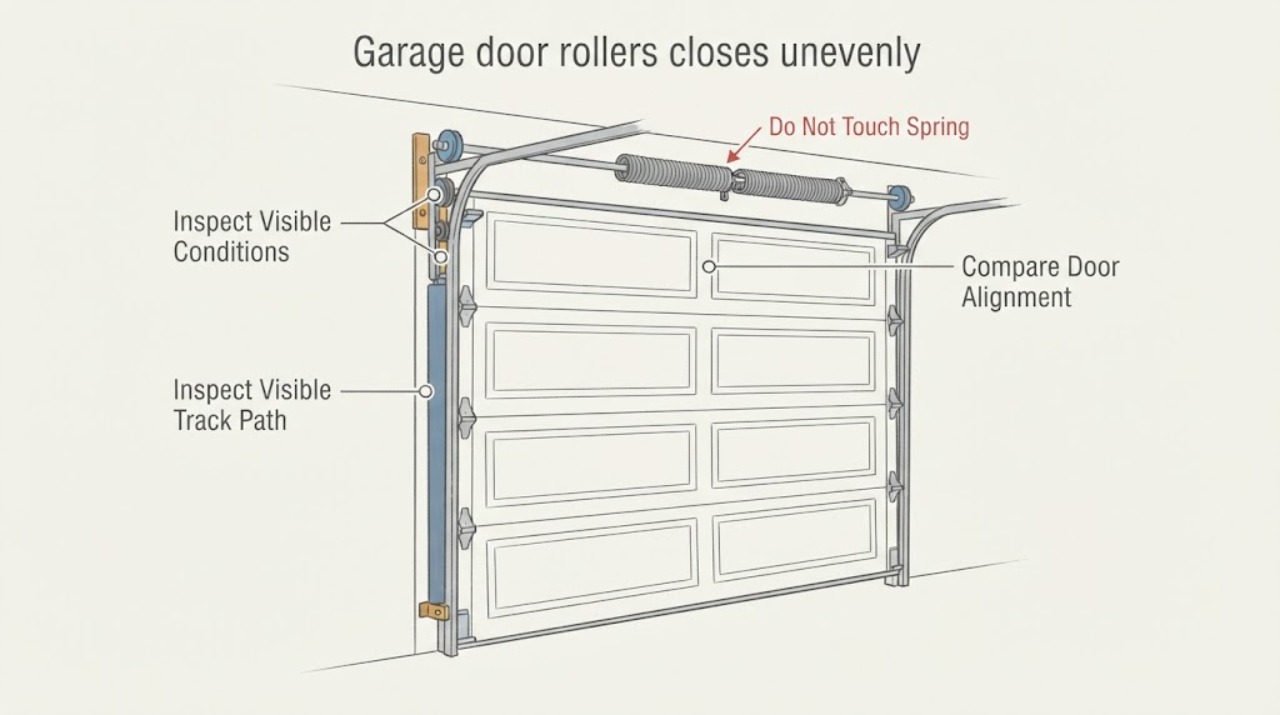
Work through in order
Diagnostic checks
Use only checks that match the exact appliance or system and its official guide.
-
Check 1
From a position outside the door's travel path, watch one supervised close and note whether the left or right side leads, a section tilts, a roller scrapes, the door stops at one height, or the opener reverses before the floor.
Expected result: Record the first point where the two sides stop matching, any rubbing or popping sound, whether the door is visibly crooked, and whether the opener reverses or the door simply binds.
Next step: Use the symptom branch below and perform only the corresponding visual check; stop operating if the door jerks, slams, hangs, or leaves the track.
Stop if: Do not stand under the door, place hands between sections, or try repeated cycles to force a door past a bind.
Why this matters
Why: A changing side-to-side gap or localized rub makes a roller, track, hinge, or hardware path more likely. A straight door that reverses near the floor points more toward opener safety sensors or travel/force behavior than a roller alone.
-
Check 2
With the garage door fully closed and the opener left alone, visually inspect both vertical and horizontal tracks for leaves, twigs, dirt buildup, a dent, a gap between roller and rail, or a section that has shifted away from its mounting.
Expected result: Compare the two tracks and record whether loose debris is present, whether a rail is visibly bent or misaligned, or whether the roller path is open and consistent.
Next step: Sweep or wipe away only loose debris that is safely reachable with the door closed; leave a bent, loose, or misaligned track untouched and arrange a trained technician.
Stop if: Do not loosen track fasteners, pry a rail straight, hammer the track, or put fingers into the track or section joints.
Why this matters
Why: Amarr notes that debris can disrupt roller travel and that gaps or bends can create rubbing at one point. A visibly bent, shifted, or damaged track is not a cleaning issue and can make the door unsafe to operate.
-
Check 3
With the door closed, visually compare each accessible roller and roller hinge from both sides; look for a cracked or flat wheel, a roller sitting outside the rail, a hinge pulled away from a section, loose-looking hardware, or a roller that does not sit in the same track path as its neighbors.
Expected result: Record the roller position, wheel condition, hinge condition, and section where the unevenness begins; do not spin, pull, remove, or reposition the roller by hand.
Next step: Photograph the affected side and exact model information, then have a trained Amarr dealer or garage-door technician confirm the roller, hinge, track, and fastener diagnosis.
Stop if: Do not remove a roller hinge, lift a section, pull a roller from the track, or tighten hardware that is attached to a spring, cable, bottom bracket, or counterbalance assembly.
Why this matters
Why: A single damaged or displaced roller can cause a localized tilt or scrape, while a repeated pattern across several sections makes track alignment, hinge hardware, balance, or installation more likely. Visual alignment cannot confirm a safe roller repair by itself.
-
Check 4
Without touching springs or cables, observe whether the door is unusually heavy, slams while closing, barely lifts, or changes speed markedly; look only for a visibly broken spring, frayed cable, cable off the drum, or a door that is no longer level.
Expected result: Record whether the problem affects the whole door, whether a spring or cable is visibly damaged, and whether the door becomes more uneven as it carries its weight rather than only at one roller location.
Next step: Keep people and vehicles clear, leave the door in its safest stable position, and arrange prompt service for any spring, cable, balance, or level problem.
Stop if: Do not wind, stretch, remove, clamp, cut, or adjust springs, lift cables, bottom brackets, drums, or other counterbalance parts.
Why this matters
Why: Amarr associates heavy, slamming, or barely lifting doors with spring or balance concerns, and says a cable off the drum should not be operated. A whole-door balance symptom is not safely corrected by replacing one roller.
-
Check 5
If the door looks level and its rollers stay in the tracks but the opener reverses or refuses to close, inspect the photo-eye lenses and beam path from a safe position for an obvious obstruction or misalignment, and compare whether manual-looking door movement is actually smooth only as the owner's manual permits.
Expected result: Record whether the photo eyes are blocked or visibly out of alignment, whether the opener reverses at a repeatable height, and whether the door itself is crooked or binding before the reversal.
Next step: Remove only an obvious obstruction and consult the opener manual for alignment or settings; arrange service if reversal continues or if the door path is not smooth and level.
Stop if: Do not defeat photo eyes, increase force to overpower a bind, adjust opener limits blindly, or test the reversal function while standing in the door path.
Why this matters
Why: A clean, aligned door with a repeatable opener reversal makes photo eyes, opener travel or force settings, or opener service more likely than rollers. A crooked or binding door remains a door-system problem even if the opener also reverses.
-
Check 6
Record the Amarr door model or owner-manual information, the affected side and section, photographs of the roller and track path, and any unusual sound; after a technician's repair, watch one complete close from a safe position and confirm that the door remains aligned and reverses safely when tested according to the opener instructions.
Expected result: Check for a level bottom edge, smooth roller travel, no rubbing or popping, no cable or spring warning signs, and an opener safety response that matches the manufacturer's procedure.
Next step: Stop using the door for any returning or new fault and give the technician the model, affected section, before-and-after observations, and any part category already replaced.
Stop if: Do not continue cycling a door that is crooked, off-track, heavy, slamming, or unable to pass its safety test.
Why this matters
Why: A smooth, level close after the confirmed repair supports that the diagnosed door path was corrected. A returning tilt, new scrape, failed reversal, or fresh cable or spring symptom means the system remains unsafe or another cause was missed.
Use your observations
Decision map
Find the observation that best matches what you see, then follow the next safe action.
-
PATH 01Safety boundary
What you see
One side leads or rubs at the same section, and a single roller, hinge, or nearby track shows visible damage, debris, a gap, or misalignment.
Do this next
Clear only loose reachable debris with the door closed, photograph the location and model, and have a trained technician confirm the roller, hinge, track, and hardware repair.
Why this path and its safety boundary
Why it matters: A localized roller-track or hinge path is more likely than a whole-door balance issue, but the visible symptom does not make roller removal safe for a homeowner.
Safety stop: Do not pry the roller into the rail, bend the track, remove hinge hardware, or run the opener repeatedly over the bind.
-
PATH 02Safety boundary
What you see
The entire Amarr door is heavy, slams, barely lifts, changes speed, or becomes crooked under its weight, with a broken or frayed spring or cable visible.
Do this next
Keep the area clear, do not operate the door, and arrange a trained garage-door technician for counterbalance and door-system diagnosis.
Why this path and its safety boundary
Why it matters: Balance, spring, cable, drum, or another counterbalance problem is more likely than a single roller defect and can make the door fall or overload the opener.
Safety stop: Do not adjust springs, cables, drums, bottom brackets, or tensioned hardware, even if only one side appears affected.
-
PATH 03Safety boundary
What you see
The door remains visually level and rollers stay in their tracks, but the opener reverses near the floor or refuses to close while the photo-eye path is blocked or misaligned.
Do this next
Remove an obvious obstruction, follow the opener owner's alignment instructions, and arrange opener service if the reversal or non-close condition remains.
Why this path and its safety boundary
Why it matters: The opener's photo eyes, travel or force settings, or control path are more likely than Amarr rollers; increasing force could hide a door problem and create a hazard.
Safety stop: Do not bypass sensors, increase force to overcome resistance, or stand under the door during a reversal test.
-
PATH 04Safety boundary
What you see
A track is visibly bent or pulled away, a roller is outside the rail, a section is dented or cracked, or the door is visibly crooked throughout its travel.
Do this next
Stop operating the door, keep people and vehicles clear, and arrange an Amarr dealer or trained technician to secure and repair the system.
Why this path and its safety boundary
Why it matters: This is a door-system alignment or structural problem, not a safe roller-lubrication or replacement decision. Continued operation can worsen the damage or cause the door to leave the track.
Safety stop: Do not push the door back onto the track, straighten rails, remove panels, or loosen structural or counterbalance fasteners.
-
PATH 05Safety boundary
What you see
The door still closes unevenly after loose debris is removed and the visible tracks, rollers, and hinges appear intact.
Do this next
Stop repeated cycling, provide the model and video or photographs to a trained technician, and request a complete door, roller, track, balance, and opener assessment.
Why this path and its safety boundary
Why it matters: A hidden roller bearing, hinge, track geometry, balance, installation, or opener interaction may remain; a visual check cannot safely rule these out.
Safety stop: Do not substitute generic rollers, add parts, lubricate plastic rollers, or adjust spring or opener force settings as a guess.
Helpful context
Understand the symptom
Decide whether the door or the opener is making the closure uneven
Watch the door from the side and stay out of its path. If one side of the Amarr door leads, rubs, or leaves a changing gap as the sections travel, the roller, track, hinge, or hardware path deserves attention. If the door remains physically aligned but the opener reverses near the floor, photo eyes, force or travel settings, or the opener may be the issue instead.
Rollers run as part of a complete track system
Amarr describes rollers as the wheels that let door sections roll along the tracks. A single roller can look faulty when a twig, dirt, bent rail, loose hinge, or shifted bracket changes its path. Compare both sides and inspect the whole visible system before selecting a roller; a similar-looking replacement is not proof of model fit.
Keep tensioned parts outside the homeowner check
Springs, lift cables, bottom brackets, and other counterbalance hardware can move or release substantial force. Amarr's safety and owner materials direct significant adjustment and repair to a trained technician. A homeowner check can document wear, an obstruction, or a crooked door, but it should not include spring winding, cable removal, track bending, roller extraction, or hardware work that changes the door's alignment.
Safety boundary
Stop conditions
- Do not stand or walk under a moving garage door, put fingers in section joints or tracks, or operate a door that is crooked, off-track, slamming, heavy, or visibly damaged.
- Do not adjust, wind, remove, clamp, or replace springs, lift cables, drums, bottom brackets, track fasteners, or other tensioned or structural hardware; Amarr directs significant repair to a trained garage-door technician.
- Do not bend a track, pry a roller into place, defeat photo eyes, increase opener force to overpower a bind, or lubricate plastic or nylon rollers contrary to the owner manual.
- Stop immediately for a cable off the drum or frayed, a broken spring, a roller outside the track, smoke or electrical damage, a failed reversal safety test, or a door that cannot close and remain stable; keep people and vehicles clear and arrange prompt service.
Only after diagnosis
Potential parts
- garage door roller
Consider this class only when a technician confirms that a specific roller is damaged, seized, displaced, or worn and is the cause of the localized uneven travel.
Match the exact Amarr door model, roller diameter and stem arrangement, track design, and manufacturer or technician fit information; do not choose by appearance alone. - garage door roller hinge
Consider this class only when the affected roller hinge is cracked, loose, bent, or no longer holds the roller in the correct track path according to the technician's diagnosis.
Confirm the exact Amarr section position and hinge arrangement before ordering; hinge replacement can change door alignment and is not a generic adjustment. - garage door track or track hardware
Consider this class only when a trained technician confirms a bent, shifted, corroded, or damaged track or mounting assembly rather than a roller-only fault.
Track geometry and mounting must match the complete Amarr door and lift configuration; do not substitute or reposition track hardware without professional measurement. - garage door opener photo-eye or control component
Consider this class only when the door stays physically aligned but the opener repeatedly reverses or refuses to close after visible obstruction and alignment checks.
Match the exact opener model and safety-system design; this part class does not correct a crooked, binding, or off-track Amarr door.
When checks do not resolve it
Need a professional?
Arrange a trained garage-door technician when a roller is outside the track, a track is bent or shifted, a hinge or fastener is damaged, the door is heavy or slams, a cable is off the drum or frayed, a spring is broken, the door remains uneven after loose debris is removed, or the opener reverses or fails its safety test. Significant Amarr door, roller, track, balance, cable, spring, and opener repairs should not be improvised by a homeowner.
Safety scope: This article covers safe observation from outside the travel path, visual inspection with the door closed, removal of loose accessible debris, model identification, and following the opener manual for visible photo-eye checks. Do not manually force a heavy or crooked door, remove rollers or hinges, adjust tracks, work on springs or cables, defeat sensors, or increase opener force.
Common questions
FAQ
Can worn Amarr rollers make a garage door close unevenly?
Yes, a damaged, displaced, or misaligned roller can change one section's path, but debris, a bent or shifted track, hinge hardware, balance, or the opener can look similar. Compare the first point of tilt or rubbing and have a technician confirm the part before replacing it.
What should I look for on the tracks when an Amarr door is uneven?
With the door closed, look for loose debris, dirt buildup, a visible dent or bend, a shifted mounting area, or a gap between a roller and its rail. Clear only loose reachable debris; do not bend, loosen, or realign the track yourself.
Should I lubricate Amarr garage door rollers?
Follow the exact owner manual. Amarr specifically says not to lubricate plastic rollers; a technician or model instructions should determine whether any other metal moving part needs an approved garage-door lubricant. Lubrication cannot correct a roller outside the track or a bent rail.
When is an uneven Amarr garage door unsafe to operate?
Stop for a roller outside the track, a bent or shifted rail, a broken spring, a frayed or off-drum cable, a heavy or slamming door, exposed damage, a failed opener reversal test, or any door that cannot remain stable. Keep people and vehicles clear and call a trained garage-door technician.
Read the exact guide
Official sources
- Owner's ManualAmarr · Amarr residential sectional garage doors covered by the English owner's manual; opener and door model instructions control.
- Residential Garage Door and Commercial Door FAQsAmarr · Amarr residential and commercial door questions on the page; use a trained dealer for system-specific diagnosis and repair.
- Everything You Need To Know About Garage Door RepairAmarr · Amarr residential garage doors and associated openers; exact installation and model conditions control.
- Garage Door Care and MaintenanceAmarr · Amarr garage door systems and openers; exact owner manual and installed system control model-specific details.
- How To Do a Garage Door Inspection (and Why It’s Important)Amarr · Residential Amarr garage door visual inspection; significant repair remains technician work.
- Garage Door SafetyAmarr · Amarr garage door systems and openers; exact opener safety instructions control any test.
Community feedback
Share a repair observation
Share a plain-text repair observation. Accepted observations are published automatically; this page may take a moment to update.