
On this page
Start here
Quick answer
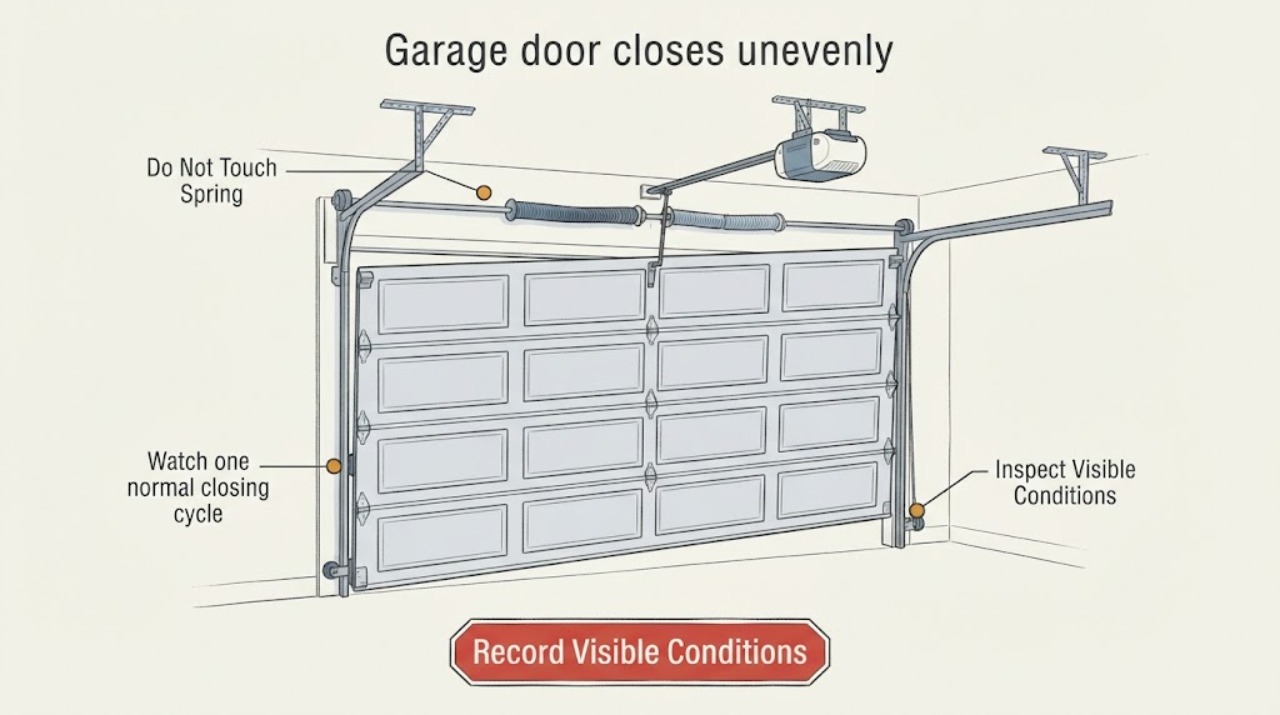
Treat an unevenly closing garage door as a high-tension safety issue. From outside the door's path, observe one ordinary cycle only if the door currently moves without obvious danger, then note whether the panels tilt, bind, jerk, stop, or reverse. Look from a distance for a slack or frayed cable, a broken spring, bent track, obstruction, damaged roller, or a sensor indication. Do not adjust springs, cables, brackets, tracks, force, or travel; do not lift the door or handle high-tension parts. Stop using it and call a trained garage-door technician if it is crooked, heavy, off-track, noisy, damaged, or unsafe.
Work through in order
Diagnostic checks
Use only checks that match the exact appliance or system and its official guide.
-
Watch one normal closing cycle from a safe distance
Only if no cable, spring, panel, or track hazard is visible, stand outside the door's path and watch one ordinary wall-control or remote closing cycle; keep people, pets, vehicles, and objects clear and do not repeat the cycle.
Expected result: The door may close evenly, tilt with one side leading or lagging, jerk or bind at one height, stop before the floor, reverse, or make a new grinding, snapping, or scraping sound.
Next step: Stop operating the door and record the side, height, sound, and final position. Request a trained garage-door technician, especially if the door is crooked, heavy, off-track, or noisy.
Stop if: Stop immediately if the door jerks, hangs, falls, binds, reverses unexpectedly, makes a bang, or moves toward a person, pet, vehicle, or object.
Why this matters
Why: The location and timing of the uneven movement help a technician distinguish a guide, panel, roller, balance, or opener-safety concern. A door that reverses or strains is not made safe by repeated attempts.
-
Look for visible cable, spring, track, and panel warnings
With the door closed or stationary and from a safe distance, visually inspect both sides for a slack or frayed cable, a separated or broken spring, a bent or displaced track, a roller outside its track, panel damage, or hardware that is visibly loose; do not touch, straighten, lubricate, or adjust anything.
Expected result: The hardware may look intact, or one side may show a slack/frayed cable, broken spring, bent track, displaced roller, damaged panel, or another obvious abnormality.
Next step: If any warning is visible, keep the door closed and the area clear and call a trained technician. If no warning is visible but the cycle remains uneven, still arrange professional inspection rather than making adjustments.
Stop if: Stop and do not operate the door if a cable is slack/frayed, a spring is broken or separated, a roller is out of track, the door is off-track, or a panel/bracket is damaged.
Why this matters
Why: A cable or spring warning can indicate stored-energy danger, while a displaced roller or bent track can allow the door to bind or fall. A normal-looking exterior does not rule out an internal balance or alignment fault.
-
Record the panel and floor-gap pattern
From outside the movement path, compare the left and right panel edges and the bottom seal against the floor during the single observed cycle; note where the gap first becomes uneven, without placing hands, tools, or objects under the door.
Expected result: One side may contact first, a panel may twist at a hinge line, the bottom seal may leave a gap, or the mismatch may appear only near the floor.
Next step: Photograph the stationary final position from a safe distance and provide the pattern to the technician. Keep the door out of service if the gap leaves an opening or the door is not seated safely.
Stop if: Stop if the door does not remain stationary, the gap is large enough for a person or object to enter, the bottom edge is sharp/damaged, or the door begins to move without a control input.
Why this matters
Why: The point where the mismatch begins gives the technician context about panel articulation, track guidance, floor/threshold contact, or balance. It is not a reason to change travel or force settings.
-
Observe the visible safety-sensor and threshold state
From outside the path, look at the two visible safety sensors and the floor/threshold for an obstruction, debris, damaged wire, displaced sensor, or standing water; do not move brackets, bypass sensors, hold the wall button, or place an object in the beam.
Expected result: Both sensor indicators may appear normal, one may be dim or off, the beam path may be blocked, or the threshold may have debris, water, or a damaged seal.
Next step: If there is an obvious loose object that can be removed without entering the door path, leave the area safe and report the condition; otherwise stop and call a technician. Do not change sensor alignment or opener settings.
Stop if: Stop if sensor wires, brackets, or the threshold are damaged, if clearing the area requires reaching under the door, or if the door reverses or closes unevenly after the observation.
Why this matters
Why: A sensor or threshold condition can cause a stop or reversal, but it does not explain away a physical tilt, cable warning, or binding door. Safety sensors must remain enabled.
Use your observations
Decision map
Find the observation that best matches what you see, then follow the next safe action.
-
PATH 01Next step
What you see
A cable is slack or frayed, a spring is broken or separated, the door is off-track, or a bracket/panel is visibly damaged.
Do this next
Keep the door closed and the area clear, do not touch or operate it, and call a trained garage-door technician for urgent assessment.
-
PATH 02Next step
What you see
The door jerks, binds, falls, hangs, makes a bang or grinding sound, or moves without a normal control input.
Do this next
Stop all operation, keep people and vehicles away, and request professional service; do not attempt to free, lift, or straighten the door.
-
PATH 03Next step
What you see
The door reverses or stops with a visible sensor, obstruction, threshold, or water condition but no physical high-tension warning is visible.
Do this next
Keep safety sensors enabled and report the visible condition to a technician. Do not bypass sensors, hold the wall button, or adjust travel/force settings.
-
PATH 04Next step
What you see
The door remains crooked or uneven after one safe observation even though no exterior warning is obvious.
Do this next
Take the door out of service and arrange inspection; an unseen balance, roller, track, or opener issue still needs professional assessment.
-
PATH 05Next step
What you see
The one safe cycle appears normal and no visible damage or obstruction is found.
Do this next
Do not create repeated tests. Monitor only during ordinary use and schedule service if the uneven condition returns or any warning appears.
Helpful context
Understand the symptom
Uneven closing is not a normal adjustment task
A crooked or binding door can involve the rollers, tracks, panels, spring balance, or cables. Springs and cables can be under substantial tension, so a visual record is useful while adjustment or repair belongs to a trained technician. Keep people, pets, vehicles, and stored items out of the door's movement path.
One controlled observation is enough
If the door is currently safe to observe and no cable or spring warning is visible, watch one normal wall-control or remote cycle from a position outside the path. Do not repeat the cycle to reproduce a fault, hold the wall button to override safety behavior, or use a disconnected door to test balance.
Report the visible clues
Give the technician the side that leads or lags, where the tilt begins, whether the door reverses, what sounds were heard, and whether any cable, spring, roller, track, panel, or sensor looks damaged. Do not touch or straighten any part while collecting that information.
Only after diagnosis
Potential parts
- garage door rollers
Consider rollers only after a technician confirms a worn, damaged, or displaced roller is the cause of the uneven movement.
Match door weight, track system, stem dimensions, and bearing/design requirements; do not remove a roller from a tensioned or misaligned door yourself. - garage door track lubricant
Lubricant is conditional on the technician or the manufacturer's maintenance guidance confirming that lubrication is appropriate; it will not correct a bent track, cable, spring, or balance fault.
Use only the product and application method specified for the door system, and never use lubrication as a substitute for alignment or high-tension repair. - garage door weather seal
A weather seal may be relevant only if the door is mechanically sound and the observed issue is a worn or uneven bottom seal rather than a crooked door.
Match door width, retainer profile, seal shape, and climate exposure; do not use a seal to mask an unsafe gap or uneven movement.
When checks do not resolve it
Need a professional?
Call urgently for slack or frayed cables, broken or separated springs, an off-track or falling door, a loud bang, damaged panels or brackets, or any movement that threatens people, pets, vehicles, or property. Stop using the door until inspected.
Common questions
FAQ
Why does my garage door close crooked?
Uneven movement can involve rollers, tracks, panels, spring balance, cables, or opener safety behavior. Observe one safe cycle and visible clues, then have a trained technician inspect it rather than adjusting high-tension parts.
Can I keep operating a garage door that closes unevenly?
Do not keep cycling it to test the symptom. Stop use immediately for slack or frayed cables, a broken spring, off-track movement, binding, heavy or falling behavior, loud bangs, or visible damage, and arrange urgent service.
Should I adjust the track, spring, or opener force?
No. Track, spring, cable, bracket, force, and travel adjustments can create injury or further damage when the underlying cause is unknown. These jobs belong to a trained garage-door technician.
What information helps the technician?
Report which side leads or lags, where the tilt starts, whether the door reverses or binds, visible cable/spring/track/roller/panel clues, unusual sounds, and whether the door is currently closed or off-track.
Read the exact guide
Official sources
- Garage Door Safety ChecklistClopay · Door that closes unevenly or shows cable, spring, balance, or opener safety concerns
- Garage Door Components - A Complete GuideClopay · Uneven or crooked garage-door movement and visible component observations
- Why Does My Garage Door Open Again After Closing?Clopay · Uneven closing accompanied by stopping, reversing, threshold, or sensor behavior
Community feedback
Share a repair observation
Share a plain-text repair observation. Accepted observations are published automatically; this page may take a moment to update.