
On this page
Start here
Quick answer
An Amarr garage door that closes with one side leading, sagging, scraping, or leaving an uneven gap can have a lift-cable, drum, roller, track, spring-balance, or opener problem. From the floor, stop repeated cycles and look for a frayed, slack, crossed, or off-drum cable, a visibly damaged track or roller, a crooked door, or an obstruction at the photo eyes. Do not operate a door with a cable off the drum, a broken spring, severe leaning, or visible damage, and do not adjust cables, drums, springs, brackets, or opener force yourself. Amarr directs owners to a trained professional for cable, track, balance, and significant garage-door repairs.
Before you begin
Safety first
- This article supports observation from a safe standing position and removal of only loose obstructions outside moving hardware. Do not operate a damaged door, touch or adjust cables, drums, springs, brackets, tracks, rollers, or opener settings, and do not open the opener housing.
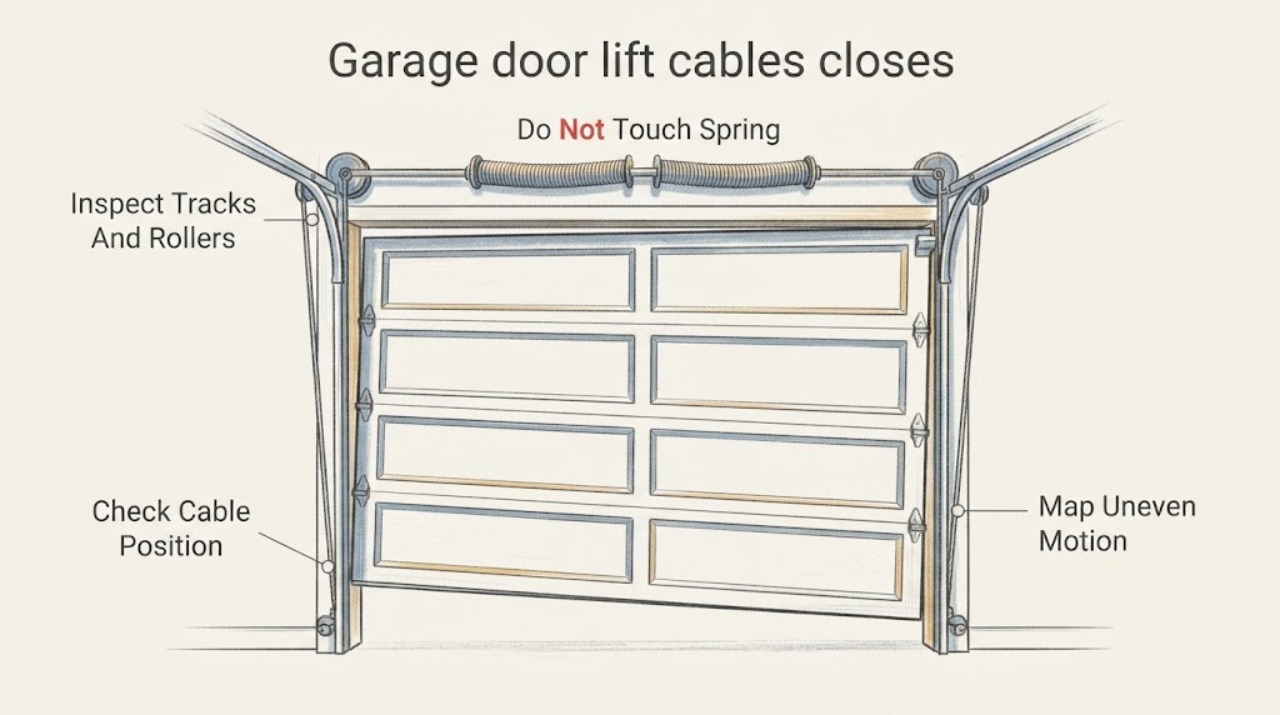
Work through in order
Diagnostic checks
Use only checks that match the exact appliance or system and its official guide.
-
Check 1
Stop repeated open-and-close cycles and, from a clear position, note how the door becomes uneven: which side leads, whether the bottom edge tilts, where a panel rubs, and whether the door stops or reverses.
Expected result: The door is visibly crooked or rubbing, one side moves ahead of the other, the opener reverses while the door stays square, or the behavior cannot be observed safely.
Next step: Leave the door closed if it can be left safely, take a floor-level photograph without touching the hardware, and continue only with a visual inspection.
Stop if: Stop immediately for a falling, buckling, severely leaning, jammed, or rapidly moving door; do not catch, hold, or force it.
Why this matters
Why: A tilt, side-to-side mismatch, or rubbing points toward door hardware, cable, track, roller, or balance trouble. A square door that reverses points more toward an opener safety or travel issue. An unsafe or unobservable movement is itself a reason to stop.
-
Check 2
With the door stationary, visually compare both lift cables from the floor, including the visible runs near the bottom brackets and drums; do not touch the cables, drums, springs, or brackets.
Expected result: Each cable appears taut and seated, or one has frayed strands, kinks, flattening, slack, crossed winding, or has come off its drum.
Next step: If any cable is damaged, slack, crossed, or off the drum, stop using the door and arrange a qualified garage-door technician; provide the side and photo record.
Stop if: Do not rewind, pull, splice, cut, remove, tension, or replace a lift cable, and do not operate the opener to see whether it will reseat.
Why this matters
Why: Fraying or abnormal routing can allow the sides to lift and close at different rates. A cable off the drum or visibly damaged is a high-tension failure condition, not a lubrication or alignment task for the owner.
-
Check 3
From outside the travel path, inspect both tracks, rollers, hinges, and the bottom door edge for visible debris, a bent section, a roller outside its track, a displaced hinge, or a loose-looking bracket; do not remove hardware or place fingers in the track.
Expected result: One side has a visible obstruction or damaged track or roller, both sides look clear, or the suspected defect cannot be judged without moving the door or loosening fasteners.
Next step: Remove only a loose obstruction that is safely outside the moving hardware. For a bent track, displaced roller, loose bracket, or any defect requiring tools, leave the door out of service and request professional repair.
Stop if: Do not straighten a track, reseat a roller, tighten a bracket, lift the door, or work inside the track while the door is supported by the opener or springs.
Why this matters
Why: A one-sided track or roller defect can make a door close unevenly even when both cables look intact. A clear visual path does not rule out cable geometry, balance, or concealed hardware problems.
-
Check 4
If no cable, spring, track, or bracket damage is visible and the door can remain safely closed, use only the balance-check procedure in the exact Amarr owner instructions; do not improvise a release or force the door.
Expected result: The door moves smoothly and remains in the instructed partially open position, or it feels heavy, drifts, drops, rises, binds, or stays tilted.
Next step: Return the door to a safe closed position only if it moves normally; otherwise stop where it is safe and arrange qualified service. Do not change spring tension or cable position.
Stop if: Do not perform this check when the door is crooked, a cable or spring is abnormal, the door cannot be controlled safely, or the procedure requires hands near tensioned components.
Why this matters
Why: Smooth movement and stable balance make a gross balance fault less likely. Heavy, drifting, binding, or tilted movement indicates an out-of-balance or hardware condition that can make the cables run unevenly and requires trained adjustment.
-
Check 5
If the door stays square but the opener reverses or stops near the floor, inspect the two photo-eye lenses and the space between them from a standing position; clear only loose items that are not part of the opener and do not adjust the sensors.
Expected result: The beam path is blocked or a sensor is visibly knocked out of position, or the path is clear while the opener still reverses.
Next step: Restore only clear line of sight and try no more than the normal documented test. If reversal persists, stop using the opener and request service; do not change force or travel settings as a guess.
Stop if: Stop for damaged sensor wiring, exposed conductors, a door that is leaning, or any need to open the opener housing or adjust electrical settings.
Why this matters
Why: A blocked or misaligned photo-eye can interrupt closing on a square door. A clear path with continued reversal points toward opener controls, wiring, travel limits, or another fault rather than proving a lift-cable problem.
-
Check 6
Collect the door and opener model information, the side that leads, the cable and track observations, the photo-eye result, and photographs taken without touching the mechanism.
Expected result: The pattern is documented, or the cause remains uncertain after safe visual checks.
Next step: Keep the door out of service when the hardware is abnormal and give the record to a trained garage-door professional for a complete cable, balance, track, and opener assessment.
Stop if: Do not buy or install a cable, drum, spring, roller, bracket, or opener part based only on a visual guess, and do not resume operation to test a suspected repair.
Why this matters
Why: Uneven closing can combine cable routing, drum, roller, track, spring balance, and opener behavior; a record of the exact pattern helps a qualified technician inspect the correct system without a risky owner adjustment.
Use your observations
Decision map
Find the observation that best matches what you see, then follow the next safe action.
-
PATH 01Safety boundary
What you see
One lift cable is frayed, slack, crossed, visibly damaged, or no longer seated on its drum.
Do this next
Keep the door closed and isolated if it is stable, do not operate the opener, and arrange qualified garage-door service for cable, drum, balance, and related hardware inspection.
Why this path and its safety boundary
Why it matters: The cable path can no longer be trusted to keep both sides synchronized, and operation could worsen the failure or release stored tension.
Safety stop: Do not touch, rewind, splice, cut, replace, or tension the cable or attempt to reset it on the drum.
-
PATH 02Safety boundary
What you see
Both cables look intact, but the same side leads and that side has a bent track, displaced roller, damaged hinge, or rubbing panel.
Do this next
Do not straighten, reseat, or tighten the hardware. Keep operation stopped and have a trained technician inspect the track, rollers, hinges, brackets, cable routing, and door alignment together.
Why this path and its safety boundary
Why it matters: A one-sided travel restriction is more likely than an opener-only setting; the cable may be reacting to the hardware rather than causing it.
Safety stop: Stop for a loose-looking bracket, track separation, roller outside the track, or any door movement that changes the defect.
-
PATH 03Safety boundary
What you see
The door is heavy, drifts or drops during the documented balance observation, remains tilted, or a spring appears broken even though the cables are not visibly frayed.
Do this next
Leave the door out of service and request a trained garage-door professional to assess springs, cables, drums, brackets, and balance as one system.
Why this path and its safety boundary
Why it matters: An out-of-balance door or spring-system fault can load the lift cables unevenly and is not made safe by changing the cable position.
Safety stop: Do not remove a spring, adjust a winding component, add a safety cable, or use the opener to compensate for the imbalance.
-
PATH 04Safety boundary
What you see
The door remains square with no visible cable or track defect, but the opener reverses or stops near the floor; the photo-eye path is blocked, misaligned, or clear but the behavior persists.
Do this next
Clear only a loose obstruction and follow the model's normal safety test once. If the opener still reverses, stop using it and arrange opener and door-system service without changing force or travel settings.
Why this path and its safety boundary
Why it matters: The visible symptom is more consistent with a photo-eye or opener control/travel issue than with the lift cables, although a technician should still confirm the door is balanced before adjusting the opener.
Safety stop: Stop for damaged sensors, exposed wiring, a failed safety test, or any need to open the opener or alter electrical settings.
-
PATH 05Safety boundary
What you see
The door repeatedly closes unevenly, but ordinary-access inspection finds no clear cable, track, roller, spring, or photo-eye clue.
Do this next
Stop further experimentation, keep the door in the safest stable position, and provide the motion pattern and photographs to a qualified technician for a complete inspection.
Why this path and its safety boundary
Why it matters: The fault may be in cable geometry, drums, balance, concealed hardware, or opener interaction that cannot be safely distinguished from the floor.
Safety stop: Do not continue cycling the door, disassemble panels, or replace a suspected part without a compatible diagnosis.
Helpful context
Understand the symptom
First decide whether the door hardware or opener is driving the symptom
Uneven closing means the two sides are not traveling together. One side may lead, a panel may rub a track, or the bottom edge may finish at different heights. That pattern is more consistent with a door, cable, drum, roller, track, or balance issue than with a simple opener setting. If the door reverses without leaning, also check the photo-eye path; an opener safety response can interrupt closing but does not explain a visibly crooked door.
Inspect the lift cables without touching tensioned hardware
With the door stationary and viewed from a safe position, compare the cable on each side where it runs toward the bottom bracket and drum. Look for broken strands, flattened or kinked sections, slack, crossing, a cable wound outside the drum, or a cable that has left the drum. Also look for a shifted bottom bracket or visibly loose track or roller, but do not loosen fasteners or put hands near springs, drums, or cable loops. Amarr says visible cable wear should be addressed immediately by a qualified professional.
Use balance and motion clues only as observations
A healthy, properly balanced door should move smoothly with little resistance and should not become heavy or remain crooked. Do not force a manual test when a cable, spring, track, or bracket looks abnormal, or when the door is not fully supported. If the door is safe to leave closed and the manufacturer's instructions permit a controlled balance check, follow those instructions exactly; a door that will not hold the instructed position or moves unevenly needs trained service, not a spring or cable adjustment.
Give the technician the pattern, not a guessed part diagnosis
Record which side leads, whether the cable is slack or off the drum, where the panel rubs, whether the opener reverses, and whether the photo-eye indicators are blocked. Include the model information and clear photographs taken from the floor. Cable sets, drums, springs, rollers, tracks, and brackets are conditional parts; the exact replacement and adjustment depend on the door's construction and the technician's inspection.
Safety boundary
Stop conditions
- Stop using the door for a frayed, slack, crossed, or off-drum lift cable, broken spring, severe lean, falling movement, or visible structural or hardware damage.
- Do not remove, repair, rewind, splice, cut, tension, or replace lift cables, drums, springs, brackets, or safety cables as an owner adjustment.
- Do not straighten tracks, reseat rollers, tighten brackets, lift a crooked door, or put fingers near tracks, cables, drums, springs, hinges, or door sections.
- Do not use repeated opener cycles or change force, travel, or electrical settings to compensate for an unevenly closing door.
- Stop for exposed wiring, damaged photo-eye wiring, a failed safety reversal test, smoke, fire, or any condition that prevents safe isolation of the door.
Only after diagnosis
Potential parts
- garage-door lift cable set
Consider this category only if a qualified inspection confirms a frayed, broken, stretched, or otherwise damaged lift cable and identifies the correct cable specification.
Confirm the exact door model, height, drum and spring configuration, cable length, diameter, and manufacturer fit information before ordering; cable installation and tensioning are professional work. - garage-door cable drum
Consider this category only if a technician finds a damaged, mismatched, or worn drum contributing to cable tracking or uneven travel.
Confirm the exact door weight, lift type, drum profile, cable specification, and paired hardware with a qualified technician; do not substitute a drum by appearance. - garage-door roller or track hardware
Consider this category only when inspection confirms a damaged roller, bent track, hinge, or related hardware is restricting one side of travel.
Confirm the door section, track profile, roller stem and bearing design, and compatible repair scope before ordering; track and roller replacement can affect door support and alignment.
When checks do not resolve it
Need a professional?
Arrange qualified garage-door service immediately for a frayed or off-drum cable, broken spring, crooked or falling door, loose or bent track, displaced roller, damaged bracket, or any need to adjust tensioned hardware. Request service promptly for repeated uneven closing even when no defect is visible, because cable routing, drums, balance, and opener interaction require a complete system inspection.
Safety scope: This article supports observation from a safe standing position and removal of only loose obstructions outside moving hardware. Do not operate a damaged door, touch or adjust cables, drums, springs, brackets, tracks, rollers, or opener settings, and do not open the opener housing.
Common questions
FAQ
Can I keep using an Amarr garage door if one side closes lower than the other?
No. Stop repeated cycles and inspect only from the floor. A tilted or uneven door can indicate a cable, drum, roller, track, spring-balance, or bracket problem; stop immediately for a frayed or off-drum cable, broken spring, severe lean, or visible damage and arrange qualified service.
What should I do if an Amarr lift cable is off the drum?
Do not operate the door or try to rewind the cable. Keep people away, leave the door in the safest stable position, and request a trained garage-door technician to inspect the cable, drum, springs, balance, and related hardware.
Could the photo eyes cause uneven closing?
Photo eyes can cause a square door to stop or reverse near the floor when the beam is blocked or the sensors are misaligned. They do not explain a door that is visibly leaning or closing with one side ahead; that pattern needs door-hardware and balance assessment.
Should I adjust the garage-door spring or cable to make both sides even?
No. Springs, cables, drums, and brackets carry stored force. Amarr directs owners to trained professionals for frayed or off-drum cables, out-of-balance doors, and significant repairs. Provide the observed pattern and photographs instead of changing tension or cable position.
Read the exact guide
Official sources
- Care & MaintenanceAmarr · Manufacturer maintenance guidance for visual inspection of cables, pulleys, rollers, hardware, door balance, photo eyes, and reversal testing.
- SafetyAmarr · Manufacturer safety guidance for visual cable inspection, worn cables, out-of-balance doors, springs, and safe professional service.
- Residential Owner's ManualAmarr · Amarr residential owner's manual for smooth manual movement, balance clues, safe handles, and trained-technician warnings.
- FAQsAmarr · Manufacturer FAQ for Amarr residential garage-door cable wear, cables off drums, jerky operation, and when to use a trained professional.
Community feedback
Share a repair observation
Share a plain-text repair observation. Accepted observations are published automatically; this page may take a moment to update.