
On this page
Start here
Quick answer
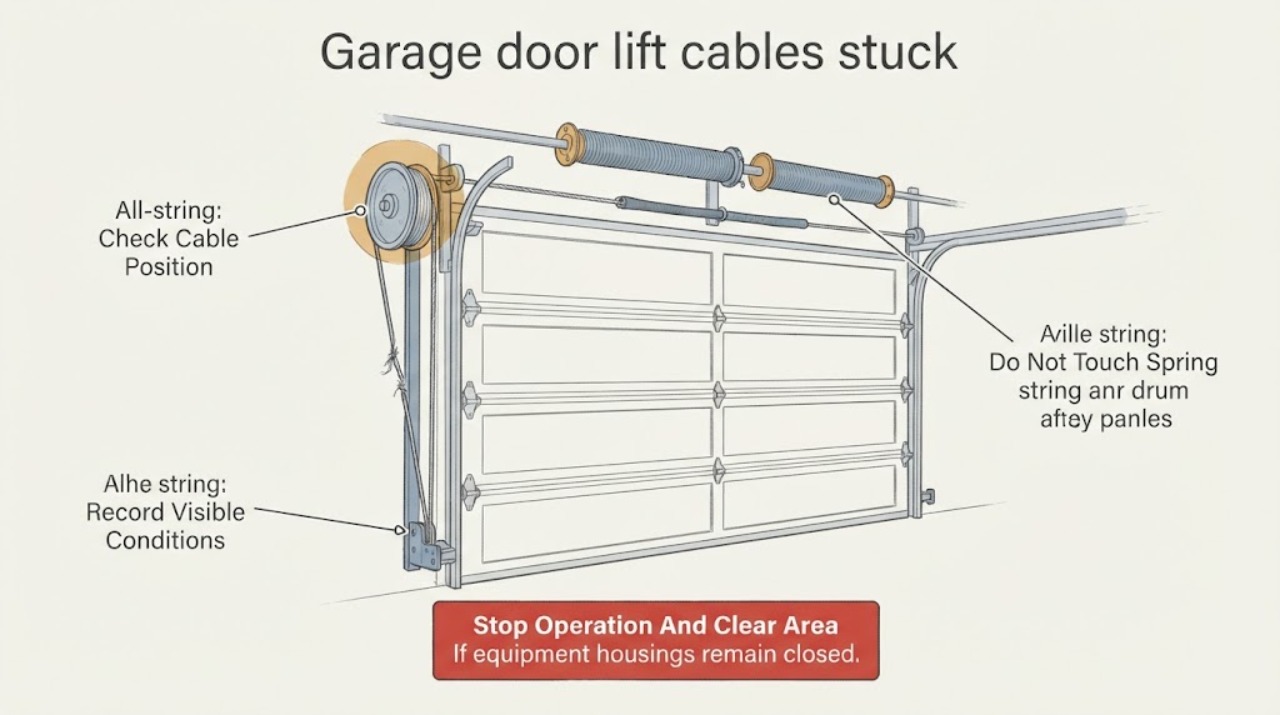
Do not run the opener, pull the cable, move the door, loosen a red fastener, or attempt to rewind or replace a lift cable. Amarr says not to operate a door when a cable has jumped off the drum and to call a qualified garage-door technician; its safety material also says visible cable wear or fraying requires professional service. From a safe position, keep people, pets, and vehicles clear, note whether the door is open, closed, crooked, or partly raised, and look only for visible cable fraying, a cable off the drum, a broken spring, track displacement, or impact damage. Do not reach between sections or stand under a raised door. If the door is crooked, the cable is loose or off the drum, a spring is broken, the opener strains, or the door cannot be secured without force, leave it out of service and contact a trained Amarr dealer or qualified garage-door technician. Cable and spring systems are under hazardous tension, so part selection and any adjustment must wait for an in-person inspection.
Before you begin
Safety first
- Owner checks are limited to stopping operation, clearing the area, observing from a safe position, taking non-invasive photos, and recording symptoms. A trained technician must handle cable, drum, spring, bottom-bracket, track, balance, opener-load, manual-release, and any other adjustment or repair involving tensioned or moving components.
Work through in order
Diagnostic checks
Use only checks that match the exact appliance or system and its official guide.
-
Check 1
Stop using the remote, wall control, and any manual lifting attempt. Keep people, pets, and vehicles out of the doorway and away from a raised or partly raised door, and watch only from a position outside the door's travel path.
Expected result: The door remains still, the opener hums or strains, the door moves unexpectedly, or the door is suspended partly open.
Next step: Keep the area closed off and call a qualified garage-door technician. Do not try to catch, lower, prop, or balance the door yourself.
Stop if: Stop immediately and move farther away for any movement, falling panel, loud snap, broken spring, or inability to keep people clear.
Why this matters
Why: A still door can remain out of service while help is arranged. Straining, unexpected movement, or a partly raised door increases the crush and falling-door hazard and is not a safe troubleshooting state.
-
Check 2
From a safe position, record whether the Amarr door is fully closed, fully open, partly raised, level, or visibly crooked. Photograph the overall door and doorway without standing underneath or opening any hardware covers.
Expected result: The door is level and closed, partly raised, crooked, one side is higher, or panels and tracks show impact or displacement.
Next step: Leave the door in place, keep the opening isolated, and provide the position and photos to a trained technician. Do not pull the emergency release or manually move a door with a suspected cable fault.
Stop if: Stop for a door that shifts, sags, falls, rubs severely, or has a damaged panel or track; do not approach the travel path.
Why this matters
Why: A crooked or uneven door can accompany a cable, spring, track, bottom-bracket, or panel problem. A partly raised or damaged door can fall or move without warning and must not be manually tested.
-
Check 3
Without touching the cable, drum, spring, bottom bracket, red fasteners, or track, look from the side for visible fraying, broken strands, slack cable, a cable off the drum, binding, or a cable hanging differently on the two sides.
Expected result: The cable is intact and seated, visibly frayed, loose or off the drum, tangled or bound, or not visible because the door or hardware blocks the view.
Next step: Do not operate the door or attempt to reseat, cut, splice, pull, or replace the cable. Call a qualified technician and report the exact visible pattern.
Stop if: Stop for any frayed cable, cable off the drum, broken strand, loose bottom bracket, damaged spring, or red fastener in the area.
Why this matters
Why: Fraying, slack, an off-drum cable, or unequal cable position is a professional-service condition. A blocked view does not prove the cable is safe; hidden tensioned hardware must not be exposed by removing covers.
-
Check 4
From the floor and outside the moving path, note visible spring breakage or separation, a displaced or bent track, roller out of the track, panel impact, or opener damage. Do not inspect by climbing, loosening hardware, or moving the door.
Expected result: A spring is visibly broken, the track or roller is displaced, panels are dented or shifted, the opener is damaged, or none of these clues are visible.
Next step: Keep the system out of service and give the technician the complete set of observations. Do not repair the track, adjust the spring, or add a bracket or cable.
Stop if: Stop for any loose hardware, broken spring, detached roller, bent track, panel collapse, or need to enter the door's travel path.
Why this matters
Why: A broken spring, displaced track, damaged panel, or opener can make a cable appear stuck or create the same stuck-door symptom. No visible clue does not rule out a concealed cable or balance fault.
-
Check 5
Do not disengage the opener, pull the emergency-release handle, or attempt an Amarr balance test while a lift cable is suspected to be stuck, loose, frayed, or off the drum. Do not use a ladder or place a prop under the door.
Expected result: The door is already disconnected, the release handle was pulled, a prop is present, or none of these actions occurred.
Next step: Back away, keep the area clear, and tell the technician exactly what state the opener, release, and door are in. Do not reconnect or reposition anything unless directed in person by a qualified technician.
Stop if: Stop for movement, sagging, a slipping prop, a loose release, or any person under or beside the door.
Why this matters
Why: Manual operation can transfer the door's weight to a compromised cable or spring and can cause movement or a drop. A disconnected or propped door is not proof that the system is safe.
-
Check 6
Prepare the Amarr door model or label if visible without entering the hazard area, door position, cable and spring observations, track or panel damage, opener behavior, recent impact or weather event, and clear photos taken from a safe location.
Expected result: The model is known, the model is unknown, the issue followed an impact or storm, or the failure appeared during ordinary operation.
Next step: Contact a trained Amarr dealer or qualified garage-door technician for an in-person inspection and quote. Share all photos and do not alter the system before the visit.
Stop if: Stop gathering information if it requires touching hardware, entering beneath the door, removing labels or covers, or moving the door.
Why this matters
Why: Model and history help the dealer identify the correct cable, drum, spring, bracket, or panel system. A missing model or unclear history does not justify buying a generic part or attempting repair.
Use your observations
Decision map
Find the observation that best matches what you see, then follow the next safe action.
-
PATH 01Next step
What you see
The lift cable is visibly off the drum, hanging loose, crossed, or different from the cable on the other side, and the door will not close or is crooked.
Do this next
Keep the door and opener out of service, isolate the doorway, and call a qualified garage-door technician. Do not reseat or rewind the cable.
-
PATH 02Next step
What you see
Visible cable strands are frayed, broken, kinked, rusted through, or the cable is binding near a drum or bottom bracket.
Do this next
Do not touch or operate the door. Contact a professional Amarr dealer or trained technician and report the visible damage from a safe distance.
-
PATH 03Next step
What you see
A spring appears broken, the door is unusually heavy or sags on one side, or the opener strains after the stuck-door symptom.
Do this next
Leave the door in place and out of service. Do not perform a balance test or adjust springs; arrange qualified system inspection.
-
PATH 04Next step
What you see
The door is crooked and a track, roller, panel, bracket, or opening shows visible displacement or impact damage, while the cable view is incomplete.
Do this next
Keep the travel path clear and call a technician. Do not straighten a track, pull a roller back, loosen hardware, or force the opener.
-
PATH 05Next step
What you see
The cable and door appear seated and level from a safe view, but the opener hums, reverses, stops, or fails to respond.
Do this next
Do not repeatedly cycle the opener or disengage it for a manual test if the door is stuck. Have a qualified technician inspect the opener and door together.
-
PATH 06Next step
What you see
The cable, spring, drum, or bottom bracket cannot be safely seen, the door is partly raised, or a shutoff, release, or hardware state is uncertain.
Do this next
Stop inspection, keep everyone away from the door, and call a trained Amarr dealer or qualified garage-door technician.
Helpful context
Understand the symptom
Treat a stuck cable as a door-system safety fault
A lift cable works with the drums, bottom brackets, springs, tracks, and the door's weight. A cable that is off the drum, slack, frayed, or bound can leave the door uneven or unsupported. Amarr's troubleshooting guide specifically says not to operate a door when the cable has jumped off the drum, and its owner manual warns that cable and spring repairs require a trained technician. Do not test the system by pressing the remote or wall control.
Make the area safe before looking
Keep children, pets, vehicles, and bystanders away from the doorway and the space beneath a raised or partly raised door. Do not stand under the door, put fingers between sections, touch the cable or spring, or place a ladder, board, or other improvised support under the door. If the door is moving, stop using the controls and wait from a safe position; do not try to catch or guide it.
Look for clues without disturbing the tensioned hardware
From outside the path of the door and without opening covers, note whether the door is level, crooked, partly raised, or fully closed. Look for a cable visibly off its drum, fraying, broken strands, an empty or damaged spring, a track that is displaced, or impact damage. This information helps the technician distinguish a cable-path problem from spring, track, panel, or opener damage; it does not make a repair safe for an owner.
Do not confuse an opener symptom with a safe cable test
A motor that hums, strains, reverses, or stops can reflect a cable, spring, track, balance, or opener problem. Amarr notes that worn springs can make the door heavy and add load to the opener, while a crooked door can indicate track misalignment. These symptoms are not a reason to disengage the opener and lift a door with a loose cable. Leave the door in its current safe state and let a technician inspect the complete system.
The correct replacement depends on the complete door system
Cable length, drum arrangement, spring system, bottom bracket, door height, track configuration, and opener setup all affect compatibility and adjustment. Amarr's warranty guidance says the local professional dealer should confirm the issue and repair, service, or replace parts. Do not order a generic cable or spring from a picture, and do not add parts or change spring tension as a workaround.
Safety boundary
Stop conditions
- Stop immediately for a cable off the drum, fraying or broken strands, a broken spring, a crooked or partly raised door, a displaced track, falling panels, loud snapping, or any unexpected movement. Keep people and vehicles clear and call a qualified technician.
- Do not run the opener, pull the emergency release, manually lift or lower the door, catch or guide a moving panel, place an improvised prop underneath, or perform a balance test when a cable or spring fault is suspected.
- Do not remove, repair, adjust, rewind, splice, or replace lift cables, springs, drums, bottom brackets, red fasteners, or related hardware. Amarr warns that high spring tension can cause serious injury or death and reserves this work for trained technicians.
- Do not climb, reach between door sections, loosen tracks or brackets, add parts, or buy a generic cable from a photo. Stop owner troubleshooting after safe visual observation and documentation; the complete door system needs professional inspection.
Only after diagnosis
Potential parts
- Amarr lift cable
Relevant only after a qualified technician confirms the cable is damaged or incompatible with the installed door and identifies the correct cable assembly.
Match door model, height, weight, spring and drum system, cable length and end construction, and the technician's measured requirements; do not select by appearance or generic diameter. - cable drum
Relevant only when a technician finds a damaged, worn, or incompatible drum causing the cable to leave its intended path.
Drum geometry and winding direction depend on the complete torsion system and door dimensions. Drum work is tensioned repair, not an owner adjustment. - garage-door spring assembly
Relevant only when inspection confirms a broken, weakened, or incorrectly matched spring contributing to cable slack, imbalance, or a stuck door.
Spring selection and winding depend on door weight, dimensions, track, and hardware. Never add, remove, or adjust springs without a trained technician. - bottom bracket or cable anchor hardware
Relevant only when a technician confirms the cable anchor or bottom bracket is damaged or has shifted.
Bottom brackets can be attached to high-tension components. Confirm exact door hardware and have the technician perform the replacement; do not loosen red fasteners. - garage-door track or roller service
Relevant only when a qualified inspection finds track displacement, roller failure, or binding that is causing the cable and door to become uneven.
Track and roller geometry must match the door and configuration. Do not straighten tracks, force rollers, or move a door with a cable fault.
When checks do not resolve it
Need a professional?
Call a trained Amarr dealer or qualified garage-door technician immediately when a lift cable is off the drum, frayed, loose, stuck, or binding; the door is crooked, partly raised, heavy, or inoperable; a spring, track, roller, bracket, panel, or opener appears damaged; the door will not stay safely in place; or the fault cannot be identified without touching tensioned hardware.
Safety scope: Owner checks are limited to stopping operation, clearing the area, observing from a safe position, taking non-invasive photos, and recording symptoms. A trained technician must handle cable, drum, spring, bottom-bracket, track, balance, opener-load, manual-release, and any other adjustment or repair involving tensioned or moving components.
Have this ready
- Provide the Amarr model or label if safely visible, door position, cable appearance, spring and track observations, opener behavior, recent impact or weather event, whether anyone pulled a release or moved the door, and photos taken from outside the travel path. Do not remove covers or alter hardware to collect information.
Common questions
FAQ
Can I operate an Amarr garage door if the lift cable is off the drum?
No. Amarr specifically says not to operate the door when the cable has jumped off the drum. Keep the area clear and call a qualified garage-door technician; do not try to reseat the cable.
Can I pull the emergency release when an Amarr cable is stuck?
Do not use the release as a cable test. A compromised cable or spring can leave the door unsupported when the opener is disengaged. Keep the door out of service and let a trained technician determine the safe procedure.
What if the Amarr lift cable is frayed but the door still opens?
Do not keep using it. Amarr says visible cable wear or fraying requires professional service and warns owners not to repair or adjust cable or spring hardware.
Why is my Amarr garage door crooked when it is stuck?
A crooked door can accompany uneven cable tension, a spring or bottom-bracket problem, a displaced track or roller, panel damage, or another balance fault. Do not straighten it or move it by hand; have the full system inspected.
Can I replace an Amarr lift cable myself?
Not safely as a generic owner repair. The cable works with high-tension springs, drums, brackets, and the door's weight. Amarr warns against removing, repairing, or adjusting cables and related hardware; a trained technician must identify and replace the correct assembly.
Is the garage-door opener the problem if the cable looks normal?
It could be, but a safe floor-level view cannot clear the balance system or hidden cable path. Straining, reversing, or stopping can also result from spring, track, panel, or balance faults. Do not repeatedly cycle the opener; arrange a door-and-opener inspection.
Should I prop up a partly open Amarr garage door?
Do not place an improvised prop, ladder, board, or other support under it. A partly raised door can move or fall, and adding support can create another hazard. Keep people away and call a qualified technician.
What information should I give the Amarr technician?
Share the model if safely visible, door position, whether it is crooked, cable and spring appearance, track or panel damage, opener behavior, recent impact or weather, any release or movement already attempted, and safe photos. Do not alter the hardware to gather more details.
Can I buy a generic cable for my Amarr garage door?
Do not choose by a photo or generic size. Cable length, end, drum, spring system, door dimensions, and hardware must match. Have the technician identify the complete system and compatible parts.
When is a stuck Amarr garage door an emergency?
Treat a falling, shifting, partly raised, crooked, or rapidly worsening door, a broken spring, a loose or off-drum cable, a blocked vehicle exit, or people exposed to the doorway as urgent. Clear the area and call a qualified technician; never stand under or between moving sections.
Read the exact guide
Official sources
- Garage Door SafetyAmarr · Amarr safety guidance used for keeping clear of moving doors and sections, visual cable inspection, spring tension, and professional service boundaries.
- Residential and Commercial Door Troubleshooting GuideAmarr · Amarr's official FAQ directly addresses a cable off the drum, frayed cables, broken springs, track misalignment, door balance, and when to call a professional.
- Residential Owner's ManualAmarr · Amarr owner manual warning labels and operating guidance used for high spring tension, cable and red-fastener prohibitions, pinch hazards, opener release cautions, and safe manual-operation limits.
- Garage Door Care and MaintenanceAmarr · Amarr maintenance guidance used for safe visual inspection, recognizing that significant lift-cable or track repair belongs to professional dealers, and avoiding owner repair procedures.
- Amarr Warranty GuidanceAmarr · Amarr warranty guidance used for directing owners to a local professional dealer, documenting damage with photos, and avoiding removal or repair of a heavy garage door.
Community feedback
Share a repair observation
Share a plain-text repair observation. Accepted observations are published automatically; this page may take a moment to update.