
On this page
Start here
Quick answer
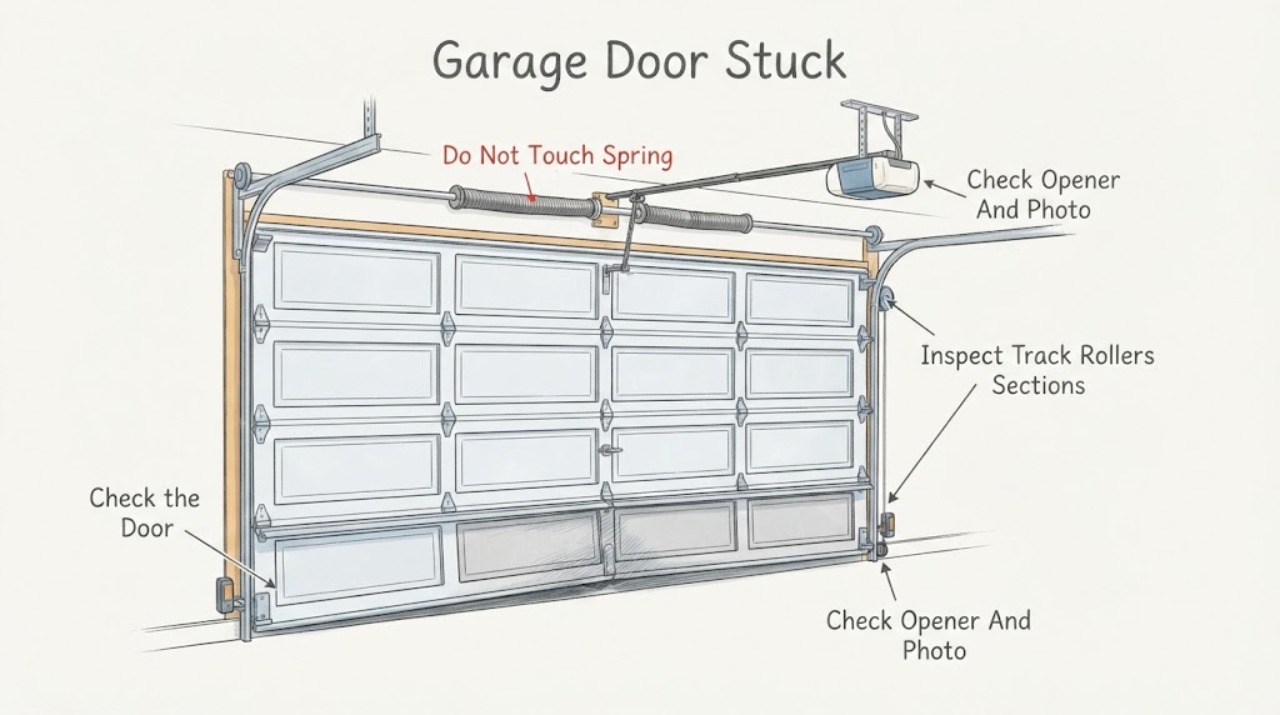
Treat a stuck Clopay garage door as a heavy moving-door and counterbalance hazard before assuming the opener is at fault. Keep people, pets, vehicles and fingers out of the travel path and do not stand below a partly open door. From a safe position, note whether the opener is silent, the photo eyes are blocked, the door is off track, a spring or cable is visibly damaged, a section is bent, or the door is heavy, crooked or binding. Clopay says a broken spring, worn cable, off-track door or unsafe balance requires professional attention; conventional bottom brackets and spring tension can cause serious injury. Only follow the exact installed opener and Clopay instructions for a simple visible obstruction or a manual check when the door is fully closed, undamaged and clearly safe. Stop cycling the door and arrange qualified service if it is mechanically stuck, damaged, unbalanced, partly open or affected by springs, cables, tracks or brackets.
Before you begin
Safety first
- This article supports safe observation and manufacturer-directed checks of controls, photo-eye obstructions or a confirmed lock engagement only when the door is closed and undamaged. Do not touch or adjust springs, cables, brackets, tracks or wiring; do not operate a damaged, off-track, unbalanced or partly open door.
Work through in order
Diagnostic checks
Use only checks that match the exact appliance or system and its official guide.
-
Check 1
Stop the opener and keep people, pets, vehicles and stored items away from the door's travel and fall area; observe the door from the side without putting hands between sections or underneath it.
Expected result: Record whether the door is fully closed, partly open, fully open, tilted, sagging, detached from a track, or held by an obstruction. Note a sudden movement, loud snap, crushed panel, falling hardware, broken glass or impact damage.
Next step: Leave a hazardous door undisturbed and arrange qualified garage-door service. If the door is falling, someone is trapped, or there is an immediate injury hazard, keep clear and contact emergency services.
Stop if: Do not stand beneath the door, catch it, prop it with a ladder or board, pull a panel by its edge, or reach into joints, tracks or roller areas.
Why this matters
Why: A partly open, tilted, damaged or suddenly moving door may fall or shift. A fully closed door with no visible damage allows a cautious opener-versus-door check, but it does not prove the spring and cable system is safe.
-
Check 2
With the door area clear and the door not visibly damaged, observe the wall control, remote, opener light or sound and the two photo-eye sensor faces; remove only a plainly visible floor-level obstruction without moving a sensor mount or door.
Expected result: Note whether the opener has power, clicks or hums, runs while the door stays still, starts then reverses, and whether a photo-eye beam is blocked, dirty or visibly misaligned.
Next step: Use only the installed opener instructions to address a simple visible sensor obstruction or control battery. If the door is physically stuck, the opener strains, the sensors remain faulty, or any spring, cable or track is damaged, stop using it and call a qualified technician.
Stop if: Do not bypass photo eyes, change force or travel settings as a guess, repeatedly cycle the opener, open its housing or touch wiring while troubleshooting.
Why this matters
Why: A response from neither control can indicate a power, control or remote-battery issue. An opener that runs without moving the door points toward a mechanical connection, spring, cable or door problem. A photo-eye can prevent closing or operation, but it does not explain a crooked, rubbing or heavy door.
-
Check 3
From a safe standing position, visually compare both tracks, rollers, hinges, brackets, door sections, bottom seal and visible fasteners without loosening, straightening or pushing any component.
Expected result: Look for a roller outside its track, a creased or separated track, bent hinge or shaft, loose fastener, cracked or crushed section, an obstruction at the threshold, or scrape marks on one side.
Next step: Remove only a loose object that can be lifted from a safe position without contacting the door or track. For any displaced roller, bent track, loose bracket or damaged section, keep the door still and request qualified repair.
Stop if: Do not hammer a track straight, pull a roller into place, remove hinges or brackets, loosen tension-related fasteners, or operate the door to see if it clears.
Why this matters
Why: A localized scrape, displaced roller, bent track or damaged section makes a mechanical bind likely; operating the opener can worsen alignment or release door weight. A threshold obstruction may explain refusal to close, but it does not justify defeating the safety system.
-
Check 4
From the floor and without reaching into the mechanism, visually compare the spring and lift-cable assemblies; do not release the opener or lift the door to make this observation.
Expected result: Look for a spring gap or break, a frayed cable or loose strands, a cable displaced from its path, a missing extension-spring containment cable, a hanging bottom bracket or a door that suddenly became heavy or lopsided.
Next step: Keep the door in its current safe position, keep everyone away from the hardware and call a qualified garage-door technician. Provide safe-distance photos and the Clopay model or serial information if available.
Stop if: Do not touch springs, drums, bottom brackets, containment or lift cables, winding hardware or tension fasteners; do not adjust, unwind, splice, re-seat or replace them.
Why this matters
Why: Any of these signs indicates a counterbalance or lifting-system hazard. A broken spring can make the door extremely heavy, and a frayed cable can break and allow the door to drop or tilt. The containment cable on an extension-spring system does not make the assembly safe to adjust.
-
Check 5
Only if the door is fully closed, straight and undamaged, the springs and cables show no warning signs, the area is clear, and the exact Clopay and opener instructions permit it, disconnect the opener as instructed and use the designated grip handles or step plates; otherwise skip this check.
Expected result: Observe whether the door moves smoothly with controlled resistance and stays in place when stopped partway, rather than drifting, slamming, rising or binding.
Next step: Re-engage the opener only according to its instructions and only if the door passes the permitted check; otherwise leave it out of service and call a trained Clopay or garage-door technician.
Stop if: Do not perform this check on a partly open, crooked, damaged, spring-affected or cable-affected door, and do not use fingers between sections, a pry bar, rope, ladder or added weight.
Why this matters
Why: Smooth, controlled movement supports an opener or control investigation but does not clear recurring faults. Binding, unusual resistance, drifting, failure to hold position or inability to release the opener safely indicates imbalance or mechanical service is needed.
Use your observations
Decision map
Find the observation that best matches what you see, then follow the next safe action.
-
PATH 01Safety boundary
What you see
The door is fully closed, straight and undamaged, the spring and cable system looks intact, and the opener is silent, refuses to close or reverses while a photo eye is visibly dirty, blocked or misaligned.
Do this next
Remove a simple visible obstruction and follow the exact opener manual for sensor or control checks. If it still will not operate, have a qualified technician inspect the opener and door together.
Why this path and its safety boundary
Why it matters: An opener control, power, remote battery or photo-eye issue is more likely than a broken counterbalance, but a sensor symptom cannot explain physical binding or an uneven door.
Safety stop: Do not bypass sensors, change force or travel settings as a workaround, or keep cycling a door that strains, scrapes or moves unevenly.
-
PATH 02Safety boundary
What you see
The door hangs crooked, a roller is outside its track, a track or hinge is bent or separated, a section is cracked or crushed, or the opener runs against a visible bind.
Do this next
Stop operating the door, keep the opening clear, document the condition from the floor and call a qualified garage-door technician for a track, section, hardware and opener assessment.
Why this path and its safety boundary
Why it matters: A mechanical track, roller, hinge or section fault is more likely than an opener-only problem; moving the door can release weight or worsen damage.
Safety stop: Do not straighten tracks, push sections, pull rollers into place, remove hardware or use the opener to force the door past the bind.
-
PATH 03Safety boundary
What you see
A spring has a visible gap or break, a cable is frayed or displaced, an extension-spring containment cable is missing, a bottom bracket is hanging or the door suddenly became heavy.
Do this next
Do not operate or manually lift the door. Keep people away and call a qualified garage-door technician to secure and repair the spring, cable and related hardware.
Why this path and its safety boundary
Why it matters: The counterbalance or lifting system is compromised and the door may fall, rise or shift unexpectedly. The opener cannot safely compensate for lost spring or cable support.
Safety stop: Do not adjust, unwind, re-seat, splice or replace springs or cables, loosen bottom brackets or add a stronger opener.
-
PATH 04Safety boundary
What you see
The door binds, sticks, slams, rises, will not hold a partial opening or cannot move smoothly during an otherwise permitted manual check.
Do this next
Leave the door closed or in its current safe position and arrange qualified service for balance and mechanical diagnosis. Do not use the opener to overcome the resistance.
Why this path and its safety boundary
Why it matters: The door is out of balance or has a spring, cable, track, roller, hinge or other hardware issue. Clopay and CPSC treat binding or sticking as a professional-service condition.
Safety stop: Do not force the door, change spring tension, change opener force, add weight or stand below it while testing.
-
PATH 05Safety boundary
What you see
The door became stuck after a vehicle impact, wind event, freezing condition or attempted opening with an inside slide lock engaged, or panels and hardware are visibly displaced.
Do this next
Keep the door out of service, document the condition from a safe position and request qualified inspection. If a simple lock engagement is visibly confirmed while the door is closed and undamaged, use only the exact Clopay instructions to disengage it; otherwise do not force the door.
Why this path and its safety boundary
Why it matters: The door, tracks, opener reinforcement, lock, counterbalance and mounting may all be affected. Concealed damage can make operation unsafe even if the motor still runs.
Safety stop: Do not repeatedly cycle the opener, pull damaged panels, chip ice at hinges or tracks, defeat a lock, or enter beneath the door to secure it.
Helpful context
Understand the symptom
First separate a control problem from a stuck door
A dead remote or a close-and-reverse symptom can come from power, a battery, a blocked photo-eye beam or an opener control. A door that is crooked, rubbing, off its track, heavy, or stopped at one section is a mechanical branch. Clopay's photo eyes sit near the bottom of the tracks and can stop an opener from operating when the beam is interrupted, but cleaning a sensor cannot correct a bent track, broken spring or displaced cable. Do not keep pressing the control to force a physical bind.
Clopay spring and cable systems are not a trial-and-error repair
Clopay warns that conventional bottom brackets are under extreme tension and that frayed or worn cables can break and cause injury or property damage. Extension springs should have containment cables, but that safety feature does not make a broken or stretched system safe to handle. Do not loosen brackets, wind or unwind springs, re-seat cables, or add force to the opener. A professional must secure the door and identify the correct counterbalance repair.
Use the model manual for any permitted check
Clopay's installation and safety guidance describes grip handles or step plates for safe operation and a manual balance check only after disconnecting the opener with the door closed. The door should move smoothly and hold its position when stopped partway. If it does not, the spring system may be out of balance and the door needs trained service. The exact opener manual controls release and re-engagement; do not improvise a release on a partly open or damaged door.
Safety boundary
Stop conditions
- Do not operate or manually move a Clopay door with a broken spring, frayed or displaced cable, bent track, displaced roller, damaged section, crooked alignment or unknown balance.
- Do not loosen or remove bottom brackets, adjust or unwind springs, re-seat cables, remove containment cables, or handle tension-related hardware; these parts can release hazardous force.
- Do not stand or walk beneath a moving or partly open door, put fingers between sections, pull panels, use a ladder or pry bar, or use a vehicle or rope to force movement.
- Do not bypass photo eyes or change opener force and travel settings as a guess; stop repeated cycles if the opener strains, scrapes, binds or reverses unexpectedly.
- Call emergency services for entrapment, an immediate falling-door hazard, fire or injury; call a qualified garage-door technician for mechanical, balance, spring, cable, track, section or significant opener faults.
Only after diagnosis
Potential parts
- garage-door photo-eye sensor or mounting bracket
Consider this only if the opener manual and qualified diagnosis confirm a failed or damaged sensor or bracket rather than a simple obstruction or alignment issue.
Match the opener manufacturer, model, sensor protocol, wiring and mounting arrangement; do not bypass or substitute a sensor based on appearance alone. - garage-door roller, hinge or track component
Consider this only when a qualified technician confirms a worn roller, hinge, track or related hardware is causing the bind and identifies the exact door system.
Match section, track profile, roller stem, hinge position, loading and installation instructions; do not straighten or swap hardware without the technician's plan. - Clopay replacement door section or reinforcement
Consider this only when a qualified inspection confirms an impact-cracked, crushed or otherwise failed section and verifies the correct replacement or reinforcement.
Match exact Clopay series, section height, width, window layout, weight, hinge and reinforcement arrangement; changing weight affects the counterbalance and opener. - garage-door spring, containment cable or lift-cable assembly
Consider this only as a technician-installed repair after the door's weight, dimensions, spring type, cable path and counterbalance system are identified.
Never order or install by color, length or appearance alone; the technician must match the system and safely manage stored tension, bottom brackets and related hardware.
When checks do not resolve it
Need a professional?
Arrange qualified Clopay or garage-door technician service when the door is mechanically stuck, crooked, off track, unbalanced, damaged, stuck partly open, persistently noisy or affected by a spring, cable, bracket, track, section or opener connection. A simple visible photo-eye obstruction, remote battery or confirmed lock engagement may be checked using the exact installed instructions only when the door is undamaged. Do not operate a door with a broken spring, frayed cable or displaced hardware.
Safety scope: This article supports safe observation and manufacturer-directed checks of controls, photo-eye obstructions or a confirmed lock engagement only when the door is closed and undamaged. Do not touch or adjust springs, cables, brackets, tracks or wiring; do not operate a damaged, off-track, unbalanced or partly open door.
Common questions
FAQ
Why is my Clopay garage door stuck while the opener still runs?
The opener may be running against an off-track roller, bent track, damaged section, broken spring, displaced cable or other mechanical bind. Stop cycling it, keep the area clear and have a qualified technician inspect the door and opener together.
Can I manually open a stuck Clopay garage door?
Only follow the exact Clopay and opener manual procedure when the door is fully closed and undamaged, the area is clear and no spring, cable, track or balance warning is visible. If it is partly open, crooked, heavy, damaged or mechanically bound, do not release or force it.
What should I do if a Clopay garage-door cable is frayed or displaced?
Do not operate the door or try to re-seat the cable. Clopay says worn or frayed cables can break and cause injury or property damage. Keep people away from the door and spring hardware and arrange qualified garage-door service.
Could a Clopay photo eye make the door seem stuck?
Yes. A blocked or misaligned photo eye can stop an automatic door from closing or operating, but it does not explain a crooked, rubbing, heavy or off-track door. Remove only a plainly visible obstruction and follow the opener manual; do not bypass the sensors.
Is it safe to adjust a Clopay spring or bottom bracket myself?
Do not adjust conventional springs or bottom brackets yourself. Clopay warns that bottom brackets are under extreme tension and that spring and cable repairs can cause serious injury. A broken spring, frayed cable or heavy door needs a qualified technician.
What if the Clopay door is stuck after an impact or storm?
Keep it out of service and do not pull panels or use the opener to force it. An impact or weather event can bend tracks, sections, reinforcement, mounting or counterbalance parts. Photograph the condition from the floor and arrange qualified inspection.
Read the exact guide
Official sources
- Garage Door Safety ChecklistClopay · Clopay residential garage-door safety guidance; it supports observation and professional-service boundaries without replacing the installed manuals.
- Publication 523: Non-Reversing Automatic Garage Door Openers Are a HazardU.S. Consumer Product Safety Commission · CPSC consumer safety publication; it supports safe-operation and professional-service boundaries but does not replace Clopay or opener instructions.
- How to Install a Garage DoorClopay · Clopay residential garage-door installation and post-installation checklist; the exact door and opener manuals control model-specific operation.
- Emergency Garage Door ServiceClopay · Clopay manufacturer guidance describing emergency failure patterns and why heavy, spring, cable or off-track repairs need trained professionals.
Community feedback
Share a repair observation
Share a plain-text repair observation. Accepted observations are published automatically; this page may take a moment to update.