
On this page
Start here
Quick answer
If a Clopay garage door panel or its hinge area is damaged, stop automatic operation and keep people, pets, and vehicles away from the moving sections. With the door closed and stable, photograph the dent, crease, cracked panel, bent hinge, pulled fastener, displaced roller, track, cable, spring, and any sharp edge. A shallow center dent may be cosmetic, but damage near a seam, hinge, edge, or track can affect alignment, sealing, and safe movement. Clopay says damage location, panel material, extent, model, and section availability affect the repair choice; Clopay and DASMA also reserve spring, cable, balance, track, and adjustment work for trained service. Do not straighten a hinge, remove a panel, loosen tensioned hardware, or keep cycling the opener. Arrange service for a structural crease, damaged hinge or bracket, off-track or unbalanced door, broken glass, frayed cable, spring damage, or failed safety response.
Before you begin
Safety first
- This article supports stopping the opener, keeping the area clear, photographing damage, and making cautious visual checks with the door closed and stable. A trained technician must handle panel or hinge removal, track and roller alignment, springs, cables, bottom brackets, reinforcement, balance, opener adjustment, glazing, and final safety testing.
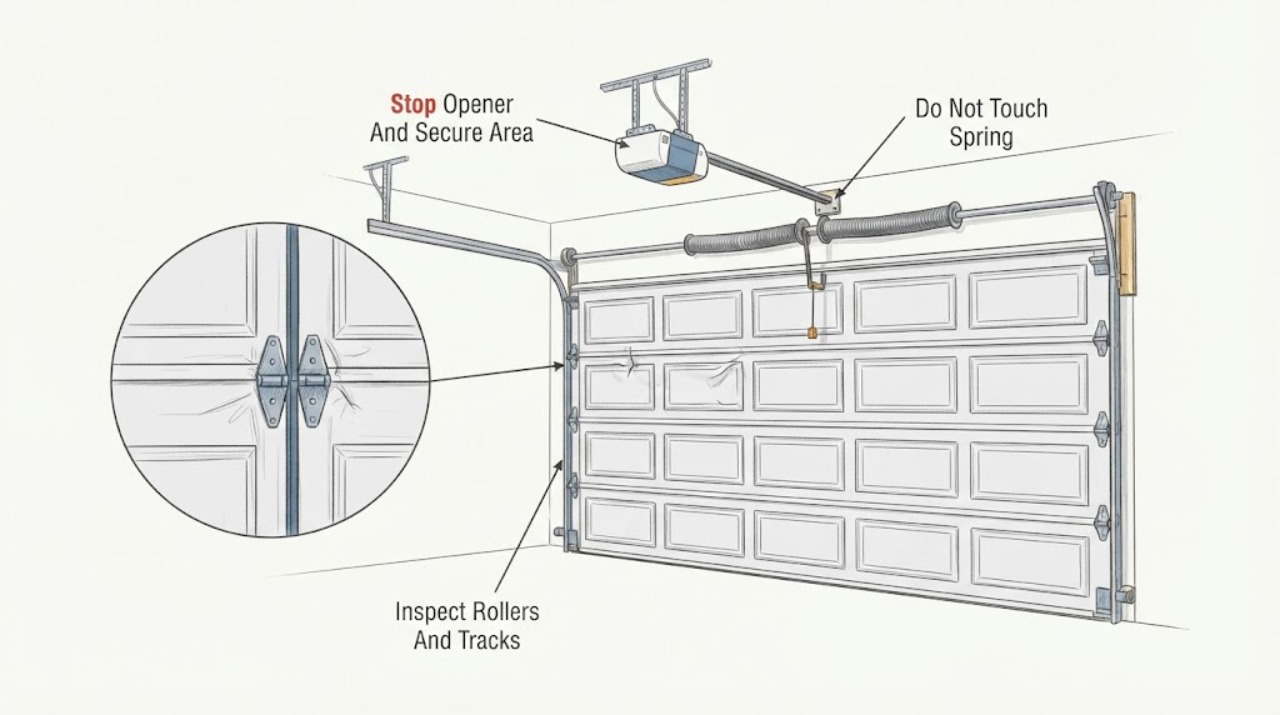
Work through in order
Diagnostic checks
Use only checks that match the exact appliance or system and its official guide.
-
Check 1
Stop using the opener, keep the door in its current safe position, and clear the doorway and the space beneath the door; do not pull on the damaged panel or place fingers between sections.
Expected result: Record whether the door is fully closed, partly open, sagging, off the track, hanging unevenly, or still being driven by the opener.
Next step: Leave the opener unused and arrange trained garage-door service for any unstable, binding, displaced, or partly open door. If the door is closed and stable, continue only with visual observations from outside the moving path.
Stop if: Do not release a partly open door, pull it down by a damaged panel, or stand beneath a door that is sagging or unsupported.
Why this matters
Why: A door that is unstable, off-track, or unable to hold position has a structural or counterbalance concern rather than a cosmetic dent alone. Continued cycles can enlarge a hinge or section failure and can move a roller, cable, or spring unexpectedly.
-
Check 2
With the door closed and stable, inspect both faces, section joints, hinge attachments, and panel edges without removing hardware; photograph the damage relative to the top, middle, or bottom section.
Expected result: Classify the issue as a shallow surface dent, deep crease, split or crack, bowed section, pulled screw, bent or cracked hinge, separated joint, broken glass, or exposed sharp edge.
Next step: Treat damage at a hinge, stile, joint, edge, or glass area as a no-use condition until a technician assesses the section and its attachments. Do not straighten metal or drive new fasteners into a damaged panel.
Stop if: Stop for a section crack, sharp exposed material, broken glass, a hinge leaf pulling away, or any panel movement while the door is still.
Why this matters
Why: A center surface dent may be cosmetic, while a crease at an edge or seam can affect movement and sealing. A cracked section, pulled hardware, damaged hinge, separated joint, broken glass, or sharp edge is a structural or handling hazard.
-
Check 3
From outside the track and without touching the door, look along both vertical tracks and the horizontal track area, including the damaged section's rollers, for alignment, loose hardware, debris, or a roller that is no longer seated.
Expected result: Record a straight clear track, a bent or loose track, a roller outside the track, rubbing at one side, a gap between sections, or a door that sits lower on one side.
Next step: Keep the opener off and call a trained technician when a roller is displaced, the track is bent or loose, the door rubs, or the sections are no longer level. Remove only loose debris clearly away from the door; do not realign anything.
Stop if: Do not hammer the track, pull a roller into place, loosen track brackets, or operate the door to see whether it clears the damage.
Why this matters
Why: A bent or loose track, displaced roller, rubbing edge, or uneven door suggests the impact affected the moving system beyond the visible panel. Clopay advises inspecting hinges, rollers, and tracks for loose, bent, or damaged parts; DASMA says a struggling door can indicate an unsafe balance condition.
-
Check 4
From a safe distance, visually inspect springs, lift cables, bottom brackets, and visible reinforcement for a break, gap, fraying, rust, displacement, or unequal loading; do not touch or adjust these parts.
Expected result: Record intact-looking components, a separated spring, frayed or slack cable, damaged bottom bracket, bent strut, or one side of the door carrying a visibly different load.
Next step: Keep the area clear and request trained service for any abnormal spring, cable, bottom-bracket, or reinforcement observation. Tell the technician whether the damage followed an impact, storm, or opener event.
Stop if: Never loosen bottom brackets, spring hardware, cable connections, or supports, and do not lift a damaged door by hand.
Why this matters
Why: Spring, cable, bottom-bracket, or reinforcement damage can turn a panel issue into a counterbalance hazard. These parts may remain loaded when the door is closed, so a normal-looking panel does not make adjustment safe.
-
Check 5
Only when the door is fully closed, visually stable, and free of sharp edges, displaced rollers, cable or spring damage, and section separation, use the manual disconnect and suitable handles for a small movement check; never grip the damaged edge or place fingers between sections.
Expected result: Record smooth movement, binding, scraping, twisting, unusual effort, one side rising first, or a door that will not remain balanced when stopped.
Next step: Stop at the first resistance or uneven motion and arrange service. If the door passes a gentle observation, do not resume automatic use when the damage is more than cosmetic until the hinge or section has been assessed.
Stop if: Do not force movement, hold the door against resistance, test balance on a damaged or partly open door, or continue if it shifts unexpectedly.
Why this matters
Why: Smooth movement with a flat panel supports a cosmetic issue but does not prove a hinge is sound. Binding, scraping, twisting, imbalance, or excessive effort points to panel, hinge, roller, track, or counterbalance trouble.
-
Check 6
After a trained technician has corrected the panel or hinge issue and confirmed alignment, test the opener's photo-eye and reversal functions only as described by the opener manual, with no person under the door.
Expected result: Record smooth travel, reversal during the approved obstruction test, and refusal to close when the photo-eye path is interrupted; note any renewed rubbing, noise, or panel shift.
Next step: Leave the opener out of service and contact the technician again for failed reversal, sensor response, noise, binding, or renewed section movement. Keep the door in sight during any supervised closing test.
Stop if: Do not defeat sensors, change force settings, hold the door down, or repeat tests if the door behaves unpredictably.
Why this matters
Why: A failed safety response or renewed rubbing means the door is not ready for normal use even if the replacement section looks good. A passed test confirms only the observed safety functions, not every hinge or counterbalance component.
Use your observations
Decision map
Find the observation that best matches what you see, then follow the next safe action.
-
PATH 01Safety boundary
What you see
The damage is a shallow center dent or finish mark; the panel remains flat, hinges and fasteners are secure, tracks and rollers are aligned, and the closed door has no sharp edge or movement change.
Do this next
Photograph and monitor the area during routine visual care. Ask a Clopay dealer or trained technician about finish or panel assessment if rust starts, the dent grows, or operation changes; do not attempt to pop or fill the dent while the section is installed.
Why this path and its safety boundary
Why it matters: A cosmetic panel issue is more likely than an immediate alignment or counterbalance failure, although the material and exact panel construction still affect repairability.
Safety stop: Stop use if the panel bows, rubs, separates, exposes sharp material, or changes the door's balance.
-
PATH 02Safety boundary
What you see
A hinge is bent or cracked, a fastener has pulled from the panel, a section is split or bowed, a joint is separated, or the damage sits at an edge or hinge attachment.
Do this next
Keep automatic operation off and arrange a trained inspection of the section, hinge, rollers, track, reinforcement, and counterbalance before movement. Provide close photos, panel position, and model information if safely available.
Why this path and its safety boundary
Why it matters: The panel and hinge are no longer only a finish concern; section alignment and load transfer may be compromised, and cycling can enlarge damage or displace a roller.
Safety stop: Do not straighten the hinge, tighten or replace its screws, brace the panel, or lift the door to test it.
-
PATH 03Safety boundary
What you see
The damaged side sits lower, a roller is outside the track, a track is bent or loose, the door scrapes or twists, or the door binds and cannot hold a position.
Do this next
Do not operate or manually lift the door. Keep the opening clear and request trained service to secure and realign the complete system.
Why this path and its safety boundary
Why it matters: Impact damage likely affected more than the panel face, such as a roller, track, hinge, cable, or balance system. The door may move or fall unexpectedly.
Safety stop: Do not hammer the track, pull a cable, reposition a roller, loosen brackets, or stand beneath a partly open door.
-
PATH 04Safety boundary
What you see
A spring is broken or separated, a cable is frayed or slack, a bottom bracket is damaged, or reinforcement is bent after the panel impact.
Do this next
Leave the door in a safe closed position if it is already closed, isolate the area, and arrange trained service. Tell the technician which tensioned component looked abnormal; do not attempt a temporary adjustment.
Why this path and its safety boundary
Why it matters: The counterbalance load may no longer be controlled. Replacing a panel or hinge without correcting this system can create sudden drop or uncontrolled movement.
Safety stop: Do not touch springs, cables, bottom brackets, or supports, and do not reconnect the opener.
-
PATH 05Safety boundary
What you see
The damaged panel has broken glass, exposed insulation or sharp metal, a failed weather seal, or an opening that admits water or wind.
Do this next
Keep people and pets away, do not handle fragments bare-handed, keep the opener off, and arrange a qualified door or glazing assessment. Protect the opening only with a safe temporary measure that does not load the door.
Why this path and its safety boundary
Why it matters: There is a cut, falling-fragment, weather, or material-exposure hazard in addition to the mechanical risk. A section or glazing repair must preserve the door's geometry and seal.
Safety stop: Do not tape, drill, pry, or remove glass retainers or panel hardware while the section is installed and under load.
Helpful context
Understand the symptom
A damaged panel can change the way the whole door moves
A sectional garage door folds at its panel joints. Hinges connect the sections, rollers guide them in the tracks, and springs and cables counterbalance the door's weight. A dent in the broad center of one panel may leave those relationships unchanged, while a crease at an edge or hinge attachment can make a section twist, rub, or pull hardware out of line. Check the damage and the movement symptoms together.
Use the damage location to set the service boundary
Clopay notes that dents near the center are often easier to assess than damage near edges or seams, where opening, closing, and sealing can be affected. A cracked or bowed section, pulled hinge attachment, broken glass, or displaced roller is a system problem. A surface scratch or shallow dent with normal alignment may be cosmetic, but exposed steel can corrode and a sharp edge can injure someone.
Panel replacement is not a simple hinge swap
A single replacement section may be possible when the rest of the door is sound, but the exact model, section size, position, material, color, window layout, hinge position, and hardware must match. Clopay says panel removal involves heavy sections and spring tension and recommends professional handling. DASMA adds that tracks and sections work as a system and that counterbalance parts must not be adjusted by a homeowner.
Safety boundary
Stop conditions
- Keep the opener off for a door that is off-track, sagging, unstable, binding, separated at a section joint, or damaged around a hinge, roller, cable, spring, bottom bracket, or reinforcement.
- Do not loosen or adjust springs, cables, bottom brackets, supports, hinges, rollers, or track hardware. These repairs and adjustments require a trained door-systems technician.
- Stop for broken glass, exposed sharp metal, exposed insulation, a falling or partly open door, a failed safety sensor or reversal response, or an impact that changed door balance.
- Never place fingers between sections, stand below an unsupported door, force a panel through resistance, bypass opener safety devices, or run repeated cycles to see whether damage worsens.
Only after diagnosis
Potential parts
- Clopay replacement door section or panel
Consider a section or panel only when inspection confirms structural damage, a split, deep crease, failed attachment, or damage that cannot safely be treated as a finish issue.
Confirm the exact Clopay model, section position, size, profile, material, insulation, window layout, color or finish, and hardware arrangement before selecting a section. - Clopay garage door hinge
Consider a hinge only when a trained inspection confirms that the hinge is bent, cracked, worn, or damaged and that the section attachment remains suitable.
Match the hinge position, section profile, roller arrangement, fastener pattern, and exact door model; do not infer a hinge from appearance or panel location alone. - garage door roller or track component
Consider this category only when service confirms a displaced or damaged roller, bent track, or failed track hardware linked to the impact or panel shift.
Confirm the track configuration, roller stem and bearing arrangement, section thickness, mounting hardware, and door model; tracks and sections function as a matched system. - garage door spring, cable, bottom bracket, or reinforcement
Consider this category only after a trained technician confirms counterbalance or reinforcement damage and specifies the component for the measured door weight and configuration.
Do not select or install tensioned components from a symptom. Confirm door weight, dimensions, spring or cable arrangement, bracket, reinforcement, and current manufacturer instructions through trained service.
When checks do not resolve it
Need a professional?
Arrange trained Clopay garage-door service before moving the door when a panel is cracked, bowed, separated, damaged at a hinge or edge, has pulled hardware, broken glass, exposed sharp material, or has changed alignment or balance. Call promptly for a displaced roller, bent track, frayed cable, broken spring, damaged bottom bracket, or failed opener safety test. A shallow center finish mark can be monitored only while the panel, hinges, tracks, and door movement remain normal; ask a Clopay dealer or trained technician to confirm any doubt.
Safety scope: This article supports stopping the opener, keeping the area clear, photographing damage, and making cautious visual checks with the door closed and stable. A trained technician must handle panel or hinge removal, track and roller alignment, springs, cables, bottom brackets, reinforcement, balance, opener adjustment, glazing, and final safety testing.
Common questions
FAQ
Can I still use my Clopay garage door with a dented panel?
Only a shallow, surface-only mark with a flat panel, intact hinge attachments, aligned tracks and rollers, no sharp edge, and unchanged movement may be cosmetic. Do not use the door when the dent is at a hinge or edge, the panel bows or separates, the door rubs or sags, or any cable, spring, roller, or track is damaged.
Should I replace the damaged Clopay panel or the hinge?
Do not choose from appearance alone. A technician must determine whether the impact damaged the section, hinge attachment, roller, track, reinforcement, or counterbalance. The correct component depends on the exact Clopay model, section profile and position, hardware, and door weight.
Can I straighten a bent garage-door hinge myself?
Do not straighten or loosen a hinge on an installed sectional door. The hinge transfers movement between sections and may be attached near loaded hardware. Keep the opener off and have a trained door-systems technician inspect the hinge, panel, roller, track, and balance system.
What if the damaged Clopay door is off its track?
Do not operate or lift it. Keep people and vehicles clear, avoid cables and springs, and arrange trained service. An off-track or uneven door can involve a roller, track, hinge, cable, spring, or bottom bracket rather than only the visible panel.
What information helps with a Clopay panel-damage repair?
Provide the door model if safely available, the damaged section and hinge location, photos with the door closed, impact or storm timing, whether the opener was running, and any change in level, balance, rubbing, scraping, noise, or sensor response. Mention broken glass, sharp edges, exposed insulation, cable or spring damage, and track changes.
Read the exact guide
Official sources
- Garage Door Safety ChecklistClopay · Official Clopay residential safety checklist; use the installed door and opener manuals for model-specific procedures.
- Essential Tips for Preparing Your Garage Door for FallClopay · Official Clopay maintenance article; general care guidance does not replace the installed door manual.
- DASMA Releases Updated Checklist for InspectionsDoor & Access Systems Manufacturers Association International · Official DASMA technical guidance describing a consumer inspection checklist and its limits.
- Should I Repair or Replace a Dented Garage Door?Clopay · Official Clopay article; current availability and repair choices vary by exact door model and section.
- Can I Replace My Garage Door Panels?Clopay · Official Clopay panel guidance; it describes general considerations and is not a model-specific installation instruction.
- Safety Tips For Garage Door SystemsDoor & Access Systems Manufacturers Association International · Official DASMA safety guidance; it is general industry information and does not replace the Clopay model manual.
- Automatic Garage Door Opener Safety & Maintenance GuideDoor & Access Systems Manufacturers Association International · Industry safety guide for automatic garage doors and openers; the installed door and opener manuals remain model-specific.
Community feedback
Share a repair observation
Share a plain-text repair observation. Accepted observations are published automatically; this page may take a moment to update.