
On this page
Start here
Quick answer
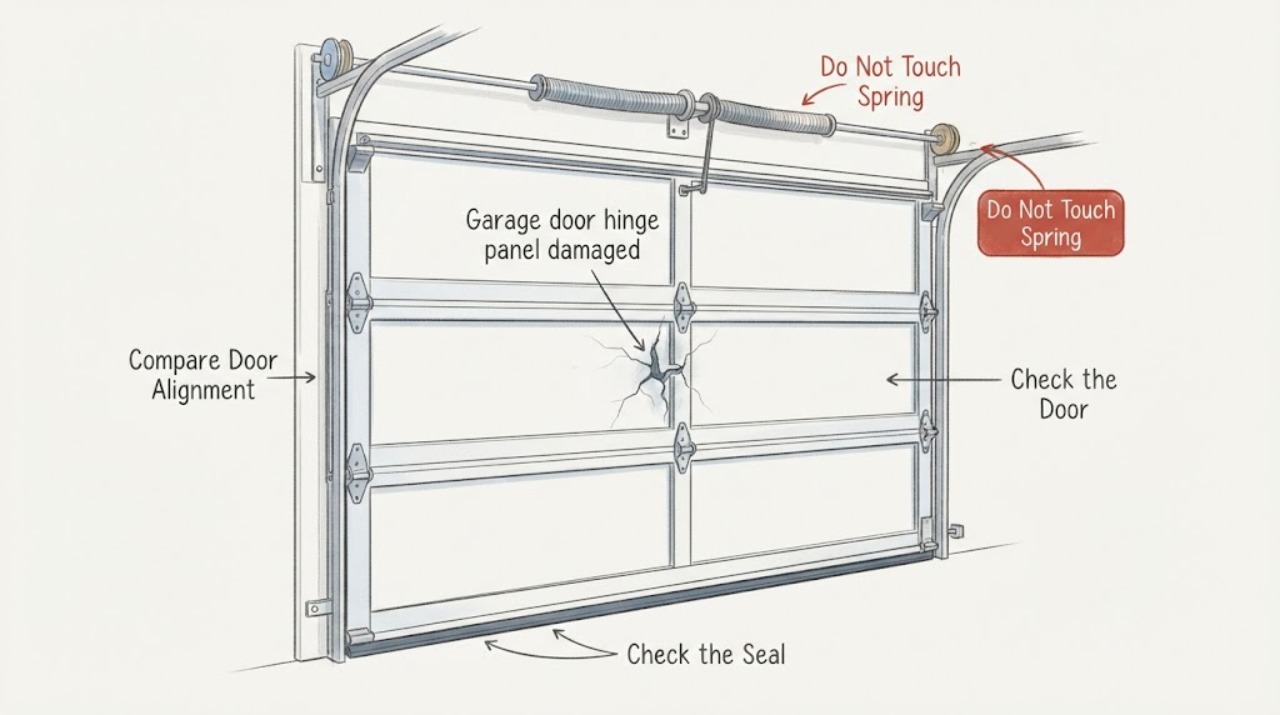
A damaged garage-door panel or hinge can change the load and alignment of the entire moving door. Do not run the opener, force a binding door, touch springs or cables, loosen hinge fasteners, or try to straighten a panel. From the floor and from a safe distance, document the panel and hinge damage, observe whether the door is level and whether any panel edge rubs the track, and note whether the door is stuck or moves unevenly. If it binds, sags, leaves the track, has damaged glass, or shows cable, spring, roller, or track damage, keep everyone clear and call a trained garage-door technician.
Work through in order
Diagnostic checks
Use only checks that match the exact appliance or system and its official guide.
-
Check 1
With the door stopped and the opener controls untouched, visually inspect the damaged panel and hinge from the garage floor or another safe position.
Expected result: Record dents, bends, cracks, separated seams, a hinge pulled away from the panel, missing or loose-looking hardware, sharp edges, damaged windows, and the door's current position.
Next step: Photograph the damage without touching it and arrange a trained garage-door technician to assess the complete system.
Stop if: Stop immediately for loose or falling material, cracked or shattered glass, exposed sharp edges, or any need to touch, straighten, loosen, or remove hardware.
Why this matters
Why: Damage at a hinge or panel seam can affect how sections articulate and transfer load. Visible damage does not identify whether the hinge, panel, roller, track, or lifting system is safe to service without professional handling.
-
Check 2
From the floor, compare the closed door's visible panel edges and bottom seal with the opening without opening, lifting, or forcing the door.
Expected result: Note whether the door appears level, one section is bowed or shifted, a corner is raised, the bottom seal has an unusual gap, or the damaged hinge side sits differently from the other side.
Next step: Keep the door in its current position, restrict access, and send the photos and observations to the technician.
Stop if: Do not open or close the door if it is not level, if a panel is separated, or if the damaged side appears unsupported.
Why this matters
Why: A changed level or shifted section suggests an alignment or support problem beyond cosmetic panel damage. It is not a safe basis for adjusting hinges, rollers, springs, or cables.
-
Check 3
Look along the accessible track and panel edges from a safe distance without reaching into the track, moving the door, or removing anything.
Expected result: Record visible rubbing, a bent track, a roller outside its track, a gap at a hinge, loose trim, an obstruction, or a panel edge that catches or changes position.
Next step: Leave the opener and door unused and request a complete door-system inspection.
Stop if: Do not reach into the track, push a roller back, remove track hardware, or force the panel past a rubbing point.
Why this matters
Why: Rubbing, a displaced roller, or a bent track can make the door unsafe and can amplify hinge or panel damage. A clear-looking track does not rule out hidden damage.
-
Check 4
Observe the opener, cables, springs, and supports only from the floor and without operating the door or touching any component.
Expected result: Note a slack or displaced cable, a separated spring, a loose-looking support, unusual tension, a hanging panel, a recent impact, or damage near the opener attachment.
Next step: Keep the door and opener out of service, clear the area, and contact a trained door-system technician.
Stop if: Do not pull cables, adjust springs, loosen supports, remove hinge fasteners, disconnect the opener, or perform a test cycle.
Why this matters
Why: Any cable, spring, support, or attachment concern can involve stored energy and changes the incident from panel assessment to urgent professional service. A homeowner should not adjust these parts.
-
Check 5
Assess the garage-door area for people, vehicles, and access hazards without entering the door's travel path or trying to stabilize it.
Expected result: Record whether the door blocks an exit, cannot secure the garage, has a trip hazard, is leaning, is partially open, or could fall or move unexpectedly; keep children and pets away.
Next step: Use a separate safe route if available, keep the garage isolated, and tell the technician whether access or security is affected.
Stop if: Stop all door activity and leave the area if the door shifts, falls, makes a loud pop or grinding sound, or presents an unavoidable entrapment or falling-object risk.
Why this matters
Why: An unstable or unsecured door is an immediate safety and security issue even if the visible panel damage seems small. Continued operation can worsen hidden damage.
Use your observations
Decision map
Find the observation that best matches what you see, then follow the next safe action.
-
PATH 01Safety boundary
What you see
The panel or hinge is visibly damaged, but the door is closed, stable, and not obstructing a safe route.
Do this next
Keep the opener unused, document the damage, and arrange a trained garage-door technician to assess panel, hinge, roller, track, and lifting-system condition.
Why this path and its safety boundary
Safety stop: Do not operate the door or tighten, loosen, straighten, or replace hinge hardware.
-
PATH 02Safety boundary
What you see
The door binds, moves unevenly, is off the track, sags, shifts, or cannot remain safely positioned.
Do this next
Keep everyone clear and request urgent professional service; tell the technician that the door is binding or unstable.
Why this path and its safety boundary
Safety stop: Do not move the damaged door, run the opener, lift a section, push it back onto the track, or try a balance test.
-
PATH 03Safety boundary
What you see
A cable, spring, roller, track, support, or opener attachment appears damaged or displaced.
Do this next
Isolate the garage and call a trained door-system technician for controlled assessment.
Why this path and its safety boundary
Safety stop: Do not touch or adjust springs, cables, drums, supports, tracks, rollers, or hinge fasteners.
-
PATH 04Safety boundary
What you see
Glass is cracked or shattered, sharp material is exposed, or the door threatens an exit, vehicle, person, or pet.
Do this next
Keep people and pets away, use another safe route, and request urgent professional repair or emergency assistance as appropriate.
Why this path and its safety boundary
Safety stop: Do not handle fragments, stabilize the panel, open or close the door, or enter beneath it.
-
PATH 05Safety boundary
What you see
Only cosmetic damage is visible and no safe movement test is possible without operating the door.
Do this next
Do not create a test cycle; send photos and the door's current state to the technician for a complete assessment.
Why this path and its safety boundary
Safety stop: Do not treat cosmetic appearance as proof that hidden hinge, panel, track, or lifting components are safe.
Helpful context
Understand the symptom
Panel damage can affect more than the visible hinge
Sectional garage doors move as a connected system. A damaged panel or hinge can alter alignment and place unusual load on rollers, tracks, cables, springs, and the opener. The Door and Access Systems Manufacturers Association warns that a garage door is a large moving object and that springs, cables, supports, and related components require trained service. A visible dent is not enough to decide that the door is safe to operate.
Observe without putting the door under load
Use photos from the floor and preserve the door's current position. If the door is binding or unstable, do not move it for a better view. A technician can inspect the complete system and determine whether the panel, hinge, roller, track, or another component needs repair or replacement.
Only after diagnosis
Potential parts
- garage door panel hardware
Consider this category only if a trained technician identifies a compatible panel-hardware repair after assessing the damaged section and the full door system.
Match the door series, panel construction, hinge position, and manufacturer specifications; do not order by appearance or install it while the door is damaged. - garage door hinge
Consider this only if the technician confirms that the hinge is the failed component and that the panel and adjacent hardware are sound.
Confirm hinge number, location, panel system, fastener requirements, and professional handling; do not loosen or replace a loaded hinge yourself. - garage door strut
Consider this only if a qualified door technician determines that a support strut is specified for the damaged panel and is appropriate for the door's design.
Match panel width, door construction, load design, and manufacturer guidance; support selection or installation must not be improvised on a moving door.
When checks do not resolve it
Need a professional?
Call a trained garage-door technician for any damaged hinge or panel, especially when the door binds, sags, is off the track, cannot be secured, or shows cable, spring, roller, track, support, or glass damage. Treat an unstable or falling door as urgent.
Have this ready
- Provide floor-level photos, the door's current position, panel and hinge damage, level or gap observations, rubbing or track clues, cable/spring/roller/support observations, impact history, and any access or security problem. Do not move the door to collect more information.
Common questions
FAQ
Can I run the opener once to see how bad the panel damage is?
No. A damaged or binding door can worsen hidden hinge, roller, track, cable, spring, or opener damage. Keep it stopped and have a trained technician assess it.
Can I tighten the damaged hinge screws?
Do not loosen or tighten hinge, panel, support, spring, cable, or track hardware. The door may be under load, and the visible fastener may not be the cause of the damage.
Is a dented panel only cosmetic?
Not necessarily. A dent can change panel alignment and affect hinges, rollers, tracks, and the lifting system. Document it from the floor and arrange a complete door-system inspection.
What should I do if the door is off its track or sagging?
Keep everyone away, do not operate or lift the door, and request urgent trained garage-door service. Do not touch cables, springs, rollers, tracks, or supports.
Read the exact guide
Official sources
- Automatic Residential Garage Door OperatorsU.S. Consumer Product Safety Commission · Supporting caution around operation of a damaged door and opener
- Automatic Garage Door Opener Safety & Maintenance GuideDoor and Access Systems Manufacturers Association · Setting a stop point when panel or hinge damage changes door operation or involves stored-energy components
Community feedback
Share a repair observation
Share a plain-text repair observation. Accepted observations are published automatically; this page may take a moment to update.