
On this page
Start here
Quick answer
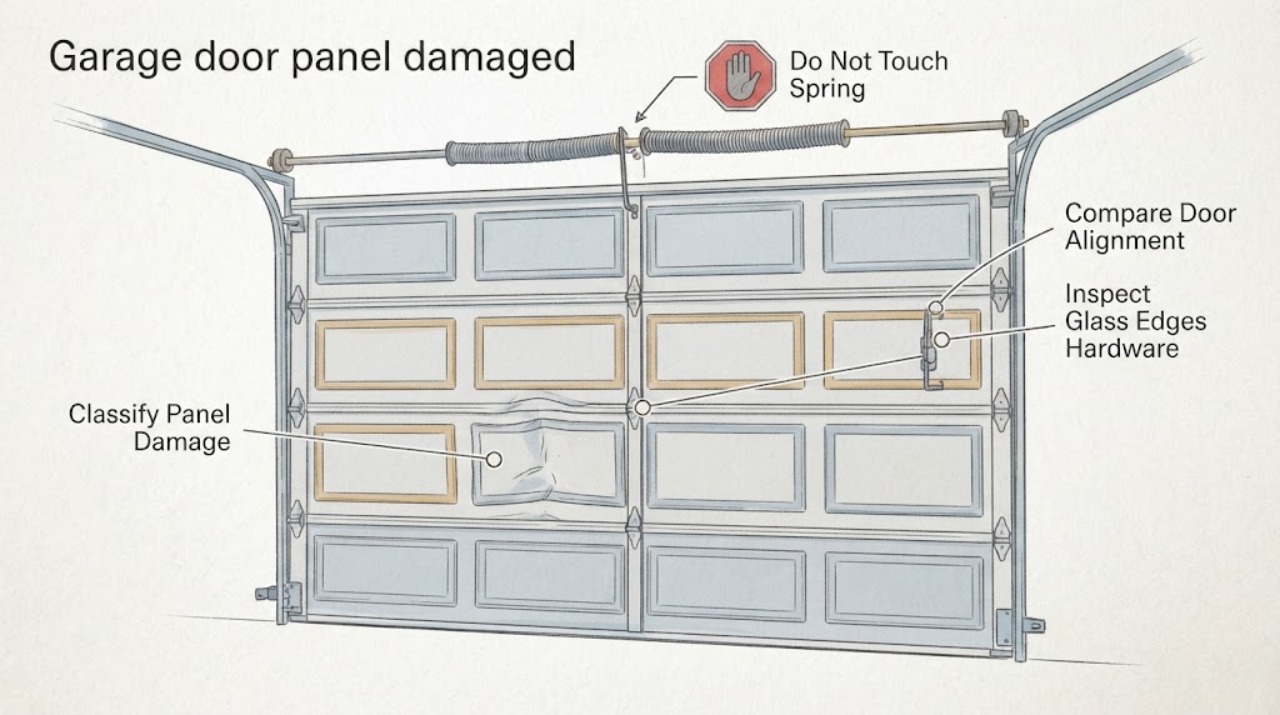
A damaged Amarr garage door panel is not automatically a whole-door replacement. First leave the door stationary and use safe, exterior observations to classify a cosmetic dent, a crack or bend, a shifted section, damaged glass or edge, or a hinge, roller, track, spring, or cable concern. Amarr's official construction and collection information shows why the exact series and material matter: steel collections use different panel constructions and designs, while Horizon and Vista are aluminum collections. Do not run a door that is unstable or binding, adjust the door, or remove a panel.
Work through in order
Diagnostic checks
Use only checks that match the exact appliance or system and its official guide.
-
Check 1
From the floor with the door stationary, photograph the affected Amarr panel and classify what is actually visible: a shallow dent, a crease or crack, a bend, an opened seam, or an edge that no longer sits in its normal plane.
Expected result: A shallow mark with intact paint, edges, and section joints is different from a sharp crease, torn skin, separated edge, or visibly distorted panel.
Next step: Keep the door at rest and give the photos and description to an Amarr dealer or qualified garage-door technician for a repair-versus-section assessment.
Stop if: Stop observing and keep clear if the panel is falling, sharply protruding, moving on its own, or the door is leaning or binding.
Why this matters
Why: This separates likely cosmetic damage from panel or section damage that can affect stiffness and safe movement; do not press the panel to test it.
-
Check 2
Without operating the door, look along the horizontal joints between sections and the vertical side gaps from a safe position; compare the damaged area with the same joint and gap on the other side.
Expected result: A joint that remains even and a panel that stays in line suggest localized visible damage, while a stepped joint, bowed section, uneven side gap, or displaced roller path suggests section or hardware misalignment.
Next step: Photograph the joint and side-gap pattern and arrange professional diagnosis; do not loosen hardware or try to square the sections.
Stop if: Stop if any section, roller, hinge, or track appears loose, out of its path, or unsupported.
Why this matters
Why: Alignment changes the service boundary: a dent may be a panel assessment, but a shifted section can load hinges, rollers, and tracks and should not be exercised.
-
Check 3
From a clear position, inspect only visible window glass, window frames, panel edges, hinges, roller brackets, and struts for cracks, loose pieces, bends, or sharp projections; do not touch damaged glass or hardware.
Expected result: Broken or cloudy glass, a pulled-out frame, a torn panel edge, or a bent hinge or bracket is a different risk from an intact window and intact edge around a cosmetic dent.
Next step: Keep the opening clear and tell the technician exactly which window, edge, hinge, bracket, roller, or strut is affected; use only the qualified provider's safe isolation plan.
Stop if: Stop immediately for shattered glass, sharp metal, a hanging hinge or bracket, a loose roller, or any part that could fall.
Why this matters
Why: Glass, edge, and hardware damage can create falling or cutting hazards and may require a section-specific repair even when the panel face looks repairable.
-
Check 4
Read an accessible Amarr label, invoice, warranty record, or prior service record without opening covers or removing the door; note the collection or model, steel or aluminum construction, panel design, window layout, and approximate door size.
Expected result: The record may identify a steel collection such as Heritage or Lincoln, a carriage-house design, or an aluminum Horizon or Vista door; an absent or conflicting record leaves compatibility unknown.
Next step: Send the label or record and clear photos to an Amarr dealer or qualified technician and ask them to verify the exact section and hardware compatibility.
Stop if: Stop searching if identification would require climbing, removing trim, opening the opener, or reaching into the door assembly.
Why this matters
Why: Amarr collections use different construction, panel designs, window options, and section details, so identity is needed before a replacement panel, section, hinge, or strut can be matched.
-
Check 5
From the floor, make a yes-or-no safety check for a visibly displaced spring or cable, a bent or derailed track, a loose roller or hinge, a sagging section, a broken glass panel, or a door that is leaning or binding.
Expected result: If none is visible and the door is stable at rest, the next decision can stay focused on panel or section compatibility; if any is present, the damaged-panel report includes a mechanical or falling hazard.
Next step: For a no-hazard result, keep the door stationary and arrange a normal qualified assessment. For a yes result, isolate the area and request prompt garage-door service without operating the door.
Stop if: Do not cycle, lift, lower, balance, adjust, disconnect, or bypass any safety feature when the answer is yes.
Why this matters
Why: A mechanical hazard cannot be safely separated from the panel by repeated operation or adjustment.
-
Check 6
Decide whether the damage is limited to appearance with intact edges, joints, glass, and hardware, or whether the panel, section, or surrounding mechanism is compromised; base the decision on the stationary observations only.
Expected result: A contained dent may support a localized repair assessment, while a crack, bend, edge separation, shifted section, damaged window, unknown collection, or mechanical warning requires a broader professional scope.
Next step: Provide photos, the Amarr identity record, door material and collection if known, event history, and the no-operation boundary to the service provider.
Stop if: Stop the DIY path if diagnosis would require running the door, adjustment, panel removal, spring or cable handling, track work, or glass handling.
Why this matters
Why: This prevents a generic panel purchase from hiding a section, hardware, or safety problem and gives the technician a specific starting point.
Use your observations
Decision map
Find the observation that best matches what you see, then follow the next safe action.
-
PATH 01Next step
What you see
The mark is a shallow dent with intact panel edges, section joints, windows, and visible hardware, and the stationary door is stable.
Do this next
Request a qualified Amarr-compatible cosmetic or panel repair assessment; do not assume paint, filler, or a generic panel will restore the door.
-
PATH 02Next step
What you see
The panel has a crack, sharp crease, bent edge, torn skin, separated seam, or a section joint that no longer lines up.
Do this next
Keep the door stationary and the area clear while a qualified technician determines whether the section or related hardware must be repaired or replaced.
-
PATH 03Next step
What you see
Glass is cracked or broken, the window frame is pulled out, or a panel edge creates a sharp or falling-piece hazard.
Do this next
Keep people away and request qualified glass or garage-door service; do not handle fragments or operate the door.
-
PATH 04Next step
What you see
A spring or cable is displaced, a track is bent or derailed, hardware is hanging, or the door is leaning, sagging, unstable, or binding.
Do this next
Do not run, lift, lower, balance, adjust, or dismantle the door. Isolate the opening and request prompt trained garage-door service.
-
PATH 05Next step
What you see
The Amarr collection, model, material, dimensions, window layout, or prior replacement history cannot be verified from safe records.
Do this next
Have an Amarr dealer or qualified technician verify the exact panel or section and hardware compatibility before any part is ordered.
Helpful context
Understand the symptom
What the damage may mean
A shallow dent in one steel panel with intact edges, windows, joints, and hardware may be a localized appearance or panel assessment. A crease, crack, bent edge, separated section joint, broken window frame, or shifted section can change how the door carries its weight. If a hinge, roller, track, spring, or cable looks displaced, treat the door as a mechanical safety issue rather than a cosmetic repair.
Why the Amarr series matters
Amarr's official construction page lists steel collections such as Heritage, Lincoln, Classica, Hillcrest, Olympus, and Carriage Court, and identifies Horizon and Vista as aluminum collections. The official styles page also distinguishes short and long panel designs and window options. Those differences mean a replacement section or panel must be matched to the installed collection, material, dimensions, window layout, finish, and hardware—not selected from a photo alone.
Keep the door stationary
Make observations from the floor or another stable, clear position while the door is at rest. Keep people and vehicles clear of a leaning, loose, cracked, or binding door. Do not cycle an unstable door, adjust springs, cables, tracks, hinges, or opener force, remove a section, handle broken glass, or climb a ladder. A trained garage-door professional can determine whether a panel, complete section, hardware set, or whole-door assessment is appropriate.
Safety boundary
Stop conditions
- Do not run, lift, lower, balance, or repeatedly cycle a garage door that is leaning, sagging, cracked, shifted, unstable, or binding.
- Do not adjust or disconnect springs, cables, tracks, rollers, hinges, struts, opener force, or safety devices.
- Do not remove a panel or section, handle broken glass, pry bent edges, or work from a ladder or roof.
- Keep people, pets, vehicles, and stored items clear; stop and seek prompt qualified service for falling material, sharp edges, displaced hardware, or a mechanical hazard.
- If identification requires covers, disassembly, or unsafe access, stop and have an Amarr dealer or qualified technician verify the match.
Only after diagnosis
Potential parts
- garage door panel hardware
Panel damage may involve a complete section or supporting hardware, and a generic item may be unsafe or incompatible.
Conditional only after an Amarr dealer or qualified technician confirms the installed collection, section, material, dimensions, window layout, and hardware. - garage door hinge
A bent hinge may be a symptom of shifted sections or a loaded mechanism; do not replace it without diagnosis.
Match the exact door collection, section construction, hinge location, and manufacturer guidance. - garage door strut
A strut changes door loading and is not a substitute for correcting a damaged section, track, spring, or cable.
Use only when a qualified provider confirms the need, placement, dimensions, and compatibility.
When checks do not resolve it
Need a professional?
Arrange qualified garage-door service when the cause, Amarr compatibility, or safe operating status is uncertain. Request prompt service for a crack, bent section, displaced hardware, broken glass, spring or cable concern, derailed track, leaning door, or binding movement; do not operate the door while waiting.
Common questions
FAQ
Can a dented Amarr garage door panel be repaired instead of replaced?
Sometimes, but the decision depends on the panel construction, depth and shape of the damage, edge and joint alignment, finish, and the condition of the hardware. A qualified provider should assess it with the door stationary.
How do I know whether the damage is cosmetic or structural?
A shallow dent with intact edges, seams, windows, and alignment is more likely to be localized appearance damage. A crack, crease, bent edge, separated skin, shifted joint, or distorted section needs professional panel or section assessment.
Does my Amarr collection affect replacement-panel fit?
Yes. Amarr lists different steel collections and identifies Horizon and Vista as aluminum collections; panel designs, construction, window layout, dimensions, and hardware can differ. Use the accessible label or service record and have the exact match verified.
Can I run the garage door to see whether the damaged panel still works?
No if the door is unstable, leaning, binding, has a shifted section, damaged glass, or any spring, cable, track, roller, or hinge concern. Keep it stationary and ask a trained technician to determine a safe test method.
Should I replace only the damaged panel from an online photo?
No. A photo does not establish the Amarr collection, material, section profile, window configuration, dimensions, finish, or hardware compatibility. Verify those details with Amarr documentation or a qualified dealer first.
What should I tell the garage-door technician?
Provide stationary photos, the location and type of damage, whether the edge or section joint moved, glass or hardware observations, the Amarr label or collection if available, when the damage appeared, and whether the door has remained unused.
Read the exact guide
Official sources
- Garage Door and Commercial Door Installation InstructionsAmarr · Supports directing a technician to the correct Amarr steel or aluminum instruction family instead of a generic panel procedure.
- Garage Door StylesAmarr · Supports recording short or long panel design, carriage-house sections, and window options before a compatibility decision.
- Garage Door Repair vs. Garage Door ReplacementAmarr · Supports professional assessment for dented sections and verification of compatibility before relying on existing hardware or track.
- Understanding Garage Door ConstructionAmarr · Supports the distinction between Amarr steel collections and the aluminum Horizon and Vista collections when assessing panel compatibility.
- Residential Garage Door FAQsAmarr · Supports using trained dealer service and avoiding user adjustment of springs or cables.
Community feedback
Share a repair observation
Share a plain-text repair observation. Accepted observations are published automatically; this page may take a moment to update.