
On this page
Start here
Quick answer
Do not run a C.H.I. garage door that is bent, cracked, separating, tilted, binding, has pulled hardware, broken glass, or an abnormal spring or cable. From floor level, record whether the damage is a shallow cosmetic dent or a crease, split, deformed edge, alignment problem, window or hardware failure, and capture the C.H.I. collection or model if it is visible on paperwork or a label. C.H.I. residential doors are not one interchangeable panel family: the official catalog distinguishes collections, panel styles, section construction, materials, insulation, and window configurations. Use that identity with a C.H.I. dealer or qualified garage-door technician before selecting a panel, hinge, or strut.
Before you begin
Safety first
- Do not run or manually force a door that binds, tilts, sags, separates, has broken glass, pulled hardware, or an abnormal spring, cable, or drum. Do not touch or adjust springs, cables, drums, tracks, hinges, brackets, or panels under load.
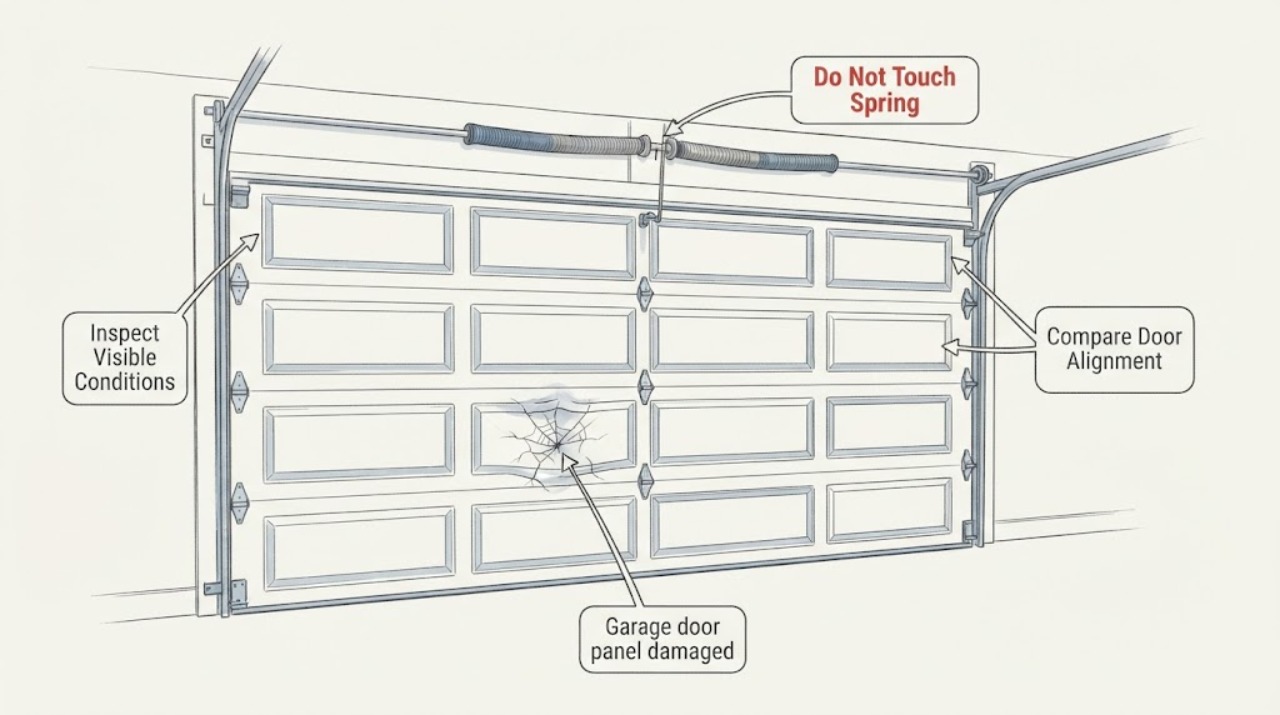
Work through in order
Diagnostic checks
Use only checks that match the exact appliance or system and its official guide.
-
Check 1
With the operator off, observe the door from the floor and note whether it is closed, partly open, tilted, sagging, visibly separated, or resting unevenly. Do not run it or try to lift it if it binds, leans, or has broken glass or pulled hardware.
Expected result: The door is either stable with panels seated and no obvious hazard, or it is unstable, obstructed, leaning, separated, or unsafe to approach.
Next step: If unstable, keep the area clear and arrange prompt garage-door service. If stable, continue with floor-level visual checks.
Stop if: Stop immediately for movement, a falling section, broken glass, a hanging cable, a displaced spring, or any need to reach into the mechanism.
Why this matters
Why: A stable door permits documentation only; an unstable door is an operation and injury hazard, not a panel-adjustment project.
-
Check 2
From outside and inside only where the floor is clear, compare the damaged panel with the adjacent section. Photograph a shallow dent, crease, fold, crack, split seam, deformed edge, loose skin, or panel separation without pressing on it.
Expected result: The mark is shallow with intact edges and seams, or the panel has a bend, crack, split, separated section, or damage around a window frame.
Next step: Save wide and close photos and describe the damage pattern to service; do not fill, straighten, drill, or brace the panel.
Stop if: Stop if sharp fragments, loose glass, a detached section, or material that could fall is present.
Why this matters
Why: An intact shallow dent may be cosmetic; a fold, crack, separated skin, or damaged frame is structural and needs a professional panel or section decision.
-
Check 3
Look at the panel edges and section seams from standing level, then note whether the damaged area is centered, at an end, beside a hinge, around a window, or at the bottom seal. Do not pry a seam or remove a window, hinge, roller, or bracket.
Expected result: The damage is isolated in the face, follows a seam or edge, surrounds a window, or coincides with a hinge or roller location.
Next step: Include the location and the matching adjacent-section condition in the service request; leave all attached hardware in place.
Stop if: Stop if inspecting the edge requires moving the door, climbing, removing a cover, or reaching near springs or cables.
Why this matters
Why: Location separates a cosmetic face dent from a section-edge, glass, or hardware problem that can affect alignment and load transfer.
-
Check 4
Without operating the door, compare the visible gaps between sections and the side tracks, and look for a roller out of its track, a hinge pulled away, a bowed section, or an uneven gap from one side to the other.
Expected result: Gaps remain even and hardware appears seated, or the panel is skewed and a roller, hinge, bracket, or track appears displaced.
Next step: Photograph the gap and hardware relationship and ask the technician to inspect alignment before ordering a panel.
Stop if: Stop if the door must be moved to see the hardware, or if any roller, hinge, bracket, track, or cable is loose or displaced.
Why this matters
Why: Even gaps support a panel-focused assessment; skew, rubbing, or pulled hardware points to alignment or hardware involvement rather than a panel-only repair.
-
Check 5
From a safe distance, visually check the exposed springs, cables, and drums for a clearly broken, loose, frayed, or displaced condition; do not touch, test, release tension, or adjust any counterbalance part.
Expected result: The counterbalance components look normal from the available view, or a spring is broken, a cable is loose or frayed, or a drum or attachment is displaced.
Next step: Keep the door in place and call a garage-door professional if anything looks abnormal; a normal-looking view does not authorize operation or adjustment.
Stop if: Stop at the first sign of a broken spring, loose or frayed cable, displaced drum, or inaccessible component.
Why this matters
Why: An abnormal counterbalance component can make the whole door unsafe and can explain a panel that bowed, dropped, or was pulled out of alignment.
-
Check 6
Use only safely available paperwork, an existing label, or a C.H.I. record to write down the collection or model, panel style, material, insulation, and window layout. Do not open the door or remove trim to find a label.
Expected result: C.H.I. identity is clear enough to match a collection and model, or it is missing, conflicting, or only an owner description such as “steel door.”
Next step: Give the identity notes and photos to a C.H.I. dealer or qualified technician; use C.H.I.'s model-based document finder or comparison information as a reference, not as permission to substitute a generic section.
Stop if: Stop if identification requires disassembly, elevated access, removing glass, or contact with energized or tensioned hardware.
Why this matters
Why: C.H.I. replacement compatibility depends on the specific collection and construction, not the brand name alone.
Use your observations
Decision map
Find the observation that best matches what you see, then follow the next safe action.
-
PATH 01Safety boundary
What you see
The door binds, tilts, sags, separates, has broken glass, pulled hardware, or an abnormal spring, cable, or drum.
Do this next
Keep the operator off, isolate the area, and call qualified garage-door service.
Why this path and its safety boundary
Why it matters: The door may be carrying load unevenly; repeated operation or manual forcing can worsen the failure.
Safety stop: Do not run, lift, brace, or attempt counterbalance work on the unstable door.
-
PATH 02Safety boundary
What you see
The damage is a shallow face dent with intact edges, seams, window frame, and attached hardware, and the door is visibly stable.
Do this next
Treat it as a possible cosmetic repair and document it for a C.H.I.-aware assessment.
Why this path and its safety boundary
Why it matters: A shallow dent does not by itself prove that a panel or the door structure is safe or repairable.
Safety stop: Stop if the dent is accompanied by rubbing, tilt, separation, glass damage, or new operating resistance.
-
PATH 03Safety boundary
What you see
A section is folded, bowed, cracked, split, has a deformed edge, or is separating from an adjacent section.
Do this next
Keep the door stationary and request a panel or section evaluation.
Why this path and its safety boundary
Why it matters: Structural panel damage can alter hinge and roller geometry; a cosmetic patch or generic panel is not a safe conclusion.
Safety stop: Do not straighten, drill, screw, or add a brace to a damaged section.
-
PATH 04Safety boundary
What you see
The panel sits skewed, gaps are uneven, or a roller, hinge, bracket, or track appears pulled, rubbing, or displaced.
Do this next
Request alignment and hardware diagnosis before treating the panel as the sole failed part.
Why this path and its safety boundary
Why it matters: An alignment or hardware problem can produce panel damage or prevent a replacement section from seating correctly.
Safety stop: Do not loosen hardware, move the track, remove a hinge, or force the door through the tight spot.
-
PATH 05Safety boundary
What you see
Glass is broken or the window frame is loose, cracked, or separated from the panel.
Do this next
Keep people clear, isolate loose fragments, and call a professional for the glass or panel decision.
Why this path and its safety boundary
Why it matters: Window construction and panel design are part of the C.H.I. configuration; glass damage is not a generic dent repair.
Safety stop: Do not operate the door, remove glazing, or reach through the window opening.
-
PATH 06Safety boundary
What you see
A spring, cable, drum, or attachment looks broken, loose, frayed, displaced, or cannot be safely viewed.
Do this next
Stop and use a garage-door professional for counterbalance and door assessment.
Why this path and its safety boundary
Why it matters: Counterbalance components store energy and can make a seemingly small panel issue dangerous.
Safety stop: Do not wind, unwind, disconnect, cut, replace, or test a spring or cable.
-
PATH 07Safety boundary
What you see
A C.H.I. collection or model can be identified from a safe label, record, or document.
Do this next
Match the proposed section or hardware against the C.H.I. collection, panel style, section construction, material, insulation, and window layout.
Why this path and its safety boundary
Why it matters: This is the C.H.I.-specific compatibility gate: the same brand can have different residential collections and constructions, so a visual match is insufficient.
Safety stop: Do not order or install a generic panel based only on color, number of sections, or brand name.
-
PATH 08Safety boundary
What you see
The model or construction is unknown, conflicting, or would require unsafe access to verify.
Do this next
Pause part selection and request an identification and compatibility assessment.
Why this path and its safety boundary
Why it matters: Without the C.H.I. family and section construction, panel, hinge, and reinforcement choices remain uncertain.
Safety stop: Do not remove trim, panels, glass, or hardware to discover an identity.
Helpful context
Understand the symptom
Treat a damaged panel as part of a moving, counterbalanced door. A shallow mark with intact seams may be cosmetic, but a folded section, crack, separated joint, broken window, or pulled hinge can change how the door carries its weight. Keep the operator off and keep people, vehicles, and pets clear if the door is not stable.
C.H.I. compatibility is the key brand-specific decision. Its residential catalog lists distinct collections such as Raised Panel, Stamped Shaker, Skyline Flush, Planks, Full-View Aluminum, and others, while the comparison tool distinguishes model, panel style, section construction, material, and insulation. A replacement that merely looks similar can still be the wrong section or window arrangement.
Only make observations from ordinary standing level. Do not run an unstable door, pull on a damaged section, touch springs or cables, remove hinges or brackets, loosen fasteners, dismantle glass, or adjust tracks or counterbalance hardware. A qualified garage-door professional should decide whether the panel, alignment, hardware, or counterbalance caused the symptom.
Safety boundary
Stop conditions
- Do not run an unstable, binding, tilted, sagging, separated, or glass-damaged door.
- Keep clear of springs, cables, drums, rollers, hinges, brackets, and any section that can move or fall.
- Do not adjust or remove counterbalance, track, hinge, bracket, glass, or panel hardware, and do not drill or brace the door.
- Use a qualified garage-door professional when the condition affects safe operation or cannot be identified from floor-level observation.
Only after diagnosis
Potential parts
- garage door panel hardware
Consider only when a technician confirms that the damaged C.H.I. section's hardware is the failed item rather than an alignment or counterbalance symptom.
Match the C.H.I. collection or model, panel style, section construction, material, insulation, window arrangement, and hardware position before ordering. - garage door hinge
Consider only when a professional finds a bent or failed hinge and confirms the exact C.H.I. door family and hinge position.
Do not substitute by appearance; hinge geometry, section construction, and position must be confirmed for the specific C.H.I. door. - garage door strut
Consider only when a qualified technician determines that reinforcement is appropriate for the identified C.H.I. panel and door configuration.
A strut is not a user-installed brace for an unstable panel; require professional confirmation of fit, placement, and load.
When checks do not resolve it
Need a professional?
Call qualified garage-door service promptly for any unstable door, bent or cracked section, uneven alignment, broken glass, pulled hardware, or counterbalance concern. A stable shallow dent still merits a C.H.I.-aware assessment before repair or panel ordering.
Safety scope: Do not run or manually force a door that binds, tilts, sags, separates, has broken glass, pulled hardware, or an abnormal spring, cable, or drum. Do not touch or adjust springs, cables, drums, tracks, hinges, brackets, or panels under load.
Have this ready
- Provide floor-level photos and the door position, damage pattern, affected section and side, window layout, gaps, visible hardware or counterbalance observations, recent impact or work, and any safe C.H.I. collection or model information.
Common questions
FAQ
Can I run a C.H.I. garage door with a dented panel?
Only a qualified professional should decide after a safe assessment. Do not run it if the dent is accompanied by a bend, crack, separation, rubbing, tilt, broken glass, pulled hardware, or an abnormal spring or cable.
Is a shallow dent only cosmetic?
It may be cosmetic when the edges, seams, window frame, and hardware are intact and the door is stable, but the dent alone does not prove that a panel can be repaired or that operation is safe.
How do I find the right C.H.I. replacement panel?
Record the C.H.I. collection or model from safe paperwork or a label, then match panel style, section construction, material, insulation, and window layout. Use C.H.I.'s document finder or dealer support for confirmation; do not order from a generic visual match.
Could a hinge, roller, or alignment issue have damaged the panel?
Yes. Uneven gaps, a skewed section, rubbing, or visibly pulled hardware can indicate an alignment or hardware problem, so ask for that diagnosis before selecting a replacement section.
What if a spring or cable looks broken?
Keep the operator off, clear the area, and call a garage-door professional. Do not touch, release tension, cut, replace, or test a spring, cable, or drum.
Can I add a strut or replace a hinge myself?
Not on a damaged or unstable door. A professional must confirm the exact C.H.I. configuration and whether reinforcement or a hinge is appropriate; a generic brace can hide or worsen a structural or counterbalance problem.
Read the exact guide
Official sources
- Residential garage doorsC.H.I. Overhead Doors · C.H.I. residential garage-door collections and product-specification choices
- Automatic Residential Garage Door OperatorsU.S. Consumer Product Safety Commission · General safety context for not operating an unsafe automatic garage-door system
- Residential Garage Door Comparison | C.H.I. Overhead DoorsC.H.I. Overhead Doors · C.H.I. model and panel compatibility checks before selecting a replacement section or related hardware
- Document finderC.H.I. Overhead Doors · Confirming the C.H.I. door model and applicable manufacturer documentation
- C.H.I. Help & SupportC.H.I. Overhead Doors · Routing a damaged C.H.I. door to manufacturer support or a dealer after safe observation
Community feedback
Share a repair observation
Share a plain-text repair observation. Accepted observations are published automatically; this page may take a moment to update.