
On this page
Start here
Quick answer
A damaged Amarr garage-door panel or strut should be treated as a door-system problem, not just a cosmetic dent. Keep people and vehicles clear, stop using the opener if the door is bent, out of square, rubbing, sagging, or making a new sound, and inspect only from a safe stationary position. A small dent or crack limited to one section may be repairable or may allow replacement of that section, while a crushed top section, detached or bent strut, broken cable or spring, loose red fastener, off-track door, or opener arm contacting the strut requires a trained garage-door technician. Do not loosen strut or spring hardware, manually lift a damaged door, add reinforcement by guesswork, or run the opener to test a visibly unsafe door. Photograph the panel, strut, hinges, rollers, tracks, and warning labels, record the Amarr model, and have a professional determine whether the section, strut, or complete door needs service.
Before you begin
Safety first
- Panel or section replacement, strut and top-section reinforcement, track or hinge correction, opener alignment, counterbalance, spring, cable, bracket, and balance work should be performed by a trained garage-door technician using the exact Amarr and opener instructions.
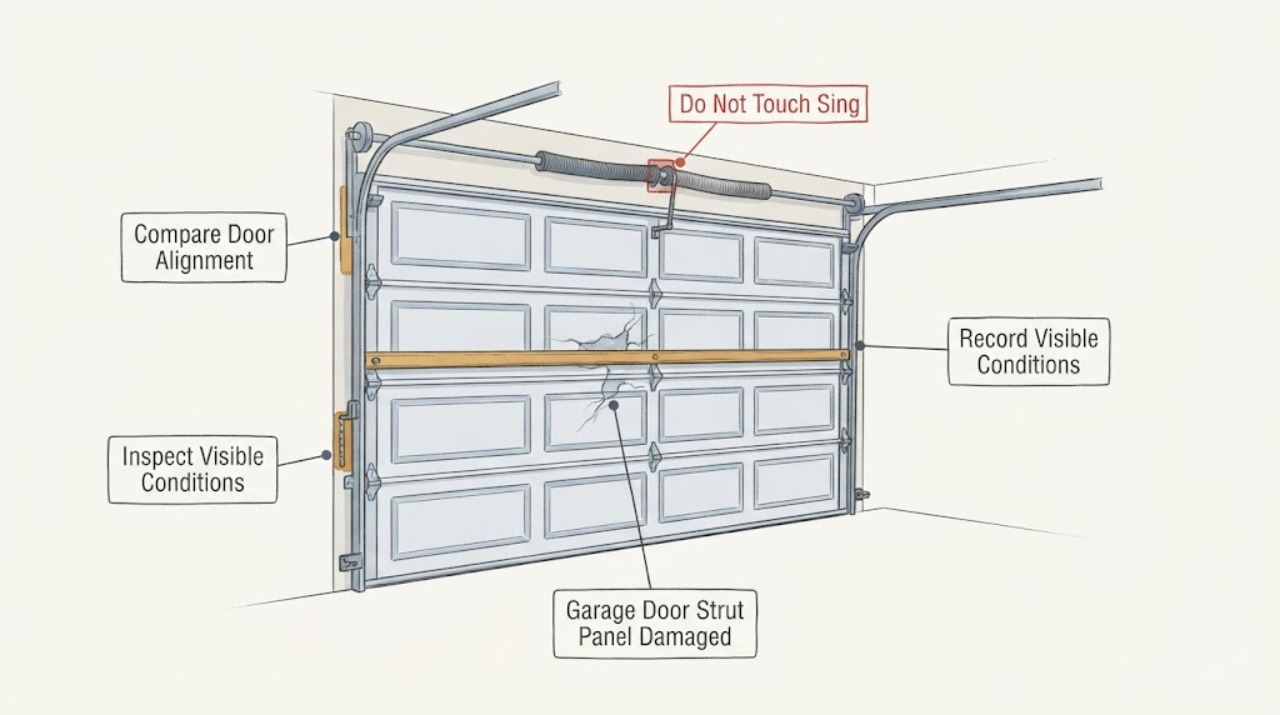
Work through in order
Diagnostic checks
Use only checks that match the exact appliance or system and its official guide.
-
Check 1
Stop the opener and keep the doorway clear. From the floor and without touching the door, photograph the damaged panel, the strut, section joints, hinges, rollers, tracks, cables, springs, and opener arm. Note whether the damage is a dent, crack, hole, crushed edge, separated seam, or visibly bent reinforcement.
Expected result: The damage is cosmetic and limited to one section, the panel is split or crushed, the strut is bent or detached, a cable or spring appears abnormal, or the door is leaning or off its track.
Next step: Leave the door and opener unused when structural or hardware damage is visible, and arrange a trained garage-door technician to inspect the complete system. Do not move the door to improve the photograph.
Stop if: Stop immediately for a hanging section, loose or frayed cable, broken spring, loose red fastener, door off the track, falling material, or any person or vehicle under the door.
Why this matters
Why: A small isolated panel defect may be a section-replacement question, but a crushed or separated section, damaged strut, leaning door, cable or spring symptom, or off-track condition can affect the entire counterbalance and lifting system.
-
Check 2
With the door stationary, compare the damaged section with the adjacent sections and look along the closed door's edges. Observe whether the joints remain aligned, the panel bows, a window frame has shifted, the strut contacts the opener arm, or the door rubs a track or jamb. Do not press the panel back into shape.
Expected result: The section remains aligned and the damage is shallow, the section is bowed or separated, the opener arm or strut contacts the door, or the door is binding against a track or jamb.
Next step: Keep the opener disconnected from use and have a technician assess the panel, strut position, opener reinforcement, hinges, rollers, and tracks. Do not loosen hardware or force the section into alignment.
Stop if: Do not operate a door that binds, bows, contacts the opener, or has a separated section; keep clear of section joints and moving parts.
Why this matters
Why: Aligned shallow damage may be limited to a panel appearance issue, although the strut still needs inspection. Bowing, separation, contact, or binding indicates a travel, reinforcement, hinge, track, or installation problem that can worsen if operated.
-
Check 3
Check the visible door and opener identity without dismantling anything. Record the Amarr model or label, section count, approximate panel width and height, window layout, color or finish, strut location, and whether the opener is a drawbar type. Keep warning labels and red-colored fasteners untouched.
Expected result: The model and section details are legible, the panel includes windows or a special design, the door is older or discontinued, or the identity and strut arrangement are unknown.
Next step: Give the technician the photographs and recorded details so they can identify a compatible section or determine whether the whole door needs replacement. Do not order or add a part based only on a visual match.
Stop if: Do not remove warning labels, loosen red-colored fasteners, add parts, or climb on the door to read a hidden label.
Why this matters
Why: Panel and reinforcement fit depends on the door's model, dimensions, design, windows, hardware, and opener arrangement. A generic panel or strut cannot be assumed to match or preserve the tested balance of the door.
-
Check 4
From a safe position, inspect the surrounding tracks, floor, wall, and opener rail for an impact mark or obstruction that may have caused the panel damage. Note whether the damage followed a vehicle impact, storm, attempted closing on an object, installation, or an opener adjustment; do not run the door to recreate the event.
Expected result: A clear impact or obstruction is present, the opener arm or bracket appears misaligned, the door was recently installed or altered, or no outside cause is visible.
Next step: Leave the system unused and report the event and any visible marks to a trained technician or the installer. Have the door and opener checked together before any adjustment or panel replacement.
Stop if: Do not straighten tracks, alter opener force or travel settings, move the door manually, or work near springs, cables, brackets, or the strut.
Why this matters
Why: An impact or obstruction can damage one section while also bending tracks, hinges, rollers, or reinforcement. Amarr notes that incorrect opener installation, top-section bracing, slope, or limit adjustment can crack or crush a top section; no visible cause does not rule out hidden hardware damage.
-
Check 5
Decide only from the stationary inspection whether the door can remain safely closed while awaiting service. Document any gap, weather exposure, sharp edge, glass damage, sag, loose panel, or inability to close, and keep the opening isolated from people and vehicles.
Expected result: The door is fully closed and stable with limited cosmetic damage, it cannot close or seal, a section is loose, or the door is partially open or supported unevenly.
Next step: Arrange prompt professional inspection for any functional or structural symptom. Do not improvise braces, lift supports, or temporary reinforcement, and do not use the opener until the technician declares the system safe.
Stop if: Keep everyone clear and do not approach a partially open, sagging, falling, or unsupported door; obtain urgent trained service for a door that cannot remain stable.
Why this matters
Why: A closed, stable door may wait for an appointment while the panel decision is made. A loose, partially open, unsealed, or unevenly supported door is a fall, pinch, security, weather, and property hazard regardless of whether only one panel looks damaged.
Use your observations
Decision map
Find the observation that best matches what you see, then follow the next safe action.
-
PATH 01Next step
What you see
Do this next
Have an Amarr-trained technician confirm whether the single section can be restored or replaced and verify the door balance and opener setup before operation.
Why this path and its safety boundary
Why it matters: A limited section repair or replacement may be possible, but the visible condition does not rule out hinge, roller, or reinforcement damage.
-
PATH 02Next step
What you see
Do this next
Keep the door and opener unused and arrange prompt professional inspection to decide between section repair, section replacement, or complete door replacement.
Why this path and its safety boundary
Why it matters: The damage is functional or structural and may involve adjacent sections, hinges, tracks, strut position, or the opener rather than a panel alone.
-
PATH 03Next step
What you see
Do this next
Do not loosen or reposition the strut. Have the complete door and opener inspected by a trained garage-door technician using the exact Amarr documentation.
Why this path and its safety boundary
Why it matters: Reinforcement or opener geometry may be contributing to the panel damage, and an unapproved strut or adjustment could alter door loading.
-
PATH 04Next step
What you see
Do this next
Keep everyone clear, do not operate or manually lift the door, and obtain urgent trained garage-door service.
Why this path and its safety boundary
Why it matters: This is a high-tension counterbalance or falling-door hazard, not a panel-only repair.
-
PATH 05Next step
What you see
Do this next
Have the installer or technician inspect the entire door and opener together before selecting a section or strut replacement.
Why this path and its safety boundary
Why it matters: The initiating event may have damaged hidden hardware or altered the top-section reinforcement even if one panel is the only obvious defect.
Helpful context
Understand the symptom
A strut carries more than appearance
A strut reinforces a garage-door section against the forces applied by the door and, on some installations, the opener. A bent panel can therefore distort the section, alter the door's balance or travel, and put extra load on hinges, rollers, tracks, cables, springs, or the opener. The visible dent is useful evidence, but it does not show whether hidden hardware is safe.
Separate a panel decision from a hardware emergency
Amarr's panel guidance distinguishes limited damage to one or two sections from damage that prevents the door from closing or creates a large opening. That decision comes after a professional checks the complete system. A panel replacement must match the door's model, section dimensions, design, windows, hinges, and finish; a strut or other reinforcement must match the tested door and opener arrangement.
Safety boundary
Stop conditions
- Do not operate or manually lift a door that is off track, leaning, partially open, sagging, crushed, separated, or supported unevenly.
- Do not remove, loosen, repair, or adjust springs, cables, red fasteners, bottom brackets, struts, tracks, or opener force and travel settings.
- Keep fingers away from section joints and moving parts; keep children, pets, people, and vehicles clear of a damaged or moving door.
- Do not add an unapproved brace, reinforcement, pull cord, or other part, and do not run the opener with a panel or strut visibly contacting it.
- Arrange trained garage-door service for structural damage, a damaged strut, broken or frayed cable or spring, off-track movement, sharp edges or broken glass, or any uncertainty about safe operation.
Only after diagnosis
Potential parts
- Amarr replacement door section or panel
Consider this only when a technician confirms that damage is limited to a replaceable section and the door's model, dimensions, design, windows, and hardware can be matched.
Section height, width, profile, insulation, window layout, finish, hinges, and production availability are model-specific; identify the exact door before ordering. - Amarr garage door reinforcement strut
Consider this only when a trained technician confirms that the strut is bent or damaged and specifies the reinforcement required for that door and opener arrangement.
Strut position, length, gauge, mounting, wind-load design, and opener reinforcement requirements are door-specific; do not add or relocate one by guesswork. - garage door hinge and roller hardware
Consider this only when inspection finds that the impact or panel distortion damaged a hinge, roller, or related section hardware.
Hinge number, roller stem, track geometry, and fasteners must match the door design and section position; installation can affect balance and should be handled by a technician.
When checks do not resolve it
Need a professional?
Contact a trained garage-door technician for any panel that is crushed, split, bowed, detached, or unable to close smoothly; for a bent or detached strut; after an impact or opener change; or when hinges, rollers, tracks, cables, springs, or the opener may be involved. Treat an off-track, partially open, leaning, or falling door as urgent.
Safety scope: Panel or section replacement, strut and top-section reinforcement, track or hinge correction, opener alignment, counterbalance, spring, cable, bracket, and balance work should be performed by a trained garage-door technician using the exact Amarr and opener instructions.
Have this ready
- Provide the Amarr model or label, panel location and dimensions if safely known, photos of the damage and strut from the floor, window layout and finish, opener type, door position, impact or installation history, and any rubbing, binding, cable, spring, or opener-contact observations.
Common questions
FAQ
Can an Amarr garage-door panel be replaced without replacing the whole door?
Sometimes. If damage is limited to one or two sections and the door's model, dimensions, design, windows, finish, and hardware can be matched, a technician may recommend a section replacement. A crushed, misaligned, or nonclosing door needs a complete system assessment first.
What does the strut do on an Amarr garage door?
A strut reinforces a door section against loading from the door and, in some installations, the opener. Its position and requirements are specific to the door and opener, so a bent, detached, or contacting strut should be assessed rather than repositioned by guesswork.
Can I straighten a dented Amarr garage-door panel myself?
Do not press, brace, drill, or straighten a damaged section while it is installed. Even a visible dent can involve hinges, rollers, tracks, strut loading, balance, or the opener. Photograph it from the floor and have a trained technician decide whether restoration or replacement is safe.
Should I operate the opener to test a damaged Amarr door?
No if the door is bent, crushed, off track, leaning, binding, rubbing the strut or opener, or has loose cable or spring hardware. Keep the path clear and arrange trained service; repeated operation can worsen structural or counterbalance damage.
When is a damaged Amarr garage door an emergency?
Treat a broken or frayed cable or spring, loose red fastener, off-track or partially open door, falling material, sharp edge or broken glass, severe lean, or uncontrolled movement as urgent. Keep people and vehicles clear and do not operate or manually lift the door.
Read the exact guide
Official sources
- Garage Door Replacement Panels: When to Repair or ReplaceAmarr · Official Amarr guidance for assessing damaged residential garage-door sections; a professional inspection remains necessary for hidden hardware and safe replacement.
- Owner's Manual - EnglishAmarr · Official Amarr residential owner's manual used to define high-tension hardware and moving-door safety boundaries; exact door and opener manuals control operation.
- Care & MaintenanceAmarr · Official Amarr maintenance guidance used for stationary visual inspection, balance observations, and the boundary against owner repair of significant damage.
- SafetyAmarr · Official Amarr safety guidance used to set the safe visual-inspection and stop boundary for a damaged garage door.
- FAQsAmarr · Official Amarr FAQ used for the relationship between struts, top-section damage, opener installation, and high-tension hardware; model instructions control the specific door.
Community feedback
Share a repair observation
Share a plain-text repair observation. Accepted observations are published automatically; this page may take a moment to update.