
On this page
Start here
Quick answer
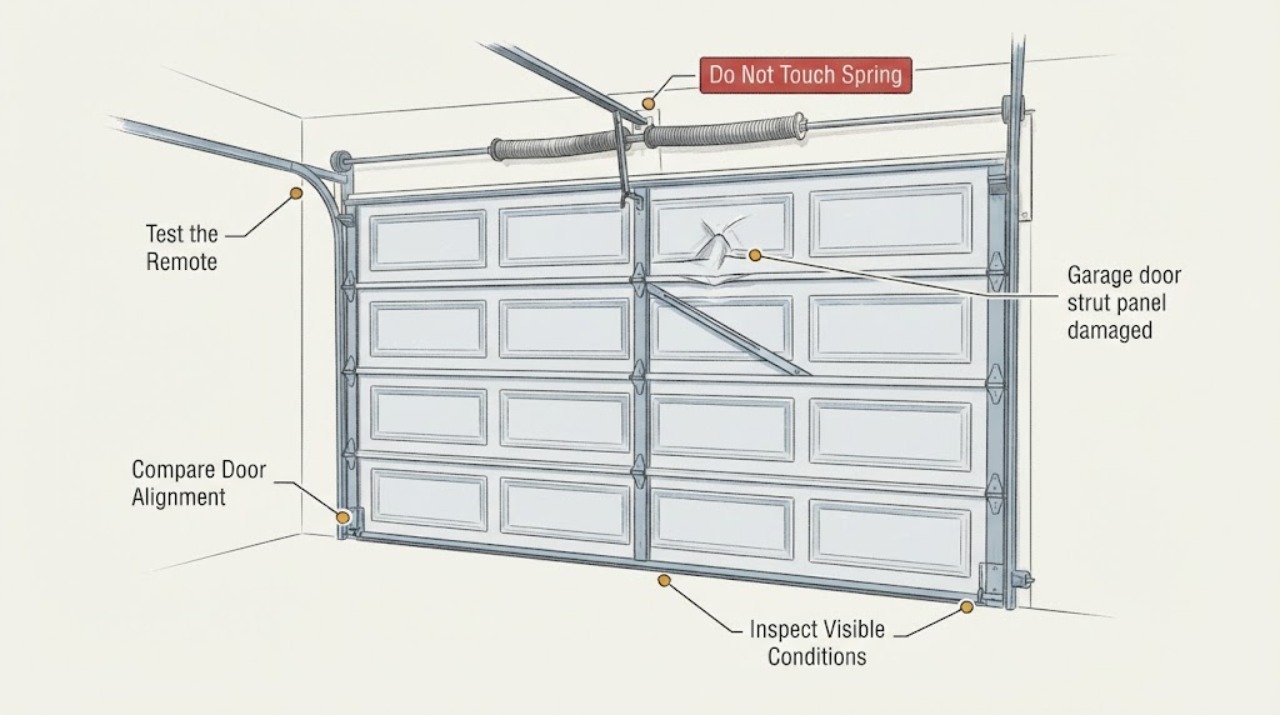
A damaged strut or garage-door panel is structural damage, not just a cosmetic dent. Clopay defines a strut as a horizontal reinforcement member that adds rigidity and helps prevent a section from sagging or bowing, so a bent strut, torn fastener area, cracked panel, separated hinge, or distorted section can change the door's balance and track load. Stop using the opener and keep people, vehicles, and pets clear of the door. From the floor, photograph the damaged panel and strut, note whether the door is closed, tilted, bowed, off the tracks, or supported unevenly, and look for slack or frayed cables without touching them. Do not loosen strut, hinge, roller, bottom-bracket, cable, or spring hardware, manually lift a damaged door, or remove panels. Clopay says major section damage needs professional evaluation; arrange a qualified garage-door inspection to decide whether the strut, panel section, hardware, or complete door requires repair or replacement.
Before you begin
Safety first
- A qualified technician should inspect the damaged section and strut together with hinges, rollers, tracks, cables, springs, bottom brackets, opener attachment, and door balance before moving or replacing hardware. Homeowner checks should remain visual and documentation-based; do not adjust high-tension counterbalance or track components.
Work through in order
Diagnostic checks
Use only checks that match the exact appliance or system and its official guide.
-
Check 1
Stop the automatic opener and keep people, pets, and vehicles out of the door's travel area; do not operate the remote, wall control, or manual door until the damaged strut and panel have been assessed.
Expected result: The door is fully closed and stable, partially open or hanging unevenly, off the track, visibly bowed, or supported by a loose or frayed cable.
Next step: Leave the door in its current position, keep clear, and arrange qualified garage-door service. Do not pull the emergency release, prop the door with improvised supports, or try to counterbalance it.
Why this matters
Why: A stable closed door still has damaged load-bearing components, while a tilted, off-track, or cable-distressed door may move or fall if the opener or manual release is used.
-
Check 2
From the floor and without touching the door, photograph the damaged section and strut, including bends, cracks, pulled fasteners, torn metal, separated hinges, damaged windows, and the panel's location from top to bottom.
Expected result: Damage is a light surface mark, a deep crease or bow, a crack or tear at a hinge or strut attachment, a loose or detached reinforcement, or damage across more than one section.
Next step: Keep the opener unused and provide the photos to a qualified technician. Do not hammer the panel flat, drill new strut holes, or tighten damaged fasteners as a temporary repair.
Why this matters
Why: A finish mark may be cosmetic, but deformation at a reinforcement, hinge, roller, or section edge can affect rigidity and movement. Multiple or deep damaged areas make a simple touch-up less likely to restore safe operation.
-
Check 3
Visually compare the damaged section with adjacent sections and the opening: look for sagging, bowing, a twisted panel, an uneven gap at the jambs, a roller out of the track, or a track that appears bent or displaced.
Expected result: The panel remains square with damage limited to its surface, or the section is bowed, the door is racked, a roller is displaced, or the track and panel no longer align.
Next step: Do not cycle or manually lift the door. Arrange inspection of the section, strut, hinges, rollers, tracks, cables, and counterbalance system before any repair decision.
Why this matters
Why: Square surface-only damage may be cosmetic, while bowing, racking, displaced rollers, or track misalignment indicates a structural or movement problem involving more than the visible strut.
-
Check 4
Look from a safe distance at the visible lifting cables, spring area, bottom brackets, and track hardware for slack, fraying, separation, missing pieces, or fresh impact damage; do not touch, loosen, wind, or test any of them.
Expected result: A cable is frayed or slack, a spring is broken or separated, a bottom bracket or fastener is damaged, hardware is displaced, or those components look undisturbed.
Next step: For any cable, spring, bracket, or hardware abnormality, keep the door still and arrange immediate qualified garage-door inspection. Do not attempt a spring, cable, bracket, or track adjustment.
Why this matters
Why: Cable, spring, bottom-bracket, and track symptoms can change the load carried by a damaged panel and introduce stored-energy hazards. An apparently normal spring or cable does not clear a distorted strut or section.
-
Check 5
Find the Clopay model or serial information and note the section position, door width and height if known, material or window layout, WindCode or other reinforcement markings, impact history, and whether the damage followed an opener event or storm.
Expected result: The model and section information is clear, only one section appears damaged, multiple sections or the frame are affected, or the model and reinforcement arrangement cannot be identified.
Next step: Give the identifying information and photos to a Clopay-qualified professional. Do not order a generic strut or panel based only on width, appearance, or a similar model name.
Why this matters
Why: A single available section may be a repair candidate, but custom designs, unavailable sections, frame damage, multiple damaged panels, or unidentified reinforcement can change the repair into a broader replacement decision.
-
Check 6
Ask the inspecting professional to determine whether the damage is limited to a finish, requires a strut or section repair, or has changed door balance and track geometry before authorizing movement or replacement.
Expected result: The professional finds cosmetic damage only, a repairable strut or panel section, damage to connected hardware or counterbalance parts, or a door/frame condition that needs broader replacement.
Next step: Follow the documented repair scope and keep the door out of service until the professional confirms that the repaired door is correctly aligned, balanced, and safe to operate.
Why this matters
Why: A strut or panel cannot be selected safely without checking how the section, hinges, rollers, tracks, cables, springs, and opener interact. A part that looks similar may not restore the designed load path.
-
Check 7
After repair, observe one controlled operation from outside the travel path and verify that the panel stays aligned, the strut and fastener areas remain secure, the rollers stay in the tracks, and the door stops and reverses as the opener documentation requires.
Expected result: The door travels smoothly and squarely, or it binds, bows, rattles, shifts sideways, drops, leaves a gap, or the opener safety response is abnormal.
Next step: Stop operation for any abnormal result and call the servicing professional back. Do not compensate by changing opener force, travel, spring tension, cables, or track position yourself.
Why this matters
Why: Smooth, aligned travel supports a successful repair, but binding, racking, noise, renewed bowing, or abnormal opener behavior indicates unresolved structural, hardware, balance, or safety problems.
Use your observations
Decision map
Find the observation that best matches what you see, then follow the next safe action.
-
PATH 01Next step
What you see
The damaged strut or panel is accompanied by a tilted or partially open door, a slack or frayed cable, a displaced roller, a broken spring, or a bent track.
Do this next
Keep the door and opener out of service, clear the area, and arrange qualified garage-door inspection. Do not release, lift, lower, or brace the door by guesswork.
Why this path and its safety boundary
Why it matters: The damage affects the door's load path or counterbalance system and presents movement and stored-energy risk beyond a panel touch-up.
-
PATH 02Next step
What you see
The panel is square, the strut and attachment area are intact, and the only visible defect is a shallow finish scratch or rub mark with no movement symptom.
Do this next
Use only the finish-care instructions for the exact Clopay door and monitor alignment. Do not paint, sand, or straighten near strut, hinge, roller, or section attachments without confirming the manual's scope.
Why this path and its safety boundary
Why it matters: Cosmetic damage is more likely than a structural failure, although hidden deformation cannot be ruled out from appearance alone.
-
PATH 03Next step
What you see
The strut is bent or detached, the panel bows or has a deep crease, or fasteners have pulled from the section even though the door is currently closed.
Do this next
Keep the opener unused and arrange professional evaluation of the strut, panel section, hinges, rollers, tracks, and counterbalance before movement or replacement.
Why this path and its safety boundary
Why it matters: Structural section damage is more likely and may have altered rigidity, hinge alignment, or load distribution; the door should not be judged safe merely because it is resting closed.
-
PATH 04Next step
What you see
Damage appears limited to one section and the model, section position, and reinforcement arrangement can be identified, with no frame or counterbalance symptom visible.
Do this next
Have a qualified professional verify the section and strut specification and inspect the entire door before ordering or fitting a replacement. Do not use a generic reinforcement bar.
Why this path and its safety boundary
Why it matters: A section or strut repair may be feasible, but exact design, dimensions, attachment points, and the condition of connected hardware determine whether it is suitable.
-
PATH 05Next step
What you see
Multiple panels, the frame, windows, tracks, cables, springs, or opener are also damaged, or the repaired door binds, shifts, drops, or fails its safety response.
Do this next
Leave the door out of service and obtain a full garage-door inspection. Do not change opener force or travel settings, loosen springs, or replace cables or brackets as a workaround.
Why this path and its safety boundary
Why it matters: The event is broader than a single strut or panel and may compromise the door's balance, containment, or travel safety.
Helpful context
Understand the symptom
Why a strut and panel must be assessed together
A strut reinforces a sectional door section, while hinges, end stiles, rollers, tracks, cables, and springs share the lifting and guiding loads. A bent strut can accompany a bowed panel, pulled-out fasteners, a damaged hinge mount, or a door that no longer travels squarely. Straightening one piece without checking the section and counterbalance system can leave the door unsafe or out of balance.
Treat movement as a safety decision
A door that is leaning, partially open, off its tracks, rubbing, sagging, or hanging from one side should remain still. Do not use the opener to see whether it can overcome the damage and do not pull the emergency release or try to lift a heavy door unless a qualified technician has made it safe. A closed door is not automatically safe if a cable is slack or a panel is under strain.
What can be checked without touching hardware
From a safe distance, document the panel position, strut shape, fastener-area damage, hinge separation, track alignment, cable condition, and whether the damage is limited to one section or extends across the door. These observations help distinguish a cosmetic surface repair from structural, balance, or track damage. Never use a loose bolt, missing fastener, or visible cable problem as an invitation to tighten or replace it yourself.
Repair versus panel or door replacement
A small scratch or rub mark may be a finish issue, but a deep crease, bowed or cracked section, damage at a hinge or roller attachment, multiple damaged sections, or a door that is no longer square can require a replacement section or broader repair. The exact Clopay model, section position, size, design, reinforcement arrangement, and hardware must be confirmed before any part is selected.
Safety boundary
Stop conditions
- Do not operate the opener or manually move a door with a bent or detached strut, bowed or cracked panel, displaced roller or track, slack or frayed cable, broken spring, or uneven hanging position.
- Do not loosen or remove strut, hinge, roller, bottom-bracket, cable, spring, or track hardware; garage-door counterbalance parts can carry dangerous stored force.
- Do not hammer a panel flat, drill new attachment holes, add a generic brace, change opener force or travel, or prop the door with improvised supports as a temporary fix.
- Keep people, pets, and vehicles clear and arrange qualified garage-door service for major damage, multiple affected sections, frame damage, storm impact, uncertain model or reinforcement, or any abnormal post-repair movement.
Only after diagnosis
Potential parts
- garage-door reinforcement strut
Consider this only when inspection confirms the strut is the failed component and the panel, attachment points, hinges, rollers, track, and counterbalance remain suitable; a generic bar may not restore the designed load path.
Confirm the exact Clopay door model, section width, strut profile, reinforcement or wind-load design, fastener locations, and installation procedure before ordering or fitting. - garage-door replacement panel section
Consider this only when a qualified evaluation confirms a damaged section cannot be safely repaired and the remaining door, frame, hardware, and counterbalance are sound.
Match the exact Clopay model, section position, dimensions, material, color or finish, window layout, insulation, hinge pattern, and reinforcement arrangement. - garage-door hinge or roller hardware
Consider this only when inspection finds a hinge, roller, or attachment damaged by the same event; a noisy or misaligned door does not identify which hardware failed.
Confirm the exact Clopay door section, hinge position, roller stem and track arrangement, fastener pattern, and professional installation requirements. - garage-door cable or spring system component
Consider this only after a qualified technician confirms the counterbalance component is damaged or worn; never select or adjust a cable or spring from appearance alone.
Match door weight, height, track hardware, spring type, cable routing, safety containment, and exact Clopay installation specifications; high-tension work is professional service.
When checks do not resolve it
Need a professional?
Safety scope: A qualified technician should inspect the damaged section and strut together with hinges, rollers, tracks, cables, springs, bottom brackets, opener attachment, and door balance before moving or replacing hardware. Homeowner checks should remain visual and documentation-based; do not adjust high-tension counterbalance or track components.
Common questions
FAQ
What does a strut do on a Clopay garage door?
A strut is a horizontal reinforcement member attached to a door section to add rigidity and help prevent sagging or bowing. Because it works with the panel, hinges, rollers, tracks, cables, and counterbalance system, a bent or detached strut should be assessed with the whole door rather than replaced as an isolated cosmetic piece.
Can I still open a Clopay door with a damaged panel or strut?
Do not operate the opener or manually lift a door with a bent or detached strut, bowed or cracked panel, displaced track or roller, slack cable, broken spring, or uneven position. A closed door can still be under abnormal load. Keep the area clear and arrange qualified garage-door inspection.
Can a dented Clopay garage-door panel be repaired instead of replaced?
A small surface mark may be a finish issue, but a deep crease, bow, crack, pulled fastener area, hinge or roller damage, or multiple affected sections can require a replacement section or broader repair. Clopay recommends professional evaluation for major damage before deciding between repair and replacement.
Can I replace a damaged Clopay strut myself?
Do not treat a strut replacement as an ordinary fastener job. The section may be heavy or distorted, and the strut's attachment can interact with hinges, rollers, tracks, cables, springs, and wind-load reinforcement. Have a qualified professional confirm the exact model and repair scope before any hardware is removed.
When does a damaged Clopay panel mean the whole door needs replacement?
A whole-door decision becomes more likely when multiple panels or the frame are damaged, the model or matching section is unavailable, the door is no longer square or balanced, or tracks, cables, springs, and opener attachments were affected. One damaged section may be replaceable, but only after the remaining structure and counterbalance are inspected.
Read the exact guide
Official sources
- Why Clopay's WindCode Technology is the Gold Standard for Hurricane ProtectionClopay · Confirms that, for WindCode doors, reinforcement struts, panel construction, and hardware attachment points are engineered together, supporting exact-model compatibility cautions.
- Repairing Damaged Garage Door SectionsClopay · Directly distinguishes minor surface repairs from major damaged sections that require a professional dealer evaluation and discusses section-specific repair boundaries.
- Garage Door Safety ChecklistClopay · Warns about cable failure, bottom-bracket tension, spring adjustment, opener reversing, and professional repair boundaries.
- Homeowners Guide to Garage Door Spring SystemClopay · Explains how torsion and extension springs transfer force through cables to lift the door and warns that incorrect tension or replacement can cause injury or damage.
- Glossary of Common Garage Door Terms & DefinitionsClopay · Defines struts as horizontal reinforcement members that add rigidity and help prevent sagging or bowing, and describes how hinges, rollers, tracks, cables, and springs participate in door movement.
- Can I Replace My Garage Door Panels?Clopay · Explains that one or two damaged sections may be replacement candidates, while deep or multiple damage, frame damage, or unavailable designs can change the decision; stresses heavy panels and spring tension.
Community feedback
Share a repair observation
Share a plain-text repair observation. Accepted observations are published automatically; this page may take a moment to update.