
On this page
Start here
Quick answer
Start by deciding whether the damage is a light surface mark, a localized dent in one section, or damage that has bent the panel, frame, track, hinges, cables, or springs. Clopay allows some minor touch-ups according to the door collection's care instructions, but it recommends professional evaluation for major damage and strongly recommends a garage-door professional for replacing door sections. A replacement panel is only a safe, useful option when the exact Clopay model, section position, size, color, and current availability can be confirmed and the surrounding door remains sound. Do not remove a panel, loosen hinges, handle springs or cables, or force a door that is sagging, stuck, or off its tracks.
Before you begin
Safety first
- This article supports ordinary-access visual inspection and documentation only. Do not remove sections or hardware, adjust high-tension parts, operate an unstable door, or work beneath a raised door.
Work through in order
Diagnostic checks
Use only checks that match the exact appliance or system and its official guide.
-
Check 1
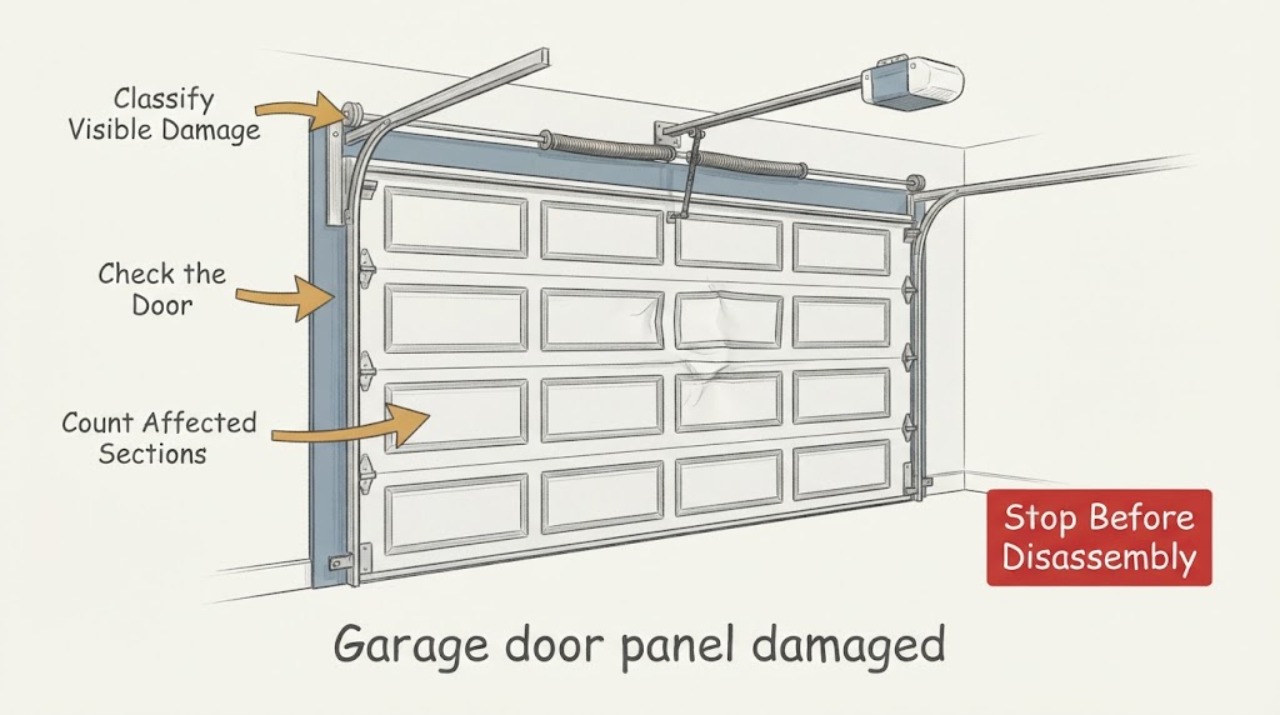
With the garage door stationary and the opener controls left alone, photograph the affected section from inside and outside and inspect only from ordinary safe standing access for scratches, rub marks, peeling paint, rust, dents, creases, cracks, splinters, or separated layers.
Expected result: Classify the damage as a light surface mark, a shallow localized dent, a deep or creased dent, corrosion or cracked material, or damage that reaches an edge, hinge area, window section, or adjacent panel.
Next step: Use the exact Clopay care instructions only for a confirmed minor surface issue; request a professional evaluation for a deep dent, cracked or rusted section, edge damage, or any uncertain classification.
Stop if: Do not press the panel back into shape, cut damaged metal or wood, sand near a window or hinge, or remove any fastener during this inspection.
Why this matters
Why: A surface mark may fit a collection-specific touch-up procedure. A deep crease, cracked or rusted material, edge damage, or damage across adjoining sections can affect strength or alignment and is not a simple cosmetic repair.
-
Check 2
From a safe distance, observe whether the damaged door is resting squarely in the opening and whether the sections, rollers, tracks, hinges, cables, and springs look aligned and intact; do not cycle the opener or manually lift the door to test it.
Expected result: Record a door that is closed and square with no visible related damage, a gap or sag between sections, a roller outside the track, a bent track, a slack or frayed cable, a broken or displaced spring, or a door that is stuck or partly open.
Next step: Keep people and vehicles clear and arrange qualified garage-door service when alignment, tracks, cables, springs, or safe movement are in doubt; do not attempt to compensate by adjusting hardware.
Stop if: Do not touch, unwind, cut, disconnect, adjust, or replace springs or cables, and do not stand under a raised or unstable door.
Why this matters
Why: An isolated cosmetic panel issue with normal alignment may support a later panel-availability check. Sagging, a door out of square, track or roller displacement, cable or spring damage, or an unsafe position indicates a moving-system problem rather than a panel-only repair.
-
Check 3
Walk the door visually from side to side and section to section, comparing the damaged panel with neighboring sections without opening, closing, or separating the door.
Expected result: Note whether damage is confined to one panel, reaches two or more panels, includes the frame or opening, affects a window section, or is accompanied by widespread rust, peeling finish, or age-related deterioration.
Next step: Give the photo set and affected-section count to a Clopay dealer or qualified garage-door professional and ask whether the scope is touch-up, section replacement, or a larger replacement assessment.
Stop if: Stop if the door moves, shifts, or makes a new grinding or snapping sound; keep the opening clear until it is assessed.
Why this matters
Why: Damage limited to one or two sections with an otherwise sound door may make a replacement-section evaluation practical. Multiple damaged sections, frame damage, widespread deterioration, or an outdated design can make a complete-door assessment more appropriate.
-
Check 4
Locate the Clopay model or serial information from a safe interior position and record the door style, approximate age, section position, section width and height, color or finish, insulation or window features, and any purchase or installation documents.
Expected result: Classify the record as complete, partial, or unreadable; separately record whether the damaged section is the top, middle, or bottom section and whether its finish has visibly weathered compared with the rest of the door.
Next step: Send the identity record and photos to an authorized Clopay dealer for availability and compatibility review; do not order an all-purpose section from appearance or rough dimensions alone.
Stop if: Do not remove the label, detach a section to find a number, or climb on the door or tracks to reach a marking.
Why this matters
Why: A complete identity record lets a dealer check whether the model is still manufactured and whether a matching section is available. Missing identity, a discontinued model, custom construction, or a weathered finish can prevent an exact match and change the replacement recommendation.
-
Check 5
Compare the documented damage and door condition with the repair boundaries in the exact Clopay collection care manual, without starting a panel-removal procedure.
Expected result: Record whether the manual addresses the observed issue as a surface touch-up or maintenance item, directs glass or specialty work to an authorized dealer, or provides no applicable procedure for the damaged section.
Next step: Follow only the applicable low-risk care instruction when the material and collection match; otherwise request a Clopay dealer's repair-versus-replacement assessment.
Stop if: Do not treat a general online panel-removal description as permission to handle heavy sections, springs, cables, hinges, rollers, or tracks yourself.
Why this matters
Why: A matching, low-risk care instruction supports only that limited maintenance step. A missing procedure, specialty construction, major damage, or any panel-removal requirement means the repair needs product-specific professional handling.
Use your observations
Decision map
Find the observation that best matches what you see, then follow the next safe action.
-
PATH 01Safety boundary
What you see
The damage is limited to a light scratch, rub mark, or paint discoloration; the panel is not bent or cracked, and the door remains aligned and stable.
Do this next
Use only the exact collection's approved repair or refinishing guidance, then monitor the section; ask a dealer if the material, finish, or procedure is uncertain.
Why this path and its safety boundary
Why it matters: A collection-specific touch-up may be reasonable, but the visible finish and material still need to match the Clopay care instructions. Bare metal should not be left exposed where corrosion could develop.
Safety stop: Stop if touch-up would require reshaping, removing hardware, working near glass, or addressing a structural edge or hinge area.
-
PATH 02Safety boundary
What you see
One section has a dent or other substantial damage, but neighboring sections, the frame, tracks, rollers, hinges, cables, and springs appear intact and the door is not sagging or stuck.
Do this next
Give the dealer the model or serial information, section position, dimensions, color or finish, photos, and damage description so availability and fit can be checked.
Why this path and its safety boundary
Why it matters: A single-section replacement evaluation may be practical. It is not yet proof that a matching section exists or that a homeowner can safely remove the old one.
Safety stop: Do not remove the section or loosen hinges, rollers, tracks, springs, or cables; Clopay recommends professional handling of door-section replacement.
-
PATH 03Safety boundary
What you see
The panel is deeply creased, bent, cracked, rusted through, or damaged along an edge, or two or more sections, the frame, or the opening are affected.
Do this next
Keep the door stationary and request a professional inspection that compares repair, section replacement, and complete replacement options for the exact Clopay construction.
Why this path and its safety boundary
Why it matters: The damage may compromise alignment or the door's structural behavior, and a panel-only repair may not address the full condition. A complete-door assessment may be more appropriate, especially when the model or finish is no longer available.
Safety stop: Do not operate a door that binds, shifts, sags, or has a loose section; keep people and vehicles clear until the system is assessed.
-
PATH 04Safety boundary
What you see
A cable is frayed or off its drum, a spring is broken or displaced, a roller is outside the track, the track is bent, the door is stuck or partly open, or the door will not sit squarely.
Do this next
Stop using the opener, keep the area clear, and arrange a qualified garage-door professional to secure and inspect the door before any panel decision.
Why this path and its safety boundary
Why it matters: This is a garage-door movement or high-tension hazard, not a safe panel troubleshooting problem. Adjusting one component can release stored energy or allow a heavy section to fall.
Safety stop: Do not touch or adjust springs, cables, tracks, rollers, hinges, or operator connections and do not stand beneath the door.
-
PATH 05Safety boundary
What you see
The model or serial information is missing, the door is discontinued or custom, or a proposed replacement section would differ visibly in color, finish, window layout, or profile.
Do this next
Have an authorized Clopay dealer identify the door and confirm the available matching or reasonable replacement options before ordering or dismantling anything.
Why this path and its safety boundary
Why it matters: A generic section is not established as compatible, and a new section may not visually match an older weathered door. Availability and construction restrictions can change the choice between a section repair and a complete replacement.
Safety stop: Do not force an apparently similar panel into the opening or modify a panel, hinge, roller, or track to make it fit.
Helpful context
Understand the symptom
Separate a cosmetic mark from a door-function problem
A scratch, rub mark, or limited paint damage is a different decision from a deep crease, a bent section, rust through the metal, a cracked wood section, or damage that changes how the door sits in the opening. Clopay's care guidance is collection-specific: a product may permit a touch-up while another construction or window section needs dealer assistance. The outside appearance alone does not prove that a section can be repaired safely.
The panel is part of a counterbalanced moving system
Sectional garage doors are heavy and work with hinges, rollers, tracks, cables, and springs. A panel that looks replaceable can still be supporting or misaligning neighboring sections. Clopay notes that door sections, tracks, springs, cables, and operators are not ordinary homeowner repair items. Keep the inspection visual and arrange qualified service when damage affects movement or any high-tension hardware.
Identify the exact Clopay section before discussing parts
A dealer needs more than the word “Clopay” to identify a matching section. Gather the model or serial information, section position, dimensions, color or finish, and door style. Clopay also warns that weather exposure can change the finish, so a new section may not match an older door perfectly. Do not substitute a generic panel or order from a rough measurement.
Safety boundary
Stop conditions
- Do not remove or replace a garage-door section, hinge, roller, track, spring, cable, or operator as a first DIY step.
- Stop for a sagging, stuck, partly open, off-track, loose, cracked, or unstable door and keep people and vehicles clear.
- Never loosen, unwind, cut, disconnect, or adjust springs and cables; they store high tension and require trained handling.
- Do not reshape a deep dent by force, cover structural rust or a water-damaged wood section with cosmetic coating, or force an unmatched panel into place.
- Do not order a replacement section until the exact Clopay model, section position, dimensions, finish, and surrounding door condition have been checked.
Only after diagnosis
Potential parts
- replacement garage door panel section
Consider this category only after the damaged section is confirmed, the surrounding door and moving hardware are sound, and an authorized Clopay dealer verifies the exact model, section position, size, and availability.
Confirm model or serial information, section dimensions, profile, window layout, insulation, color or finish, and current manufacturer or dealer fit information; a weathered door may not match a new section exactly. - collection-specific touch-up or refinishing material
Consider this category only for a light surface mark or finish damage that the exact Clopay collection care instructions explicitly address and that does not involve a bent, cracked, or rusted-through panel.
Confirm the exact Clopay collection, surface material, color, and approved care procedure; do not use coating to conceal structural damage or corrosion through the panel. - replacement hinge or roller hardware
Consider this category only when a qualified inspection identifies hinge or roller damage related to the panel problem and confirms that the hardware, rather than a track, cable, spring, or frame issue, needs replacement.
Match the exact Clopay door model, hinge position or stamped number, roller design, track configuration, and manufacturer fit information; do not use hardware to compensate for a bent panel or track.
When checks do not resolve it
Need a professional?
Arrange a qualified garage-door professional or authorized Clopay dealer when damage is deep, creased, cracked, rusted through, at an edge or hinge area, affects multiple sections, changes alignment or movement, involves a window section, or requires panel removal. Call before touching anything if a spring, cable, track, roller, hinge, or operator is damaged, displaced, or under load. A professional should also confirm availability and compatibility when the model is discontinued, custom, unidentified, or visibly weathered.
Safety scope: This article supports ordinary-access visual inspection and documentation only. Do not remove sections or hardware, adjust high-tension parts, operate an unstable door, or work beneath a raised door.
Common questions
FAQ
Can I repair a small dent in a Clopay garage door panel myself?
Only treat a clearly minor, surface-level issue according to the exact Clopay collection's care instructions. Do not try to reshape a deep or creased dent, and arrange professional evaluation if the panel edge, hinges, alignment, or neighboring sections are affected.
Can one damaged Clopay panel be replaced without replacing the whole door?
Sometimes. A dealer must confirm that the exact model is still supported, the section position and dimensions match, the surrounding door is sound, and the finish can be accepted. Clopay recommends professional handling of door-section replacement because the panels are heavy and work with spring tension.
How do I find the correct replacement panel for my Clopay door?
Record the model or serial information, door style, section position, dimensions, color or finish, window layout, and approximate age. Send those details and photos to an authorized Clopay dealer; do not order a generic section from appearance or rough measurements.
What if the damaged panel is bent and the door is sagging or off the track?
Stop using the opener, keep people and vehicles clear, and call a qualified garage-door professional. Do not touch springs, cables, tracks, rollers, or hinges or try to hold a heavy section in place.
Will a new Clopay panel match an older door's color?
Not necessarily. Clopay notes that exposure to the elements can change a door's color over time, so a replacement section may not be a perfect visual match. Ask the dealer to compare the available finish and discuss the repair-versus-complete-replacement choice.
Read the exact guide
Official sources
- Find the Right Garage Door Parts for Your Clopay® DoorClopay Corporation · Clopay service and repair guidance for selecting parts by exact door model and recognizing spring, cable, and heavy-system hazards.
- Repairing Damaged Garage Door SectionsClopay Corporation · Clopay residential support guidance for minor panel-section damage, finish repair, and when major damage needs dealer evaluation.
- Garage Door Service and Repair GuideClopay Corporation · Clopay service and repair overview for assessing cosmetic versus structural panel damage and related garage-door hardware issues.
- Can I Replace My Garage Door Panels?Clopay Corporation · Clopay guidance for evaluating damaged residential garage-door panels and deciding between section replacement and a complete door assessment.
- Garage Door FAQClopay Corporation · Clopay FAQ for residential garage-door replacement sections, model identification, and homeowner repair limits.
Community feedback
Share a repair observation
Share a plain-text repair observation. Accepted observations are published automatically; this page may take a moment to update.