
On this page
Start here
Quick answer
Treat a damaged Amarr door panel and hinge as a garage-door-system problem, not just a cosmetic repair. From a safe position with the door closed, photograph the panel, hinge, rollers, tracks, cables, springs, and opener, and note whether the damage is a shallow finish mark, a dent or crack, a bent or pulled hinge, a separated section, or a door that no longer moves, closes, or balances normally. Small finish damage on an otherwise correctly operating section may be documented for a professional repair decision, but a bent hinge, cracked or crushed section, loose hardware, shifted track, frayed cable, broken spring, or panel that affects movement requires the door to remain out of service. Do not remove hinges, lift brackets, springs, cables, or panels, and do not keep cycling the opener to test it. Amarr says damaged doors should be photographed and handled by a professional dealer; a technician can determine whether one section, hinge hardware, or the complete door needs repair or replacement.
Before you begin
Safety first
- Keep the door out of service for a damaged panel or hinge, off-track or unstable movement, broken spring, frayed cable, damaged bracket, or any door that cannot close normally. Do not loosen tensioned hardware or dismantle the door.
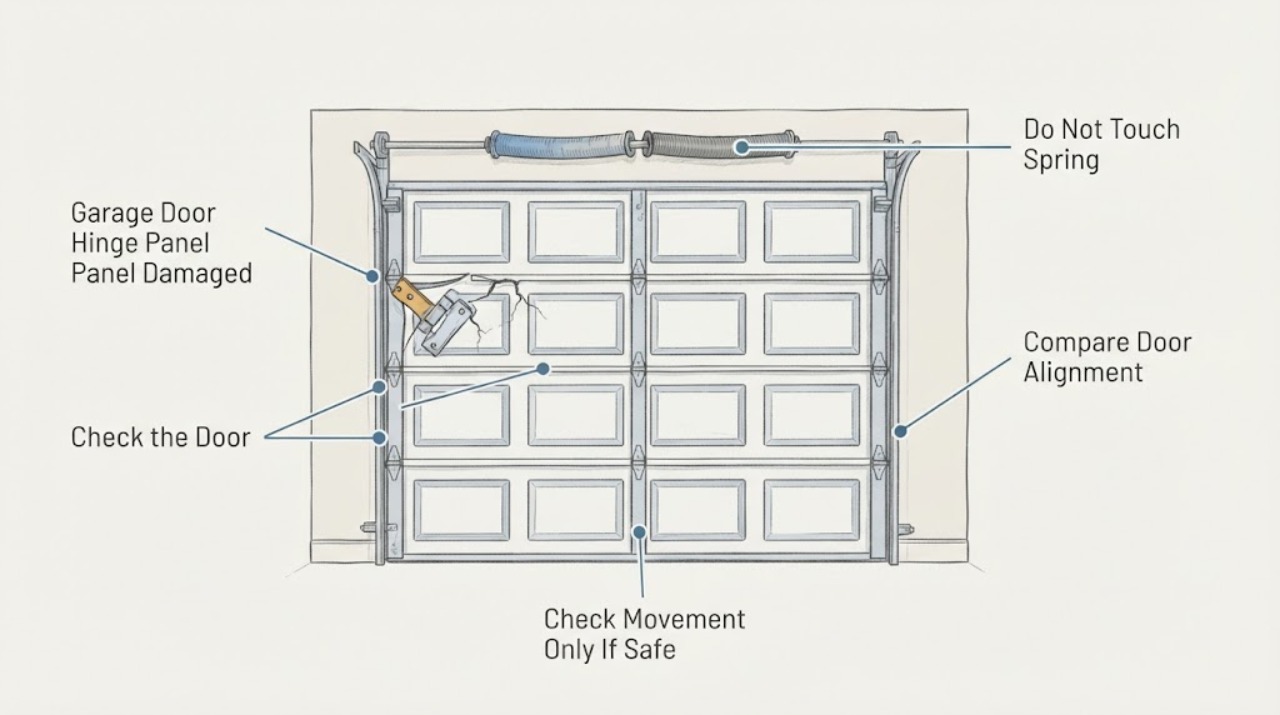
Work through in order
Diagnostic checks
Use only checks that match the exact appliance or system and its official guide.
-
Check 1
Keep people, vehicles, and objects clear of the door path. If the door is closed and stable, leave it closed and stop using the opener. Do not operate a door with a hanging panel, bent hinge, separated section, off-track roller, frayed cable, broken spring, or unexplained movement.
Expected result: The door is stable and closed, partly open or sagging, the opener strains or reverses, a cable is off the drum, a spring is broken, or a section is visibly shifting.
Next step: Leave an unstable or damaged door untouched and arrange a trained garage-door technician. If the door is stable and only cosmetic damage is visible, continue with photographs from a safe distance without operating it.
Stop if: Stop immediately for a falling or moving door, broken spring, frayed or loose cable, off-track door, crushed section, or opener that continues to pull against damage.
Why this matters
Why: A stable closed door allows a visual record. Sagging, off-track, cable, spring, or movement symptoms indicate that counterbalance or section forces may no longer be controlled; repeated opener cycles could worsen damage or cause a fall.
-
Check 2
With the door stationary, photograph the damaged panel and hinge from outside and inside without placing fingers in section joints. Include the panel seam, hinge leaf and attachment area, roller, track, nearby fasteners, decorative hardware, and any damage to the opener or trim.
Expected result: There is paint rub or a shallow dent, a crack or hole, a bowed or crushed section, a hinge bent or pulled away, a loose fastener, a roller out of the track, or damage extending into another section.
Next step: Save the photographs and record the section position and cause. Do not straighten, glue, drill, screw, or remove the hinge or panel; give the complete record to an Amarr professional.
Stop if: Do not reach between sections, under the door, near springs or cables, or into a track to measure or hold the damaged part.
Why this matters
Why: Surface damage on an operating section can support a finish or section evaluation. A cracked, crushed, separated, or hinge-pulled section may affect load transfer and door movement. Damage to adjacent hardware or the track broadens the inspection beyond a single panel.
-
Check 3
Do not disconnect or remove the opener for a DIY inspection. If and only if the closed door is intact, stable, and the owner's manual specifically permits an external manual check, have a trained person assess whether it moves smoothly using the attached handles; never lift a door with damaged or tensioned hardware.
Expected result: The door moves freely and remains aligned, binds at the damaged section, drops or rises, will not close, scrapes the track, or the manual check cannot be done without handling damaged parts.
Next step: For any binding, imbalance, scraping, or uncertain condition, keep the door out of service and request qualified inspection. Do not test opener reversal or run repeated cycles until the door system is repaired and balanced.
Stop if: Stop if the door drops, rises, twists, binds, makes a sudden noise, or requires force; never stand under it or place hands in joints or tracks.
Why this matters
Why: Smooth movement does not prove a damaged hinge or panel is safe, but binding, imbalance, scraping, or inability to close indicates a mechanical or structural problem. An unsafe manual check is itself a reason to stop.
-
Check 4
Record the Amarr door model or design if available, the number and position of affected sections, approximate section length, width, and height, finish or color, door age, impact or weather event, and whether the opener or trim was involved. Do not order a replacement section or hinge from a photograph alone.
Expected result: Damage is limited to one section, affects one or two sections, involves multiple sections or the frame, or the model, measurements, or finish cannot be confirmed.
Next step: Provide the record and photographs to a professional Amarr dealer or trained technician for evaluation. Let the professional verify the section, hinge style, hardware, finish, and structural condition before any part decision.
Stop if: Do not remove a section to measure it, repaint or alter the damaged area in a way that could affect warranty evaluation, or continue operating a door with structural damage.
Why this matters
Why: A limited section may be a candidate for section replacement after inspection, while multiple or mechanically significant sections may require a broader repair or door replacement decision. Amarr notes that discontinued designs, color variation, decorative hardware, and matching dimensions affect the choice.
-
Check 5
Arrange qualified garage-door service and give the technician the photographs, model information, section measurements, damage cause, and movement symptoms. Ask for inspection of the damaged hinge and panel together with rollers, tracks, springs, cables, brackets, opener reinforcement, and balance.
Expected result: The technician finds cosmetic-only damage, a replaceable section, a damaged hinge or attachment, track or counterbalance damage, or a door whose mechanical integrity is compromised beyond one panel.
Next step: Follow the technician's documented repair or replacement recommendation and keep the door out of service until it is secure, aligned, balanced, and tested. Do not approve a part based only on color or appearance.
Stop if: Do not attempt to assist by loosening springs, cables, bottom brackets, hinges, rollers, or panels unless specifically directed within a professional procedure by the qualified technician.
Why this matters
Why: The repair scope depends on the load path and condition of the entire door system, not only the visible panel. A section replacement may be appropriate only when adjacent components and balance remain safe; tensioned hardware can require specialized repair.
Use your observations
Decision map
Find the observation that best matches what you see, then follow the next safe action.
-
PATH 01Safety boundary
What you see
The door is closed and stable, the panel has only a finish mark or shallow dent, the hinge and attachments are intact, and there is no binding, imbalance, or other hardware damage visible.
Do this next
Document the damage and have an Amarr professional confirm whether restoration or a matching section is appropriate before altering the finish.
Why this path and its safety boundary
Why it matters: A finish repair or limited section decision may be possible, but the appearance does not eliminate hidden hinge or section damage.
Safety stop: Stop if a crack grows, the hinge moves, the panel bows, or door operation changes.
-
PATH 02Safety boundary
What you see
The hinge is bent, broken, pulled from the panel, or attached to a cracked, split, bowed, or crushed section.
Do this next
Keep the door closed and out of service and arrange trained garage-door inspection of the section, hinge, rollers, track, and counterbalance system.
Why this path and its safety boundary
Why it matters: The hinge may be carrying or transferring abnormal section load, and a simple fastener or cosmetic repair cannot be assumed to restore the door system.
Safety stop: Do not straighten or remove the hinge, lift the panel, or run the opener.
-
PATH 03Safety boundary
What you see
The damage prevents the door from closing, the sections are separated or misaligned, a roller is out of the track, or the door scrapes or twists.
Do this next
Do not operate or manually force the door. Keep the area clear and obtain qualified garage-door service; secure the opening only by a safe method recommended by the professional.
Why this path and its safety boundary
Why it matters: The door's alignment and load path may be compromised, creating a falling, pinch, or entrapment hazard.
Safety stop: Never pull the door down, push a roller back into a track, or hold a section with improvised supports.
-
PATH 04Safety boundary
What you see
A spring is broken or displaced, a lift cable is frayed or off the drum, a bottom bracket or red fastener is damaged, or the opener is pulling against the door.
Do this next
Keep people away, do not operate the door, and call a trained door-systems technician for the complete system assessment.
Why this path and its safety boundary
Why it matters: These parts can be under high tension or carry the door's counterbalance; continued operation can cause severe injury or additional property damage.
Safety stop: Do not touch, loosen, replace, or adjust springs, cables, bottom brackets, red fasteners, or supports.
-
PATH 05Safety boundary
What you see
A professional confirms that damage is limited to one or two sections and the remaining door, hinges, tracks, rollers, counterbalance, and opener reinforcement are sound.
Do this next
Have the professional verify the exact section dimensions, model, finish, hinge and decorative-hardware requirements, and warranty implications before ordering or installing anything.
Why this path and its safety boundary
Why it matters: A section replacement may be feasible instead of replacing the entire door, subject to exact design, production availability, finish, and hardware matching.
Safety stop: Do not remove the old panel or accept a visually similar section without confirming fit and system safety.
-
PATH 06Safety boundary
What you see
More than one section is seriously damaged, the frame or trim is displaced, the door was struck by a vehicle or storm, or the damage affects the door's mechanical integrity.
Do this next
Keep the system out of service and have an Amarr professional inspect the door, opening, hardware, and opener before choosing section or complete-door work.
Why this path and its safety boundary
Why it matters: A single-panel fix may not restore alignment, balance, sealing, or structural strength; a broader repair or complete replacement assessment is needed.
Safety stop: Do not dismantle the door or attempt to make a large opening safe with the damaged door still under spring or opener load.
Helpful context
Understand the symptom
Start with a closed, stationary door
Do not begin by pulling on a bent panel or operating the opener. Stand clear of the door's travel path and inspect with the door closed if it can be closed safely. Photograph the damage from outside and inside, including the hinge attachment, panel seams, rollers, tracks, cables, springs, and opener bracket. A panel can look dented while its hinge or track load has also shifted.
Cosmetic damage is different from structural damage
Paint rub, a shallow dent, or a small finish crack on a door that still moves smoothly may be a repair or section-replacement decision after inspection. A crushed, split, bowed, or separated section, a hinge pulled from the panel, or damage that prevents the door from closing or sealing changes the risk. Amarr describes limited section damage and more extensive damage as different repair or replacement paths; do not decide from appearance alone.
Do not make the hinge the first DIY repair
Sectional garage doors carry forces through hinges, rollers, tracks, lift cables, springs, brackets, and the opener. Removing a hinge or panel can let a heavy section move unexpectedly, and the bottom brackets and cables are especially hazardous. A loose decorative hinge may look simple, but do not assume it is separate from the structural section or that its fasteners are safe to remove.
Capture information for the repair decision
Save the door brand, model or design information, section position, approximate dimensions, finish, age if known, cause and date of damage, and whether the damage followed an impact or storm. Photograph any inside hardware or motor damage. A professional can then determine whether the correct remedy is panel restoration, a matching section, hinge and hardware work, or a complete door-system repair.
Safety boundary
Stop conditions
- Stop operating the door for a bent or pulled hinge, cracked or crushed panel, separated section, off-track roller, binding, sagging, or any door that will not close or remain aligned.
- Stop immediately for a broken or displaced spring, frayed or off-drum cable, damaged bottom bracket, red fastener, falling section, or opener pulling against the door. Keep people and vehicles clear and obtain trained service.
- Do not remove or adjust hinges, rollers, tracks, springs, cables, bottom brackets, opener brackets, panels, or supports. Do not put fingers in section joints or stand under a moving or partly open door.
- Do not keep cycling the opener, force a damaged door, improvise clamps or supports, or order a replacement panel or hinge by appearance alone. Have the exact model, dimensions, finish, and surrounding hardware verified first.
Only after diagnosis
Potential parts
- replacement door section or panel
Consider this only when a professional confirms limited section damage and verifies the exact Amarr model, dimensions, section position, finish, and compatibility with adjacent sections.
Section style, profile, size, finish, production status, and decorative hardware vary. Do not select a panel by appearance or photograph alone. - hinge and roller hardware
Consider this only when qualified inspection confirms the hinge or roller is the damaged component and the panel and attachment structure remain suitable for repair.
Hinge and roller position, design, and fasteners are model- and system-specific; replacement can involve door tension and must not be treated as a casual adjustment. - track, bracket, or opener-reinforcement component
Consider this category only if inspection finds impact or hinge damage has shifted the track, bracket, or top-section reinforcement.
These components affect alignment and load transfer. Confirm the complete door and opener configuration before any part decision. - cable, spring, or counterbalance component
Consider this only after trained service identifies damage or incorrect balance in a tensioned counterbalance component.
Springs, cables, and brackets are high-tension safety components and require trained installation; no user-level replacement is implied.
When checks do not resolve it
Need a professional?
Call a trained garage-door technician for any bent, broken, loose, or pulled hinge; cracked, bowed, crushed, or separated panel; door that binds, shifts, scrapes, will not close, or is off track; damaged rollers, tracks, springs, cables, brackets, or opener reinforcement; or any uncertainty about the door's balance. Use the photographs and exact Amarr model information to help determine whether the remedy is finish work, a replacement section, hinge and hardware repair, broader door repair, or complete replacement. Treat tensioned hardware and an unstable door as urgent safety conditions.
Safety scope: Keep the door out of service for a damaged panel or hinge, off-track or unstable movement, broken spring, frayed cable, damaged bracket, or any door that cannot close normally. Do not loosen tensioned hardware or dismantle the door.
Common questions
FAQ
Can I replace only the damaged Amarr garage-door panel?
Sometimes. If a professional confirms that damage is limited to one section and the remaining door, hinge hardware, tracks, rollers, counterbalance, and opener reinforcement are sound, a matching section may be considered. Exact model, dimensions, finish, production status, and decorative hardware must be verified; do not remove the section yourself.
Is a bent garage-door hinge safe to keep using?
Do not assume it is safe. A bent or pulled hinge can change how the section, roller, and track carry load. Keep the door out of service and have a trained garage-door technician inspect the hinge, panel, adjacent hardware, and balance. Never straighten or remove the hinge as a first step.
What if the damaged Amarr door will not close?
Stop operating it. A door that will not close, binds, twists, scrapes, or has a shifted section or roller may be off alignment or carrying uncontrolled force. Keep people and vehicles clear and arrange qualified service; do not force it down or run the opener repeatedly.
What should I photograph before calling for garage-door repair?
Take exterior and interior photographs of the damaged section and hinge, panel seams, rollers, tracks, cables, springs, brackets, opener or motor, and nearby trim. Record the Amarr model or design, section position, approximate dimensions, finish, cause of damage, and whether the door moved or closed normally afterward.
Read the exact guide
Official sources
- Amarr Garage Door FAQsAmarr · Amarr dealer FAQ; causes and remedies must be confirmed for the exact door and installation.
- Garage Door Replacement Panels: When to Repair or ReplaceAmarr · Amarr blog guidance for residential door sections; actual fit and repair depend on the exact door and trained inspection.
- Routine Maintenance Can Prevent TragediesDoor and Access Systems Manufacturers Association International · DASMA consumer safety guide for automatic garage-door systems; the door and opener manuals remain model-specific.
- Amarr Warranty GuidanceAmarr · Amarr residential garage-door guidance; exact warranty terms and door model documentation control.
- Amarr Residential Garage Door Owner's ManualAmarr · Amarr residential owner manual; the exact installed door and opener instructions also apply.
Community feedback
Share a repair observation
Share a plain-text repair observation. Accepted observations are published automatically; this page may take a moment to update.