
On this page
Start here
Quick answer
First confirm that the thermostat is actually calling for cooling, then check the dry, user-accessible filter and airflow. If airflow is weak or absent, the filter, return path, blower motor, or indoor control may be involved. If the indoor fan runs but the system still does not cool, look only for external signs such as ice, water, a blocked outdoor unit, or a condensate drain problem. A clogged drain line or a tripped condensate safety switch can stop some systems, while blower-motor, electrical, and refrigerant work requires HVAC service. Do not open the air handler, test a motor or capacitor, clear an internal drain while energized, or add refrigerant.
Before you begin
Safety first
- The homeowner scope ends at thermostat controls, a dry accessible filter, registers, a clearly user-accessible drain termination, and external visual observations. The air handler, internal drain, condensate switch, blower motor, capacitor, compressor, refrigerant, wiring, disconnect, and live testing require qualified service.
Work through in order
Diagnostic checks
Use only checks that match the exact appliance or system and its official guide.
-
Check 1
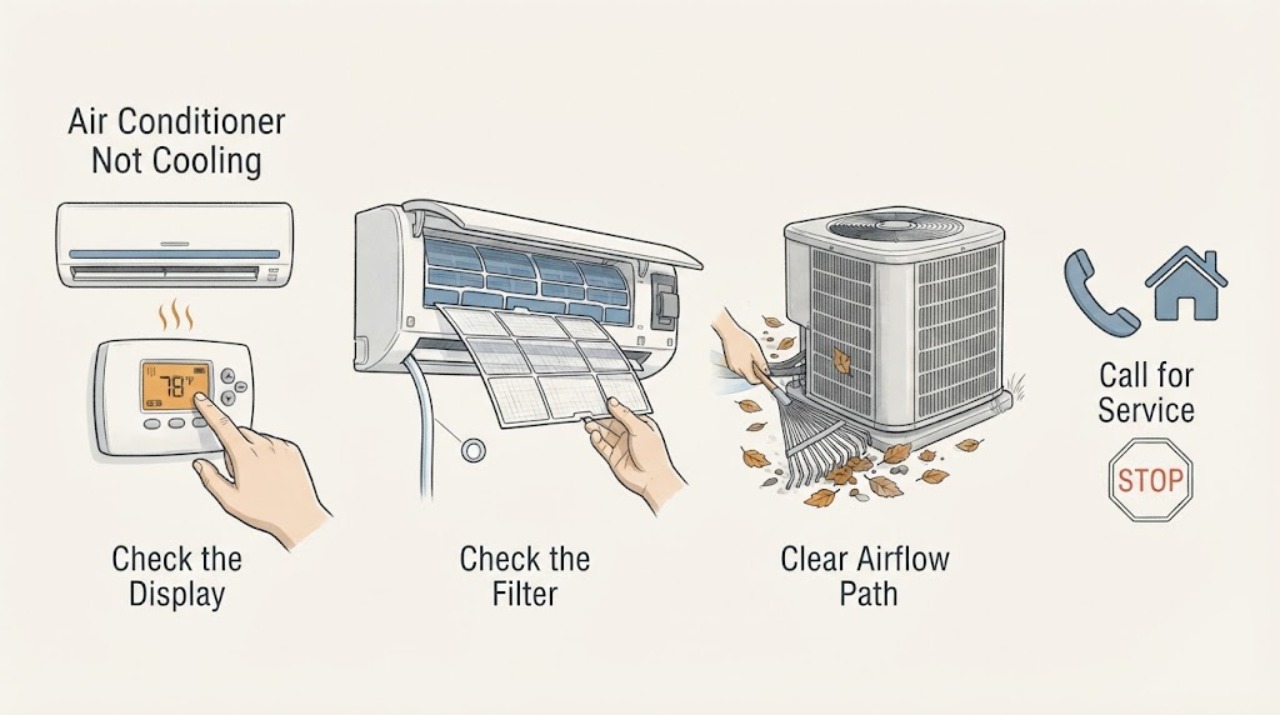
Check the thermostat display and settings: select cooling, set the target below the current room temperature, confirm the schedule is not overriding the request, and use the fan mode appropriate to the equipment; change batteries only when the manual identifies them as user-replaceable.
Expected result: The display is blank, the thermostat is not calling for cooling, the fan runs without a cooling call, or a valid cooling call produces no response.
Next step: Correct only the clearly applicable user setting or battery. If the call is valid and cooling does not begin, continue with external checks without opening thermostat wiring or equipment cabinets.
Why this matters
Why: A setting, schedule, or thermostat power issue can imitate a failed air conditioner; a valid call with no response shifts attention to power, the indoor unit, or the outdoor unit.
-
Check 2
Turn the system off at the thermostat, then inspect the dry, user-accessible filter and confirm that return grilles and supply registers are not blocked by furniture, dust, or closed louvers.
Expected result: The filter is visibly loaded, airflow is weak at several registers, one register is blocked, or the filter and airflow path look clear.
Next step: Clean or replace the filter only as the equipment manual permits. If airflow remains weak, leave the system off and arrange HVAC service rather than opening the air handler.
Why this matters
Why: Restricted airflow can reduce cooling and contribute to icing or abnormal operation; a clear filter does not rule out a blower motor, coil, refrigerant, or control issue.
-
Check 3
With the thermostat off, compare airflow at several registers and listen from outside the cabinet for the indoor blower; do not insert tools, reach into the return, or spin a fan by hand.
Expected result: There is no airflow, airflow starts and stops, airflow is weak everywhere, or airflow is normal but the air is warm.
Next step: Report the airflow pattern to an HVAC technician. Blower-motor and capacitor diagnosis involves internal electrical parts and is not a homeowner test.
Why this matters
Why: No or weak airflow keeps the filter, return path, blower motor, and indoor controls in the decision path; normal airflow with warm air points more toward outdoor heat rejection or refrigerant-related causes.
-
Check 4
Look at accessible tubing and the area around the indoor unit without touching it, and check for ice, unusual frost, or excess water; do not scrape ice, apply direct heat, or continue cooling to see whether the symptom changes.
Expected result: Ice is visible on tubing or the unit, water is collecting near the indoor equipment, or there is no ice or unusual water.
Next step: Turn cooling off and arrange HVAC service for ice, water, or repeated freezing. Do not open the refrigerant circuit or attempt a refrigerant adjustment.
Why this matters
Why: Ice and excess condensate can accompany restricted airflow or a refrigerant-related fault, and continued operation can damage the system; an ice-free view does not prove the refrigerant charge is correct.
-
Check 5
If the equipment has a clearly labeled, user-accessible condensate outlet or drain termination, observe it from a dry location for overflow, standing water, or no expected drainage; do not pour chemicals, insert tools, disconnect tubing, or open the air handler.
Expected result: Water is backing up or overflowing, the drain termination is visibly blocked, a condensate safety switch appears to have stopped the system, or there is no visible drainage symptom.
Next step: Keep the system off for overflow or a safety-switch symptom and call HVAC service. Do not bypass the switch or attempt an internal drain repair without model-specific professional instructions.
Why this matters
Why: A blocked drain line, full pan, pump problem, or condensate safety switch can interrupt cooling on applicable systems; the absence of visible water does not clear an internal blockage or switch.
-
Check 6
From a safe distance, observe the outdoor unit only if there are no warning signs and no cover needs to be removed; check whether the fan starts, whether the grille is visibly blocked by leaves or debris, and whether the unit hums or stops unusually.
Expected result: The outdoor fan runs normally, the fan does not start, the unit hums, the unit starts and stops rapidly, or the coil area is visibly obstructed.
Next step: Turn the system off after an abnormal observation and arrange HVAC service. Do not reach through the grille, test a capacitor, or open the outdoor cabinet.
Why this matters
Why: Outdoor airflow and start behavior affect heat rejection, but a non-starting or humming unit can involve a capacitor, motor, compressor, controls, or power supply and cannot be identified from sound alone.
-
Check 7
From a dry standing position, note the breaker or disconnect state and any visible water, damaged cord or conduit, heat, odor, buzzing, smoke, or arcing; do not open the panel or repeatedly reset a tripped device.
Expected result: The breaker is off and stable, it trips again, electrical equipment is wet or damaged, or there is a warning symptom.
Next step: Leave the affected circuit off and arrange qualified electrical service, with HVAC service when the air conditioner is the consistent trigger. For smoke or fire, leave and contact emergency services from a safe location.
Why this matters
Why: A repeat trip or warning symptom indicates an unresolved electrical or equipment fault, while moisture can create shock or ground-fault risk even when the source is not obvious.
-
Check 8
Record the thermostat call, airflow at the registers, filter condition, ice or water, drain behavior, outdoor-fan behavior, breaker timing, sounds, and odors before contacting service; do not restart a failed system solely to improve the record.
Expected result: The record shows a thermostat or airflow issue, a condensate symptom, an outdoor start problem, an electrical trip, or no consistent pattern.
Next step: Give the record and exact equipment model to an HVAC technician, and include an electrician when the breaker, disconnect, cord, or fixed wiring is implicated.
Why this matters
Why: The record separates user-accessible checks from blower-motor, drain-line, condensate-switch, capacitor, compressor, refrigerant, and wiring faults that need professional diagnosis.
Use your observations
Decision map
Find the observation that best matches what you see, then follow the next safe action.
-
PATH 01Next step
What you see
The mode, target, schedule, fan setting, or display is wrong or unavailable.
Do this next
Correct the user setting or battery only when clearly applicable. If the display remains blank or the call does not control the system, arrange HVAC service without opening the wiring.
-
PATH 02Next step
What you see
Several registers have little air, the filter is blocked, or the indoor blower is silent or intermittent.
Do this next
Address only a clearly user-accessible filter or register obstruction. If airflow does not return, keep cooling off and call HVAC service; the blower motor and its electrical parts are professional work.
-
PATH 03Next step
What you see
Airflow is normal but the room does not cool.
Do this next
Observe the outdoor unit without removing covers. A non-starting, humming, noisy, or unusually cycling unit needs HVAC service for possible outdoor fan, capacitor, compressor, coil, or refrigerant causes.
-
PATH 04Next step
What you see
Frost, ice, an overflowing pan, or water near indoor equipment is present.
Do this next
Turn cooling off and arrange HVAC service to evaluate airflow, drain line, pan, safety switch, coil, and refrigerant-related causes. Do not scrape ice, bypass a switch, or open the system.
-
PATH 05Next step
What you see
The breaker trips again, or a panel, disconnect, cord, or unit is hot, discolored, wet, buzzing, smoking, sparking, or burning-smelling.
Do this next
Do not reset or touch the equipment. Keep people away, leave the circuit off, and request urgent qualified electrical service; leave and contact emergency services for active smoke or fire.
Helpful context
Understand the symptom
Separate airflow, cooling, and drainage symptoms
A warm room can result from a thermostat that is not requesting cooling, an air filter or return path that restricts airflow, a blower that is not moving air, an outdoor unit that cannot reject heat, or a refrigerant-related fault. Water adds another branch: a condensate drain line, pan, pump, or safety switch may interrupt operation on systems equipped with that protection. The visible symptom decides the next safe check; it does not identify a replacement part by itself.
Safe homeowner boundary
Use only dry, user-accessible controls and observations. A filter, thermostat setting, register, and visible outdoor clearance may be checked when the equipment manual permits it. Do not remove an air-handler or outdoor-unit cover, reach into a fan opening, handle a capacitor, measure live voltage, open wiring, work on refrigerant, or bypass a condensate safety switch. Turn the system off for ice, water near electrical equipment, burning odor, smoke, arcing, or a repeat breaker trip.
Safety boundary
Stop conditions
- Stop immediately for smoke, flame, visible arcing or sparks, sizzling, a burning or melting odor, or a hot or discolored panel, disconnect, cord, or unit.
- Do not touch or operate electrical equipment that is wet or surrounded by standing water. Keep people away and arrange qualified service from a safe location.
- If a breaker trips again or trips immediately, leave it off. Do not repeatedly reset it, install a larger breaker, bypass a condensate safety switch, or defeat another protective device.
- Do not open the electrical panel, air handler, or outdoor cabinet; handle or discharge a capacitor; test live voltage; work on a blower motor; clear an internal drain while energized; or open the refrigerant circuit.
- If ice, excess water, damaged wiring, a non-starting or humming outdoor unit, or repeated short cycling is present, stop cooling and arrange HVAC service.
Only after diagnosis
Potential parts
- air filter
Consider a replacement only if the existing filter is visibly loaded and the equipment manual identifies a user-replaceable filter and the correct size.
Confirm the exact equipment model and filter specification in the manufacturer's documentation before ordering. - condensate drain line
Consider drain-line work only after a qualified technician confirms a blocked, damaged, or incorrectly routed drain is causing the water or safety-switch symptom.
Drain routing, fittings, slope, and safety controls are system-specific; confirm the model and local installation requirements with the technician. - blower motor
Consider this part only after a qualified technician confirms that weak or absent indoor airflow is caused by the blower motor rather than the filter, return path, controls, or wiring.
Fit and electrical characteristics must be confirmed for the exact equipment model by the technician.
When checks do not resolve it
Need a professional?
Call an HVAC technician when thermostat and accessible airflow checks do not restore cooling, airflow is weak or absent, ice or condensate water is present, the outdoor unit does not start or hums, or a blower motor, drain line, condensate switch, capacitor, compressor, or refrigerant issue is suspected. Include a qualified electrician when a breaker, disconnect, cord, or fixed wiring trips or shows damage.
Safety scope: The homeowner scope ends at thermostat controls, a dry accessible filter, registers, a clearly user-accessible drain termination, and external visual observations. The air handler, internal drain, condensate switch, blower motor, capacitor, compressor, refrigerant, wiring, disconnect, and live testing require qualified service.
Common questions
FAQ
What should I check first when an air conditioner is not cooling?
Confirm the thermostat is calling for cooling, then inspect the dry accessible filter and airflow. Look for ice, water, or an outdoor unit that does not start without removing covers. Persistent weak airflow, water, ice, abnormal sound, or electrical trips needs professional service.
Can a clogged condensate drain stop an air conditioner from cooling?
On systems equipped with a condensate safety switch or pump, a drainage problem can stop operation or cause water to collect. Treat overflow or a suspected safety-switch event as an HVAC service issue; do not bypass the switch or open the air handler.
How do I know whether the blower motor is the problem?
Weak or absent airflow with a correct thermostat call keeps the blower motor in the decision path, but the same symptom can come from a loaded filter, blocked return, control, wiring, or frozen coil. An HVAC technician should diagnose the internal motor and electrical parts.
Should I keep restarting the air conditioner if it does not cool?
No. Do not repeatedly restart a system with ice, water, a repeat breaker trip, burning odor, smoke, arcing, or an abnormal outdoor-unit sound. Leave it off and arrange the appropriate HVAC or electrical service.
Read the exact guide
Official sources
- CPSC Guide to Home Wiring HazardsU.S. Consumer Product Safety Commission · Residential circuit breakers, overloads, repeated trips, wiring hazards, and electrical warning signs
- Troubleshoot an Air Conditioner: 6 Steps to Fix an AC Not WorkingCarrier · Air-conditioner thermostat, filter, airflow, breaker, icing, outdoor unit, condensate, and professional service guidance
- Air Conditioner Troubleshooting: Why Your AC Is Not CoolingTrane · Air-conditioner thermostat, filter, airflow, drain line, condensate, breaker, outdoor unit, icing, and HVAC technician guidance
- Air Conditioner and Fan SafetyElectrical Safety Foundation International · Air-conditioner electrical safety and qualified installation or service
Community feedback
Share a repair observation
Share a plain-text repair observation. Accepted observations are published automatically; this page may take a moment to update.