
On this page
Start here
Quick answer
First decide whether the air conditioner is not running, is running with weak airflow, or is blowing air that is not cool. Check the thermostat mode and setpoint, compare supply vents and the return, inspect the accessible filter with the system off, and look from a safe distance for ice, water, or outdoor-unit obstruction. A blower motor, capacitor, contactor, thermostat, wiring, compressor, or refrigerant problem needs HVAC diagnosis; do not open the cabinet or handle a capacitor or refrigerant line. If ice is visible, turn cooling off and arrange service. Stop for smoke, burning smell, arcing, a hot disconnect, water near electrical parts, or a repeated trip.
Before you begin
Safety first
- An HVAC technician can separate thermostat, blower motor, capacitor, contactor, power, duct, coil, compressor, and refrigerant faults without the user opening equipment or handling stored electrical charge.
Work through in order
Diagnostic checks
Use only checks that match the exact appliance or system and its official guide.
-
Check 1
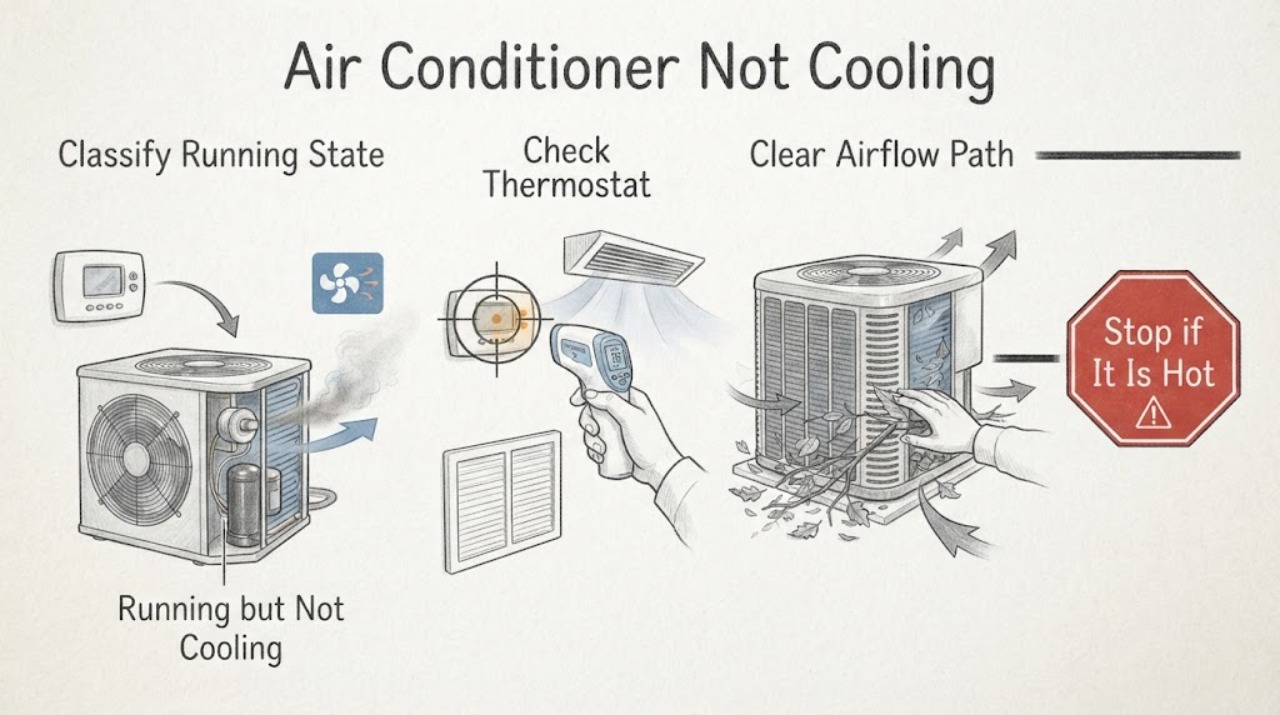
From a safe, dry position, observe the thermostat, indoor supply airflow, and outdoor unit during an existing cooling call. Note whether the system is silent, the indoor fan runs, the outdoor fan runs, and the air is warm or cool; do not open a cabinet or touch a disconnect.
Expected result: The system may be completely off, the indoor blower may run alone, both units may run with warm air, or airflow may be weak or absent.
Next step: Record the state and follow the thermostat, filter, airflow, ice, or professional-service branch. Stop immediately for smoke, burning odor, arcing, hot electrical parts, water near electrical equipment, or a repeated trip.
Why this matters
Why: A silent system points toward thermostat, power, control, contactor, or motor paths. A running system with weak airflow points toward the filter, return, blower, coil, or ducts; normal airflow with warm air points toward cooling, outdoor-unit, or refrigerant paths.
-
Check 2
Read the thermostat mode, setpoint, fan setting, schedule, battery or display status, and any alert. Correct only an obvious setting such as a non-cooling mode or a setpoint above the room temperature; do not keep changing settings when the system is tripping, wet, smoking, or making abnormal noise.
Expected result: The thermostat may be off, in heat or fan-only mode, following a schedule, calling for cooling, blank, or showing an alert.
Next step: After one clear setting correction, observe the system normally. If it remains silent or warm, turn cooling off and arrange HVAC diagnosis rather than changing the thermostat or internal controls yourself.
Why this matters
Why: An incorrect mode or setpoint can explain warm air without a component failure. A valid cooling call with no system response keeps power, contactor, control, motor, or safety faults in consideration.
-
Check 3
Turn the system off at the thermostat, then inspect the homeowner-accessible filter and visible return and supply grilles. Look for a clogged, wet, damaged, wrong-size, or backward filter and for furniture or debris blocking the air path; do not open the blower cabinet.
Expected result: The filter may be heavily loaded, wet, damaged, misoriented, clean and correct, or inaccessible; the grilles may be blocked or open.
Next step: Replace a disposable filter only with the exact approved size and airflow direction, or clean a reusable one as directed. If cooling or airflow does not recover, arrange HVAC service.
Why this matters
Why: A restricted filter or air path can reduce cooling and airflow and can contribute to coil freezing. A clean filter and clear grilles shift the diagnosis toward the blower, coil, ducts, controls, outdoor unit, or refrigerant.
-
Check 4
From outside the air handler, listen and observe without removing a panel or reaching into the unit. Note whether the indoor blower starts, hums, stops, cycles, makes grinding noise, or runs while airflow remains low; do not touch the blower motor, wheel, capacitor, contactor, or wiring.
Expected result: The indoor blower may be silent, humming, intermittent, noisy, running normally, or running with weak airflow.
Next step: Turn cooling off if the blower stalls, smells hot, or makes abnormal noise and arrange qualified HVAC service. Do not replace or discharge a capacitor yourself.
Why this matters
Why: A silent, humming, intermittent, or noisy blower supports a blower motor, capacitor, control, or power diagnosis. A running blower with poor output keeps the filter, coil, return, supply, and duct path in consideration.
-
Check 5
Look only at visible tubing, the accessible indoor unit exterior, and the area below it for frost, ice, unusual condensate, overflow, or water. Do not open the coil cabinet, chip ice, apply heat, touch refrigerant lines, or run cooling to compare the result.
Expected result: There may be no ice or water, frost on tubing or the coil area, a large iced section, or condensate collecting near the unit.
Next step: If ice or water is present, turn cooling off and arrange HVAC service. Keep people away from wet electrical equipment and do not handle refrigerant or internal drains.
Why this matters
Why: Ice can restrict airflow and may be associated with a dirty filter, blower problem, coil restriction, or low refrigerant. Water can follow thawing ice or a drain problem and can create an electrical hazard.
-
Check 6
From a safe distance, observe whether the outdoor fan and unit respond during an existing cooling call, and look for leaves or debris blocking the exterior without touching the grille, fan, disconnect, wiring, or refrigerant tubing. Do not reset the disconnect for comparison.
Expected result: The outdoor fan may run, remain still, cycle off, or be inaccessible; the coil area may be clear or visibly obstructed.
Next step: Clear only loose debris that can be removed without touching the unit. If the fan is stalled, the unit hums, the disconnect is hot, or cooling remains absent, turn the system off and arrange HVAC service.
Why this matters
Why: A stopped outdoor unit with a valid cooling call points toward power, contactor, capacitor, control, motor, or safety diagnosis. A running outdoor unit with warm air points toward airflow, coil, compressor, or refrigerant paths.
-
Check 7
Record the equipment model, thermostat state, filter condition and size, vent pattern, indoor and outdoor fan behavior, ice or water location, sounds, breaker or disconnect behavior, and when cooling declined. Do not open the equipment to find more information.
Expected result: The record may show a thermostat or power issue, restricted airflow, a blower or capacitor symptom, an outdoor-unit event, ice, or a refrigerant or control concern.
Next step: Keep the system off when it has ice, water, abnormal fan behavior, electrical symptoms, or no cooling after the safe checks, and arrange qualified HVAC service.
Why this matters
Why: A complete symptom sequence helps a technician separate the blower motor, capacitor, contactor, thermostat, coil, compressor, refrigerant, wiring, and duct possibilities.
Use your observations
Decision map
Find the observation that best matches what you see, then follow the next safe action.
-
PATH 01Next step
What you see
There is smoke, burning smell, arcing, a hot disconnect or plug, damaged wiring, water near electrical equipment, or a repeated electrical trip.
Do this next
Stop the system and keep clear. Isolate power only from a dry, safe location without touching damaged equipment.
-
PATH 02Next step
What you see
The thermostat is off, in the wrong mode, set incorrectly, following a schedule, blank, or not sending an apparent cooling call.
Do this next
Correct only a clear setting or battery issue using the thermostat instructions, then allow one normal call for cooling.
-
PATH 03Next step
What you see
The filter is dirty, wet, damaged, wrong-size, or airflow is blocked at the return or supplies.
Do this next
Turn the system off and correct only the accessible filter or movable obstruction according to the equipment instructions.
-
PATH 04Next step
What you see
The indoor blower is silent, humming, intermittent, noisy, or running with low airflow despite a valid cooling call and clear visible air path.
Do this next
Turn cooling off and do not touch the blower motor, capacitor, contactor, wheel, or wiring.
-
PATH 05Next step
What you see
Frost or ice is visible, airflow is very low, condensate is excessive, or refrigerant trouble is suspected.
Do this next
Turn cooling off from a safe control and protect the area from meltwater; do not chip ice, handle refrigerant, or open the coil cabinet.
-
PATH 06Next step
What you see
The indoor airflow is normal but the outdoor unit does not start, runs abnormally, or the system blows warm air.
Do this next
Keep the system off and do not touch the outdoor fan, contactor, capacitor, disconnect, compressor, or refrigerant lines.
Helpful context
Understand the symptom
Classify the no-cooling symptom first
A system that is completely silent has a different path from one that runs but blows weak or warm air. Note the thermostat display, indoor fan, outdoor unit, airflow at several vents, and any ice or water. This record helps separate a thermostat or power issue from an air-path, blower, coil, refrigerant, or outdoor-unit issue.
The four named components are not interchangeable
The thermostat requests a cycle, the contactor switches power in applicable outdoor equipment, the capacitor helps a motor start and run, and the blower motor moves indoor air. A symptom can involve more than one of these, and no component should be selected from a warm-room complaint alone.
Use homeowner-level checks only
Thermostat settings, visible registers, and an accessible filter are reasonable checks when the system and access are safe. Do not open the indoor or outdoor cabinet, touch a capacitor or contactor, handle refrigerant, make electrical measurements, or work around a wet unit.
Ice changes the next step
A frozen evaporator coil can reduce airflow and cooling and may leave water as it thaws. Turn cooling off from a safe control, protect nearby surfaces, and arrange HVAC service. Do not chip ice, apply a flame or hot water, or restart the system to see whether it refreezes.
Safety boundary
Stop conditions
- Stop the system immediately for smoke, burning smell, arcing, a hot disconnect or plug, damaged wiring, a repeated electrical trip, or water near electrical equipment. Keep clear and use urgent electrical or fire support as appropriate.
- Stop cooling when the evaporator coil or tubing is iced, airflow is nearly absent, or meltwater is reaching the unit or electrical area. Do not chip ice or use flame, hot water, or a heat gun.
- Do not open the indoor or outdoor cabinet, touch a blower motor, capacitor, contactor, fan wheel, compressor, or refrigerant line, and do not make electrical measurements.
- Do not bypass a condensate safety switch, bridge a control, repeatedly reset a breaker or disconnect, or run the system again to compare a suspected fault.
- Stop if the access is wet, unstable, confined, at height, or otherwise unsafe. Arrange professional HVAC service.
Only after diagnosis
Potential parts
- blower motor
Consider only when a qualified technician confirms the indoor blower motor is not running correctly after thermostat, filter, power, and air-path causes are assessed.
Confirm the exact HVAC model, motor type, rotation, and approved fitment through qualified service. - run capacitor
Consider only when a qualified technician confirms a capacitor fault; humming or no-start symptoms do not authorize user access to the capacitor.
Capacitors can retain charge and must match the exact equipment requirements; professional handling is required. - contactor
Consider only when a qualified technician confirms that the contactor is not switching the outdoor unit correctly after thermostat and supply checks.
Contactor selection and installation are model- and system-specific electrical work. - thermostat
Consider only when settings, batteries, schedule, and system response point to a confirmed thermostat fault.
Confirm system compatibility, wiring, and configuration with qualified HVAC service before replacement.
When checks do not resolve it
Need a professional?
Request qualified HVAC service when thermostat, visible air-path, filter, and external-unit observations do not restore cooling, or immediately for ice, water, blower or motor noise, burning smell, smoke, arcing, or electrical symptoms.
Safety scope: An HVAC technician can separate thermostat, blower motor, capacitor, contactor, power, duct, coil, compressor, and refrigerant faults without the user opening equipment or handling stored electrical charge.
Have this ready
- Provide the equipment model, thermostat mode and setpoint, filter size and condition, vent pattern, indoor and outdoor fan behavior, ice or water location, breaker or disconnect behavior, sounds, and when cooling declined.
Common questions
FAQ
What should I check first when my air conditioner is not cooling?
Classify whether the system is silent, has weak airflow, or runs with warm air. Then check the thermostat mode and setpoint, visible vents, and the accessible filter with the system off.
Can a bad blower motor make the AC stop cooling?
Yes. A silent, humming, intermittent, or weak indoor blower can reduce airflow and cooling. The motor, capacitor, control, and power path require qualified HVAC diagnosis.
What does a contactor do in an air conditioner?
In applicable outdoor equipment, a contactor switches power when the system calls for cooling. A no-start or intermittent outdoor unit can involve the contactor, but only a technician should diagnose or handle it.
Should I run the AC if ice is on the coil?
No. Turn cooling off from a safe control and arrange HVAC service. Ice can restrict airflow and may involve a filter, blower, coil, drain, or refrigerant problem; do not chip it or apply heat.
When is an AC not-cooling problem urgent?
Stop for smoke, burning smell, arcing, a hot disconnect, water near electrical equipment, a stalled or grinding blower, a repeated trip, or severe ice and water. Keep the system off and use urgent electrical, fire, or HVAC service as appropriate.
Read the exact guide
Official sources
- Why is My AC Not Blowing Cold Air?Carrier · AC thermostat, filter, condenser, evaporator coil, refrigerant, blocked vents, and professional service guidance
- AC Filter Replacement Guide | How to Replace AC FilterCarrier · Homeowner-accessible AC filter location, power-off precaution, exact size, airflow direction, and restricted-airflow effects
- AC Fan Not Working? Reasons Why It Stopped SpinningTrane · Indoor blower versus outdoor fan, thermostat, breaker, frozen coil, run capacitor, motor, and professional service guidance
- Troubleshoot an Air ConditionerCarrier · Air-conditioner filter, thermostat, electrical panel, blower, evaporator coil, condenser, refrigerant, and professional HVAC boundaries
- Electrical Safety in the WorkplaceNational Institute for Occupational Safety and Health · Electrical shock, burns, arcing, fire hazards, de-energizing equipment, and qualified-person boundaries
- Will Frozen AC Fix Itself?Carrier · Frozen AC coil signs, airflow and refrigerant causes, shutdown, thawing boundary, and professional service guidance
- AC Not Blowing Cold Air? Learn What to DoTrane · AC thermostat, filter, airflow, frozen evaporator coil, condenser, refrigerant, and professional service guidance
Community feedback
Share a repair observation
Share a plain-text repair observation. Accepted observations are published automatically; this page may take a moment to update.