
On this page
Start here
Quick answer
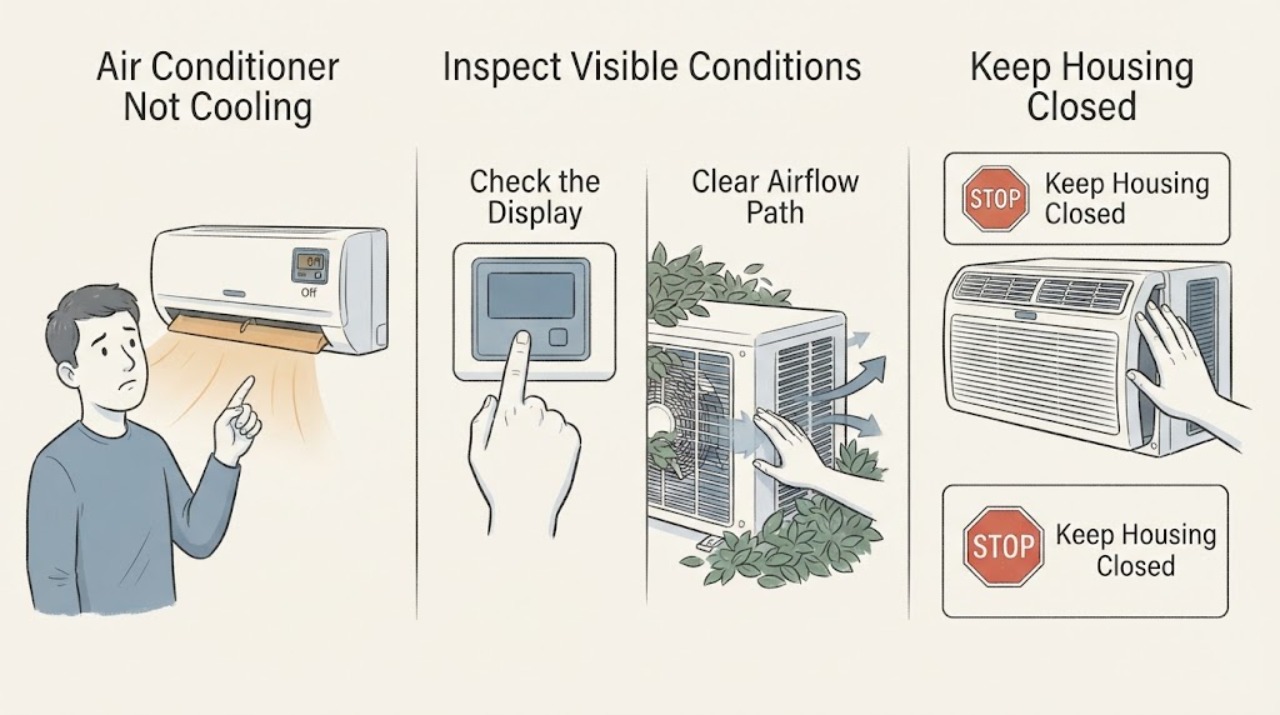
Start with the thermostat, filter, airflow, and visible ice, but treat capacitor and compressor work as professional HVAC service. Set the thermostat to cooling with the fan on Auto, confirm the filter is not blocked, and make sure supply and return paths and the outdoor unit are not visibly obstructed. If ice is present, switch the system off and arrange service rather than continuing to run it. Observe whether the indoor fan runs, whether the outdoor fan starts, whether the outdoor unit hums or stays silent, and whether the system stops quickly or runs continuously without lowering the room temperature. A capacitor stores electrical energy even after power is disconnected, and the compressor, refrigerant circuit, high-voltage wiring, and sealed-system diagnosis are not homeowner checks. Stop for smoke, burning odor, arcing, a hot disconnect or cord, repeated breaker trips, exposed wiring, refrigerant or oil leakage, or water near electrical equipment.
Before you begin
Safety first
- Do not open cabinets, touch terminals or fan blades, discharge or replace capacitors, make live measurements, add refrigerant, open sealed tubing, bypass safety controls, or operate equipment with smoke, odor, arcing, ice near electrical parts, water, or repeated trips.
Work through in order
Diagnostic checks
Use only checks that match the exact appliance or system and its official guide.
-
Check 1
Stop and observe the system from a safe position for smoke, burning odor, visible arcing, a hot or damaged disconnect, exposed wiring, a repeated breaker trip, refrigerant or oil residue, or water near electrical equipment. Do not open the cabinet or reset protection to reproduce a hazard.
Expected result: No warning sign is visible, or smoke, odor, arcing, heat, exposed wiring, repeated trips, leakage, or water near electrical equipment is present.
Next step: Keep the system off and arrange qualified HVAC or electrical service; leave and contact emergency help for smoke or fire. If no warning sign is present, continue with external low-risk checks.
Stop if: Stop immediately for smoke, burning odor, arcing, exposed wiring, a hot connection, repeated breaker trips, refrigerant or oil leakage, or water near electrical equipment.
Why this matters
Why: The second result is an electrical, fire, refrigerant, or water hazard rather than a routine cooling adjustment.
-
Check 2
Check the thermostat display and settings without opening equipment: confirm cooling is selected, the target is below the room temperature, the schedule has not overridden the request, and the fan is set to Auto rather than running continuously without compressor cooling.
Expected result: The thermostat is in heating or another mode, the target is not calling for cooling, the fan is On, the display is blank, or the settings are correct but the air remains warm.
Next step: Correct only a clearly wrong setting using the thermostat instructions. If the display is blank, the system does not respond, or cooling remains poor with correct settings, keep the system off as needed and arrange HVAC or electrical service.
Stop if: Stop for smoke, odor, arcing, a hot control, water near the thermostat or equipment, repeated trips, or any need to open the thermostat or wiring.
Why this matters
Why: A mode, schedule, fan setting, or thermostat-power issue can mimic an equipment failure. Correct settings with warm air move the diagnosis toward airflow, outdoor operation, refrigerant, or a component fault.
-
Check 3
With the indoor equipment off or in a safe standby state, inspect the accessible air filter and return and supply openings. Note a visibly loaded filter, weak airflow, a blocked return, closed registers, or furniture and debris restricting a register; replace or clean the filter only according to the equipment instructions.
Expected result: The filter is dirty or blocked, airflow is weak, registers are obstructed, or the filter and visible airflow paths are clear.
Next step: Restore only the correct filter and clear accessible registers without opening the unit. If airflow stays weak, the coil is wet or iced, or cooling remains poor, stop operation and arrange HVAC service.
Stop if: Stop for water near electrical parts, ice that reaches wiring, burning odor, smoke, a damaged filter cabinet, or any need to enter the blower or coil compartment.
Why this matters
Why: Restricted airflow can reduce cooling and contribute to coil icing or equipment stress. Clear external airflow with persistent poor cooling points beyond a simple filter issue.
-
Check 4
Look from outside the outdoor unit for leaves, packaging, snow, or other visible obstructions around the cabinet and discharge path, and listen from a safe distance when the thermostat calls for cooling. Do not remove panels, reach through the grille, or touch the fan.
Expected result: The outdoor unit is silent, the fan starts, the unit hums without starting, the fan is not spinning, or airflow around the cabinet is visibly blocked.
Next step: Clear only loose debris that is safely outside the cabinet and keep hands away from the fan. For silence, humming, a stopped fan, unusual noise, or continuing no-cool, switch the system off and arrange qualified HVAC service.
Stop if: Stop for smoke, burning odor, arcing, a hot disconnect, damaged cabinet, refrigerant or oil residue, a fan that may start unexpectedly, or any need to reach into the unit.
Why this matters
Why: A blocked outdoor airflow path can reduce heat rejection. Silence, humming, or a stopped fan can involve power, control, motor, capacitor, or compressor issues and cannot identify a part safely from sound alone.
-
Check 5
Observe the accessible refrigerant lines and indoor or outdoor area for ice, frost, unusual water from a thawing coil, or oily residue without touching the lines or opening the system. If ice is present, turn cooling off and leave the equipment to a professional rather than continuing to run it.
Expected result: No ice or residue is visible, ice or frost is present, water is accumulating from thawing, or oily residue or a suspected refrigerant leak is visible.
Next step: Keep cooling off and arrange HVAC service for ice, water, oily residue, or persistent no-cool. Do not chip ice, apply heat, add refrigerant, or handle the lines.
Stop if: Stop for ice near electrical components, a refrigerant or oil leak, hissing, chemical odor, water near electrical parts, or any need to open the coil or line set.
Why this matters
Why: Ice can follow restricted airflow or low refrigerant and continued operation can stress or damage the compressor. Refrigerant and sealed-system leaks require certified handling and cannot be confirmed by a homeowner visual check.
-
Check 6
Record the operating pattern without repeatedly cycling the system: whether indoor air moves, whether the outdoor fan runs, whether the compressor sounds like a steady run or only a hum, whether the system short-cycles, and whether the room never reaches the target.
Expected result: The indoor fan runs but air is warm, the outdoor fan runs but cooling is weak, the unit hums and stops, the system short-cycles, or it runs continuously without reaching the target.
Next step: Keep the system off if it hums, short-cycles, ices, overheats, or cannot cool. Give the pattern to a qualified HVAC technician and do not attempt capacitor or compressor diagnosis.
Stop if: Stop for a hum without startup, repeated short cycling, smoke, burning odor, unusual mechanical noise, hot surfaces, arcing, or a repeated electrical trip.
Why this matters
Why: Fan-only warm air can be a control or cooling-side issue. Humming, short cycling, continuous no-cool, or a stopped outdoor section can involve the capacitor, compressor, airflow, refrigerant, or controls; the symptoms do not prove which component failed.
-
Check 7
Prepare a service record without opening the unit: system type and model, thermostat settings, filter condition, airflow, outdoor-unit sound and fan behavior, ice or residue, condensate water, operating stage when the symptom appears, recent outage or service, and every safety warning.
Expected result: Correct settings and airflow do not restore cooling, the outdoor unit does not start normally, ice or residue returns, or a capacitor or compressor fault is suspected.
Next step: Arrange qualified HVAC service. Ask the technician to verify the diagnosis and exact model compatibility before any capacitor or compressor replacement; do not purchase or install a part based only on the symptom.
Stop if: Stop for any hazard, repeated trip, leakage, ice near wiring, or request to open high-voltage or refrigerant components yourself.
Why this matters
Why: Persistent no-cooling after safe checks requires diagnosis of the controls, motors, capacitor, compressor, refrigerant circuit, coils, condensate protection, or wiring. A visual symptom cannot select a compatible part.
Use your observations
Decision map
Find the observation that best matches what you see, then follow the next safe action.
-
PATH 01Next step
What you see
The thermostat is not calling for cooling, the fan is set to run independently, or the display is blank.
Do this next
Correct only an obvious thermostat setting using its instructions. For a blank display, no response, or uncertain supply, arrange HVAC or electrical service and do not open wiring.
Why this path and its safety boundary
Why it matters: A control or power condition can mimic no cooling; the outdoor components should not be diagnosed until a safe request and supply are established.
-
PATH 02Next step
What you see
The filter is visibly blocked, airflow is weak, or supply and return paths are obstructed.
Do this next
Install or clean the correct filter and clear only accessible registers according to the equipment instructions. Arrange service if flow or cooling remains poor.
Why this path and its safety boundary
Why it matters: Restricted airflow can reduce cooling and contribute to coil icing or equipment stress.
-
PATH 03Next step
What you see
Ice or frost is visible on the lines, indoor coil area, or outdoor unit, or thawing produces unusual water.
Do this next
Turn cooling off and arrange qualified HVAC service. Do not chip ice, apply heat, add refrigerant, or open the system.
Why this path and its safety boundary
Why it matters: A frozen system can result from restricted airflow or low refrigerant, and continued operation can stress the compressor.
-
PATH 04Next step
What you see
The outdoor unit is silent, hums without starting, has a stopped fan, or makes an unusual noise while the thermostat calls for cooling.
Do this next
Keep the system off and arrange qualified HVAC service. Do not open the cabinet, touch the fan, discharge a capacitor, or make electrical measurements.
Why this path and its safety boundary
Why it matters: Power, controls, motor, capacitor, compressor, or a safety condition may be involved; sound alone cannot identify the failed component.
-
PATH 05Next step
What you see
The indoor fan runs but air is warm, the outdoor section runs but the room does not cool, or the system runs continuously or short-cycles.
Do this next
After the safe thermostat, filter, airflow, and ice observations, arrange HVAC service for persistent no-cool. Do not add refrigerant or replace a capacitor or compressor by guesswork.
Why this path and its safety boundary
Why it matters: Airflow, refrigerant, coil, control, capacitor, compressor, or sizing conditions are possible; a running fan does not prove the refrigeration cycle is healthy.
-
PATH 06Next step
What you see
Smoke, burning odor, arcing, a hot disconnect or cord, repeated breaker trips, exposed wiring, or water near electrical equipment is present.
Do this next
Stop using the system, keep clear, and contact emergency help for fire or smoke. Have a licensed electrician or qualified HVAC professional isolate and assess it.
Why this path and its safety boundary
Why it matters: This is an electrical or fire hazard, not an ordinary cooling-performance fault.
-
PATH 07Next step
What you see
Oily residue, suspected refrigerant leakage, hissing, or a sealed-system concern is visible or suspected.
Do this next
Keep the system off and arrange qualified HVAC service. Do not touch the lines, release refrigerant, add refrigerant, or open the system.
Why this path and its safety boundary
Why it matters: Refrigerant and sealed-system work requires certified handling and is not a safe homeowner diagnosis or refill task.
Helpful context
Understand the symptom
Separate an airflow problem from a component fault
Warm air can result from an incorrect thermostat mode, a fan set to run without cooling, a blocked filter, closed or obstructed airflow paths, ice, a failed outdoor fan, low refrigerant, a capacitor problem, or a compressor fault. The useful low-risk distinction is what the indoor and outdoor units are visibly doing, not a guess based on one sound. A system that runs continuously without reaching the set temperature, short-cycles, or develops ice needs professional attention when basic settings and airflow are correct.
Do not open the outdoor unit
The capacitor and compressor are inside equipment that can contain stored electrical energy, high voltage, moving parts, hot surfaces, and refrigerant under pressure. Do not remove the service panel, discharge a capacitor, touch terminals, measure live voltage, add refrigerant, open the sealed system, or bypass a safety control. Safe user checks stop at the thermostat, filter, clear airflow, visible ice, and observations from outside the cabinet.
Safety boundary
Stop conditions
- Stop immediately for smoke, burning odor, visible arcing, an overheated or damaged disconnect, exposed wiring, repeated breaker trips, shock, or water near electrical equipment. Keep clear and arrange emergency, electrical, or HVAC help.
- Stop for ice, hissing, oily residue, suspected refrigerant leakage, unusual pressure or line damage, or water accumulating near electrical components. Turn cooling off and arrange qualified HVAC service.
- Do not open the outdoor cabinet, touch the fan, discharge or replace a capacitor, inspect energized terminals, measure live voltage, add refrigerant, open the sealed system, or bypass a safety control.
- Do not keep cycling a silent, humming, short-cycling, overheating, or repeatedly tripping system to reproduce the symptom. Keep the suspect equipment off.
- Stop if a filter cabinet, coil compartment, disconnect, cord, or wiring is wet, damaged, hot, or inaccessible from a dry safe position. Do not enter standing water or touch wet equipment.
Only after diagnosis
Potential parts
- air-conditioner run or start capacitor
Consider this class only if a qualified HVAC diagnosis confirms a capacitor fault after checking the controls, motor, wiring, and model-specific ratings.
Capacitors store electrical charge after power is off; the exact capacitance, voltage, system design, and model fit must be confirmed by qualified service. - air-conditioner compressor
Consider this class only if qualified HVAC diagnosis confirms a compressor fault and rules out airflow, refrigerant, control, motor, capacitor, and power causes.
Compressor selection and sealed-system work are model- and refrigerant-specific professional work; a no-cooling symptom does not establish compatibility.
When checks do not resolve it
Need a professional?
Keep the air conditioner off and request HVAC service for persistent no cooling, ice, unusual outdoor sounds, a stopped fan, short cycling, continuous operation, suspected capacitor or compressor trouble, or a refrigerant concern. Request electrical service for a breaker, disconnect, cord, wiring, moisture, arcing, or shock issue.
Safety scope: Do not open cabinets, touch terminals or fan blades, discharge or replace capacitors, make live measurements, add refrigerant, open sealed tubing, bypass safety controls, or operate equipment with smoke, odor, arcing, ice near electrical parts, water, or repeated trips.
Common questions
FAQ
Can a bad capacitor make an air conditioner stop cooling?
Yes, a capacitor fault can affect compressor or fan starting and running, but humming, warm air, or short cycling does not prove the capacitor is bad. Capacitors retain electrical charge and require qualified HVAC diagnosis and replacement.
What can I safely check before calling for AC service?
Check the thermostat mode and fan setting, the accessible filter, clear supply and return paths, visible ice, and the outdoor unit from a safe distance. Do not open cabinets or handle electrical, refrigerant, capacitor, or compressor parts.
Should I keep running the AC if ice is on the line?
No. Turn cooling off and arrange qualified HVAC service. Ice can follow restricted airflow or low refrigerant, and continued operation can stress the compressor; do not chip the ice, apply heat, or add refrigerant.
Does a running outdoor fan prove the compressor is working?
No. The outdoor fan can run while the compressor, capacitor, controls, airflow, or refrigerant circuit has a problem. Record the sound and cooling result, then have a qualified HVAC technician diagnose the system.
Read the exact guide
Official sources
- Maintenance ChecklistENERGY STAR · General central cooling and heat-pump maintenance guidance; exact equipment instructions govern.
- Understanding AC Capacitors: A Comprehensive GuideCarrier · Carrier educational guidance for residential AC capacitors; system design and exact ratings vary by model.
- Troubleshoot an AC Not WorkingCarrier · Carrier residential air-conditioning guidance; exact system type and model instructions vary.
Community feedback
Share a repair observation
Share a plain-text repair observation. Accepted observations are published automatically; this page may take a moment to update.