
On this page
Start here
Quick answer
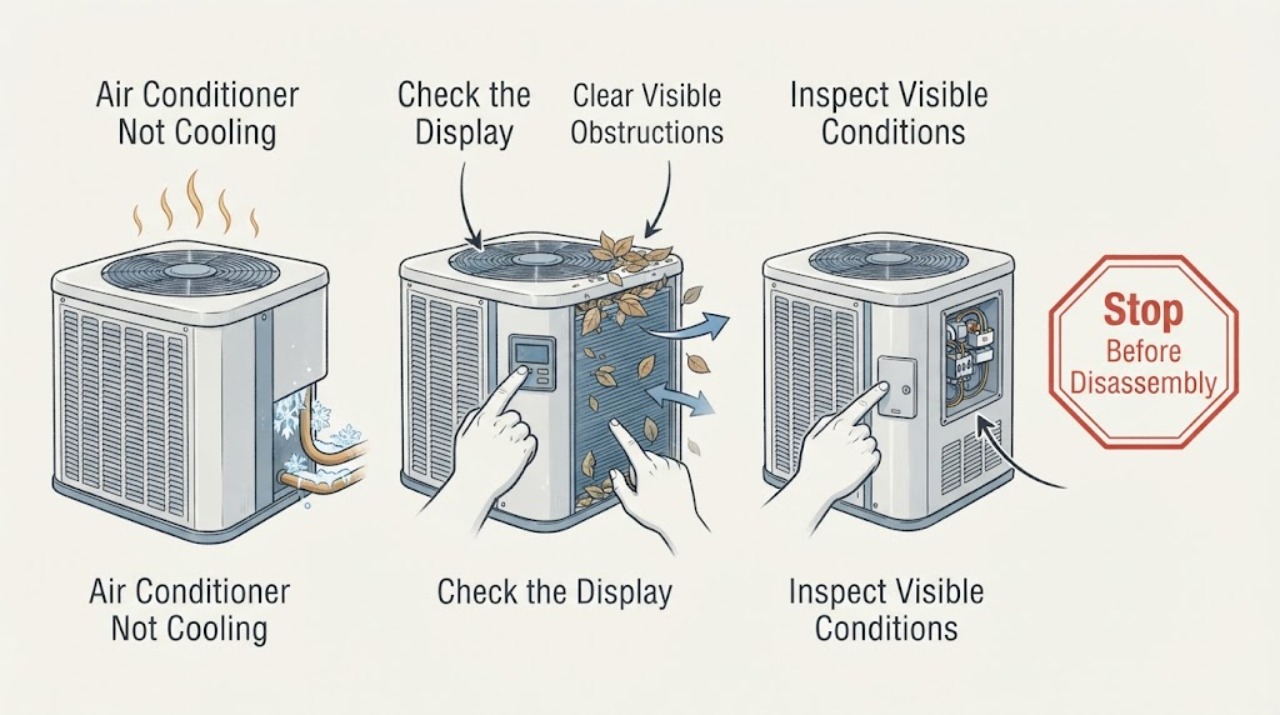
If an air conditioner is not cooling, begin with the thermostat mode, target, filter, airflow, and visible outdoor clearance. A contactor or capacitor may be involved when the outdoor unit does not start, hums, or stops, but neither part can be confirmed from a sound or a warm room. Capacitors can retain a high-voltage charge and the contactor is inside the electrical section, so do not open a panel, touch terminals, measure voltage, or attempt a replacement. Turn cooling off for ice, water near electrical equipment, smoke, burning odor, sparks, severe heat, or a breaker that trips again.
Work through in order
Diagnostic checks
Use only checks that match the exact appliance or system and its official guide.
-
Check 1
Read the thermostat without opening it. Confirm Cool mode, set the target below the room reading, choose the documented fan setting, and note a delay, alert, blank display, or rapid cycling pattern.
Expected result: The control is not calling for cooling, the fan runs without a cooling call, a delay or alert remains, or the call appears normal while the air is warm.
Next step: Make only the documented external setting correction and allow one normal call. If cooling remains absent or cycling continues, keep the system off and request HVAC diagnosis.
Why this matters
Why: A setting or thermostat communication issue can look like equipment failure. A normal call with warm air shifts attention toward airflow, the outdoor section, coils, refrigerant, or electrical controls, but does not identify the contactor or capacitor.
-
Check 2
With cooling stopped, inspect the accessible filter and supply and return registers. Clean or replace the filter only according to the exact equipment instructions, and move a visible obstruction without opening the air handler.
Expected result: The filter is loaded, airflow is weak at several registers, one register is blocked, or airflow is normal while the room remains warm.
Next step: Make one normal observation after the safe filter or register correction. If airflow stays weak, the filter is wet, or the blower sounds abnormal, turn cooling off and arrange service.
Why this matters
Why: A loaded filter or blocked air path can reduce cooling and can contribute to coil icing. Normal airflow makes an outdoor, coil, refrigerant, thermostat, contactor, or capacitor issue more relevant.
-
Check 3
From a dry, safe position, look for frost or ice on accessible tubing, water around the indoor unit, and debris blocking the outside coil. Do not chip ice, pour water into equipment, wash an energized unit, or reach through the grille.
Expected result: Ice is visible, water is pooling, the outdoor area is blocked, or no ice or water is present.
Next step: If ice or water is present, leave cooling off and request HVAC service. If only loose debris outside the cabinet is blocking airflow, clear it without touching the equipment and make no more than one normal observation.
Why this matters
Why: Ice can follow restricted airflow or low refrigerant, and water can follow condensate trouble or thawing ice. Outdoor blockage can harm heat rejection. These findings do not prove a capacitor or contactor fault.
-
Check 4
During one normal cooling call only, observe from outside the equipment boundary whether the outdoor fan starts and whether the indoor registers move air. Note a click without startup, a hum, a silent outdoor cabinet, rapid cycling, or the outdoor unit running while cooling remains poor.
Expected result: The outdoor unit does not start, the fan does not move, a hum or click repeats, the breaker trips, or both sections run while the room stays warm.
Next step: Turn cooling off for a non-starting fan, repeated clicking, abnormal hum, rapid cycling, or a breaker event. Do not open the electrical compartment or attempt to test either component.
Why this matters
Why: A click or hum without startup can be a capacitor, contactor, motor, control, or compressor clue. A breaker event points to an electrical protection response. Both sections running with poor cooling can involve coils, refrigerant, compressor performance, airflow, or controls.
-
Check 5
Record the exterior model label and the complete pattern for service: thermostat setting, filter and airflow, ice or water, outdoor fan behavior, click or hum timing, cycle timing, and any breaker event. Do not repeatedly restart the equipment to obtain another symptom.
Expected result: The issue remains after safe external checks, or the system shows an outdoor start failure, poor cooling, ice, water, or an electrical clue.
Next step: Leave the system off when the cause is unresolved or unsafe and give the record to an HVAC professional. Resume normal operation only after the fault and any safety issue are addressed.
Why this matters
Why: A persistent failure needs a qualified diagnosis of the contactor, capacitor, motors, compressor, thermostat, coils, refrigerant, wiring, and safety controls as appropriate.
Use your observations
Decision map
Find the observation that best matches what you see, then follow the next safe action.
-
PATH 01Next step
What you see
The thermostat is not in Cool mode, the target is too high, the fan setting is misleading, or a normal delay is displayed.
Do this next
Correct only the documented external setting and allow one normal call. If cooling remains absent or cycling persists, request HVAC service.
-
PATH 02Next step
What you see
The filter is loaded or airflow is weak at several registers.
Do this next
Clean or replace the filter as the exact manual permits and open blocked registers. If airflow remains weak, keep cooling off for blower, coil, and control diagnosis.
-
PATH 03Next step
What you see
The outdoor unit clicks or hums but the fan or compressor does not start.
Do this next
Leave the system off. A capacitor, contactor, motor, compressor, control, or electrical fault is possible; do not open the panel or handle a high-voltage part.
-
PATH 04Next step
What you see
The breaker trips, or ice or water is visible.
Do this next
Stop cooling and do not repeatedly reset the breaker, chip ice, or handle wet equipment. Arrange qualified HVAC or electrical service as appropriate.
-
PATH 05Next step
What you see
Both sections run but the air stays warm or the system runs continuously.
Do this next
Keep the equipment off if the issue persists and request diagnosis for airflow, coils, refrigerant, compressor, thermostat, contactor, and capacitor conditions.
-
PATH 06Next step
What you see
Smoke, burning odor, sparks, severe heat, a damaged disconnect, or water near electrical equipment is present.
Do this next
Stop immediately and keep clear. From a dry, safe position, isolate power only if this can be done without contact with water or damaged equipment; use emergency help for fire or active arcing and qualified service for the system.
Helpful context
Understand the symptom
A warm room does not identify the electrical part
A no-cooling complaint may be a wrong thermostat setting, restricted airflow, a frozen coil, an outdoor unit that never starts, or a compressor or refrigerant problem. The capacitor helps start or run a motor, while the contactor switches power to equipment under control of the cooling call. Both are only possible clues until a qualified technician checks the system.
Keep capacitor and contactor checks external
A click at the outdoor unit or a hum without a fan start does not justify opening the cabinet. Leave electrical covers closed and keep hands away from the fan grille, wiring, capacitor, contactor, and terminals. Do not reset a breaker again if it trips immediately.
Ice and water change the plan
Ice on accessible tubing or the indoor coil can follow restricted airflow or low refrigerant. Water near the air handler can indicate condensate trouble or thawing ice. In either case, stop cooling and arrange service rather than forcing another cycle.
Safety boundary
Stop conditions
- Stop immediately for smoke, a burning or electrical odor, visible sparks or arcing, severe equipment heat, a damaged disconnect, or a breaker that trips again.
- Stop and keep clear if water or ice is near powered equipment, the floor is wet, or the indoor unit is leaking. Do not handle wet electrical equipment.
- Do not remove panels, touch a capacitor, contactor, motor, compressor, wiring, or terminals, perform live electrical tests, or open the refrigerant circuit.
- Do not keep running a system with a non-starting outdoor fan, repeated clicking or humming, ice, rapid cycling, or worsening cooling.
Only after diagnosis
Potential parts
- run capacitor
Consider this category only if a qualified technician confirms a capacitor fault after observing the startup symptom and checking the system safely.
Electrical ratings, terminals, enclosure, and physical fit must match the exact equipment. A capacitor can retain a charge after power is removed. - contactor
Consider this category only if professional testing confirms a contactor or control-path fault.
Pole count, coil voltage, load rating, and enclosure fit vary by equipment. Do not select or install this part from a click alone.
When checks do not resolve it
Need a professional?
Request diagnosis for persistent no-cooling, a non-starting outdoor section, repeated click or hum, a breaker event, ice, water, or any capacitor or contactor suspicion.
Common questions
FAQ
Can a bad capacitor or contactor cause an air conditioner not to cool?
Yes, either can prevent the outdoor section from starting, but a click, hum, or warm room does not identify which part failed. Leave the electrical compartment closed and have a qualified HVAC professional diagnose it.
What can I check without opening the AC cabinet?
Check the thermostat mode and fan setting, inspect the accessible filter and registers, look for ice or water, and note whether the outdoor fan starts from a safe distance. Do not touch wiring, terminals, the capacitor, or contactor.
Should I keep running the AC if the outdoor unit is silent or the fan is not moving?
No. Turn cooling off if the outdoor section does not start, a fan does not move, a click or hum repeats, or the unit runs without cooling. Repeated operation can stress the compressor or worsen icing; arrange professional service.
Read the exact guide
Official sources
- HomeCooling101U.S. Department of Energy · Basic air conditioner filter, thermostat, drain, outdoor compressor, and certified service guidance
- AC Unit Not Turning On? Troubleshooting Steps & SolutionsCarrier · Air conditioner thermostat, filter, capacitor, contactor, compressor, electrical, and professional service clues
- Air Conditioner Not Cooling | AC Not Blowing Cold AirCarrier · Air conditioner cooling failure causes involving thermostat, filter, airflow, coils, compressor, refrigerant, and outdoor unit
- AC Fan Not Spinning? Here’s Why and How to Fix ItCarrier · Air conditioner fan, filter, frozen coil, compressor, capacitor, high-voltage safety, and service escalation
- Maintenance ChecklistENERGY STAR · Air conditioner filter, condensate, controls, coils, blower airflow, and professional maintenance boundaries
Community feedback
Share a repair observation
Share a plain-text repair observation. Accepted observations are published automatically; this page may take a moment to update.