
On this page
Start here
Quick answer
Start with the thermostat mode and fan setting, then check the air filter and the outdoor unit from a safe distance. A dirty filter or blocked outdoor coil can reduce airflow and cooling, while ice on the refrigerant lines, repeated breaker trips, a non-running outdoor unit, or suspected low refrigerant requires the system to be shut down as appropriate and examined by a qualified HVAC professional. Do not open electrical compartments or handle refrigerant.
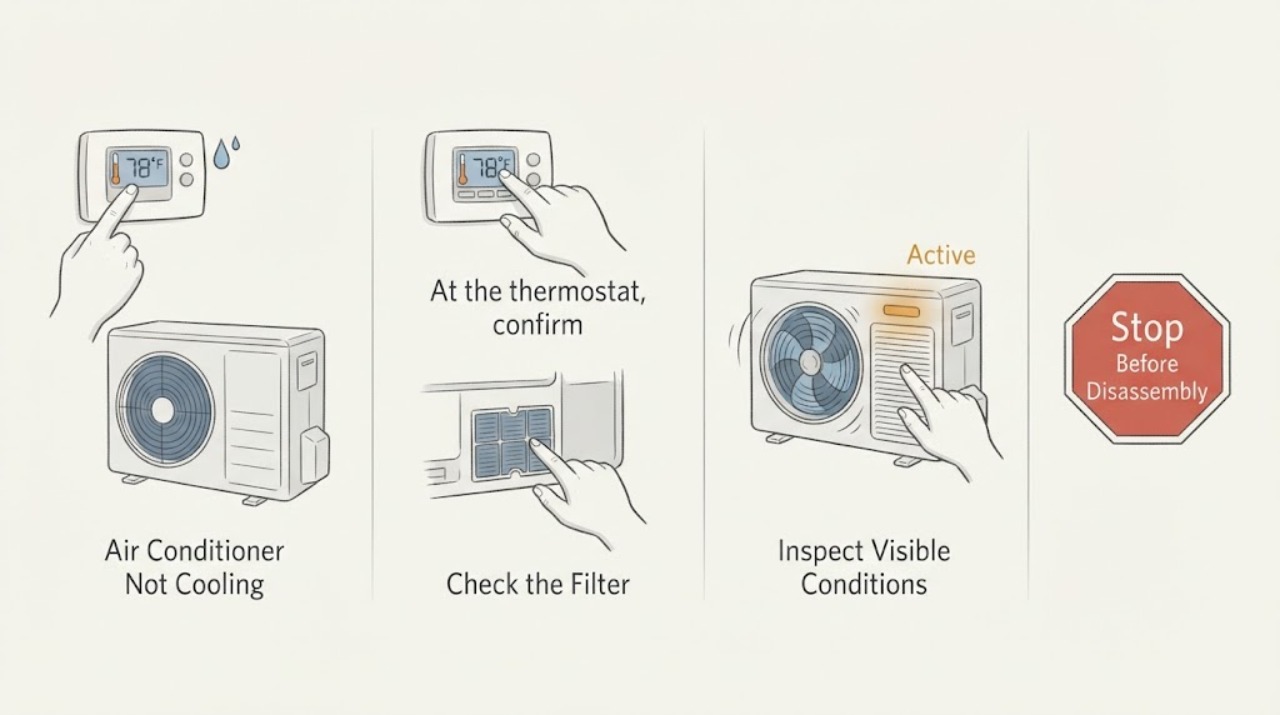
Work through in order
Diagnostic checks
Use only checks that match the exact appliance or system and its official guide.
-
Check 1
At the thermostat, confirm the system is calling for cooling, the set temperature is below the room temperature, and the fan is not set to run continuously when you are evaluating cooling.
Expected result: The thermostat is set to cooling with a normal call, or it is set to heat, off, an unsuitable schedule, or continuous fan operation.
Next step: Correct only the accessible settings, allow the system to complete a normal cooling cycle, and continue to the filter check if the supply air remains warm.
Why this matters
Why: An incorrect mode or schedule can prevent a cooling call, while a fan set to run continuously can blow room-temperature air between cooling cycles and make the system seem warm.
-
Check 2
Turn the system off at the thermostat as directed by the equipment instructions, then inspect the accessible air filter and clean or replace it only in the manner specified for that filter.
Expected result: The filter is visibly loaded with dust or airflow improves after a clean, correctly fitted filter is installed, or the filter was already clean and airflow remains weak.
Next step: Restore cooling only after the filter is correctly installed; if airflow remains weak or the system still cannot cool, arrange HVAC service rather than opening the air handler.
Why this matters
Why: A loaded filter can restrict the air crossing the indoor coil and reduce cooling; unchanged weak airflow after the filter check points toward a blower, coil, duct, or other airflow problem.
-
Check 3
From outside and without removing panels, look around the outdoor condensing unit for leaves, grass, snow, or other blockage and observe whether its fan runs when the thermostat calls for cooling.
Expected result: The unit is obstructed, the fan does not run, the unit makes an unusual noise, or the unit is visibly clear and operating.
Next step: Clear only loose debris that is safely reachable without opening the unit; if the fan does not run, the noise is abnormal, or cooling does not return, shut the system down as appropriate and call a qualified technician.
Why this matters
Why: Blocked outdoor airflow can reduce heat rejection, while a non-running or noisy unit can indicate a control, motor, capacitor, compressor, or electrical fault that is not a homeowner repair.
-
Check 4
Look at the accessible refrigerant lines and the area around the indoor air handler for frost or ice, unusual condensate, or water, without touching refrigerant fittings or removing covers.
Expected result: Ice is present on a line or coil area, water is collecting near the indoor unit, or there is no visible ice or abnormal water.
Next step: If ice or abnormal water is present, stop running the system and arrange professional diagnosis; do not scrape the ice, add refrigerant, or open the coil cabinet.
Why this matters
Why: Ice with inadequate cooling can result from restricted airflow or a refrigerant problem, and excess water can accompany a frozen coil or blocked condensate drain; absence of visible ice does not rule out a mechanical fault.
-
Check 5
If the thermostat, filter, visible airflow, and outdoor-unit checks do not restore cooling, provide a qualified HVAC technician with the symptom pattern and the checks already completed.
Expected result: The system runs continuously or short-cycles, the outdoor unit will not start, cooling remains inadequate, or suspected refrigerant or electrical symptoms are present.
Next step: Leave refrigerant, electrical, sealed-system, and internal coil work to the technician and ask for a diagnosis of the failed condition before approving a part replacement.
Why this matters
Why: Persistent symptoms after basic checks point beyond routine homeowner maintenance and may involve refrigerant, coil, blower, compressor, controls, or high-voltage components.
Use your observations
Decision map
Find the observation that best matches what you see, then follow the next safe action.
-
PATH 01Next step
What you see
The thermostat was not calling for cooling or the fan was set to run continuously, and the system cools after the setting is corrected.
Do this next
Monitor the next complete cycle and verify that the space reaches the expected temperature; no part replacement is justified by the original setting alone.
-
PATH 02Next step
What you see
The filter is dirty and airflow improves after the correct maintenance step, but cooling is still inadequate.
Do this next
Arrange HVAC service for the remaining airflow, coil, refrigerant, or control possibilities rather than repeatedly changing filters or running the system harder.
-
PATH 03Next step
What you see
Ice or frost is visible, water is pooling near the indoor unit, or the system is repeatedly short-cycling.
Do this next
Turn the system off and call a qualified HVAC professional; continued operation can worsen coil or compressor damage, and the cause may be restricted airflow or low refrigerant.
-
PATH 04Next step
What you see
The outdoor unit will not start, a breaker trips again, there is an unusual electrical noise or smell, or the homeowner would need to open a panel.
Do this next
Stop at the safe visual checks and arrange professional electrical and HVAC diagnosis; do not open the cabinet, handle wiring, or repeatedly reset the breaker.
Helpful context
Understand the symptom
Read the symptom before replacing a part
Warm air with normal airflow, weak airflow, no airflow, and an outdoor unit that never starts point to different parts of the system. The thermostat controls the call for cooling and fan behavior; the filter and coils affect airflow and heat transfer; the outdoor unit must reject heat. A simple setting or filter issue can look similar to a refrigerant, coil, compressor, or electrical problem.
Safe checks you can make
Use only the controls and accessible filter intended for homeowner maintenance. Look at the outdoor unit without removing panels or reaching into it. If you see ice, water around the indoor unit, burning smells, unusual electrical behavior, or a breaker that trips again, stop troubleshooting and arrange professional service.
What the professional needs to diagnose
If settings, filter condition, and clear airflow do not restore cooling, the technician may need to check refrigerant charge and leaks, evaporator and condenser coils, condensate drainage, blower and condenser operation, controls, and electrical components. Those checks require equipment and training; a visible symptom does not identify a specific failed part by itself.
Prevent a repeat failure
Follow the equipment and filter manufacturer's maintenance schedule, keep the outdoor unit clear of leaves and other debris, and arrange seasonal professional maintenance. ENERGY STAR specifically calls out filter care, condensate drains, coils, controls, and airflow as maintenance items that affect efficiency, comfort, and equipment life.
Only after diagnosis
Potential parts
- air-conditioner air filter
Consider a replacement only when the existing filter is dirty or damaged and the equipment instructions identify that filter as the correct service item; a clean filter will not fix a refrigerant, coil, or electrical fault.
Confirm the equipment's filter type, dimensions, orientation, and reusable-versus-replaceable instructions before ordering or installing it.
When checks do not resolve it
Need a professional?
Call when settings and filter checks do not restore cooling, when ice or water is present, or when the outdoor unit or electrical system behaves abnormally.
Have this ready
- Provide the thermostat setting, filter condition, airflow strength, outdoor-unit fan behavior, presence of ice or water, whether the system runs continuously or short-cycles, and any breaker or noise symptoms.
Common questions
FAQ
What should I check first when my air conditioner is not cooling?
Confirm the thermostat is in cooling mode with the intended temperature and fan setting, then inspect the accessible air filter. If the filter is clean and the system still does not cool, check the outdoor unit from a safe distance and arrange professional service for ice, refrigerant, electrical, or internal-component symptoms.
Should I keep running the AC if the refrigerant line has ice?
No. Turn the system off and call a qualified technician. Ice can accompany restricted airflow or low refrigerant, and continued operation can damage the coil or compressor; do not scrape the ice or add refrigerant yourself.
Does a new filter guarantee that the air conditioner will cool again?
No. A dirty filter can restrict airflow, but a clean filter does not correct a blocked coil, frozen coil, low refrigerant, condensate problem, failed outdoor unit, control fault, or electrical issue. If cooling remains inadequate, stop escalating DIY work and obtain a diagnosis.
Read the exact guide
Official sources
- HomeCooling101U.S. Department of Energy, Building Technologies Office · Residential room, central, and ductless air-conditioning systems
- Troubleshoot an Air Conditioner: 6 Steps to Fix an AC Not WorkingCarrier · Residential central air conditioners that are not cooling or not operating normally
- Maintenance ChecklistENERGY STAR · Central air conditioners, furnaces, and heat pumps operating in cooling mode
Community feedback
Share a repair observation
Share a plain-text repair observation. Accepted observations are published automatically; this page may take a moment to update.